Synopsis of lectures on
THE MYSTERY AND PSYCHOLOGY OF HUMAN TYPES
by MBM
7 lectures
Begun February l6,1939
- Peculiarities in the conduct of the self and those contacted in family, business and social relations due to TYPE.Type is fixation in the flow of the life-force through persons. Life is flow. Stoppage of flow is type. “Frozen in a form.”. First steps to studying types through the two basic, movements typical of all life: in and out; systolic and diastolic; centripetal and centrifugal; contracting and expanding. A popular list of such conduct in the human. In the human this conduct is called introvert and extravert. Neither is. right; neither is wrong. Each should be in a reciprocal relation to the other as is illustrated by the in and out-breath. Balance brings health, physically, emotionally,_ mentally. This dual movement should flow in the three aspects of man; physical (sensation), emotional and mental. A stoppage of the flow bring out the type marking the “place” where it is stopped, – thus a person becomes an extravert feeling type, an introvert sensation type, et cetera.
- Contrasting the superficial struggles for personal or self-advancement with the sounder and deeper efforts to overcome type and free the flow of life.The importance of changing type. Illustrate by the development of women into extraverts from repressed or introverted types by the feminist movement. The western world generally is extraverted by competition in material gains: thus broadly speaking the mass are extravert sensation. A dramatic illustration of this in the current headlines in re Philip Coster. The history of the world is an oscillation from mass extraversion to mass introversion and back again. From this mass the individual breaks free and hastens his evolution. This constitutes the slow RHYTHM for the world; the rapid rhythm for the individual. Objectives must be removed from the next good to a greater or to the ultimate GOOD. The movement is from material to spiritual realities. As breathing is a means to an end far greater than itself, so the progress through introversion and extraversion is vaster, profounder than the immediate experience. Its object is the development of the soul. To understand and to put that understanding into practice is to speed the soul’s evolution and to develop present power and poise. Outline of extravert types.
III. As old as humanity, itself is the admission that life is not worth living without sympathy and tolerance from others. These lectures are intended as a. foundation for the exaltation of SYMPATHY INTO UNDERSTANDING. The three faculties augmented by a fourth called E.S.P., so that the faculties correspond to sensation, feeling, E.S.P., thinking. Outline philosophy for this inclusion; contrast Dr. Jung’s “intuition.” The nature of ambivalence and how it manifests. Outline of introvert types. The part of the subconscious. Illustrations: The preacher in “Rain”; Laughton’s role in “The Beachcomber”; Billy Sunday showing change in type. D.H. Lawrence as ambivalent. The philosophical ideal of man touching the worlds about him at the four points of the compass, likened to the four faculties. Thus the strain is between earth and heaven (modestly merely a larger world); sensation and E.S.P., and between feeling and thinking as east and west on the compass. The nature of “compensation” or the seeking of balance under the Natural Law, (thus the unconscious counter-balance seeking the healing for the physic strain of a prolonged fixation in a “type.”
- Review, listing the nine, theorems which are the essence of what has been discussed thus far. Continuing the study of human types as powerful influences change them from one type to another. Illustrated by examples of two Church Fathers (Tertullian and Origen) as used by Dr. Jung in his book “Psychological Types.” Type colors interpretations of early Christianity and illustrates the dilemmas to which the Church was heir. Resistance in the self (either consciously or subconsciously) is a serious obstacle to the flow of the life-energy. The personality is “against”‘ the subconscious attitudes. Abilities and disabilities are measured by type and the faculty beloved of the personality. A study of T.E. Lawrence by two biographers, who themselves illustrate two types. What “points of view” and “opinions” are, seen psychologically. The value of the ego. Persons without voltage. The role of phantasy as a gesture toward balancing opposing faculties. Active introversion and genuine mysticism,.
- A study of the life of a single man (Frederich Wilhelm Nietsche) as dramatizing the struggle between the diastolic and systolic, or extravert and introvert tendencies in the self. Nietsche, a tragic, heroic soul, questing eagerly for true values is the victim of now one, now the other force. He himself coins expression: Dionysiac and Appollonian. The former enters into life joyously and with a kind of mystic abandon; the latter withdraws in serene abstraction to heights above the world. The influence of Wagner and the influence of Schopenhauer; intensity of feeling and calm self-restraint; the crowd versus the aristocratic thinker. A friendlier and perhaps wiser interpretation of Nietsche than psychology and biographies generally bestow. Why? A discussion of rhythms in the life of individuals as magnified in the case of so richly equipped and fearless a mind as Nietzsche. The use of a ten foot chart illustrating change of type from time to time as circumstances influence the life-force and cause alterations in the major outlook on life.
- VI. Summarizing types as a temporary fixation in the flow of the life-energy. Two sets of opposites are brought into opposition or conflict when the personality becomes fixed and identifies itself with one of the faculties either extraverted or Simply stated, these are heaven and earth, – thinking and feeling. This makes a design thus: The.ignored opposite is always
 struggling to come into functioning from its place of isolation in the subconscious. What we have done thus far concerns humanity seen by psychology, and in a transverse section. Now a study of type as seen in several deposits of Wisdom Lore. The fundamental thesis for this new way to view type is that every man and woman and child is a soul in some stage of evolution. They can also be measured by a VERTICAL measure as well as the HORIZONTAL one of psychology. Illustrated by the four Castes of India (Sudra, Vaisya, Kshatriya, Brahman. Caste means lineage, race; pure, chaste), The four Orders of Manu (Student, Householder, Hermit, Ascetic). The Six Walks (from the Homa Yasht of the Persian tradition). Philosophy sees types in re age of soul. Why castes mystically speaking, should not intermarry. The unhappy error of projecting types of bodies instead of souls. A brief glimpse into corresponding grades of souls in Christian mysticism.
VII. The philosophic interpretation of human types as indicated in lecture VI is based on the purpose of the Soul’s evolution, and the Long Journey. Thus the close of this series is related to the preliminary lecture on “THE HIDDEN FACE,” as humans slowly evolve toward the Goal of perfection. Further philosophic classification of types: Gnostic – Hylics, Psychics, Pneumatics. In modern language, materialist, mystics, Knowers. The Bound, the Called, the Elect. From the Hermetic tradition: Ammon (king) Asclepius (healer) Tat (the True intuitive or seer). Reference to The Seven Types of men. The Twelve Types of Astrology corresponding to the Signs. The Twelve reduced to the Great Four (bull, lion, man, eagle). The Man who incorporates all within himself is the Houseless Wanderer, the 13th Man, the Christ. Final practical advice: In public use knowledge of types to make human relations pleasant; in private work to break up your own type and accept criticism eagerly. Do not overwork your favored faculty. Employ all faculties to the enriching of life. Higher development is above type, – it is the way toward the HIDDEN FACE.
Study of Types
A more critical study and personal application of points regarding types, to have them more understandingly. This talk by MBM was given in a series of two evenings Jan-Feb 1944 to the Training Group (old Tuesday Group). Notes and transcription by Gertrude Borchard.
– – – – – –
Freedom is inner discipline.
Pieces of “shell” (persona) are sticking to all of you.
Theorems:
- It is the commanding urge of life to flow, and in flowing to slowly evolve.The energy in the atom. Is a living concept. The basic drama. Make it living, not intellectual.
- This flow is interrupted by many kinds of obstacles — physical, emotional, mental; subjective or objective.Our study of flow is related to psychological types, not the atom, but rather the plane on which the human functions.
The human functions first in a three-fold house – objective and a subjective world. The obstacles which appear in the flow under the natural law might also pertain to interruptions that belong to the development of the mystical life; or the experiences of the Pilgrim. Some of these obstacles are those under the natural law. The natural law does not work in harmony with itself (locusts, floods, the wiping out of crops) — the war of many kinds of life within you on the physical plane. Many interruptions. And on the emotional plane. Because you are dismembered. Can war against any other part, on its own plane or on another.
- This interrupted flow of energy piles up.And pressure accumulates in the subconscious. Remains unknown, perhaps through life, if not too great. Another reason why the lukewarm are “spewed out”, because they don’t accumulate enough pressure to burst out.
- The personality identifies itself with the energy uninterrupted.Flow through the conscious areas of the self — the few energies which, in ordinary circumstances, survive.
- These energies will of necessity, and because of the interplay of heritage, inheritance and environment, become extraverted or introverted through the faculty offering the least resistance.This is the genesis of a type.
- A type, or manifestation of the life energies through the easiest way, is tacitly an admission of partialness; and thus type develops under the natural law, and expresses only a small portion of the total life energy available at any stage of the development of the monad.
- The outlawed energies generally remain in a relatively, or completely, repressed state and are thus unexercised and undisciplined by objective reality and the totality of circumstances — one of the things for which the seed came down: to be buffeted and to grow strong.
- 8. This piling up of unsuccessful and outlawed energies accumulated in the unconscious causes uprushes of energies and conduct which are foreign to the personality. Lead to astonishment at behavior in mild cases, and neuroses and psychoses when the uprush is violent and prolonged. Effort to establish a balance of pressure. Are psychological sometimes, and crave understanding and aid. Mind law should replace the natural law.
- Intelligence and directed work with the balance seeking energies not only relieves pressure in the subconscious but gradually adds power and resource to the personality.
- The personality is diminished in proportion to balanced development.It is replaced by the individuality, which is the integration of the conscious self with the personal unconscious. And thus all faculties become available for expression, the natural law being transcended.
Both extraversion and introversion are directional flows at the service of the individuality. Habit paths to be broken. Ideas may be the result of habit. If you overcome your inhibitions the flow is easy.
- Under a philosophical direction the intelligence begins to set up the direction, and set up the household.
- The progression from the personality to the individuality is a process. Degreeness, partialness.To judge by the personality is misleading; you judge on the basis of what you see, and that may be misleading. Too much or too little credit (given). Split-offs of the energy paths (that is, the eight points). You may see some in action, and draw wrong conclusions from that. (MBM referred to the “eight points”, meaning perhaps the eight main psychological type expressions.)
- The degree of partialness to which a personality is broken up is the key to the tempo and the quality of the progressive steps toward the greater realities.The transcendental, mystical or noetic development wait on the completion of the major human problems and the subduing of them to the status to which the alleged avowal of greater realities commits them. Between the intellectual and the real experience of greater realities.
The degree of the proportion between the personality and the individuality is the tempo of your progress. Heaven does not compromise with earth.
- The individual who aspires to become a pilgrim must balance his introversion by his extroversion.”By their works shall ye know them.”
Go over these notes three or four times before next week.
Study of Types – philosophical
MBM’s second evening on this subject with Tuesday (Training) group Jan. 10, 1944
Types can give you the key to your own behavior and to your neighbors.
What to anticipate in a dilemma.
Jung’s “intuition” the same thing as sensation on the physical plane.
Sensation extravert: the personality identifies itself with that faculty. Unstable; love objects change when the faculty is under the natural law. That is the philosophicalclassification.
In the subconscious that marvelous drive which is always seeking to find a balance. It will seek to compensate for the extraversion by introversion – the centripetal movement. Actually, both should be functioning at one time. The centripetal will try to go down and make for balance.
The compensatory faculties will be introvert; and since this (type) is sensation, or earth, the opposite gets away from earth. As that (subconscious) manifests in the present stage of evolution, it will be metaphysical — perceptions, hunches. The other faculties will be in varying degrees of secondary-ness.
But always note that the personality takes on according to the dominant faculty, the one which is the easiest way for you to function — or was, until you met MBM. The faculty that has shaped the personality, under the natural law — main faculty type.
Materialist; sensualist, epicure; at their worst or at their best, according as to whether the faculties are developed or not. And according to the size of the soul. Not so much heritage; because, if heritage is powerful they could not be an extravert. The idea of the extravert is that the attention is drawn out. With the introvert it goes out and comes back again. The extravert loses himself in the objective, or external. . . . .Interest usually absorbed in the literal, – money, sex, possessions.
Feeling extravert: Orientation is to the outside — people, things, objects. The way they feel about it is the way they shape their lives, their action. For such a type, that is the truth.. . .their truth. You cannot reason with such a type. Influence of sign of Cancer, tenacious. May be vivid and animated. A . . . . .faculty is “teacher’s pet”, not consciously. Does not like to take a secondary seat. Will not see that which is contrary to it. You all have spots of that yet. Until you see yourselves you do not know it. Unavoidable. The only way to get beyond it is to grow beyond it. Take someone else whom you trust, as a guide, to compensate, or show you where you are functioning whether still on the one track.
Thinking dominant in the subconscious. It is introverted. The other faculties are subordinate.
They tolerate sex through their feelings for their partner but never sex for itself. If no partner, they may be intolerant of the part sex can play in life.
Perception extravert; Really etheric sensing. May be regressive. Shocks, lesions (?) and impressions can come in. Young . . . .
So that these perceptions can grow up. The perception extravert adjusts to environment on the basis of the hunches he has to things. (Impressions) can come in on higher levels or on low ones. Re racing, etc. Adjusts to life on the basis of hunches about the objective world. The subconscious corrects by the centripetal movement. Will tend to be about physical things. Thinking infantile in this type. Feeling a stepchild. When it comes out it is usually in support of the dominant faculty. Often have compulsions to themselves.
Thinking extravert: Reasonable type. Low grade or high grade. Thinking is based on perfectly obvious causes…outer facts and values. And would direct the life of others by these outer facts. Sometimes high type thinkers. May be correct, half-baked, or infantile, according to their stature. Have little patience with feeling, because feeling, in the present studies of illustrations, tends to upset them. Fall in love….upsets reasonable things. Resents feeling. Know subconsciously, subrosa. Feeling is down there, trying to come up, dynamic. Till the later stage of the human evolution. When feeling comes out it is unadapted; the thinker is embarrassed. Battles in the household of your past selves, and other people. Often use sensation to some extent as the outlet with which feeling is to some extent associated, – surrogate. What is locked up in the subconscious does not stay down there. Breaks out of the persona every once in a while.
Introvert types
Introvert sensation
An unfortunate faculty to have introverted. It is by nature intended to relate itself to earth. Philosophically, it is only for advanced souls to seek relationship to the non-substance, for to them it is not damaging, but it must be done in understanding and strength. You are here in earth, to relate yourself objectively to earth, and to run the gamut. To this type, the senses mean something inwardly. It is not the sensation itself but what it means to you. They give them (sensations) subjective interpretations, which are not the interpretations of the objective world. Ineffectually sensualist. But sensation draws them on without satisfying them. In sex, always thrown to new partners. Capable of ruthless decisions,which are not the result of thinking. Feeling may burst out from the subconscious. Extraordinarily selfish type when the “rubber band” and the higher worlds draw. May be artists. Beauty as the substitute for the higher worlds. Beauty is the preliminary to those worlds themselves, and art has been born into the world as a struggle between those opposites. Gaugin. Sometimes a reverence, causing a swing to the opposite. From this world subjective to another world objective, for which they must labor. Heritage presents an important factor. Introverted sex makes it so alluring; in book “All This and Heaven Too.”
Feeling introvert: Thinks much to itself. Hard to know what they are feeling; they don’t tell you. May have a lot of feeling or may have none. Often suffer intensively and have no way of relieving it. Often jealous; comes out indirectly. Not demonstrative. If well developed, may be deeply religious. Have difficulty in expressing their feelings. Are surprised that others don’t know what they feel because their feelings are so real to them. Poor thinkers, in ordinary types. In high types, all faculties begin to support it (the feeling), as in Therese (of Avila), the next best to balance. Thinking the most undeveloped (faculty); comes out in flashes from the subconscious, which are often childish thoughts. Develops schemes, but somehow they never bring them about. Rarely have a plan for the betterment of others. Really a balance seeking in themselves; but may suffer from a sense of inferiority and futility.
Perception introvert: Striking; unusual manifestations. May be genuine or false. Crank on the low levels . Genuine psychics and mediums, who, incidentally, have also to learn how to shut off this stream of incoming impressions, or they become psychopaths. Excessively oriented to these impressions. On higher levels, the prophets and seers. They have kept their balance, – have done things to go with it. Prophets of the Old Testament: “Go thou and do.” You become valuable as you do as the result of. Impatient with worldly methods and education. Strong in all Teachers and Messengers; but their stature supports. If (this is) their dominant faculty, and the others support, you get real strength. Makes for the individuality.
Personality almost synonymous with type.
In the subconscious, sensation the compensatory pull, – and toward the object. Young souls, who quickly strive to reach the transcendental, are pulled back to earth. Sometimes a compromise, and the tendency to become a reformer. May be compulsions to ceremonials, a kind of compromise.
Thinking introvert: They give attention on circumstances and events, only to be withdrawn again into the consciousness of the self. The subjective world more important. Subjective ideas more important. Many levels. Berkeley, Kant, Fichte, Hegel, Schopenhauer. Plato represents this type on a very high level. Pythagoras too. Also Lao-Tsze, if you know how to look for it. The level depends on the stature of the mind. Difficulty in relating themselves to the world. Their speech may be slow. Long sentences. May be moody, sulky, – immature feelings coming up.
In the subconscious: feeling is the main repressed faculty. Strives to reach the objective and compensate for the introversion. Sometimes reached by the sensation faculty; may be toward sex. Balance sought; must be through another faculty. May become engrossed in mechanical ties.
from MBM’s series on Types
GB notes
Psychology and Philosophy
Lecture V. Mar. 16, 1939
Nietzsche
A Study in Psychological Types
Every colorful act takes place at one of the pairs of opposites. The life usually lived is relatively colorless — not a solution between the pairs of opposites but rather a timid surrender to existence. We can tell the trend in ourselves from extroversion to introversion. We will discuss again some of those trends that make for type.
Fixation is a fixing in one direction; life not continuing in its flow but held up at one place.
Nietzsche illustrates amazingly well the struggle between the opposites, not only extraversion and introversion but between heights and depths. All of his faculties were well developed. Magnifies for us what we may see round about us daily. Therefore the philosophy which has come to be associated with his name challenges us to be more colorful, – less fearful. Has become associated in men’s minds with the superman — the fearless expression of the life force in the individual. Much of that which he stands for is back of some of the ideology which is now being expressed in Europe, crudely.
His life a series of fluctuations. May see only a few spots together, but it is better to do that, and do it badly, than not at all. Since his death he has become a famous man.
In the early stages the exchange between the in and the out was beautifully sustained. Reciprocity between the two trends well sustained for a number of years. In the next cycle, the military, there was a pinching back of the life force. The musical expression dropped off. He took his moral conduct seriously. Had ideals about conduct, and had a capacity of self-discipline which very few persons have, but which most persons crave to have. He fearlessly manifested what was in him. Sought companionship that would give him mental stimulus. Was full of humor. ESP by the world (?) of will and idea. Much that he thought and developed in himself was partly derived from Schopenhauer. Nietzsche was well acquainted with music. Tristan. Devoted to all he could find out about Wagner. Swift friendship with Wagner. To him, Wagner was the expression of the things in his own heart, through music.
Nietzsche speaks of two trends in life: the Dionysian and the Apollonian. All life an illustration of these two. Dionysius, the god of nature, wine, extraversion — all that makes man express, turn out, manifest. Apollo, the god of music, – the god that draws in for the purpose of transmuting what is of the lower to the higher. All active introversion is the beginning of true mysticism. And the movement toward Apollo is the in-drawing of energies from the outer world, – not to evade life but to transmute them, and to reach a higher state. And these two drives of which Nietzsche spoke he himself illustrates.
In this chart we will watch the development and progressive expansion of the different faculties. A change of type. And we can see the flow.
At eighteen, something of the sensual comes out. He joined the drinking bouts of his companions. Reverses his first type. But then became disgusted. The red goes down (see chart). Discovers the philosophy of Schopenhauer; the influence of Eastern philosophies.
Beginning to see that there are mobs, crowds; that the drive in men to multiply crudely is mob psychology. Therefore there must be a rule of those who are aristocratic of spirit. Gradually the idea of the rule of the fine or the cultured began to grow up in him, and the will to power, – to see from a new angle.
Therefore a change in him takes place: That the highest will to life does not take expression in a mere existence but in a will to war to that which is below — a will to power, to the over-power. Saw too much of two sides to rest long in either side. Hence, the vacillations. Wagner invites him to visit him.
Now comes the conflict between good and evil as something that had to be faced. He found that good belonged to the idea of the aristocrat, the wise, the enlightened; and that which was bad belonged to the ignorant, the plebeian, proletariat. When studying these things he came to see his conflict became a philosophic one. And it changed his life. He saw those two as inevitable. Because there is the crowd, and the mob, and there are the few who know, it is basically a conflict between aristocracy and democracy. Or, if you like, between dictatorship or democracy. He meant aristocrats in mind. That was beginning to well up in Nietzsche. He accepted the conflict between good and evil because of the need to accept the crowd as well as the individual. At the same time beginning to despise the Germans for their smugness. Writes against the complacency and smugness of the Germans. So he had an objective point of view.
Did war nursing cir. 1870. At this time wrote The Birth of Tragedy. The pull of the opposites, which cannot be reconciled, because they concern the multitude. If you do not believe it think of Stalin, Kemal Pasha, and the present ones. FDR. Think what the birth of tragedy is: of the idealist, who has the vision, and the crowd, who follow like a crowd, – tear and rend, cheer and salute, and hardly know what it is about. The strain between the pairs of opposites is tragedy. Nietzsche saw it first in the Greek world —the conflict between the gods on Olympus and the people who lived in the mud down below. He saw perhaps too much for his own comfort.
All the while his physical is suffering. At 35 he resigns his professorship. Travels south for his health.
Saw the ideals of society led by those who were unselfish, – enlightened – not so very different from the idea of Einstein now. Pindar had it; and Pericles in Greece.
In any case, that now was calling him more and more. And the sense that that was in contrast . . . could not accept the meek Christ, and believed in the superman. These pairs of opposites! you haven’t dared to tear out and look at. Nietzsche did. And the conflict was on.
So he wrote the book Thus Spake Zarathustra (Zoroaster). He saw through, that weakness is sin. Recognized that struggle and discipline are necessary to bring forth better things. The rule of the aristocrat, who knows why he is doing it. He may persuade the crowd to follow him, but can never trust the crowd. Struggle and discipline necessary until the ideal society has been achieved.
“I love him who willeth the creation of something beyond himself, and then perishes.” Most people want to plant and pick the fruit. Nietzsche said: Build and do, but don’t try to get the result yourself. That is courage, wise living; better than reaping.
from MBM series on Psychological Types
Lecture VI March 23, 1939
GB notes
A Philosophical Study of Types
(Hindu, Laws of Manu. Persian tradition Christian)
Now the vertical picture begins. Not swinging the pairs of opposites from introversion to extroversion, etc. The philosopher sees the two, and the four, assimilated into different stages or degrees.
There are several different outlines of type, seen according to philosophy and religion. The first we should investigate is the one of castes, as known in India. The castes are a literalization of a mystical idea of type. Solidified. Sterile of the real meaning. The struggle of Ghandi and others to break down the barriers of types. They have missed the profound meaning of some of the things they carry through. (The castes). Castes are quite a dead letter, but a tenacious fashion.
Sudras. There are four castes— Starting with the Sudra. None of these castes are really permitted to mingle with the others except the highest caste which is free to do as it sees fit. The Sudra may not come into the region of the other castes. They are called the servants.
The Sudra caste is an old philosophical mystical way of speaking of the body, the earth side, the senses. Thus it becomes understandable. Of course the earth, body, senses, were made to be servants to the Brahmin, the sacradotal caste. The Sudra cannot receive anything of the Larger, as it is only the body. Type of the earth man, which has been thrown upon a people, until, regardless of who they are, they are a sudra.
These types or classes have nothing to do, philosophically, with any outer form. They are stages of humanity. The basic idea is that every soul is in evolution, from the beginning to the great consummation. In the beginning he is an earth man, Red Adam. A stage where he is the servant of everything else. It has nothing to do with being born in a certain family. It is a type of humanity at a certain stage. It is that in you which corresponds. The body, the earth side, cannot be anything else than servant of the Larger.
Kshatriya. Called the military caste. The people who fight. What is the military caste in you? It represents the mind side. Protects the people. Kshatriya, those who are willing to fight for the truth. Willing to protect the weaker from that which is false. That is the military caste.
Vaisya. Merchants, farmers. Commanded to tend cattle, bestow gifts, offer sacrifices. They lend money and cultivate land. A profound idea. In the great evolution of humanity, from the first early stage, it must somehow pass through this stage; and we always have in us the aspect, since we are the microcosm, which corresponds to that. What is there in you which is, as it were, a farmer and a merchant. Which buys and sells and exchanges. Tries to make good business. — to better himself by exchange. “Be ye wise money changers.” said Jesus. The farmer cultivates that which is edible, vegetables. Tends cattle. Cattle symbolize the higher emotions. This particular type is that which has reached the stage of the higher emotions. These are power, and go out to lend money, go out to raise cattle, go out to do business like merchants, because they give up the lower emotions and cultivate the higher. You are merchants in accordance as you live consciously, because you exchange a lower emotion for the higher. To throw out fears and doubt and antagonisms of various kinds in order to bring in cheerfulness, good will, kindliness, beneficence.
Now we know why the taboo against intermarrying. It is a philosophic taboo. You learn to separate your faculties and you don’t mix them. You have to learn what is what in you. You must not mistake a sensation and an urge, of one kind or another, for a higher emotion; nor thinking with feeling.
Brahmin. The priestly caste. Of him it is said, in the old tradition; and the king gave to the Brahmin for his son’s welfare, Buddha, cows full of milk, with no traces of infirmity — healthy calves to the number of 1,000.
Cows, the higher emotions — wonder, reverence, awe. The power of the higher self. Full of milk. The golden horns, the power. For the purpose of spirit of nous. No trace of infirmity, because the Brahmin, or priestly caste, is that which functions between heaven in you, the highest in you, nous, — insight, and the lesser. Healthy calves, because to have something of this higher and not bring it into action, so that it has offspring, children, is of no point. Relates to extraversion. Outgoing of the perfection which the priestly caste represents.
As long as you are an earth man, a sensation type, you are a Sudra, a vaisya. If you have the higher emotions in you sacrificing, giving up the lower for the higher, exchanging the one for the other, you are a feeling type, feeling faculty. This classification sees more than the world ordinarily sees, the process from the beginning to the consummation.
The military caste, mind, thinking faculty. Which in you fights for the truth. Looks to find out what is genuinely so. The truth of the larger life, not merely science, psychology, physics. But what are the larger truths. That is the higher mind. This is all based on the super concept of man.
Brahmin. The priest in you functions between the lower and the higher. Not exactly E.S.P., but beyond anything in the classification I gave you; but that which realizes a larger world and is relating, through this power, the lower self to the larger worlds.
Pariah. Symbolizes those things that no one should really be engaged in.
The Four Orders of Manu
These also belong to the Ayran people. But it is a profounder classification than the general exposition of caste as I have given it to you. The orders are;
Student Householder Hermit Ascetic
Householder. Now you will see a kind of overtone of these four castes Here are four separate orders, which all spring from the order of Households.
Households is the bond of brotherhood of all evolving souls. Seeds, monads, light sparks, etc.; so that those becoming conscious of it become householders. The self is not a unity, simple, but a composite of many lesser selves. Therefore there must be that which is establishing the household. So the Laws of Manu emphasize the same thing I emphasize here, the establishing of the household of the self in a higher order. That is the order of Householders. If you are in training you belong to that order.
Student. That type of the ego when, as a personality, it is learning, absorbing knowledge. I don’t mean physics and biology, bookkeeping and cooking, or running a business, but when it is learning the lessons, in consciousness, of what life is about. When it begins to know that there is a science of the soul.
- Householders. How true it is that though they are called Householders, the stage does not come until #2. Because, until you have learned and done much, you are not capable of being a householder in the philosophical sense. Because being a householder means that the ego in you, that part of you which is evolving, the work already done, the real stature of your being, – and it is not until you have gone a little stretch beyond the student, until you have begun to bring all your interests, appetites, emotions, activities, into some kind of a coherent whole instead of scattered and disarray, and causing you trouble — until then you are not a householder. Your individuation has been set up. And all the selves become one-pointed. When all the selves in you have become sheep following the shepherd, the mind. And all the others are following that. You have accomplished it only in spots. But when you accomplish it it is the householder.
- Hermit. The third. And because millions of us in earth at one time the philosopher sees the people in the earth as belonging to different stages. So there are the types of those who are outside of all things. They are not in the four classifications. They are the pariahs — Broadway, Park Ave., in little towns all over. But out of this mass, the crowd, emerge those who are, first, in the student type — and there is a great field of those students now in the world. And as they learned the science of living and coordinating they come into the next type, the householders.
There are quite a good many householders. Not so many who belong to the hermit type. The self in you, or the ego which is withdrawn from being engrossed in the world. Transpose physical hermit into the philosophical sense. When the ego, having gone through the first two types of life, withdraws from the earth, looks at the things of the earth as a wise beneficence; has become calm; is not overcome by any of the disasters of the earth; sees through them, because he has been a student and householder; has sat at the knees of wisdom for a long time; has assimilated and practiced, so he is able to be balanced. Is therefore withdrawn in interest. No longer has his fixations or attachments there. A very advanced stage.
That stage is impossible for one who is not familiar with the science of the soul. Not by going into a nunnery or monastery. It is not a literal thing.
- Ascetics. That stage of the householder when his higher nature has become athletic. The word means athlete. Not anything like being emaciated. The one who has become athletic in relation to the larger worlds. Has developed his higher faculties. Higher psychic and higher mind have evolved, and innumerable powers which earthly man does not know about are his. He is an athlete. His athletics relate to God. To nous, to spirit, the oversoul; to the great Beyond, the mighty Architect, the great Light. Strong, enduring. This stage has come about only as a logical sequence of the other three.
You have to be a hermit a long time before you can become an ascetic. The hermit is one who is learning to withdraw in order to have power to the Larger. The Ascetic has accomplished that. So the ascetic is again the ego, or self, at a superlative stage.
The philosopher from the East middle Asia, sees humanity in really five types. One, wholly unawakened, the pariah, and cast out from all knowledge of anything. By themselves. Then comes the four great divisions. These four are like super-tones on the four castes.
Ashram. Ghandi is in his Ashram. Literally means place of mortification. Has something to do with the idea of the hermit and the ascetic. Because many practice the later stages a little differently than these two, a little more in the world, as getting ready for death.
Again, the division of the student, the householder, in the sense that he takes care of his family, his tasks in the world, and then that he withdraws, or is free to be a wanderer. Then deliberately releasing himself from the things that bind him to earth. The hope in India, to free the self from the wheel of rebirth. The way was to free yourself from the attachment to things, to experiences of the flesh, to relationships with people as people; and the four steps, seen from the worldly point of view, was to release the self from the attachment to life. Then the wanderer, and finally he who releases himself from life, also called ascetic, apart from his family.
That is how the philosopher in the East sees humanity. Caste is the simpler expression of it. You have to see the meaning that is in castes.
Persian tradition. The six walks. Walking means progression. And the six different ways of walking forward. This is from the Persian tradition. Divided according to one through six walks.
Homa. The magic drink. Brings well being, expels death. The water that quenches all thirst. Knowledge, not of earth facts, but of universal and cosmic facts, Wisdom. That is the sun-water, or Homa, that expels death. For to know the great wisdom lore is to be free from the darkness of death.
- The health of this body.Body always means the vehicle, enclosure. Therefore everything that is a means, not only the physical body, should be of health. If you have drunk already of wisdom lore one of the things you are likely to know is that there are always two forms of one thing — form and content, go together. In a sense they are interchangeable. As modern physics has recently discovered that energy and matter are two aspects of something that they cannot quite call, or know by name. So the health of the body is the whole long range of (or) form side.
- Long life of the soul.This is a progression in insight and understanding. There are different levels of people. You can go out on the street and, according to where you are, you will get your answer. What do people want most in life? Winning the sweepstakes. Paid all my bills and so am free. A perfectly healthy body. They are not even Sudras. They are pariahs. They have not begun to go forth on these walks yet. Have not seen the vista of the grades of humanity which, when graded, make types.
In the Persian tradition we begin to see that grand vista of health all the way through. Integrity. That is health of mind. Loyalty, steadfastness. Then the soul. Those who have gone further and realized the great responsibility of developing the soul from the little to the great, or filling it full — fulfillment.
- 4. “That I may stand forth at will, powerful and successful on the earth.” The military castes. Victor in battle. Annihilating the destructive forces. So as to free the higher self. Organization, or the real work of the household, when it is the perfect household, is to have all his powers like someone at the head of a great industry, in their proper place — responsible, reliable, efficient, doing what they should do, and having a sense of well-being in that doing.
- Victor and conqueror.One is powerful (probably the fourth class) and the other is the climax as a conqueror.
- “That we may first become aware of a thief, murderer, or wolf.”Why should this power of wisdom, this gnosis, at its sixth step ask that, as it experiences death, that we may first become aware of a thief, murderer, and wolf? What are these? Jesus said: Whoso hateth his brother is a murderer. When we are dealing with higher things we have left the literal behind. That belongs to a much earlier stage. Here it has nothing to do with a factual murderer. Hate is committing murder. You must have such control of yourself that none of your thoughts are antagonistic. Because they are murderers. They have something that is in conflict. It is a thief in the night. So he who is the perfect master of himself must know those things first. Not be told by someone else. Eyes all over.
So here is another tradition describing type as seen by the philosopher.
Now a modern version. As seen by the Christian tradition. What are the steps?
Here we could pause to consider that wherever life is seen as progressive there must be types, classes, stages. Only the materialist, who knows nothing except the immediate present, he alone does not see types, does not see a process, stages, degrees of humanity. It is all alike.
Christianity, broadly speaking, has seen (the progression) in seven types, from first to seven, and those in turn divided. I will give it in lesser stages, smaller stages, because we are moving toward a great festival. Beginning symbols like rabbits, chickens, eggs.
- Birth. Which brings about what we saw in the Sudra type — earth, dismemberment, absorbed as an an earth man.
Baptism. Through suffering, awakened. The first step in regeneration. I am not speaking of a physical rite, but a mystical tradition. But the outer rite has been associated with these ideas to some extent. So that baptism, not the water on your head, is the first step toward regeneration. The baptism is really when it actually has pressed upon your heart and mind that there is truly a larger world — a God or a great Being, or Higher Entities; and that baptism with a higher knowledge, like the water on your head, has started a process of regeneration.
Betrothal. It is through search, temptation, victory, — the Parsifal motif, to the next step, which is known as betrothal, and which really means redemption.
These are the Christian ways of seeing humanity in its evolution from ignorance toward what Christianity calls the redemption. So there is now the redemption, which means, as in the word betrothal a pledge. The self pledged to a larger life.
Marriage. Next marriage. Suffering, passion, crucifixion, death, birth. Passion means suffering. Crucifixion means the crossing off of the earthly appetites or interests. Used long before Jesus. To the hermit, because he has crucified the world. Sounds stupid. Means that a line of demarkation has been drawn — beyond that I shall not go. I shall not again become immersed in sensual things. When that is done seriously and deeply it means that the sudra shall keep in his place and shall not come up and draw down the higher.
It means suffering to that part which heretofore has had everything. You have dabbled in all sorts of things. But if you realize that life is a process, that there are stages, types, degrees; so we begin intelligently to move to a higher degree. That is progress. The putting all things in their proper place.
And so those things are over,- done. You have made a barrier. By saying, it is over. Then you are crucifying certain trends in yourself. When that is done in a big way it means a demarkation between the earthly, or human, self and the higher self. And everyone who is really evolving in the higher stages goes through it.
Then comes the death. The death of the lower self. Aren’t you glad? You would be if you understood it.
From one point of view there is no reason whatsoever for having a black Good Friday. That is over. And really, the cross should be very joyous, Friday as well as on Sunday. They don’t dare do it. You will be glad when you are free from this body. It is the rub if you don’t make your death. You are making death when you are making a crucifixion. So that element of the old self, the personality.
By the same token that death leads to marriage, or death to birth, union. Not marriage between a man and a woman. But it does mean a binding, or alliance, between the lower and the higher. That is marriage.
There are progressions, mystical and profound, in the Christian Church. Means at-one-ment with Nous; leads to the consummation. Resurrection, ascension, and transmutation. All stages of the life of the ego moving from the beginning, from the pariah, who does not know what life is about, up to the higher stages.
The four classifications interlace. You can also see that there are the overtones, the mystical phases of what we have had psychologically in the sensation, feeling, thinking, and that other, whose foreshadowing is ESP. It is beginning to perceive the larger, but is not yet sufficient to see, as the fourth type.
These four types relate to humanity as it is. The philosophic relate to humanity from its early stages up to its consummation.
To know is to do, for the philosopher. Pariah’s only don’t know it.
Lecture VII
Types as seen in Gnosticism; Philosophical view of Type
March 30, 1939
The philosopher sees all humanity at different stages, moving from below up. Broadly has classified those types. To him, that hidden face at the end of the long road is the very reason for making that ascent. The reason for climbing through the four castes. For going through the Four Orders of Manu. The six Walks. The very goal of Christian mysticism.
For that face! Not a face as we are accustomed to think of it but in the sense of the concept of manifestation. That hidden face – the manifestation of all the potentiality originally written into your being; the working through into fulfillment of the “seven gifts of the gods”; the rounding out of the full measure of being. That is the glimpse of the face which the philosopher has, and which, through the ages, has caused him to classify humanity according to its nearness or farness from that road to the hidden face.
This does not throw out of the picture the psychological concept of types. It assimilates that. Augmenting it by the greater classification of these colossal steps.
Gnostics A few more philosophical classifications of types. We should include a few at least of the typical Gnostic classifications. I am using the word as it refers to groups who were functioning actively at the time of the birth of Christianity. In the sense of the Gnosis, all those who have been truly enlightened out of higher space are Gnostics. I do not mean the Gnostics. Some of these groups, by the very fact that they were groups, withdrawn from the procedure of daily life, demonstrated a classification of humanity.
Hylic They saw the world — people generally — as hylic; material substance, without perception. And it implied those humans who had no perception of anything higher than the material world. There have always been hylics. There are thousands, indeed hundreds of thousands, in New York City.
The psychics The second group in this vertical classification of type they called the psychics: those of faith, who, by some experience of miracles, or of the unusual, or through some deep appreciation of religious teachings, were admittedly in a class above that of the world. They lived by faith.
And in the groups, the gnostic groups, gathered all over in the ancient world, there were many psychics in this sense of the word. Those of great faith. The same would hold true of many in the modern churches.
Pneumatics The third group were the pneumatics, noumens: those who were taught, the enlightened, the knowers. They were the third group. (They were) the leaders, – the very spirit of these gnostic colonies throughout the world. They carried the great Teachings from generation to generation.
In modern language, we would undoubtedly call these three groups: the materialists, the mystics, and the gnostics.
There is no doubt that this general approach to humanity can be set up today, and that you could make a cross-section for yourself of those who are within these three classes, or were emerging from one into the other.
Another approach, meaning almost the same, but slightly different, – again dividing humanity into three types: the Bound, – like the materialists, like those called the Hylics, who saw nothing of interest or nothing of importance, beyond the material world. Or again, those who made the material world their main objective; who said: this thing comes first; this is the task. Busy, therefore, with material pursuits.
The called The next group was called the Called. Those who had heard the call of a larger world; of something beyond the immediate state. Not merely at a moment but who heard the call sufficiently to give answer. They were comparable to the psychics or the mystics, – in modern language.
The Elect The third class they called the Elect. Those like the Knowers, Pneumatics — those who were within the knowledge of things; who had not only heard the call but who had answered by living and learning, – proceeding step by step, until they had arrived in that high classification.
Within each of these three groups are many subdivisions. Every psychic or mystic is not of the same grade as every other. Certain degrees, or characteristics, of humanity. It is interesting to realize, in fact it is astounding to grasp, that down the ages, – not merely here with these gnostics, have been these classifications.
Another illustration of this vertical grouping of humanity, in the Mystery Teachings, – The groups gathered in secluded places, wherever there were those who sought the Larger, and leaders who knew and could bind those who sought. Throughout all the races and ages there have been these broad classifications. Known by many different names, and yet honored by the same broad concept.
Hermetic Followers of Hermes; followers of Thoth, or Tehuti. Greek-Egyptian. These spoke of humanity as the followers of Amon, Asclepius, and Tat. Amon is not ordinary humanity. He is a king. He is not the classification of the hylics, the bound, but many octaves up, where already development has gone on. But the development manifests in terms of Doing; in terms of leadership, the kingly office. It is as though, through this, we saw the higher division of these three — the bound, the called, the elect.
Asclepius The symbol and the name of the healer — the doctor, the very source on which modern medicine draws for its terms and symbols, is the minister, the priest, the one who heals the ills of the soul, not the ills of the body. If you know the stories of the old Wise One, based on the name of a wise healer of the East, you will see it does not mean healing in the ordinary scheme.
Tat, the one who hears. Not with his ears but with his mind, finely attuned. He is, or has been, the other two; and now has reached this third stage, where he is able to hear, being higher, what the other two cannot hear. Because their ears are as yet attuned to the problems of earth, souls of ministration (?) whereas Tat becomes the symbol of true hearing, in the sense of what intuition actually means: that which concerns the Larger worlds. Because his own stature has transcended the limitations of man; and so he is now, rightly and normally, interested, – not in the earth but in universal processes. The earth has become too small to absorb the interest of Tat. Hence he hears the great Teachings of the Master Thoth, or Hermes, in the Greek.
In this story we get the glimpse that the three divisions are not to be taken as the complete picture but that, within these classifications are, as it were, super-octaves of other divisions of humanity, which imply the gradations into which souls in evolution are attaining — by passing through.
7 types Another classification is related to the seven. There is a rather remarkable old tractate, sort of hidden away, a reference to seven types of men. Are we different? Of different types intrinsically? Are there really, from the beginning, seven types which, as it were, evolve and follow through in seven types? There is a suggestion of it here. In astrology there is a humble (?) version of that seven as seven types of humanity, according to the seven chief luminaries.
So astrology sees the type that is like Jupiter. The Mars type; the Leo type. And these seven, – are they really now seven types or are they seven stages, seen progressively. I will not answer that, but give you something which may aid you.
12 types There is another astrological classification, namely of the twelve. This twelve is a little easier to follow through. It is obviously according to the twelve astrological signs. Aries: initiating, impulsive, who rushes in. May be the organizer, and has in himself many grades, from the impulsive type to the leader type. And so with the type of Taurus: slow, plodding, methodical, earth bound type, stable but very hard to move; unable to get much response out of them, but always reliable. Gemini: nimble, changeable, mentally quick, receptive but unstable. Cancer: emotional, rather pig headed; stable of a kind, in emotions, but you do not know if that emotional nature is a deep calm or a violent storm.
So we could go through the twelve, sketching out the type according to these twelve signs. What you will quickly see is that these twelve are quite different in character, in approach than these and the gnostic groups I gave you first. The answer to that is via a reference to the seven. There is an old saying that man shall go in his evolution through the twelve seven times. Do not take it too literally. A spiral. The wide circle of the twelve will involve the seven in you and the twelve in you.
That is a picture that is transitory. Says the gnostic: Yes, but in the astrology there is nothing yet that corresponds to the pneumatic, Gnostic.
The astrological classification continues with what is known as the four, or the twelve, which cover the four elements — earth, water, fire, air — each three times: cardinal, fixed, mutable, – aggressive, adaptive and stable. Until finally they are culminated in the four. Familiar with them the experience in the Bible: bull, lion, man, eagle: Taurus, Leo, Aquarius, Scorpio in its super nature. These four are the culmination, or correspond to the pneumatic type.
Scorpio is very earthy, but in its higher aspects it goes to the death for rebirth. It is the sign of the mystical, the birth, and therefore, in that aspect, it is equated with another sign in the heavens which is beyond it, and which is the sign of the eagle. In that case it becomes the sign of the higher air. As the eagle flies to the sun. And Scorpio becomes the fire of the water. In the completion: Taurus, Leo, Aquarius, Scorpio. Because there is the point where you break out of the circle.
Every great tradition has the scheme of the four. In the Hermetic tradition of Amon, Asclepius, Tat, the fourth is Thoth, or the Teacher himself, the Eagle.
In the study of type as related to the thesis with which we began, type is gradually transcended. Type is a block of the life energy; a fixation; a disease. Not acknowledged by the world, because it often exploits such a fixation if that type is of value to the world and material things. But seen from the philosophical point of view, any fixation, wherever it is, is a block in the process from below up. Therefore, in beginning to summarize what we have learned, we acknowledge that type must be broken down. And the older the soul, the more mature the being, the more he has assimilated within himself, herself, the qualities of all that has preceded, the more the challenge.
There is an approach to that in astrology. They refer to this culminating type as the Houseless Wanderer.
When you have the qualities of the twelve developed, and have won the fruits of the twelve by accomplishing the Twelve Labors of Hercules, you become the Houseless Wanderer. It cannot be pigeonholed in one of these departments. Has transcended through assimilation. He is a sum of the strong attributes of all twelve. In other traditions, the thirteenth man.
A further illustration: the Christos, or Christ seed of that higher nature which is the Thirteenth Man, or Houseless Wanderer; is significant because it implies the gradual progression through the long spiral up to, and toward, the Hidden Face. The Houseless Wanderer has seen his Hidden Face. The Thirteenth Man knows his Hidden Face. They have become intimately intertwined. So that in the philosophical classification of types we notice something that is missing in the psychological.
In the psychological there is the admission of a swing, to the right or left, extravert introvert, Dionysian Apollonian; sensation feeling, thinking, ESP. And there is no intimation that one is better than the other. Because the psychologist has no pattern of life by which to measure. His only criteria is that the individual whose type is being discussed shall be well adapted to life. Fine, – but a wholly horizontal interpretation of life. It does not mean much. It does not really ring warmly in our hearts. Nothing by which we can guide ourselves. Someone else’s type, and contributing through that. When we help ourselves by studying the philosophical approach we can profit by what we have learned psychologically. We can recognize that here and there we have been fixed at this point and that point. Then came along circumstances, as in the life of Nietzsche, and we have been loosened. Perhaps it has caused us and our environment discomfort. It is better to be loosened in a type than to persist in it. Anything is better than a fixation. That really means death, as far as livingness is concerned. And livingness means philosophical growth and evolution. The one who is fixed is doing so little from the point of view of evolution and the evolving of his own life that the philosopher will say frankly, he is dead.
I hope you know enough of the psychological interpretation of types, so as to use them. To consciously use life in social and business relations is to make life smooth and livable. It means to take account of the fixations and idiosyncrasies of the person with whom you are speaking, in business and elsewhere, so that your giving and taking is rhythmic and smooth. There is a certain finesse, polish, graciousness that can only come either from the unconscious but sympathetic application of these things or from the deliberate employment of them. To use that, means you will not resist the type peculiar to someone else. They, like you until you have overcome your limitation, have a favorite faculty — a particular eyeglass through which they look at life; which to them though they don’t realize it, is the one beloved media. They may be very sincere in so using that pet faculty.
You should not have any pet of your faculties. Yet everyone has. And so, the feeling type will see life through that faculty, in social conduct, business conduct, in human relations generally. Admit that. Don’t offer resistance to it. Accept it, by the same token as you are expecting someone else to accept your type. The analogy of the beam (in the eye) and the mote. Remove our own beam.
So the practice of that allowance, the generous, friendly appreciation, there will be give and take, and life will flow well. Get a sense of what the repressed faculty is; in what characteristic the bursting up will take place. To be prepared is always a good policy.
But this is not the whole of life. There are other fields of life, – when we are with our superiors, teachers, those in authority over us, – who have the right by that position to protest at our fixations of type. You could list all the ills of the social and human world, if you liked, by fixation and type, and by the resistance to change, or to admit that someone who had a different pet faculty than you was not wrong. And all the irritation and friction and battles are actually due to that.
Two things to attempt in wise conduct: That in social or family relations generally, or in relations with those with whom we are engaged in work, we don’t project our type or resist their type; but we will, with good sense, adjust to their peculiarities. It will make life pleasant. On the other hand, with those who are our superiors, there our type must be hammered at. And if you don’t cross the one with the other you will get along much better in life. Much of what we call nagging (knocking ?), – abominable, but most do it to resist the type of the other, could be eliminated if we admitted type, a favorite function, in the other person and in ourselves. And if, when away from the social and business relationships, we sincerely and vigorously, tried to break down our favoritism.
Why should you, or anyone, have a favorite function. That is just what type is. One that you are overdoing — your spectacles toward life, through which you are seeing, orienting yourself. And if you will see that, gradually follow the philosophic pattern, – which means, not the swing, as in psychology, or to adapt to environment — that is too small — but actually try to use all your faculties, as eyes, and hands and feet, with less and less favoritism, until you can use all of them freely, and can supplement one faculty with the other. To use them to check up whether your feeling is true or not. Prejudice would disappear.
If we come to know what our faculties are, and deliberately balance them, one against the other, to see whether they are functioning or whether we are seeing only a little of life, this pet of ours, what a difference it would make? We would gradually break down our type, would enrich our life through four faculties, in and out. (Say) I will gradually bring these others into use; not be snobbish with one faculty. And perhaps help to take away the illusion that identification with type, or building up of a personality, is a good thing.
The thing that counts is to move all along the path, the great spiral path, through which humanity as a mass is moving, now more introvert, now more extravert; now searching material ends, another time seeking the esthetic for its value. So the mass moves slowly upward, – wigwagging.
But he who is becoming educated, in the sense of understanding life, is making every possible effort to use all his four faculties, as richly and wisely as he can. Wise, and turned to others; because he remembers how it was with himself. He goes on his way toward the Hidden Face, consciously. He knows now some of the practical rules by which he can move. The twin, the deeper self, will have stopped the pull between the opposites – the one in the conscious, the other in the subconscious. They will be coordinated. And the abiding reality in you will come into function.
So, the great man is the one who has all these things. The Householder. The Wanderer. The powers of the twelve, any of which he can use as emergency requires — resourceful; has depth and perspective; the super-man, of which Nietzsche dreamed. But now we see it philosophically and mystically.
(Reference to the chart of the concentric circles (the Unawakened, the Waking, etc.) as akin to the gnostic system.)
The ideal way of breaking type is through the subconscious. It can be done more vigorously then.
Don’t mix these two areas in human relations (personality and subconscious). Accept the limitations of the personality of the other person. Modify your own; because that is conscious living. Don’t resist it.
October 16, 1941
DETAILED SYLLABUS
to
THE PSYCHOLOGY AND MYSTERY OF HUMAN TYPES
prepared by MBM 1941
7 classes
Begin: There are two ways of considering human types. Both are valuable and of daily practical use. Neither is adequate alone. Both are necessary to give the fair and just interpretation of human types. These two ways are the psychological and the philosophical ways. The former you may know through books on psychology. The latter as presented here at the School is a contribution of our director to this wider and juster understanding of human nature.
You here at the School are studying all your subjects under the widening
AND ENLIGHTENING INFLUENCE of Wisdom Lore. etc.
Synthesizing gains from these two ways of considering types:
Psychological: enables you to understand the motivation of your own conduct, and your reactions. To anticipate behavior and response, and thus help you to avoid or to cultivate the results (in both yourself and in others,- though few have the objectivity necessary for the former)
Philosophical: Here type is seen as a temporary fixation of the soul. Indulged too long by the possessive power of the persona, it frustrates the growth of the self evolving toward the Self, and retards the development which the soul craves from the earth experience.
The former is the short range view,- related to efficient functioning. The latter is the long range view, related to providing the self in earth with unlimited opportunity to experience, instead of the markedly limited opportunity which functioning through a type necessitates. These two ways of considering Types you will find interplay continually throughout this course, and you are requested to keep them constantly in mind.
The enlightened teacher can see much of the evolution of a soul and its mystical age. The psychologist sees humanity falling into groups of types, as illustrated by typical behavior,AND MANIFESTATIONS FROM THE SUBCONSCIOUS. You will learn something of both during these classes.
We have now first to set up the groundwork for our study together. Certain basic concepts will be reviewed:
- concept of life as energy
- energy expresses by activity, movement, flow, etc.
- energy is not lost…conservation of energy
- there are varieties and grades of energy seeking expression at the same time. Therefore collisions naturally occur…etc.
- these collisions or temporary frustrations lead to variation of expression
- these variations or changes (broadly) regression or progression.
Summarize: all life has the above experience, from mineral to man.
Man, with three main streams of energy, thus experiences on three levels. Translate briefly into human conduct and integrate the material of this class.
Oct. 23, 1941
Detailed Syllabus:
A short simple review of the two approaches to type and the six basic concepts underlying the manifestation of types.
Continue with the definite applying of these to man
3-fold man body sensing (5 senses) i.e.energy
 heart
heart
emotions feelings, desires etc i.e.,energy
head
mind .thinking, many variations of; i.e. energy
Or erdenergy, movenergy, manenergy i.e. 3 types of energy which human possess. Thus man is a design of triple energies in action, inaction, or latency.
Adding another major concept: that human energies have certain customary behaviors, – they are either outgoing, (enlarge upon)
ingoing “
latent, or static “
Applying these three to energies of the conscious behavior…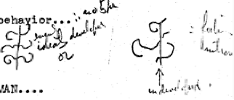
extraversion
introversion
fixation
ARE NOW READY TO STUDY THE PRODUCTION OF TYPES IN MAN….
heritage, inheritance, environment
At a given time, say infancy, childhood, or early youth, the energies naturally possessed by everyone on the 3 levels, receives impacts from without which shape it (Of this you have heard considerable in the course: Your Steps in Earth)
This develops a bent, a tendency to preference in favor of one or two of the ways of energy expression, as against those which have been frustrated, hurt, or rebuffed in childhood etc. Thus the habit of reacting in certain ways to objective situation is unwittingly cultivated, and the beginning of TYPE is underway. SHOW HOW THIS LINKS UP WITH THE MOLDING OF THE PERSONA OR MASK. THE PERSONA LOOKED AT MORE CAREFULLY REVEALS TYPE AND UNCONSCIOUS PREFERENCE TO CERTAIN FACULTIES. These have grown strong and dominant through exercise and opportunity; the other remain weak or inactive; or are repressed, so that their activity is relegated to the subconscious.
IF AN ENERGY IS NOT WHOLLY BLOCKED BY ENVIRONMENTAL CONDITIONS, IT MAY INTROVERT INSTEAD OF SURRENDERING TO REPRESSION.
USE DESIGNS or blackboard
A second major concept: of great significance, which indeed has to do with ultimates.
The concept of GROWTH. What is it that makes the things we call growth?
What takes place? two secondary concepts: overcoming obstacles; assimilating value
Again use design enlarge and illustrate idea
a seed; a babe nursing etc etc.
This increases in complexity as the scale of life ascends. The steps are effort, degrees of accomplishment; assimilation. This is the inner structure of growth. Thus growth is the successful flow of energy assimilating from that which appears to block it (on any level, physical, emotional, mental).
Conclude lecture by summing up 2 new concepts; 3 ways of energy behavior; the inner structure of growth…giving the philosophic significance of the last in relation to mind and soul.
If time permits give obvious examples of the 6 conscious types. MBM gives her classification next week.
for teachers only, given by MBM in Borchard aeries
October 30, 1941
Lecture 3
DETAILED SYLLABUS “THE PSYCHOLOGY AND IfSTERY OF HUMAN TYPES”
The object of this particular lecture is to mark certain differences in MBM’s interpretation of types based on faculties from those of Dr. Jung (which he calls functions),- and to set this systematic classification of human types within the philosophic patterns.
It is patent that the three major faculties are the basis of types, accordingly as one or the other of these faculties is “favored” and given the dominant role in the personality. Related to threefold man, – and the threefold man related to the objects and interests of this dimension. In this the observations and knowledge derived from the use of the five senses and the intelligence has obviously the ascendent. BUT MAN IS ALSO POTENTIALLY RELATED TO OTHER PLANES, and the NEAREST OP THESE PLANES IS THE ETHERIC. The etheric body also has senses, but they function independently of physical senses. They are the evidence, however small they are, of other realities than those of the physical worlds.
Human evolution and the trend to slowly evolve other sense organs than those of the physical. The present time. . . the gradual acknowledgement that there are such powers…as in ESP or the anecdotes reported in the press, or the monthly pages in Coronet. These senses also must be acknowledged. Dr Jung’s pragmatical approach,- calling these faculties under a general title of “intuition”. The observation correct, for it is pragmatic to Dr. Jung, – but not interpreted on the pattern of the evolution of the self toward higher stature and therefore the details have not been seen in perspective.
The struggle or tension between the types, – as thinking and feeling; sensation and “intuition”….and why this is so. “intuition” replaced by MBM as “perception types”. In due season these will also show variation, – because of the widely different degrees and direction of the development of this sensitivity of the etheric body. Enlarge upon philosophically.
The role of the subconscious in type, and the inherent pull toward a corrective of type, – that is the opposing type seeking to find opportunity for expression and thus overthrow the dominance of the faculty established in consciousness. The”compensatory” trend.
Setting up the “boxes” of tho 8 “conscious” types, plus the 8 opposing tendencies in the subconscious. Relate these to illustrations from striking current figures, so as to give the “boxes” practical meaning.
Nietzsche IV
November 6, 1941
THE PSYCHOLOGY AND MYSTERY OF HUMAN TYPES
(with use of MBM’s chart on the life of Nietzsche)
Class Outline
The drama of life is enacted between the pairs of opposites. The occult law about the pairs of opposites: to be stretched widely, but without loss of balance. This vs. evasion or weak, mild stretching. Ultimate withdrawal from the compulsion of the pairs of opposites. It is when man is stretched widely on the cross, not softly or evasively that he learns the lesson of the drama that is human experience. The state of the “man on the cross”, cf. Eastern tradition — Gita, Upanishads, Vedas — “seated above the pairs of opposites, when the human evolution is completed. The pairs of opposites as the very fabric on which the human drama is walked, worked, woven.
That is the way to mastery of the pairs of opposites.
Our study tonight of the life of one who in his way gives unwittingly a most dramatic illustration of the tragedy of these pairs of opposites. Nietzsche often spoke of the tragedy which was hidden in the old Greek culture: the two compelling influences, symbolized in the two gods Apollo and Dionysus.
The many rhythms in his own life. Unreconciled opposites. Change of type. Shows dynamic, and is one way of loosening fixation in type. (On chart) line indicates threshold of consciousness. Curved lines above and below illustrate conflicts between the unreconciled opposites. Nietzsche always had them in opposition.
Born 1844; small town in Saxony. Clergymen in family. Early death of father. Influence of mother. Religious motive strong. Bright. As child read Bible to schoolmates, so feelingly that they wept. Brought up gentle, refined, very sensitive.
At 16 won scholarship which enabled him to go to the university. Active sensation life. At 18 lost his faith and went to other extreme: sensuality.
Reading of old philosophies. At 21 met Schopenauer (Eastern mysticism). Challenge to restraint. Feeling and thinking up, sensation down. Developed now a high ideal of friendship with both men and women (green in the ascendant). At 23 conscripted (brief ascendant of the red again). Many interests. Over it all the arc of feeling and thinking. Many interests beside Schopenhauer. Professor at Basle. 1769-70. War, patriotic, ambulance work, accident, and first real illness.
Influence of Darwin and Bismarck (blood and iron). “The production of great men is the goal of humanity”. Preliminary to his super-man. Began to glorify the will to power. Fought increasingly the herd instinct. Inveighed against crowd morality.
As a result of these experiences, of struggle as against resignation, he had to accept the conflict between good and evil. He was beginning to see that the conflict between the opposites caused tragedy.
Friendship with Wagner. (green) Enthusiasm. Idealized him; man who had never known fear.
At 28 wrote of Apollonian and the Dionysian in “The Birth of Tragedy” out of the spirit of music from his friendship for Wagner (music) and his dislike say of “Parsifal” plays a part (i.e. dislike of the emotional).
Broke with Wagner. Protested his glorification of Christ, of pity and gentleness as epitomized in Parsifal. Tore Nietzsche into another type of expression. The diastolic movement. For a while gave himself up to it, perhaps too violently, for presently the opposite reaction set in. Nietzsche never made a gesture toward reconciling them.
Everyone who knows the life of Greece will recognize that conflict. The opposites in Greek culture. Real picture of the life of an individual or a nation not seen until we get a sense of the opposites working against each other. Nietzsche hated that a “milksop” of a hero should be so exalted, and Wagner so honored. He hated Christianity’s “slave moral” and its emphasis on meekness, gentleness, etc. Disgusted at Parsifal and wrote “Human, all too Human” in sort of neurotic fury – which is a rebellion.
“Unseasonable Essays” Later is to contradict what he said in them.
MBM’s chart tries to show how, when certain opposites do not get expression they accumulate momentum, an accumulation of energy in the unconscious. Nietzsche was not letting it out successfully. A new type of thinking now on top. (red and green go down). The writing of books did not release it. The acid test is what we are. While Nietzsche was becoming famous and attracting attention through his writings, the cataclysm was in preparation.
At 35 his physical condition deteriorates. Gives up his professorship. Love affair for the first time does not culminate, and adds to the dilemma. His experience always tended to intensify the opposites in him. Nietzsche did not have the help of the transliminal – knowledge of life on the other side of being.
He became increasingly alone, ill and poor. His writings more and more intense. Aphorisms. His books no longer accepted by publishers. BEYOND GOOD AND EVIL.
All these rhythms gain in momentum because they have not been expended in constructive ways.
Another ideal, the super-being, wise and powerful, who had no patience with the old gods, but became a god himself, starting a new race because of his mastery. That is therefore his ideal of the super-man. He said: Weakness is sin. Again the struggle for supremacy. “I love him who willeth the creation of something beyond himself, and then perisheth.” Rather heroic. Now the Dionysian is clamped down. The craving for the superman comes to expression in THUS SPAKE ZARATHUSTRA which he wrote at 39. Here he identifies himself with Zarathustra trying to teach himself. It was the call to the Superman, but instead of becoming it he wrote it. He preached it instead of living it. Stoicism in his life from childhood. Backed by Schopenhauer in this. Discipline and suffering.
The final catastrophe. The cataclysm. “Perhaps I know best why man is the only animal that laughs.”
The drama of the pairs of opposites when they quarrel. Perception. All faculties.
Nietzsche a dynamic figure; many faculties in strong active life. Great soul.
November 13, 1941
for use of teacher only
prepared by MBM 1941
DETAILED SYLLABUS to
THE PSYCHOLOQY AND MYSTERY OF HUMAN TYPES
Bind with the previous lecture on the rhythms in the life of Neitache, the 16 aspects of type outlined by MBM. Contrast the superficial struggles for personal advancement with the sounder and deeper efforts of the buried aspects of the self to overcome the limitations of type and to genuinely enter into the stream of life, continually flowing and changing. The importance of changing type. Illustrate by the development of women into extraverts (on a large scale) from the repressed or introverted types preceding the feminist movement. The western world generally is extraverted by competition in material gains. The eastern world until recently has ignored these ,- and thus “never shall meet the east and the west.” Refer to MBM’s words on this in “Investing in the Powers of the Soul”. Choose now a few illustrations from the current figures before the world. The better or safer leaders are those who are relatively balanced in both the attitude and faculty trends. (Gertrude: choose your own)
Referring to MBM’s words previous week that your type determines the way you see the world, the way you react to its stimuli.. ..AND THAT THIS ONCE SEEN IS AN ADMISSION OF FIXATION AND LIMITATION. THE SOUL IS CRAMPED BY BEING CONFINED TO A RESTRICTED SET OF EXPERIENCES; ITS DEVELOPMENT DWARFED.
Continue somewhat as follows(as an introduction to classic illustrations) that the limitation of type in powerful and important positions has given history many a strange turn. The crowd, incapable of perceiving these limitations in their leadership, has suffered by the type battles of opposing men. This is classically illustrated in the development of western religious concepts, a few of which we will now note: (here draw freely on the excellent material in Dr Jung’s book)
Tertullian versus Origin
Ebionites and Docetae
Homoouaia and Homoiousia
Augustine and Pelagius
Transsubstatiation and a symbolic rite (Lor’s supper)
How should the words of Jesus be taken?
Show the poignancy and intensity of the struggles, – men willing to die for their convictions et cetera. Paruday
Illustrate further in modern days between the literalists and the imagists; materialists who cannot agree with the mystics; scientists who cannot grasp the possibilities of spiritual realities. ALL THESE THINGS REVEAL WHAT FACULTIES ARE DEVELOPED, – WHAT FACULTIES ARE DORMANT, – AND TO ONE WHO REALLY STUDIES THE SIGNS, IT ALSO REVEALS MUCH OF THE DEGREE THAT EACH FACULTY IS DEVELOPED OR HOW DEEPLY IT IS SUBMERGED IN THE SUBCONSCIOUS.
Repeat that everyone has the potentials for a complete development…but that during the course of the evolution of the self there appear the most tenacious attachments to particular faculties as though they were the ultimate means of determination.
Close lecture by another general reference to the importance of realizing which type you and those about you are functioning through….WHAT LITTLE BOX OF MBM’S DESIGN ARE YOU AND THEY SEEING AND CONTACTING THE WORLD. This is to be prepared for the limitations which naturally are derived from such “boxing”.
November 20, 1941
Lecture 6
DETAILED SYLLABUS “THE PSYCHOLOGY AND MYSTERY OF HUMAN TYPES”
Approaching now the general consideration of type seen philosophically, as an indication of the state and stage of soul development. Though the flesh, the inheritance generally and the environment (nationality, period etc) will always modify the possible expressions of the soul, nevertheless there are in attitude, and conduct unmistakable signs of the state and stage of soul development. The lover of wisdom will identify himself with the needs of the soul rather than the needs of the personality.
Two sets of opposites are continually striving to balance themselves within the self, and a third set in regard to directional flow of energy. These are as you know, thinking versus feeling; sensation versus perception; introversion versus extraversion.
 Learning-knowing versus being emotionally affected; earth versus heaven (not-earth); in versus out.
We shall now observe some of the teachings deposited in Wisdom Lore on this great subject of type, thus replacing the “horizontal” classification with a “vertical” classification.
An outstanding example of such philosophic classification is the underlying significance of the four classic types of India. These are the Sudra, Vaisya, Kshatriya and Brahman. Caste means lineage, race, pure, chaste.
Sudra – the servant of them all, but especially of the Brahman: body; senses; earth.
Vaisya – merchants, farmers….psychic, to raise the lower to the higher
Kshatriya – the soldiers; the fire which fights the battles
Brahman – the twice-born; the enlightened mind, etc.
Build these four out showing what they actually imply. Refer to the Laws of Manu (help can be gotten from Hastings Encyclopedia)
Show how this pattern which is a “vertical” one has been literalized by the ignorance in India, and how it has been capitalized by those in power, to their advantage, identical in purpose with the capitalizing of other types of power by those in control in other parts of the world. Well here to use some examples of this literalizes tendency, – i.e., not eating pork; sprinkling with holy water in Roman churches etc.
Show that the sever taboo against intermarriage of castes is philosophically identical with MBM’s ever reiterated warning to separate the faculties, to not use unconsciously a “mixed” reaction. Or again that everything to be effectively used, must first be separated and made “free” of other inhibiting influences, before it can be constructively united with another ingredient. Cp. in MBM’s fashion, all objects in the room, – all things in the physical world that are used by man have gone through that process. Man himself, in his parts must and will submit to the same wonderful process. This is the mystical reason why castes should not intermarry.
Philosophically speaking the soul moves upward from earth to heaven, through these four, filling out the spaces of his being by developing all of these in and through himself as he is in continues relation with an objective environment.
The four Orders of Manu (Student, Householder, Hermit, Ascetic) are an advanced correspondent to the four castes. These are not for the people at large, but for those who had already singled themselves out from the crowd to earnestly accomplish the vertical transition. Thus again the difference between the conscious and the unconscious manner of living is shown forth. Next week will continue this philosophic and vertical study of type.
December 1941
Lecture 7
DETAILED SYLLABUS “THE PSYCHOLOGY AND MYSTERY OF HUMAN TYPES”
Continuing the philosophical consideration of human types. Repeating that this is the “vertical” interpretation as contrasted with the cross section or “horizontal” of the psychological classification. This derives from seeing every human as intrinsically a soul with a “long past history behind it”. Various experiences are needed to call each soul into active expression of the seed-powers that are in it, for inertia is a powerful force, and adding to it the volition which is the human prerogative, it is necessary to repeatedly stimulate to action, until after a thorough awakening the self takes on the responsibility for development. Mind and understanding finally replace the coercion of circumstance. You all know something of how long it takes until that is accomplished.
Last week in the discussion of vertical interpretation of caste as seen philosophically, and of the more individuated “Four Orders of Manu”, you already saw considerably into the mysteries that are hidden in human type. These are the mysteries of the evolving soul as contrasted to the limitations of the personality. We will extend that perspective this evening over further evidences of this interpretation based on soul stature, as found in other mystery traditions.
From the Gnostic groups: Hylics, Psychics, Pneumatics. Those involved with the problems and interests of earth and the human self; those aspiring to higher planes of functioning and attaining it in varying degrees; the few whose minds have grown to the stature of rulership, pure mind, Nous and thus have a rapport with Mind planes. (in modern language, but not adequately they might be called the materialists, the mystics, the gnostics). Compare with the Bound; the Called, the Elect. Hermetic tradition: Ammon, king over the lower worlds; Asclepius, the physician who has healed the soul’s illness (limitations); Tat, the true Seer and intuitive, who’s activities relate him peculiarly to the Goal. Hermes Trismegistus is he around whom these three circle, each supreme in his field. (cp Thoth, Tehuti, the Mind Lore)
Compare the above with “The Six Walks” of the Persian Lore, from the Home Yasht and what on each “walk” is asked of Homa. These are stages of progression in which the “walker” knows what to overcome in himself in order to pass on from stage, degree, type to the next. Not that on each “walk”, or step forward vertically it is acknowledged that “Homa expells death”. (enlarge upon) Compare here briefly steps or grades in the Christian Mysteries. (Birth, baptism, betrothal – including passion crucifixion, death, burial) marriage, resurrection, ascension, transmutation.
Likewise briefly the twelve types in Astrology, – then reduced to the Four. . . (bull, lion, man, eagle) The Three Ladders of the Faculties as taught by MBM. The 13th Man who incorporates within himself the values of all 12: all 3 Ladders; who is the Houseless Wanderer. . .because he can dwell in any “house” or type as his intelligence or Nous directs as effective in a give field. Enlarge upon. . . . what it means to incorporate all fruit of the 12 etc. . . . .
Final practical advice. Persist in breaking your fixation in a type. Free yourself from your prison. Do not overwork your favorite faculty in favorite ways of reaction. Use “command” and “discipline” (two of the methods of ruling the Household of Selves) by persevering determination. Cultivate the neglected faculties and bring them to the fore. Accept criticism that is intelligent eagerly. Value what you learn from the reactions to you of others. Do not see it from your angle…(that is remaining within your type) BUT TRY TO SEE IT FROM THE WAY YOU LOOK TO OTHERS. Never mind right or wrong . . .that will take care of itself later. Remember your faculties are means to enrich your life daily, hourly. . .not in some far away time. Remember you are “a soul in continuous life”, – you are be coming more awakened year by year. . you can now profit by the maps of the ways of evolution . . .you too, like the Persion, can WALK OUT AND ASK OF LIFE . . HOMA. . . YOU ARE MOVING ONWARD. NEVER FEAR NOR DOUBT.
Memos for Types class
No. 6
March 23, 1939
Re philosophic versions of Types
THE FOUR ORDERS OF MANU
“The Student, the Householder, the Hermit, and the Ascetic; these constitute four separate orders which all spring from the Order of Householders.”
Laws of Manu VI, 87
Order of Householders — is the bond of the brotherhood of evolving souls (also called seeds, monads, builders, names, germs, egos, sparks.) In the Laws of Manu the same concept is emphasized as MBM uses, namely, THE HOUSEHOLD OF THE SELF, with all its selves and powers. The evolving intelligence, which gradually learns to administer over the lesser selves and powers is called by MANU the Householder. Therefore consciously evolving souls or egos, or householders are aware of the “Order of Householders.”
- The Student is the stage or type of the ego when as a personality it is learning, acquiring the knowledge which will later be integrated into essence-values for the ego. In the lower sense this applies to all humanity; in the esoteric sense it applies to those who have begun CONSCIOUS EVOLUTION (as in the Training Department at the School.)
- The Householder is that stage or type when the ego is actually in command and control of the Household of the Self, when the lesser selves have become like “sheep” following the leadership of the shepherd (mind; higher). In other words, when individuation has taken place and is one-pointed.
- The Hermit is that stage of the Householder when he withdraws from his lower nature, and retires to dwell with the higher self.
Compare what was said of Buddha: “Buddha laid aside weapons and pondered the Sastra; he practiced perfect calm, and underwent various observances; like a hermit he refused all objects, of sense; he viewed all his kingdoms like a father.”
Buddha-Karita II, 32
“Active introversion” in its full mystical sense, with all the implications of higher disciplines, and of reliance on spirit-nous, though it cost death to the body. This stage is impossible to describe to one not familiar with the science of the soul.
- The Ascetic is that stage of the Householder when his higher nature has become athletic (that is, the true meaning of the word: ascetic) and is able to withdraw to higher (not psychic) planes of being, and gradually prepares the way for permanent release from the body of flesh.
THE FOUR ASRAMAS or LIFE STAGES are the later names for the FOUR ORDERS.
Asramas means “places of mortification”.
“Mortification” here means the gradual subduing of the lower life, with the objective of releasing and developing the higher life.
Guiding questions 6th lecture G.Borchard
THE PSYCHOLOGY AND MYSTERY OF HUMAN TYPES
What are the three sets of opposites continually striving for balance in type?
Describe the “vertical” as contrasted with the “horizontal” study of type.
How do the four classic castes of India elucidate the vertical study?
What is the mystical reason that castes should not intermarry?
What can you say of the four Orders of Manu?
POJODAG HOUSE
118 East 76th Street, New York City
May Benzenberg Mayer Study – Butterfield 8-5212
Founder and Director House – Rhinelander 4-6267
_______________________________________________________________________
BULLETIN OF CLASSES FOR THE SPRING OF 1955
Thursdays at 8:30, beginning March 16 – two sessions. Tuition $3.00
The Five Classic Dragons Which Every Soul
on its Pilgrimage Must Successfully Pass
!
A clue to their nature and a guide to their vanquishing are as talismans to the soul, and constitute a part of the equipment for conscious evolution.
Thursdays at 8:30, beginning March 30 – eight sessions. Tuition $12,00
The Philosophical Classification of Psychological Types
(For detailed description see following pages)
Fridays at 6:l5, beginning March 3rd – three sessions. Tuition $4.50
The object of the Friday classes is to build up backgrounds in philosophies, religions, and mystery teachings. The first evening will present
The Difference Between Cosmogonies, Myths, Sagas, and Folklore
The second and third evenings will be devoted to one of history’s eldest occult stories (Egyptian):
The Tale of Two Brothers
This will probably be followed by a lecture on “The Elements of Symbolism”, – the eternal and universal language by which man tries to learn the way of the Gods.
These interpretations, and others which may follow, will provide an excellent means whereby interested listeners may gain some idea of the work of Pojodag. The classes are planned for an hour which will not conflict with either afternoon or evening engagements. They are open to all who are interested in these subjects.
The Philosophical Classification of Psychological Types
Eight sessions in psychological classification (generally called Psychological Types), partially using Dr. Jung’s technique.
This has come to be known as the Pojodag Classification, and is based on both persona-behavior and the heritage of the soul. It supplies an index to human relations, accounting for the frictions and tragedies not only of daily life, but also the spectacular conflicts of social upheavals and racial oppositions. A psychological understanding of life set in the matrix of Wisdom-teaching is a key to happiness and a boon beyond price.
- General Introduction. Review of the great principles which are the hidden factors causing the changes in man’s behavior.
(a) The concept of life as energy; (b) “all things flow”; (c) the conservation of energy; (d) change, resistance, progression, regression; new principles; rhythm, polarity.
Definition of “type”; however, even when apparently fixed, a “type” is under the compulsion of the laws, and will presently change, either by a natural compensation, or through a conscious progression.
A brief outline for classification.
- Further principles governing the “flow of life”, the search for reality on the cross of the pairs of opposites – subjective versus objective; pleasure-pain vs. actuality (called reality in psychoanalytic literature).
The Jungian classification, giving sixteen “attitudes” as a basis for study. (This is not MBM’s classification, which will be given later.)
III. “Compensation”, the manifestation of the swing between the pairs of opposites. An analysis of the “seeking for equilibration” as seen by its extreme manifestations. Libra. The short way; (conscious) the long way; (natural).
First comments on types as illustrated in historical figures: Origen and Tertullian.
- IV. A clear understanding of the principles governing types is the first step toward genuine elimination of temperamental, religious, and racial conflicts. All principles must be kept simultaneously in mind as the study is continued.
A new slant on history; illustrated in the problems of “Transub-stantiation”; Nominalism and Realism; the early Christian Church and Gnosticism.
- Apollo and Dionysus as symbols of two movements in constant opposition. Illustrated further by Nietzsche and Schiller. (Systolic and diastolic)
Prometheus and Epimetheus as seen through Spittler, Nobel prize winner. The story; its mystical progression and the reconciliation of the dominant opposites.
Anima; persona; soul image; “participation mystique”.
Phantasy as a product of the urge toward equilibration, attempting the reconciliation of the pairs of opposites.
- Caste classification in India, in China. Classification of types according to ancient Gnostic systems.Choic, hylic, psychic, pneumatic. The “reconciling symbol”. Conversion to be seen as stimulated changes in type-flow. The progressions of Gautama consciously directed. In the short way Gautama is a Leader of men. Further comparisons in conversion: Paul; Augustine; Tolstoy.
VII. The first steps in Pojodag classification of type, using the Ladders of Anubis, Set, and Thoth. The Ladder of the Four Sons of Horus.
Jazz dancer; clothes monger; bridge player; shop girl; bookkeeper; poet; socialist; merchant; magnate; housewife; scientist; mother; protestant; catholic; inventor; philosopher; mystic; knower.
VIII. Types according to philosophical astrology. Seven and twelve. The passing beyond type; as seen through the Ladders; as seen through the compacting of the cardinal and mutable into the fixed signs. (In anticipation of a major course in philosophical astrology in the fall of 1933.)
Some inquiries into cosmic consciousness and the transcending of type.
II Oct. 23, 1941
Re Types
As we go over the bumps we more and more identify ourselves with the persona, namely, a selected bit of what we would like to have been. This is a vast potential and increases as physical life goes on.
Introvert
The introvert reacts to life, not as things are, but as he senses things, feels things. He is not factually oriented, though he may talk much of facts. They are hisfacts, not objective facts.
Extravert type
Is known as an open type. You can get at him or her; he is oriented to the objective world, but he takes this objective world as it is, and he corresponds in himself to the outer situation, or what is broadly called in psychology, the objective.
Thinking extravert
Bases his decision on objective facts, facts that you and I can see. And his aim is to bring his activity into harmony with these objective facts. He is an organizer, accumulates data. When pulls from the unconscious goes even harder into this extraversion. Becomes “sterile”.
Feeling extravert
Pleasant companion. Feeling guides them. Have skill in relating themselves to their environment through this well developed feeling faculty. So they are in rapport with circumstances. Adapt well. Warm, responsive, can vocalize their feelings.
Extravert sensation.
Thrill. The objective gets them; compulsive power over them
Some of the Differences between Jung’s and MBM’s Study of Types
Jung
Jung’s classification of types is “based on a static conception of life, life as is.
Has to do with therapy. Aim is adaptation to type – a considerable step beyond those who can attain only an adjustment to life, to present environment.
Identifies type as functions.
Sees type as inevitable – something to be accepted as a permanent condition and out of which the best possible practical adaptation to circumstances is to be made.
Based on pragmatic experience and wide observation.
Distinguishes between rational and irrational types – thinking and feeling being classified as rational, and sensation and “intuition” being irrational.
Development of “native” type to its best stage, so as to adjust to reality in the best possible relationship.
Sees type as no limitation. Content with a one-sided development, not regarding it as anything other than “balanced growth.
MBM
MBM’s classification is older, is genetic, following the basic pattern of evolution taught in all Wisdom Teachings. Life seen as a process.
Sees life as flowing, subject to and needing constant changes – progressive, planned, accelerated, whole-making changes according to a pattern – such changes brought about when mind governs, controls and directs them.
Identifies types as faculties, a more accurate identification.
Sees type as fixation which blocks the flow of life – can work disastrously or mildly. Type is a phase to be transcended, in service to evolution, causing the emphasis to be placed on the flexibility and development of the three faculties. Type seen as philosophically undesirable.
Based on age-old Truth, verified by experience. Brought through in the modern age in scientific language and concept.
Classifies only thinking as rational, the other three, i.e., all below that level as irrational. Identifies the fourth type-as “perceptive”, reserving the term intuition for a much higher aspect of life.
Teaches that the progressive way, under leadership of the mind, is to overcome whatever type we become under natural law, draw out the repressed life into activity, evolving in all three areas of life richly, disciplined, relating that growth to the evolving scheme of life and to Reality.
Sees type as a limitation, restricting the expression of repressed or latent potentialities. Sees type as a one-sided, unbalanced expression of life. Aims toward the rounded development of the individual, the filling full of all the potentials.
EXTRAVERT INTROVERT
Thinking Thinking
Manenergy “
CONSCIOUS Feeling Feeling
PERSONA Movenergy “
Sensation Sensation
Erdenergy “
Thinking Thinking
SUBCONSCIOUS Feeling Feeling
Sensation Sensation
12 Major types
6 Centrifugal
6 Centripetal
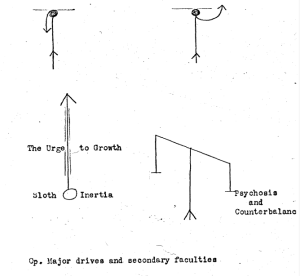
Classes under MBM
Women’s University Club
Thursdays 7:0O p.m. 1927
Series VI
Twelve Classes in Psychological Classification (generally called Psychological Types)
- General Introduction. Review of the great principles which are hidden factors causing the changes in man’s behavior.
- the concept of life as energy; (b) “all things flow”; (c) the conservation of energy; (d) change, resistance, progression, regression;
new principles: rhythm; polarity.
Definition of “type”; however even when apparently fixed, a “type” is under the compulsion of tho laws, and will presently change, either by a natural compensation, or through a conscious progression.
A brief outline for classification.
- Further principles governing the “flow of life”, the search for reality on the cross of the pairs of opposites – subjective versus objective; pleasure-pain versus actuality (called reality in psychoanalytic literature).
The Jungian classification, giving sixteen “attitudes” as a basis for study. (This is not MBM’s classification, which will be given later.)
III “Compensation”, the manifestation of the swing between the pairs of opposites. An analysis of the “seeking for equilibration” as seen by its extreme manifestations. Libra. The short way; (conscious) the long way; (natural).
First comments on types as illustrated in historical figures:
Origen and Tertullian.
- IV. A clear understanding of the principles governing types is the first step toward genuine elimination of temperamental, religious, and racial conflicts. All principlesmust be kept simultaneously in mind as the study is continued.
A new slant on history; illustrated in the problems of “Transubstantiation”; Nominalism and Realism; the early Christian Church and Gnosticism.
- Apollo and Dionysus as symbols of two movements in constant opposition.Illustrated further by Nietzsche and Schiller. (Systolic and diastolic)
Phantasy as a product of the urge toward equilibration, attempting the reconciliation of the pairs of opposites.
VI Types as found in psychiatry and pathological psychology.
The nature of psychosis as seen through the application of the principles. Some case histories. Identification: backward; forward; leading to growth of secondary personality.
VII A detailed study of Jung’s classification.
VIII Caste classification in India. Other eastern illustrations of the contrasting tendencies distinguished by “type”: in Chinese philosophy; in the Gilgamesh epic. The “reconciling symbol”.
Conversion to be seen as stimulated changes in type-flow. The progressions of Gautama consciously directed. In the short way Gautama is a leader of men. Further comparisons in conversion: Paul; Augustine; Tolstoy.
IX Prometheus and Epimetheus as seen through Spittler, Nobel prize winner. The story; its mystical progression and the reconciliation of the dominant opposites. Anima; persona; soul image; “participation mystique”.
- The first steps in MBM’s (Pojodag) classification of type, using the Ladders of Anubis, Set, and Thoth.The Ladder of the Four Sons of Horus.
Jazz dancer; clothes monger; bridge player; shop girl; bookkeeper; poet; socialist; merchant; magnate; housewife; scientist; mother; protestant; catholic; inventor; philosopher; mystic; knower.
XI Types according to philosophical astrology. Seven and twelve. The passing beyond type; as seen through the Ladders; as seen through the compacting of the cardinal and mutable into the fixed signs. (In anticipation of a major course in philosophical astrology in the fall of 1933.)
XII Classification of types according to ancient Gnostic systems. Choic, hylic, psychic, pneumatic. Some inquiries into cosmic consciousness and the transcending of type.
Lecture 1.
October 13, 1927
Notes taken by
E.G. Salt
PSYCHOLOGICAL TYPES
Series VI
by MBM
(These notes are not verbatim, hence not to be quoted)
The Great Principles which are the Hidden Factors causing the changes in man’s behavior
The basic concept of life as ENERGY.
- Conservation – continuity
Progression
(Resistance
- Transformation ( Regression
- Rhythm
- Polarity
There is a progression through every one of these Principles, and not merely through Rhythm alone.
The flow of energy through Rhythm may be thought of as winding up and down serpent-like, yet at the same time moving forward. For instance we have the rhythm which runs between the conscious and the unconscious; another, the objective and subjective worlds. Still other rhythms: we may consider the Light Spark as moving:
from latency to fulfillment
from sense to mind
from unconsciousness to super-consciousness
from the crowd to the individual
from Fate to self-determination
from suggestibility to immunity
Ambivalence (balance, polarity) – is the seeking for balance, swinging between two opposites.
Types. We have the flow of energy in and out. In the formation of a type there is a tendency to relate the consciousness to one or other of these flows. The flowing in, the introvert: the flowing out, the extravert.
The Extravert takes pleasure in the thing as it is; the Introvert takes pleasure in what he abstracts from the thing and relates to himself.
But if the attitude in the conscious is extraverted, it will be introverted in the unconscious, and vice versa. Thus we can have a conscious introversion and an unconscious extraversion; or an unconscious introversion and a conscious extraversion.
Then the energy can be introverted or extraverted on each of the three levels: physical, psychic, and mental; which gives us six possibilities, all in the conscious. If to this we add the unconscious, we double up and then have twelve possible attitudes.
may be:
Extraverted Introverted
in the: in the:
PHYSICAL consc. or unconsc. consc. or unconsc.
PSYCHIC consc. or unconsc. consc. or unconsc.
MENTAL consc. or unconsc. consc. or unconsc.
Making in all, 12 possible types of dominant attitudes.
Examples: (mental) An engineer will be extraverted in the conscious, on the mental level, but in the unconscious he will be introverted. An athlete (physical) will be extraverted in the conscious on the physical, but in the unconscious will be introverted in the mental and psychic.
But life seeks completeness, therefore, in these and other cases, the unconscious attitude will, every so often, try to come out. So we have the effort of the energy to manifest in both ways.
The more intensely a person extraverts or introverts in any one of the three, physical, psychic, or mental, the nearer he is to a breaking point, to a breakdown or a psychosis.
Polarity involves the pairs of opposites; pain and pleasure, hunger and satiety, etc.
Suppose we think of the principle of Rhythm as coming from Venus, we have to remember that it is not the only thing that comes from what is called Venus, but only one of many rays.
Question: We have dominant tendencies and auxiliary tendencies, and hobbies usually represent the auxiliary tendencies. The greater the intensity in any one direction, the greater the need for hobbies which save one from coming to the breaking point. Even the business man recognizes the saving virtue of hobbies.
PSYCHOLOGICAL TYPES (Jung’s classification)
(given by MBM 10/20/27)
EXTRAVERTED
In Conscious
Sensation
Objective sense pleasure Sensualist – from crude up to refined sensuous-ness. Mostly men. Often artists.
Feeling
They adjust to feeling-tone of environment. Very pleasant companions “but no real nature of their own. Mostly women ■
Thinking
Purely objective thinking. Judgment based on outer values. Business men, intellectuals, organizers and builders, welfare workers. They have an intellectual formula which life has got to fit.
Intuition
Oriented according to perception. Related to things behind outer facts. Have hunches. Promoters, speculators, forecasters.
In Unconscious
Sensation
Thinking is repressed. Feeling is undeveloped, hence jealous, morbid, superstitious. Intuition repressed. Superstitious and magical religiosity, anxiety states.
Feeling
Thinking is infantile, negative, and depreciatory. Obsessive, hideous thoughts. Infantile sexuality. Neurotic type: hysteria.
Thinking
Feeling is undeveloped and introverted – personal feeling. Sudden bursts of egoism. Sometimes introverted sensation. Thinking extremely irrational. Fanaticism – over compensated doubt. Neuroses. Feeling – over sensitivity – negifies qualities of others.
Intuition
Sensation introverted – being so excluded from conscious here has a come-back. Thinking and feeling subordinated to the ego. Compulsive ideas and phobias. Sensation compulsions. Often a sensationalist in secret.
INTROVERTED
In Conscious
Sensation
Subjectively oriented to sensation yet unrelated to the object. Very little outlet unless artist. In world of perverts these are “peepers”. Possible artists.
Feeling
Deep and still.
Never express feeling, which is deep and intense. Secretly religious.
Thinking
Related to subjective interpretation of facts. Cold and arbitrary. Often philosophers, or they found systems of thought.
Intuition
Related to things behind inner facts. Plato was such. Mystics, or merely cranks totally unrelated to facts.
In Unconscious
Sensation
Objective world claims attention, hence projection of archaic mat-ter. Intuition repressed. Compulsion neurosis with exhaustion.
Feeling
Thinking is archaic but tries to be extraverted, – immature and babyish. Defense mechanisms against objective world to prevent thinking getting through. Continued battle: neurasthenia with physical symptoms.
Thinking
Feeling undeveloped. Often brusque and impatient and don’t know how to handle things. Afraid to feel lest it prove their undoing. Sexual compulsions.
Intuition
A come-back because facts are ignored in conscious: compulsive ties to persons or things, because sensation repressed. Compulsive neuroses. Compulsive sensations.
Oct. 20, 1927
Lecture II.
THE JUNGIAN CLASSIFICATION OF TYPES GIVING SIXTEEN “ATTITUDES”
Two groups of types: Attitude types and Function types. Attitude – a readiness of psyche to act in certain directions, thus Extraverted and Introverted, the out-turned type and the in-turned type. Function – the path which the psychic energy uses, the channel for the energy flow.
A further classification – Rational and Irrational types.
Resistance – Pairs of Opposites
Pleasure-Pain. That which blocks the pleasure instinct is Actuality,
causing pain by the frustration.
Another pair: Subjective and Objective reality.
Dominant Types: (Jung’s – see sketch)
Extravert Sensation: Suppose we take an extravert whose dominant is sensation in the conscious. (Mostly men)
The Extravert Feeling type (mostly women) In conscious they adapt to feeling tone of environment. Have no nature of their own, but make very pleasant companions. Neurotic symptom is hysteria.
Note on Introvert thinker (in the conscious):
MBM: In the transliminal we shall find the dominant: Extravert Feeling and with it as a sub-dominant extravert sensation (because feeling and sensation associate very closely together.)
Extravert thinking type: purely objective thinking – seen in business world. Judgment based on outer values. In the transliminal feeling is undeveloped and we find sudden bursts of egoism and personal feeling breaking through into the conscious.
Extravert intuition: oriented to perceptions of their environment, but not to the environment itself as is, but their impressions of it. They have hunches, etc. As promoters and speculators. In the transliminal sensation (being so excluded from conscious) has a come-back.
Introvert types dominant (Jung’s)
Introvert sensation types live in a world of sensation delight with very little outlet unless an artist. Is orientated subjectively to sensation, but unrelated to the object. (In the world of perverts these are “peepers”.)
Introvert Feeling type. Never express feeling.
In the unconscious: Sets up all kinds of defense mechanisms against the objective world and to prevent the thinking getting through. The continuous battle brings about neurasthenia with physical symptoms.
(MBM in a lecture long ago)
….This function (i.e. sensation) is nearest, in its evolutionary development, to the Great Mother…..therefore it is also very closely associated with the sexual and egoistic impulses, – those apparently strange and uncontrollable waves of physical excitation that sweep over people.
Introverted thinking – is related to the subjective interpretation of facts, not to facts themselves. They found systems of thought. In the unconscious: are afraid to feel, feeling would be their undoing. Hence brusque.
Introverted intuition – is related to the things behind inner facts (not behind outerfacts as the extravert intuitive). Plato was such a one. They are mystics, or mere cranks totally unrelated to facts.
Case of Woman and Tiger-Man in today’s paper. Woman so named him and said he used a dreadful compelling power over her which she was unable to withstand. She was married, and he was the father of a respectable family, and quite harmless, nothing like her description of him. From the newspaper details (which are not all, however) we might guess her dominant to be extraverted feeling type (like so many women) and he probably a similar type, one in which sensation is repressed into the unconscious. What is the answer, for this sort of attraction that is common enough in our newspapers? When two people with the same repressed function in about same degree, come together – click! there is a tremendous unconscious tie between them, and just because it is unconscious they do not know how to handle it, and it assumes a monster-like shape, haunting and compelling.
(From a talk given at the Lindsays’ house – Dec. 1, 1929)
When we study Types we find that one other of the three functions: sensation, feeling, thinking, tends to dominate and crystallize into a type. Dr. Jung sees types as inevitable, at Pojodag we aim to get rid of types.
Types are classified by the dominant attitude in the conscious. Introvert type: Gets his stimulus from the world (like extravert) but relates back to himself, and does notremain related to the outside.
- Sensation introvert tends to lose himself in the effect on himself of objects. He may get his sensation even from collecting, or from the abnormal, or form images of the objects. Thus for the conscious. Sensation is in antipathy to higher psychic or what Jung calls intuition. Hence in.the unconscious we find extravert perception (intuition), compulsion neurosis, a demand in the unconscious for relation to the object. Sometimes a semi-religious thing. Animism, seeing ghosts which make demands on conscious.behavior in certain tokens and rites. Primitive rituals or superstition.
- 2. Perception (intuition) introvert in the conscious.
Stimuli from objects or situations which are hunches; they orient themselves by sniffing possibilities. A developed type of this may be an artist or a poet or even a true mystic. They make symbols from things. In the unconscious their own bodies rebel and thrust up sensations. Hence, functional diseases, ticks, and such things trying to thrust sensation upon the conscious. The person pays the price in all sorts of physical disturbances.
- Feeling Introvert.
Always feeling into the environment yet very quiet. It glorifies emotion and describes feeling and weaves a whole world of ideals of feeling – may be even high mystical feeling. Secretly mystical or poetic. The unconscious makes them cranks by compelling them to a cause or person, but secretly. In the unconscious is extravert thinking, a neurotic thinking approach to object. Even paranoia. The struggle of the conscious with this brings about great exhaustion.
- Thinking Introvert – Aristotle, Schopenhaur; evolve systems of thought, after the first stimulus from outside. May become cranks. Such a one haughty and inaccessible, brusque.
In the unconscious: extravert feeling. The conscious abruptness is a defense mechanism against feeling which might relate them to an object. Thus a mystic will be suspicious of a woman, will be harsh to her, abrupt, suspicious.
Unless a philosopher, there will also be resistance against any feeling from others, so presently it will seem as if persons near them worked spells on them and they build fantasy out of their suspicions which hold them as with a magical formula.
Using deliberately the rubber bands in the work of therapeutics at Pojodag: If you observe what function is active in the conscious you can know what is by compensation active below, and so can deliberately lessen the tension by restraining this function or bring other functions into development and play.
- Extravert Sensation
Runs the gamut of sensation. No loyalty to any object. The object is only for the kick in it. Often types of great daring, explorers, collectors. In the unconscious may be secretly religious; if a low type, pseudo-magic, fetishes, superstitious magic. The defense mechanism in the conscious would call all subjective values as “morbid””bunkum”.
- Extravert Intuition (perception)
Often useful persons, sniffing the wind of events, organizers, promoters, initiators, quick to pick up possibilities in a situation, acting on them outwardly, doing things. Excellent politicians with a sixth sense. They ride on crest of the wave.
In the unconscious sensation is subjective and inferior. Abnormal enjoyment of sensation things, i.e. sensation introvert. Subjective ideas about things belonging to the body. May become perverts, or enthralled to the physical in themselves. May be quite smutty and nasty. In low grade mystics it would show in amassing data which indicates a craving for sex in a mutilated way. For instance, a literalizing (physical aspect) of spiritual marriage. Stigmata may even be such a physical symptom resulting from the extreme stretching of the opposite of sensation and intuition. Stigmata in broad sense – conversion. Or sexual phantasies may be present.
- 3. Extravert Feeling
Chiefly women, social type, sympathetically feel themselves into any situation. Are always in key with orthodoxy, and with the changing fashions. Never think critically. Have no life on their own base. They can’t think.
In the unconscious, primitive thinking. Hence the person may be hysterical, i.e., something from the unconscious trying to break through. (Hysteria in general is typical of the extravert). These people are very adaptable, and never any trouble.
- Thinking Extravert
Always objective obvious values. Their formulas and sense of objective values makes them autocratic. May be engineers, pioneers in industry, planners. In long run they wear better than the speculators who work in hunches. An orderly crowd.
In the unconscious we find introvert feeling. Very vulnerable in feeling, one who can be twisted round a girl’s finger; double establishment; craves sympathy and understanding and often sneaks off to get it.
As the upper mental develops we may come to find a fifth type! – but it is very rare.
Individuality is that new being which emerges when the persona goes to the death. The persona goes to the death by the amalgamation of the personal unconscious with the conscious.
October 27,1927
Lecture III.
Alexander’s scheme of cultural center at Alexandria which his general Ptolemy carried out. Meeting of east and west. Eastern mysticism and Western science through Greek intellectuality.
Birth of Christianity – its emphasis on feeling, whereas the Platonic school had a philosophic ethics, a cosmogony, a vision, a reasonable religion. Through Christian emphasis on feeling and individual values it intensified the mysticism which the East had brought, – chiefly, the mysticism of the heart.
The Church’s dilemma: masses of untrained people, many passive, ignorant. Secular institutional movement and organization within the Church (resented by Tertullian and his kind as killing the spirit of the life, hence stimulated going deeper into emotionalism by reaction.
The sect of the Martinists, which fought the Church’s institutionalism, had a seat at Carthage, and Tertullian later joined.
Tertullian (Carthage 155-230) was a pagan, and like others steeped in sensation, contacted Christianity at age of 35 and became a Christian, deeply impressed with the idea of the existence of the soul.
Tertullian probably an extraverted sensation type. (Jung classes him as an introvert thinking type!) But as a close partner there was his emotional or feeling function, hence when Christianity teaches him about the soul, he seeks for good primarily through his soul, i.e. subjectively. So that the outside influence which resulted in his conversion sucked in his thinking function in service of it: introverted thinking, thinking in leash to feeling.
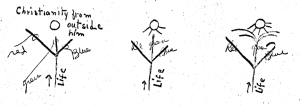
Origen (Alexandria 185-253)
Had Egyptian blood in veins. Marked mental talents. An extraordinary education. At 18 was at the head of the school. Training both in philosophy and Christian scriptures, also Gnosticism. He was prolific scholar and did much to clear up scriptures of that day. Whereas Tertullian (as introvert thinker) was looking for facts as he felt they should be. Origen looked for facts as they were. His mental function dominant, and obviously sensation was a second, because he found castration necessary.

Tertullian moved men’s hearts, Origen moved men’s minds and put philosophy into the Church and a cosmogony that antedated Christianity! Jung classifies him as an extravert thinker, a reacher out after scholarly facts. Later as the church wanted to make Christianity and Jesus the beginning of all things, resentment grew against Origen, and in 553, after his death, he was condemned and thrown out of the Church.
He taught the pre-existence (reincarnation) of souls – which was never stressed in the old Semitic tradition.
Taught a three-fold interpretation of Christian texts: (l) literally and historically; (2) ethically and morally; (3) inwardly and mystically. Only the first two were for the crowd. The third was for the few.
He who is master of his functions uses them as the stops of an organ, according to the need of the situation, no longer at the mercy of a dominant function.
November 3, 1927
LECTURE IV.
The Types seen in Church History
- Tendency toward the literal via Feeling. The movement is:
Tertullian – passionate, feeling (for the many)
Ebionites (J. Merely a holy man) Homousia (identical with Father) Monophysites (one nature) Orthodoxy
Augustine (original sin – man a miserable creature)
Radbertus (Transsubstantiation) the literal miracle
Nominalism (nothing but names)
Cyril (Mary Mother of God)
- Tendency toward the philosophical via Thinking: The movement is:
Origen – perspective and vision
(for the few)
Docetae (primarily a spirit)
Homoiousia (Like the Father, but a messenger from)
Dyophysites (2 natures of Christ) Pelagius and his pupil Caelestius (Man’s moral freedom)
Ratramanus Merely a symbol in
Scotus Ecigena Commemoration
Realism Are great Realities
Nestorius Mary, Mother of the Christ
Group A.
The one has to do with the many; the tendency is towards the literal, via feeling. The other group (B) tends towards the philosophical, via thinking, and is for the few.
The Ebionites took Jesus for merely a prophet; their literal-mindedness led them to expect a real king as Messiah.
The Docetae (meaning shadow) accepted Jesus’ main nature as divine, and regarded his human body merely as a manifestation of that divine and essential nature.
Group A is thinking down to a point, making for intensification; group B in thinking away from, or up from, makes for breadth or profundity.
The Docetae were the only ones who could logically explain the Ascension. Even today there is dissension in the church re the Ascension. Some say He did not ascend, that it was a vision only.
The Homousia (the orthodox view): the complete identity of the Son with the Father. Christ was literally God incarnate and was equal to God the Father in all respects.
Homoiousia (advanced by Arius): that there was not identity but a similarity between the Son and the Father, between Christ and God. That the Son was a manifestation, a voice, a messenger from the Father.
In the world today, remember that it is the feeling type (vide Tertullian, Athanasius, Augustine, Radbertus, Cyril) which has the dynamic personality. They lead the many, sway men’s hearts, and are often men of action, of great power and influence.
The Thinking types sway men’s minds, and since as yet mind is less developed than feeling in the bulk of humanity, they would not attract the crowd. They would be non-spectacular, quieter, more colorless (seemingly) and unobtrusive. The appeal is to the individual in regard to truth and is on the mental level above the storms of emotion.
Some Pairs of Opposites, but not synonyms:
outbreathing inbreathing
diastole systole
extravert introvert
crowd feeling individuation
proletariat aristocrat
slave superman
back to nature on to mind
November 10,1927
LECTURE V.
We saw last time that as these two types contacted Christianity they left what they had been and became something else. For Christianity demanded a sacrifice, indeed therein lies its dynamic power. It calls for a sacrifice, a re-making.
The Apollonian and the Dionysian types appear in Nietzsche himself so strongly that we shall consider them more in him than in comparison with him and Schiller.
Dionysius – Bachus, god of wine. Social qualities, frenzy, orgy, song, music, dance, adventure, peace.
Apollo, – son of Jupiter, sun god. Stood for order, law, number, symmetry, mastery, mind, civilization.
Note from sketch of rhythms that Nietzsche changes his dominant types 5 or 6 times, unlike Tertullian and Origen who were more continuously one type. Reconciliation between the pairs of opposites can be done by phantasy, but active phantasy, i.e. the participation of both conscious and unconscious, as in working in art (artist or engineer), or our work at sessions on the dream material which binds the elements of the conscious and unconscious and therefore brings a peace and a wholeness which some of you know.
Nietzsche’s pair of opposites: Thinking-perception
vs.
sensation
November 17, 1927
LECTURE VI.
Types found in Psychiatry
Psychiatry is the older form of the healing of mental disease.
It recognizes two main groups of mental disease: organic (paresis or slow deterioration) and functional, i.e. due to maladjustment.
Three main types: Manic-depressive, dementia praecox, and paranoia.
All are disturbances of the personality.
- The manic-depressive. (manic – exaltation) Joyous abandon.
In this type we have the alternation of these two extremes. Causes in the transliminal. But also stigmata inherited from parents. Alcohol can play a part. In the manic phrase – restlessness and great activity, on physical, emotional, and mental. During the other, great difficulty in thinking. Sometimes cannot act, i.e. psychomotor difficulty. One of the most difficult cases to handle because of the rhythm.
Gathers a momentum of regularity. Very hard to break. The flight into reality. We try to get them then to realize this flight to stop their wild activity and work at their conflict.
- Dementia praecox. The dementia comes on early (praecox) in the disease. Is a repressive disease. At stages looks very like manic-depressive. There is a regression to earlier stages. Difficulty of thinking, but here it is caused by infantility of thought.
This type has far more sexual difficulties than the first type. It is continuous rather than alternating. If not too advanced one can get at it through the transliminal. It is a case of regressive introversion, with the mental infantile and disordered. Their symptom is dissociated reasoning. Usually in this the dominant cause is made secondary, and an incidental thing is made dominant. It is a trick of the unconscious. (By the way, sometimes happens in normal people.) This is typically a case of evasion of an adult problem-solution.
- Paranoia. Thinking which is beside itself. A much more subtle disease than the other two. A disease which, like an island is separated from the rest of the personality, which looks quite normal. But if you look under the sea you will detect the connecting link and the cause of the disassociation.
Characteristics: suspicion, sense of persecution, based on the effort of the transliminal to right itself, and have to do with patients own difficulty.
Sudden vindictive crimes often traceable to this type.
With sense of persecution there often goes a sort of compensating idea of grandeur, or idea of being defrauded out of heritage or riches. Or hallucinations.
Question: What becomes of the soul in a case of psychosis or insanity?
If one hasn’t got a good automobile one doesn’t get anywhere. So with these. In one life the soul may have such bad adjustment that it brings nothing back to spirit for that life, or next to nothing. So that it is a “lost soul” – is wiped out, nothing learned, like a zero. Hence, “only the good is the Reality”. There are those whose vehicles are so unfit that they cannot use them at all.
December 1, 1927
LECTURE VII.
The Jungian Classification (in detail)
The Jungian system is based on observation only and is not genetic. My own system, as you will guess, is a much older one, based on the genetic conception of life.
Auxiliary Function:
If feeling is dominant function, thinking will never be the auxiliary function, because feeling and thinking are too antagonistic. They are the two points on which man as the evolving Light Spark is now working; hence one is leading at one stage, and one at another.
We can find any of these, but never feeling and thinking as auxiliaries.
Fantasy can exist in and about any one of the functions: in sensation, in feeling, in thinking, in intuition.
Extravert Sensation type is ruled by the thrill he or she gets out of the object whether a good dinner, companionship, comfort, sex, nice clothes, etc. Some feeling with it but subservient. Is so concerned with the visible objects and so represses the rest of him that the invisible objects down in the transliminal get a compulsive hold on him, as raw and undeveloped, as superstition.
Feeling Extravert never feels on own account but always feels what the environment dictates. A conventional sort of feeling, hence very unreal, yet perfectly adapted to the environment of the moment. Reason is in leash to their feeling. If they go out very much to object then they appear pitiless and cold, without feeling because the feeling has all been absorbed in the object and there is none left in the subject. Repressed thinking – symptoms.
Example: Housewife who has given so much to husband or home – breakdown into hysteria. It is the call of the self rebelling against so much being given to object; it is the claim for thought of the self. Thinking when it bursts forth is so infantile, it is hardly recognizable as thinking, yet it calls out for attention to the self.
Thinking Extravert (most often intellectual) tries to order all from standpoint of thought. Related to objects. Works according to a standard or a formula. May be a search for what is best among the objects of the world and he takes that best as a formula. A typical phrase: “One really should”. Despotic, tyranical, coercing people to things to fit his formula. The reversal in the transliminal – self-seeking, egoism, feeling undeveloped. Neuroses marked by all sorts of ego-centricities.
Intuitive Extravert (really a function of feeling — I differ from Jung). Big Bill Thompson of Chicago is such a one. They know how to work with possibilities, dealing not so much with facts as with potentialities. Hence, often promoters, sniffing the possibilities behind what is there.
Since he is working for invisibles, his enemy will he the opposite extreme, i.e. sensation – hence pushed into the transliminal. Apt to have all functions except intuition relatively undeveloped, more than in any other type.
Note: Pojodag emphasizes the flexibility and the development of all four functions, foursquare on a solid base before reaching up higher. Not so in the world, or in various sects, or even in psychoanalysis which accepts a dominant function and some auxiliary functions, and goes to only that development which helps one to just get along nicely. Pojodag insists on flexibility, on foursquareness, on growth.
Introverted, Types:
Introverted sensation type. Very hard to watch or to reach. He draws stimulus of objects back to self, and plays with the idea of the object, not the object. Live in imaginary world independent of the object. Their truth (subjective) is stronger for them than the objective values. Easily becomes victim to others. His phantasy of a situation is so real to him that he can be exploited without ever knowing the difference between the subjective truth and the objective fact.
Reversal in the transliminal – a compulsion of the object. Hence a conflict in the self, a compulsion neurosis. Phantastical images, regressive call to vicious deeds or towards crime.
Introverted Feeling based on subjective values. Very intense because ordinarily no outlet for it. Introverted feeling is different from repressed feeling; in the former feeling is intense but hidden, and is related to the self; in latter feeling is pushed out of conscious altogether.
In Pojodag students we often can see the feeling introvert and the feeling extravert at the same time as the two parts of the rhythm we emphasize: the in and then the out.
The feeling introvert is not a good companion and often is misjudged. When the feeling does come out it is often badly expressed. Mal-adaptation to environment. Often secretly religious, sometimes as a compensation for the maladjustment in the environment. Sometimes writers of poetry quietly. In transliminal thinking is extraverted and attached to objects.
These people (their feeling so hidden under the quiet exterior) seem not to care about anything. But there is tremendous caring, and for lack of adequate expression it often piles up and then occasionally bursts forth awkwardly with intensity.
Introverted Thinking – makes an extract from the mental objects. Are so careless of the object that they depreciate it and hence appear ungracious and disagreeable. Thus a man may give much thought to the niceness of his home and the beauty of his wife, but he is so wrapped up in the ideas or in his abstract of this beauty and comfort that he quite fails to express it at all to his wife or show anything of it in expression! Poor adapters to environment. Biting and bitter to the environment that calls out to them. Haughty and inaccessible, but when known, very likeable indeed. Inconsiderate, brusque, inwardly concerned with their own person.
Feeling as represented in unconscious is extraverted and immature.
Introverted Intuition draws a phantasy world from the objects of the subjective world. Take what was said of the extraverted intuitive and replace the outer facts by inner facts, and you will have it. Mystical dreamer. Fanatics, cranks, mystics. Go high up spiritually or crashing down in catastrophes.
The Relation between
The Dominant Function in the Conscious
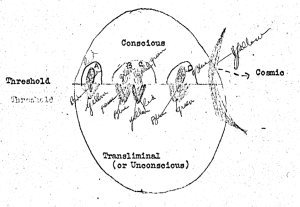
and its opposite in the Unconscious.
Dominant Function
A – sensation
B – feeling
C – intuition (pseudo intuition or psychic-perception. True intuition D -. thinking is super mental, and has to do with the Cosmic. Shown above by the interpenetrating arc of yellow.
Series VI.
Lect. 7
12/1/27
MBM
LECTURE VIII.
Caste in ancient India:
- Brahman – the priest
- Kshatriya – the warrior, soldier
- Vaisya – the merchant, farmer, householder and the professiors
- Sudra – the slave or servant class
Pariah – the outcast of all. Sometimes appears as a fifth classification.
This really is a remnant of an ancient classification of the age of the soul. Hence is philosophically significant.
Brahmana was the intermediate between heaven and earth. The thought in each individual which does this, – the higher mind.
The Kshatriya – the lower mind, the doer, the practical mind.
The Vaisya (merchant, farmer) – the psychic division
The Sudra (servant of all) – the physical senses which serve the higher, especially the higher mind. The Sudra was especially the servant of the Brahmana.
The Pariah – a sub-man, lower than all.
The rigid line of caste between these – no mixing of bloods. Why? We have first to separate and well differentiate each function. Later only, at a higher stage, is it possible for the spiritual to use one or the other or all simultaneously, at will, for its expression. But first, self-fulfillment requires a clean cut differentiation and control. The Indian rigid social barrier was a dragging down to the literal and Sudra level. Philosophically it is valid.
In ancient China the pairs of opposites: Yan and Yin. Philosophy of Lao-Tze, one of the great Knowers and thought to be founder of Taoism, or at least vocalized it clearly for the first time.
Tao – the Way (i.e. the reconciliation of the pairs of opposites). The Schen soul (the earthly soul) and the Kwen soul (the spiritual soul). Man progresses from one to the other by means of Tao.
Gilgamesh Epic. The earthly man – Eabani, the heavenly man,- Gilgamesh. They become friends. Finally the lower becomes the higher and Ea-bani is eliminated.
The Reconciling Symbol. In the process the soul becomes the victim stretched between the pairs of opposites, and the strain of tearing apart is very great. This is the first taste of being the man on the cross. 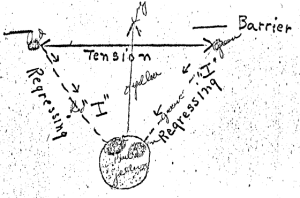 But it is only as you can endure that you can regress far enough to have a really great reconciling symbol and rebirth.
The Ego or “I” principle may identify itself with any point on this path of regression, which point then immediately forces a release into the conscious.
When the pairs of opposites are stretched apart to the utmost a barrier is formed preventing them from going further up and fusing in the conscious. Then, if the tension is endured, there begins a regression. The ego may, of course, identify itself with any point on the regressive path, and in that case forces an immediate release into the conscious.
But the further into the transliminal these two opposites regress the better chance for them to sometime meet, and they may even go back to the Source. Where the tension is kept up and they reach a strong point near enough to each other, there is the effect as of a fusion and a release, and from here leaps up into the conscious a new form of life, the product of the mating, but different from either.
This, by the way, is the mystery of the unconscious production of artists.
It is one of the forms of rebirth, or the return to the Mother. It makes all the difference when one knows. For he who knows can deliberately help the damming up. It is a very wonderful thing, to do …. It takes a big soul to stand tho great strain.
(5/4/03 – MBM)
Jung calls Paul’s experience as occurring in his unconscious. I differ, for I know that these things are objective and outside the self, from another dimension. A tremendous experience which put him out of normal functioning for three years!
Conversion to be seen as a stimulated change which makes for type transformation.
Two types: crisis type – sudden
lysis type – gradual and slow
Tolstoy – lysis type of conversion, the long slow conversion from extravert and sensualist to introvert and spiritual. Not only his writing, but his whole living became radically changed. A shift of types.
Augustine the lysis type of conversion. Early stages a sensation extravert craving excitement and a pagan. He went the limit. His beginnings were in his connections with the Manichean sect, but not the culmination. He was a divided man, the carnal desire vs. the spiritual desire. He had a great pair of opposites – not very pleasant or comfortable, but which made him a dynamic personality. A long, long struggle, Christianity helping him, and finally there emerged the man whom the Church honors. From extravert he became introvert, and after the rebirth, again extraverting, in service, but retained ever the introverted or inner life.
Paul (crisis type) In his case there was an activity outside of earth.
Paul was trained in the Jewish mystery schools, and being a true Jew did his utmost to stamp out the new sect, i.e. Christianity. Hence his assisting at the stoning of Stephen.
Paul was educated in the school of the Pharisees and had one of the greatest teachers, Gamaliel. Was trained and prepared as no one of the other disciples were, not excluding John.
The vision as he travelled. The dammed up regression was exceedingly quick, but it took three whole years afterwards before he returned from Arabia and began his work. He made a great reconciliation.
Buddha (Sidartha) Lysis type of conversion. Immersed in sense life, and married happily until the pair of opposites were so stretched in him that he had to go off and live his own life. Finally the ultimate strain towards the transliminal which took place under the Bo tree – back to those primordial sources where his lower functions gave birth to a higher function. He took deliberate steps towards this, with reason and practicality, and so demonstrated a way of looking in on the cosmic, – cosmic consciousness, or the birth of true intuition, seeing from above, life below in the three functions.
Sensation and spiritual: Sudra and Brahmana make a more dynamic pair of opposites than, say, Kshatriya and Vaisya, and this is one reason why the pairs of opposites in great souls are often the sensation and the spiritual.
Question: Buddhism is agnostic insofar as it does not posit a God, but says: “Perhaps, – I do not know”. The Way of Buddhism is a way, but not the only way. It is a practical way, direct, and uses the lower reason.
December 15, 1927
LECTURE IX.
PROMETHEUS AND EPIMETHEUS. MYSTICAL PROGRESSION OP STORY; ANIMA, PERSONA, SOUL IMAGE; PARTICIPATION MYSTIQUE.
The story of Prometheus and Epimetheus by Spitteler is not exactly according to history, but is told with poetic license and fine understanding, and dramatizes the pairs of opposites.
Prometheus the introvert who kindles (at first) the other, Epimetheus the .extravert, toward differentiation. This is the first movement which leads to another pair of opposites. The angel is looking for a king to rule earth, and proposes it to Prometheus. He refuses scornfully — What? forego his own soul?
Epimetheus has been listening in and offers himself to the angel and is accepted; i.e., part of the self (Prometheus) is given over to the soul, and part to extraversion in the world.
A conscience is given to Epimetheus to serve the same purpose that the soul serves with Prometheus. This conscience is only a sensitivity of the mores of the world.
The danger of (a) Prometheus’ identification with the soul to the ignoring of reality outside, and (b) Epimetheus’ identification with the outer world to the loss of his own soul.
Translation of first part of interpretation of Spitteler’s “Prometheus and Epimetheus”.
It was in his youth – health reddened his blood and his strength grew daily —
Then spoke Prometheus, full of exuberance, to Epimetheus, his friend and brother:
Up! Let us become different than the many who swarm down below in the common mass!
For if we constrain our lives according to the customary habits, so will our reward be commonplace, and we will never experience noble or happy fortune and soulful pain.
And the word kindled in the other, and thus they made themselves upon their way, and where it was quietest in a valley and where the mountains leaned over each other listeningly, there they sought their home. And each built himself his house on the hither and thither side of the clear stream.
And there they dwelt separated from the mass, and did not offer sacrifices to the gods of the mass, and did not go to the market to barter conventional ideas. And when the others sang they did not sing with them.
“And they laid a barrier before the path and sealed with a lock and key the valley and accepted no law nor custom, and their only law was the whispering of their own soul when they wandered reflectively in wood and meadow and along the fragrant flowery mountainsides.”
– – – – – – – – – –
The power of Epimetheus grows, while the power of Prometheus wanes and he grows very sick.
Epimetheus visits him in lordly fashion, and offers him a salve which is spurned. Naturally the two attitudes are antagonistic. Prometheus suffers more.
A look-in on Olympus – what is happening in the transliminal. Jupiter deeply distressed yet unable to help himself. She god in us is bound in a vicious circle until the reconciliation of the pairs of opposites. His daughter, Pandora, offers to take her treasure to earth. She descends. In the deeper depths of transliminal transformations were going on, and there arises a new possibility of reconciliation. She places her box (image) under a tree and returns to the gods. It glows like sunlight. A peasant boy discovers it. Meanwhile the trees and birds and winds are singing. He takes it to the king. A movement has come up from the transliminal and presents itself to the extraverted attitude (Epimetheus). He presents it to his conscience (a queer creature) who shudders and repudiates it; i.e. the practical, rational, earthy way, the worldly mores, is sickened by and hates the super-rational, and runs away and hides under the bed. Epimetheus obeys his conscience but sends box to priests (the conventional, rational religion) who also repudiate it.
This box contained a little naked figure, naked life which the world does not understand or want. He sends it to the Academy (the intellectuals) who curiously turn it about, finding it of no value, and pass it on to the goldsmiths, who find it is not of pure gold (i.e. the standards of outer value) and have no use for it. It is handed then to the shepherds (who are afraid to value it), then to the police (conventional propriety and order) who are shocked at the little naked figure it contains. Finally, it is dropped by the wayside, having become (for the world) a thing utterly worthless, useless, an object despised and hated.
But the movement up from the transliminal having been made, there is a flooding to the surface of new life, and Epimetheus’ kingdom is visited by floods and earthquakes. Epimetheus does what he can, but cannot aid his kingdom much. Finally a monster, Behemoth, appears and devours the children of God. Prometheus, in his deep, valley, hears of these disasters and goes out to help Epimetheus, preaching and talking of Truth on all the highways.and byways as he goes.
Prometheus is just in time to save the last child from being devoured by Behemoth. He takes and later trains him, – Messias, who eventually replaces Epimetheus on the throne. Prometheus induces Epimetheus to return with him to the valley where they dwelt as of old, the kingdom being ruled by Messias from now on.
The persona is the objective outer attitude. The anima or animus is the opposite of the outer attitude and is developed by the transliminal. These inner attitudes (soul image) make images of the ideal. This soul image therefore is not identical with the anima.
Due to Jung’s static conception of life, one may see, in the school at Zurich, all kinds of animas and animuses exactly as he describes them, and they are there sharply defined and unchanging. But we at Pojodag conceive of life genetically, and so, just because the type is changed, and the persona changed, the anima or animus may change many, many times, as life progresses. Cf. Pojodag conception of life as flowing and Jung’s conception of life as is, centering around merely a healthy, comfortable, practical adjustment to present environment, with no idea of a whither, nor a whence, nor a purpose, nor a Goal. . . . . .
Keyserling (in an article appearing in last Sunday’s Times) conceives only of the rise and fall of cycles of civilization, a light age followed by a dark age, but humanity as such never changing, never getting any higher or any better! He holds that humanity goes through these cycles of up and down but that it never changes.
“Participation mystique” is a kind of mystical participation in the primordial conditions wherein your nature and they merge so that the two are one. The higher mystic thus loses himself in Deity, but Jung’s static conception of life speaks nothing of this latter. Both he and Keyserling see only cycles of pairs of opposites but no progression of life.
But mystical participation may exist not only in the primitive who identified himself with a tree (i.e. with the form side), but also in the higher mystic, – in short, on many, many levels, and at a later time this may be the identification with the life side of things, though on the outside it may look all the same. In short, a merging of life on any level. Good? It is good provided you in turn release yourself. Not the steady current, but the make-and-break. There is always a danger because the lure of remaining is very great. It is the lure of the terrible Mother whom we have to resist and break away from.
Returning to the story:
Both Prometheus and Epimetheus experienced mystical participation because it is not possible to go far in separating the pair of opposites in a tensive activity without experiencing it. Presently Prometheus saw his soul as a gigantic daimonic power, a titanic, dynamic power. When he is in her power then he partakes of her nature …. for then he has gone hack (regressed) far enough to he merged in her. . . .
Lecture X.
Why does Jung without a genetic scheme, find a fourth, – intuition? Because at the present stage it is the dynamics of the upper psychic area (psychic perception) that is in the vanguard, hence becoming noticeable. MBM’s classification is on the basis of the three functions: sensation, feeling, thinking.
The Ladder of Sensation or Earth plane – anything that comes through the sense organs of the body – sensation, i.e. feeling in the sense of “sensing”. Whereas “feeling” in sense of emotion is of the psychic.
Ladder of Anubis (The Opener of the Ways, also peculiarly the servant of Isis.)
Note: The three Ladders are interpenetrating and they support each other just like three ladders leaning together. Earth-water on each ladder has to do with the form side, and Air-Fire with the content side of life.
A Few Examples of Types – Extravert and Introvert
Extravert Sensation
John Barrymore (“I must be blinded against all rational points of view. I have to do it” – a fierce inner compulsion. That alone explains some of his bewildering deeds (MBM) Also Sinclair Lewis, Babe Ruth, Billy Sunday, Napoleon, Babbit.
Extravert feeling
Mary Pickford, Aimee Semple McPherson, Sophie Tucker, Gloria Swanson, Billy Graham
Extravert thinking (with sensation) Hoover, Al Smith, H.L.Mencken
Extravert thinking (with perception) Lloyd George, Eisenhower, Rebecca West, ClaireBoothe Luce, Lindbergh, Steinmetz Henry Ford. Often have hunches.
Extravert thinking John Dewey, Wm. James, Clarence Darrow, Darwin.
(perception and sensation aids the thinking; aids observation and insight)
Extravert perceptive Heyward Broun, Bernard Shaw
Other extraverts: FDR, T.R , Jimmy Walker, Farley, Goethe, Wagner, Dorothy Thompson, Gene Tunney, Charlie Chaplin, Edison, Mc. Arthur, Stalin, Churchill.
*************
Introvert sensation Edgar Allen Poe, Nijinsky, Gaugin, Van Gogh, and the early impressionists
Introvert feeling Helen Keller, Jane Adams, Helen Wills, Beethoven, Greta Garbo, D.H.Lawrence. Cordelia in “King Lear.”
Introvert thinking Bergson, Kant, Nietzsche, Schopenhauer, Thoreau, Herman Melville, Dr. Jung, Aristotle. (with perception) Edward Arlington Robinson. See article about him in N.Y. Times Book Review, Feb. 8, 1948)
(with sensation”) Thomas Hardy.
Introvert perception William Blake (see Cheney biography.)
– – – – – – –
Extravert thinking, with strong feeling development: Nehru (showing he is on the way to overcoming type.
Leonardo da Vinci, shows the powers of many types, so getting above type; for he was a thinker, researcher, poet, artist, inventor, engineer, naturalist.
rec’d from ABG 6/57
PHILOSOPHICAL-PSYCHOLOGIOAL THEOREMS
in re human TYPES
- It is the natural or innate urge of all life “to flow”, and in flowing to slowly evolve. This is life-energy.
- This natural flow is “interrupted” by obstacles, which may be material, emotional, or/and mental.
- The “piling up” of the flow is lodged in the subconscious.
- The personality identifies itself with the life-energy which is not interrupted, and which must of necessity be either introverted or extraverted, and which will choose the faculty offering least resistance. This is the genesis of a “type.”
- A type, or expression of the life-energy through “this easiest way” is thus tacitly an admission of weakness. It develops under the natural law and expresses only a small portion of the total life-energy available.
- The outlawed energies remain in a relatively repressed state, and because they are unexercised and undisciplined by the objective realities and circumstances, they remain immature and unadapted.
- The “piling up” of outlawed energies causes “up-rushes” from the subconscious of conduct not typical to the type, and which is rarely understood as being an effort of the energies to establish balance under the Natural Law.
- Intelligent and directed working with the balance-seeking energies not only relieves pressure in the self, but gradually adds power and capacity to the conscious self.
- Type ceases in proportion to balanced development. All faculties being available for the expression of the life-energy, there is resourcefulness, stability, a widened rapport with people and their many interests, a capacity for enjoyment inconceivable to the old limited personality.
MBM
Psy. Types Lecture 3/9/39