Practical Applications of Spiritual Law
Series by MBM given Feb.-May, 1936
Notes, rather fragmentary, by GB
February 13, 1936
Introduction:
Spiritual laws require too much. They are too strenuous; they demand all. They allow no modification. They are absolutes. And there are very few who have the courage, or the determination, or the desire powerful enough to carry on in that fashion. The illustration of Jesus: Seek ye first the kingdom of Heaven. You are, in varying degrees, moving toward it, but you are compromising; and honesty requires that we see that, and acknowledge it.
Therefore discover that we are not following, or even attempting to follow, the.absolute in the manner of Jesus, Francis, and a few others; but, rather, that we are following an intelligent, conscious application of soul laws to human behavior, since the soul is the surrogate, or substitute, for spirit to man. First seek the higher ways. We are seeking practical applications of soul laws. That is strenuous enough.
Work out a little chart, headed: What sort of a person am I? We are so close to ourselves that we do not see ourselves. Try to fill out the chart as someone who learns to know you, say for a month, would write about you, – somebody you met on a cruise, and you are room mates . . . . .before breakfast, after dinner, and in between. How will you be summed up, say after a month?
The proposition is: that he who is functioning under higher Laws is self-conscious. Therefore this technique I am presenting is simply a technique to stimulate you to a new type of consciousness – a technique to help you from time to time to take a situation, at home or in the office, that is a little tricky, or difficult, and sit down opposite where you were in the picture, – how did you speak, what words, what were your mannerisms, – friendly?, antagonistic?, timid? Look at yourself detachedly. Good conversation? Write down 8 or 12 lines. Would you admire that person?
Heroes precede gods. Why not take this hero business in earnest, and see if we ca n go in a way that would arouse our admiration. How would such a situation look if it were on the stage? Could you respect yourself?
We cannot follow spiritual laws while we have many unevennesses. Our first few sessions will be in intensive self-observation. The more the situation is unpleasant the more it is a challenge . . . . . at no time to be put up to the other person.
The first lesson of major importance learned by the soul is that what occurs is theirsoul’s business, and not their affair in relation to anyone else, – no matter how pleasant or unpleasant. The law requires handling. Therefore anything that puts a challenge on the other person is an evasion mechanism. The conscious person does not do that. The interesting and challenging complication of situations . . . . Judge not. We have to become one-eyed in this process. We do not need to say it is all our fault. But the handling of it is our business.
Respect is the foundation of real relationship. Until your behavior and your standards are friends, respect and like each other, you can’t go very far. Another technique for at-one-ing.. On the ascent, we are at-one-ing all the time . . . . redemption and salvation in the religious sense. What really is occurring in a scientific process is the gathering of the broken pieces and the assembling of the cup. But the analogy is not perfect. What was shattered was a seed. What is gathered is a great cup. If we can at-one our behavior and our responsibility, we have done a useful thing.
In any of these situations, do not take the immediate circumstances too much to heart. Do not do it. See it as an opportunity for technique. Take it as grist to your mill. The soul is in a large training school. Your ideal is not the perfect behavior in these contacts but the conscious observation and cumulative benefit from them. Increased flexibility, increased immunity to feeling reactions (plus, minus), greater resilience to unexpected answers, etc. Your standard is not the final judgment per (?) each situation, or contact, but the increased flexibility, resourcefulness and power gained by the whole series. Those who are moving in conscious evolution, instead of exploiting their bumps exercise their hollows. The personal development in the world is finding your talents, and exploiting them. Use them, of course, but do not become obsessed; about them. Fill out the valleys. The larger our perspective, the more we can see the whole rather than the detail.
Question: about not accomplishing all he wants to do, yet does not feel he is attempting too much. MBM: (solution of such problems) one of the soundest results of group action. One of the soundest arguments for group action toward social and economic adjustments is that we work for conditions which allow more choice. Just now we are living in an age where we are the victims of circumstances, to some extent. We have business, homes, our own wishes, social relations, etc; and, in this day of extreme pressure, none of these things can receive its full merit. There are hundreds every week who use one means or another to get out of this plane, because they cannot stand the pressure of it.
If you should let it go at that, philosophically, you would be in a tough spot. Because no situation, to the philosopher, may be left as is. He uses his muscle against it, and it becomes his exercise ground. Within a limited area, for all of us, because the time we live in. Do your utmost; and don’t let your utmost be uncritical.
As we grow, we do not “handle people.” We go about our business, and the other will fall into place.
You know that there are supposed to be, in our Western classification, four classic virtues: prudence, justice, temperance, fortitude. How much of these have you accomplished in yourself? Prudence means exquisite discrimination. It is knowing the right thing at the right time, and doing it. It is bringing the right amount of pressure an the valve at the right time, in engineering language. Have you anything of those virtues?
February 20, 1936
What suggestions may you have if something unpleasant has gone on? None. It is the other person’s responsibility, not yours. If you haven’t a responsibility, stay detached. The basis of good relationship. Keep feelings, plus, strong or negative, absent as far as possible. Don’t see what occurs that is unpleasant unless it is your business to handle it. So no one can hurt your feelings. They may hurt your career, but can never hurt your feelings unless you permit them. May hurt your circumstances but not your feelings.
No one can really touch you, from the standpoint of the psychic. They can from the point of view of the physical man, and because we are in a physical world. Therefore, if friends, relatives, associates, are in default in behavior toward you, never mind. If you are surprised at behavior you didn’t expect, never mind. It is their loss if they are envious in any situation. You are not your brother’s keeper until you have become, first of all, your own keeper. One of the things you have to do is keep yourself immune from being offended. It does not take away the mental faculty, which can see shortcomings. It will be upon them, sometime, somewhere, to clean up their mistake, – their debt. You make it a debt to yourself if you work upon it with your feelings. No one can hurt you, unless you are vulnerable. (In an organization) If the good of the organization is in the picture, the good of that organization must be seen. Therefore, bad behavior is part of your responsibility. But be as dispassionate as possible.
(re expectations): One of the main causes of distress in life is injudicious expectations . . . . . family circumstances…… The lily is busy growing itself. You attend to your own development. The rest will be taken on in the long run — notimmediately. The philosopher has the long perspective.
The more you realize that what concerns the little self is little, the better. You use interior speech, or the Ascent via Negation: reason, persuasion, discipline, command, – until your one becomes a majority. Conscious evolution means the determination of the intelligence in you. It does not mean the majority.
In life the question is: How well can you carry on in spite of the obstacle. It is childish to wish the obstacle away. “It is what I strive to be that comforts me . . . . (Browning), not the measure of things when things are going smoothly.
(Re the physical in the discussion of the personality.)
Appearance is very important, and the impression we make through it – clothes, good grooming…..carriage and beahvior. Spruce up.
How get over timidities? Inertia, reluctance to act. Close the gap between the inspiration and the impulse. If too impulsive, build the gap. (Re glands) It is what you do in spite of the difficulties that counts. If you are over active, too quick, build the gap.
(re moodiness, depression) Make an intelligent survey of it. Find causes. There is no situation with a single cause, except the beginning of Creation. From then on, there are causes. Then you discover that some causes can be eliminated, and some cannot. Suppose 20% are removable. May be emotional and physical circumstances. Supposing you could find the causes of some of them. It only makes you the master of the details of the situation, but does not make you master of the situation.
Moods are slowly cumulative; maybe over weeks. If you don’t watch these things it is like a debt that grows. If you are not working them off day by day the ball increases. Because you have been accepting things. Water seeps through the floor. affected till the straw that breaks the camel’s back. Injudicious expectations. Watchfulness day by day, and following Conscious Living every day, prevents it. Because it is a daily catharsis. Take away the feeling of identification. You have to have expectations, or you lose all the forwardness of them, but don’t ride on them. Even have expectations and enthusiasms; otherwise you are dead.
Three important rules: Relax, ten minutes each day. If you are not in the habit of smoking, try a cigarette. Vegetate. You will be capable of carrying a bigger load. Be tactful. In daily life we ought to have much more tact. We would all be more likable if we had many considerations. Keep the machinery going. Don’t stop fighting, because that is healthy. If you have to incur a debt, pay a debt. If you have to make a fight, do something bigger, to wipe it out. You then don’t offer merely sandpaper (that may be needed at times) but you must also add oil.
February 27, 1936
Remember that the people with whom you come into daily contact are human. If they have personalities, look back on your own. May have a hard crust. Strike through to what is beneath, by a little kindness. By doing that, we are actually in service. When we have worked on the self we can do so much that is constructive. Better than leaving that job (re a job situation) in a huff, irritated, etc. Watch your opportunities all along; you can do much, especially in these days of tension.
See how much you can do of that sort of thing to those immediately around you. We can change the atmosphere. Keep a little notebook this week as to how much you have said the sincere, kindly thing. Never verbose; that spoils it.
(Re appearance) What is one entitled to do with one’s hair? Is it in a special category, not to be changed? Everything may be changed. We owe a debt to those who look at us. It is a worse emotion to fail to do what one can, not only to look, but to keep one’s looks. If one’s hair is an item in changing, change. One thing covers all of it, and that is: giving the impression of being well groomed.
Make it your business to stand in your room, without anything in your hands, and try and look dignified, and act as though 500 people were looking at you. Keep on standing there.
Q: How long do you think it takes to break up a habit path in the physical? It depends upon the amount of attention you give it.
Getting along with people. Characteristics of popularity: Likes other people; cheerful; has energy. To have energy and not use it, is bad. Tact. Tolerance. Not quarrelsome. Not suspicious. Check them off in reference to yourself.
What should you do to develop a sense of humor. A necessary attribute for every well balanced person. Have you a sense of humor? Ability to bring lightness into a situation, with wit and delicacy. It can be cultivated. Oil on troubled waters. Requires a lightness of approach, or the joke falls flat. Likeness or oppositeness of temperament will do it.
The more we transcend race the more we come toward the ideal.
Assignment: What can you do, in a constructive, kindly way, in your environment? Let us take up again the question of humor.
March 12, 1936
One who is evolving consciously can use everything that comes his way to making stepping stones. (Here there was a reference to an international congress for moral education.)
Critical attitudes the seed of dangerous larger growths. Look toward the constructive side, and use it. The building up of a pleasant atmosphere. And gradually to learn the laws of harmony. To control environment you have to learn to eliminate the smaller frictions. The large ones are worth fighting for, but not the small ones.
Keep eyes open to the wounds. Bind the ones of hard feelings. Wounded pride. What about the darn ego? In whatever ways are true. You don’t need to lie, but lift into relief the things that are good and minimize the things that are undesirable.
In training, we look into our weaknesses, defects, contemptible things in our makeup. It is apart (?) from life. But in our relationships out in the world with people, it is none of our affairs, and we help to lift into the limelight the things that are good. The reason is: that if that which is good is praiseworthy, it tends to repeat. At least subconsciously. Do everything you can to make the good desirable. The world may put a premium on other types of behavior patterns.
There are all sorts of untapped strengths in people, and the way we live does not tap one-tenth of the immediately accessible power in any of us. Show you have no malice in your makeup. Attitude of: You are human, and I am; and we are working for the same thing. It will take away the sense of offense and defense.
Go out of your way, – on the positive side.
Spare people’s sore points. Avoid diseased conversation. Foster a conversation that makes for health. Sensitiveness, watchfulness in speech with others.
If you can conduct a thing with a laugh, fine, but not everything. Discriminate whether a thing fits.
The superior man: one who lives consciously should be. Means mind. But also means heart and body. All these qualities which we propose to set up in ourselves — strengths, virtues, capacities, skills — they all lead to the superior man; but no one leads like a road in this dimension.
In reference to the superior man, which is an entity independent of time and space, though he may be, as you are now, living in time and space, — this entity cannot be approached from any one road or street. Must be approached by many simultaneously. That is a difference between the third and fourth and fifth dimensions.
For instance, he would have to have kindness, but that is not making the superior man. So with resourcefulness. As the fruit of this semester, see how many roads we would have that we would indicate the superior man would have to travel simultaneously to attain superiority; what main qualities, powers, capacities, etc.
March 19, 1936
Re relieving tension. On the surface you will get good reactions, but if you go below the surface you will get a slap very likely. For such a time, it is good if you have developed the sense of love — charity, the Greek use of the word, not our anglo-saxon charity. The word really means grace (of) love. Sometimes Grace. That powerful living good-will going out everywhere to humanity.
What is necessary to make you love people? Knowing that in essence they are light sparks, the same as you. Behind that carcass is really a light spark. And realize that they are in the same journey, and on the same road, that you are though perhaps at a different stage, degree, or aspect. When you realize, not intellectually but through your heart — for we come to love there first – that you are really brothers, you cannot have anything else rather than good will. It wipes out any of your defensiveness. That wipes away your own ego-feeling. A paradox. You have got to go about your own development.
How reconcile that interest, concern, and guarding of the integrity of the evolving self with this quality of going out, without defense, to your neighbor. It is not a mathematical equation. It is a thing that must grow in the deeps of your own being by mulling and pondering on it. Let us try this week to develop a sense that “everybody is my brother”. That need not make a darn fool of you, but you cannot build on that side of the fence until you have that foundation.
We are building on the side of self-regard and self-responsibility. But no man liveth unto himself alone. We have also to build up the relationship to our brothers. The foundation stone for that is the heart realization that we are brothers. That is not the end of it, but you cannot build a superstructure if you haven’t a living stone underneath — solid rock, in the sense that it is rooted in the earth. Because it is connected somewhere with the deeps of the earth. What fun it would be if we could stimulate them toward another kind of attitude in the world.
The world is, on the whole, depressed, morose, holding on by grim determination, in many cases. That means tension. How fine if we tried to release the tension wherever we see it. Then you would actually be doing the work of a soul doctor, knowing something of the laws that govern the psyche, or learning how to release it. If you know the laws, you know when to release and when to contract.
Re getting your ego hurt. That is a waste of energy, of psychenergy.
Everyone has an ego. It is the amount of growth you have made to date. But you do not need to have ego-feelings. The stature of your soul at this time is your ego. The amount that the acorn has grown into an oak tree. But be like the oak tree, and do not have feeling about it. Just go ahead and grow. Once you realize that you will be so busy about growing that you won’t have time to be involved. Your energies will go into that more and more. You will see it is just a stupid mistake to have any reaction. Besides, from the Larger point of view, no one can do you any harm in terms of your eternal self. They can harm you in terms of your temporary self. The more you see in terms of the larger, the less you are disturbed about that, because you have the other. One of the values of building on the eternal principles: increasingly your ego is freed from having fever.
Greed and lust are more easily overcome. Case of a few years if you are working on them, your attachments. But you still always have your tail. Man’s worst dragon is chiefly ego. It (ego-feeling) aids in the forward going path. When you are going through the green, you have pride, and its opposite, inferiority; and if that is hurt, you have ego feeling. A favorite aid of the serpent force going through the green. But as you go into the blue the thing changes. Because you are leaving feeling behind. The ego is with you eternally. But as you move up the path, it changes. First attachments are in terms of greed and lust in the red; then in terms of pride in the green; then in the blue. Released from it (ego-feelings) you have self respect, self government and no ego-feelings. In that state, you cannot have your feelings hurt. It is literally impossible. The place of release is in the yellow. This then brings you to the selfless state, – but in organization. Because no man liveth unto himself alone.
The path is really between mother and father (dragons) and ego. Always there is authority of nature, of ethic, and so on up to the Godhead. The only authority in genuine wisdom-teachings. Authority is in the cosmic principles, or in the patterns laid down by Deity and illustrated, from time to time within the pattern of the Hebraic design of living.
Pride, one opposite to inferiority. Your body serves you best when you are not aware of it. We should have self respect and self control but no self pride.
Paul, chapter 13, More and more you should be losing rancor. Put out the fire p.d.q. if it starts …. but you should and you will.
See if in our sense of relationships this week, brotherhood, we can do all we can to release tension. Read Corinthians I, chapter 13.
March 26, 1936
About trainees getting loaded up with many responsibilities. It is not a matter of time but of technique. You need not take time to do conscious living. There are certain things about which you must hold yourself fast, and others about which you should be eminently flexible. The thing you must never fail to do, as a trainee, is everyday to make a direct and conscious link with the Larger, whether as a positive affirmation or a prayer, I do not care. But you should do that: “I am the pattern of cosmic processes which include a Supreme Intelligence, which include God, or Mind, or the Light”, or whatever it is. And with it, send out the longing for it. It will tend to keep the course true. Your living is like a boat at sea — waves, winds, currents, tending to make you go differently than your ideal course; so periodically you have to correct it. This is done by transcendental man in consciousness. You have linked the two. They are doing it simultaneously. Therefore, you are trueing your relationship to the Larger.
In another sense, it is just normal to size up the day at the end of the day. See how many flops you have made and how many points you have scored. Posture is for metaphysical reasons and mystical reasons. . . . the development of the soul are not identical.
Re Conscious Living: The value of doing a thing alone in your room is that your energies are drawn more in the centripetal motion and you get the perspective.
Re many selves in the household. Do not identify her or yourself with any one thing, but see the picture. Usually the persona is the victim of that which challenges the persona due to environment and circumstances, and drive from below. A set of circumstances may make you angry, when you were not that way before. That is under the natural law. It is no more credit to you to be nice under easy circumstances than angry under other circumstances. But it is when you are in control, so that you maintain the condition that is desirable; then something is really happening. Therefore, in conscious living we tend to replace the natural reaction by that which is selected by nous, or our highest intelligence. We refuse to be put into a temper, or made despondent. Does not go up and down as the Gita says. That is when self control begins.
The ideal way of getting to that other state is to draw out the hidden factors. Making them conscious does not do it. It is what you do with the stuff that is made conscious. You can still make them conscious and be as nasty as you were before, or worse, because you have more of a whip hand to work with. But you have all your goods before you, and can build a better house, because you have had all rather than a small part in your hands. Working with the transliminal does not cure but it is the means to making things accessible that are otherwise inaccessible. The ideal relationship is when the “I” is servant to intelligence. No other way to masterhood.
“Drain thy house…” Both in terms of conscious and subconscious, which is the buffer between the twins.
“Observe the near, obey the far.” Many ways of doing and observing the near and doing it to obey the far. Do the near but obey the far. You cannot balance objectively to yourself, but only in yourself. You are not accountable to (?) other people. The Fates. Observing the near means keeping in step in right living, as far as these things are permissible in regard to obedience to the Larger. The Larger is the first and last in all things, yet doing the near, though incidental, is extremely important. The first dramatic demand made of a trainee in this writing ….difficult, a challenge, a distinct technique. The minute you measure your behavior by the small, and do not right it by the Large, it is too bad. Beads on a rifle and the target. You cannot get to the cosmic stature without it. Or by just obeying the near. Keep up the morés, but if they do not come with alignment with the Larger, be careful.
“Make thy mind to see…” Some things it is no use to think about at all, because they are. That is the reason we are not interested in philosophies, but in Wisdom. Philosophies are useful. If you do not think about Wisdom your minds would not develop. A paradox. You must think about Wisdom in order to get mental exercise. Here is the solution. If you think, your thinking about wisdom laws changes them, or modifies them, that is your illusion. Your thinking does not change the spiritual fact of their being; as, for instance, the laws of progress. Truth is never modified, or shifted by your thinking about it. It Is. No use to try to interrupt it or adjust it. It is like the sun, and sometimes it burns. You must do two things at one time. But your thinking, whether there is or there is not an Intelligence, a soul, a process of its evolution does not change the fact of an atom’s worth. On the other hand you need to think about it in order to familiarize yourself with the ways and byways of this world and its intricacies.
What usually occurs is that people, in thinking about it, form their own opinions about it, and make of that the truth, instead of making an exercise two ways, in and out, and developing. That is why we have so many philosophies: mistaking exercises for result. Ego identifies itself with that which has been spun out. Nothing we can do can add to the glory of the Cosmic Mind, but by working on it, we can develop ourselves increasingly to greater and ever greater stature.
Periodically, with a trainee comes resistance to external truth. No teacher has manufactured truth. It does not come that way. It is. But, if you may know something about it and help others . . . The other side of it is those who think that because Truth is, it is all there. And they make all sorts of affirmations about it, and it is negative thinking as Jung says. In dealing with larger realms you meet the paradox inevitably. In this dimension, we say: either this is true and the other false, or visa versa. In the larger dimensions, these things are reconciled and are both simultaneously. Accept the fact of great truths. But balance it up with exercising your minds upon it.
If, with that mental exercise, you keep a decent humility, you are all right.
In assignment: In “Conscious Living” go as far as we have gone today, and see if there is anything not clear or about which you wish to ask further questions.
April 2, 1936
Re friends: The best way to begin a study of friends, from the ground up, is to “see” mankind as souls on paths of experience, swift or tardy of travel. Friends means love; free means the same. Our question will be related to the foundations of friendship. What is friendship based on? It must be both free and have affection. See those about as swift or slow (of travel). Whether slow or swift, they are souls, and any friendship must be based on the realization that every one of us is a soul, somewheres along the path of evolution. Being in the flesh is no mark of the stage of our evolution, You can’t tell stages by the body. It is what shines through any kind of a body.
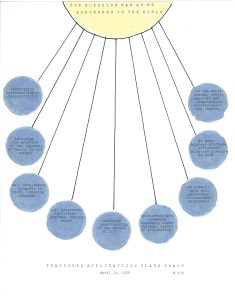
(Here MBM made reference to the Chart of the Superior Man, which will be found at the end of this series of notes. GB.)
The “superior man” is not the metaphysical man; that has nothing that belongs to the Larger. But those techniques, qualities, which make a big man in this world, who is the counterpart, in this dimension, of the transcendental man. Janus: the face that looks into earth as well as into the future. No characteristics that apply to mysticism or that anyone in this dimension could criticize. A lining up of characteristics and powers that cannot be questioned.
Knowledge and understanding of the nature of life. Could mean all nature. Or might be in a small way.
Self-government: relates to the self. Trustworthiness relates to others, and to responsibilities objective to the self.
Progression: Man must not be merely in status quo, however good or humble, but must be constantly progressing.
Kindness: In the Pauline sense of charis, – magnanimity.
Beauty: Personal hygiene; all the responsibility about the self that makes the best of the self. What does hygiene mean? Health. Hygeia is the goddess of health. The maintenance of health requires cleanliness, exercise — all those things which go toward the foundation of beauty.
Work: Doing one’s best. See it as part of a larger organization.
Sharing in civic responsibility, national, etc. The period of rugged individualism is rather over. Must be lost, or annealed, in the group life. Nothing you can do is of value apart from the group life. Nothing you could do, in work or achievement, that has value without the social organization. What about things that have value for yourself? At a given moment, a thing may have value just for yourself, but in the large picture there is nothing you can do for yourself that is not the forerunner. We are all moving, slowly or rapidly, towards a larger stature; and in that larger stature we are, in turn, coming into relationship with others.
What value has a cabbage that does not find a market? In the same way, nothing that you are or can be can be seen apart from Cosmic organization. You may be very slow at that development. You may be reluctant, absorbed in the things of the earth, but that is a short view. You can’t take yourself out of Creation. Therefore, being in Creation, you are moving, swiftly or tardily, toward that organization. Your part in it is the only place where you have real value. You have a value when you are moving on the way to it. As water moving in a pipe line. But its great value is when it comes out of the faucet and gives you a glass of water.
Early in our consciousness we must face the sense of relationship to others. Since this world is an animated picture book, social, civic and national life are parts where we learn to play our bit. By social, I do not mean parties; I mean in the organization of the life of your community. What part have you played? Are you conscious at all? Most people just live along without being conscious. You can measure stature by an awareness of their responsibility toward ever widening circles.
It is not done by talking. (You can say to yourself) I know I have a part in the larger Cosmic Pattern. It begins to prickle through your being. What sense of kinship have I with people, meaning humanity? Have you ever had experience of all boundaries being melted away? Where you just were aware of humanity as a kin of yourself?
The tree is implicit in knowledge. The Good is to be born out of all these things.
Might add devotion to the Larger, or the religious impulse.
April 16, 1936
Re the Easter egg; the symbol of our life. Rabbit prolific. Why at this season? Earth tilting on its axis at the same time that it follows the path around the sun. At a certain point in that rolling around the sun, when the axis is tilted, certain changes take place, namely, that the sun appears to move north. The days lengthen. The winter solstice is the symbol of birth. The Christmas season was moved to be near that. The second birth comes with the second high spot in this transition of the movement of the sun, which is called the Vernal Equinox, celebrated symbolically as the second birth. Start with causes in explaining this. Start with the movement of the earth.
Christmas symbolizes the, birth of spiritual consciousness. As the birth of the Christ in the Christian tradition. The second birth is the maturing of that Christ consciousness. Since man cannot accomplish this, he uses the idea to his advantage. It is a principle, not a person. The fruition of that consciousness is the second birth.
The Resurrection, in the ordinary sense of the word, exoterically, is the rising from the dead, or not being physically dead. When the Resurrection is spoken of, as in the Christian tradition, it is often connoted with the Ascension. Esoterically, it means the withdrawal from the earth’s atmosphere. He could be resurrected in the physical sense, and remain in the earth’s atmosphere.
Re little explosions in private: Break some cheap china. To do something that sounds is important. With that is tied up some of the psychology of war and guns. Don’t be afraid of anything in yourself, and don’t be afraid to let loose that way if you need it. Don’t have corners locked up that you are afraid to open. Many of us are full of rebellion because of frustrations, etc. If you can cultivate a little sense of humor you can let off steam. If you just break china in somberness, that is bad. Then better not do it, unless you can put humor in it. Don’t forget to read that sign: that there is so much rebellion. Take it up later (as to the causes of the rebellion.)
The one whose tendency has been introverted does not feel the need of it. The one who has been more extroverted does. The significance is that both ought to use it, because we should be neither one nor the other, but both. One’s rebellions should be harnessed; they should not be spilled. Rebellion is power, – gas. We do not run as smoothly as an automobile, so occasionally emergency measures are needed.
Little blows accumulate. We are not aware of them. Then they get to be too much. When that comes, we have got to do something about it. Otherwise we turn it back and repress it; then it eats in. But he who can’t be angry is not worth anything. He who knows how to use his anger is worth much. He has force. It is in the human picture to occasionally need to blow off steam.
Humor and anger: You can’t throw the cup without being angry . . . when you think, – see the other side of the picture. Never (break the cup) in public. Keep your company manners even in your most intimate family.
Humor means that you realize you are acting a part in life’s drama. It does not take away the pain, or the searing, or the rebellion, but it adds another light to it. The richness of your life is due to the overtones you can bring to it. To be able to bring humor in addition to your drama, is good.
Is it permissible ever to display anger? Yes, if you know what you are doing. For a result. No one who has taste will yield to an outburst of anger in the presence of anyone else; but if playing a role accomplishes a purpose, yes. But never out of their own desperate need. The one who is entitled to be angry before another is not really angry at all. He is putting on a darn good show.
Two lines from Live Consciously: “Give room to others; Let not thyself be crowded.” Has to do with environment; and you should make friends of your environment.
Friends: You may take it in the profound way Emerson takes it in his Essays. Or in the philosophical sense of being friendly with everyone in your environment – home, business, street. The place where we tend to crowd people most who should be friends is in the family, in the home. That is the first place. There is a Golden Rule: Do unto others, – Do as you would be done by.
The life in you has to become conscious. It claims space. Give it to the other fellow first. It is a law: Give room, no matter what it costs, and you will win in the end. Crowd, and you are sure to lose. No one can hold by holding. Though they may seem to hold, they are losing. It is a law, though it may not work inside of a year, or two years. But it works. And since, in conscious living, we are taking a large perspective, you must groom yourselves for living in that large perspective.
That is the reason why, in the procession to larger things, there is always, in sound organization, the effort made in two directions: to complete independence, personal insulation and isolation, and for unit living under a larger regime. As, for instance, in monastic orders. Each has a room to himself. The principle is that the individual life has its own sanctity, and must not be affected by the intrusion of any other personality. That is why the cell, which is seen as the enclosure of the individual self, has been closed off — sacred, or secret to anyone else coming in. It makes for such sound structure, psychically speaking, which you can’t see but which is true, that it prevents many of the dilemmas otherwise inherent in conscious living.
Therefore “Give room to others” means the sanctity of immunity, or isolation, literally. See if you can’t, every one of you, find at least a large closet that is your own. You can’t build soundly unless you have that condition available. And you must bring it upon your environment to recognize it. Let the other person do what he will. It is not your affair. And demand the same for yourself, – but with good grace.
Don’t let yourself be crowded in terms of feelings or ideas.
“And seek thy kin of soul and mind.” You can’t do it until you have first gotten your separation (psychically, from that which is not your kin of soul and mind.)
“above the cry of blood and flesh.” You yourself will cry out for that crowding. Only when you have tasted the other have you begun the kind of life that is set up in a tree, – that is set up to grow by itself. The amazing thing is that that is the philosophical foundation for friendship.
Does it sound cold? It is alluring. It means freedom. We are too lazy to liberate ourselves. It gives you a chance to test your mettle. It is not until we are alone that we know whether we can stand alone. It lends more variety and zest to the relationship with people. That can’t be done with close relationship.
There are two trends in every one of us: the trend that wants freedom and the other, which holds back, – which wants the family, the comfort, support and crutch of close living. Those are the two dragons in us: one is the father, authority, and seeking to be our own authority; and the other, the mother, which holds us back. Reminiscent of the time when we were cared for instead of being independent. We never know what we are, or what we have, until we are actually alone.
He can be the best friend who does not need a friend. More facets to yield light, variety, richness. Don’t forget that, while fire-air wants it, earth-water does not.
“Your kin of soul”. Interesting to watch life as you are learning to watch it. Some people are attracted first in terms of circumstances which contribute to their living, – perhaps something not material. Then in terms of bodies. Then in terms of likes and dislikes; or position in the world, – and so on up. But there are very few who get up very far. Most of the likes and dislikes are in terms of attraction of personality or repulsion of personality. And personality is not soul. Mull that over. See if you have seen the difference between personalities and souls. You may find you have attraction to someone in spite of their personality. Not the subconscious attraction but to something else, which is deeper lying.
Assignment: To lighten the load. To lighten the load that some friend is carrying in reference to you. … Some of the crosses you are bearing you need not bear at all. You are wearing them because they fit you. You have gotten the habit of them. Make room. And it is good for your friends.
April 23, 1936
Round Table.
(Friendship, continued.) Why are there some “century plants” in friendship? But they are very few. There may be something subtle that survives the loss of mutual interest. Can be cultivated. If you love a thing you like to cultivate it. Then it is not a chore. Anything that comes to its highest can come still higher with the aid of man, mind. That means conscious care, control, the practice of a variety of virtues, graciousness, forethought. It is not well to trust these to spontaneity.
We mean friendship in the sense of friendly relation with people about you. We should make opportunity to lift the burden we may have caused.
Don’t just see things pass by. See them in a different way, as potentials, which we may, or may not choose. Alertness to situations.
With a high strung person, first make a vent. Don’t leave the cure on the subconscious level. You induce the other person to greater consciousness.
Don’t talk about your troubles to anyone for a week. Cultivate a sense of humor about it in yourself. Learn how to let out steam alone about yourself. Don’t spill your feces and urine over the other fellow. As soon as you have feeling compulsions, do not do it with anyone else there.
Independence. Are you talking about (independence) in the popular sense or in the structural sense. In the popular sense it is a sort of carelessness or disregard of the other person. To be self-functioning and self-sustaining, that is different. In that capacity of being self-sustaining and self-functioning, be careful not to be heedless of others. If many are dependent on you, nurture their independence not their dependence. We should do what we can to stimulate the other fellow to his self-functioning, not let him then be dependent.
(Some lines from “Live Consciously”): “Complain not”. …and the next 3 lines. Never complain out of the drive of your own needs. “Remedy what thou canst…. what thou canst not bear gallantly. Why shouldst thou be free of the sorrows of the world.” (Question) Is pain for growth? Ans. Get rid of what you can. In other words, there is a proportion of pain which may be eliminated and there is a proportion which may not, both of pain and sorrow, frustration and loss. What you can remedy, you should because it is your quota in the transformation of things. Don’t fall on either side of the road. Some pain is in the picture. The straight and narrow path that is so hard to find is the right proportion of acceptance of things, because you have removed your quota. It is always easier to either accept, or discard than to find the middle road. The natural law is that you do one or the other. It is difficult to get rid of your right proportion, and use the rest.
(Re assignment) We all come from types, but should be moving from type to individuality, which is rounded, and mature, and presents a variety of facets instead of exploiting one facet to the world and to relatives. These are techniques for evening out exaggerations. Some assignments will help you more than others.
April 30, 1936
People encourage you to complain. It is a kind of vicarious outlet for them. Notice how conversation is taken up with trivialities.
If it is necessary to discuss a galling situation, do it. Or if it is necessary to put on a little anger in business, do it; but never out of your own compulsion. You may play a role like an actor in a theater. If you know what you are doing, it is all right.
You can complain without saying it, – by looking it. But psychologically that is complaining. Philosophically, the measure of our keeping ourselves above earth and water is the measure of our strength. Our strength does not really begin until we are able to resist something. Learn to smile anyhow, to pass a friendly word anyhow, to look cheerful anyhow. Carry the burden well. If we all let out our loads, it would blow up Manhattan. It is distributed and aren’t we happy!
Sometimes sarcasm is all right, if you know what you are doing.
We must not volunteer. Mabel’s* volunteering came out of genuine good will. If you enter in with too much eagerness or concern, you are lost. We should not be compelled. We should compel. If you cannot take your hands on your life and free it and know that you are doing it, you are not going very far. You must be able to weigh a situation, – not go out too much. Out of your own understanding of a situation, your own sense of control, chose or do not chose. There are some who talk too readily. Keep quiet. Don’t say anything unless it is pulled out of you. For those who don’t talk enough, volunteer more. Find the middle road. Don’t make an absolute of anything.
(A reference here to what Mr. Morgenthau Sr. said in last Sundays TIMES.) An act of personal kindness confers more on him who does it than on him who receives it. Not the kindness of charity, but something that arises wisely and logically out of situations. If something is done that is not logical in the process of life to that other person, it is not good.
He who has moved with the current of liberalism knows, when life is over, that he has been on the side of the angels.
- What is your civil and national obligation?Have you any obligation outside of your family and friends.
The movement has been toward regimentation. After that, the other (opposite). The crowd swings from one side to the other because it is inarticulate and unconscious, but the leaders try to hold to the middle of the road if they can.
Aspiration, yearning, reaching to the Larger, whatever the Larger may mean to you at your stage. The dictionary definition: “the call and desire to higher attainment”.
Re reports of you by others. How you take it and what you do with it, that is what counts. Think how relentlessly an actor is criticized. If you are not making the impression you wish, go ahead and correct it. If two reports came out opposite? You would note first that you do not convey the same impression to everybody. You might be different, or different people have different temperaments. Watch out whether the reason was the other person’s temperament or your own changeableness. Take the percentage. If the same thing is repeated twice, it is more important.
If you are superior people, your behavior pattern will be judged from a higher plane.
May 7, 1936
We can’t get over faults in outer behavior until we have accomplished the good in ourselves and have equalized pressure. If we do not, there will be a sign here and there that the thing is not eliminated. We want to be careful of unevenness. That is difficult to report on. (Re report by others) unless they are already versed in types.
Emotional reactions. Don’t put on drama until it is called for. Don’t play up about business. If there is something to play up, to which our business leads, fine.
Re motivation for participating. It may be ego satisfaction, outlet for energies, sociability, maybe psychology. Attack laissez faire. Attitude of many people. Serve the civic and national obligations by an increased consciousness in whatever situation you may be. Discussion as to political participation.
If you join any organization, you should know what your own policy is, and hold to that consistently. A keynote of this age is joining — the age of organization.
Sooner or later you will come to something like this: there is very little that any individual can do these days unless he gives his whole life to it, in bringing about any change anywhere. That challenges us to the joining principle or organization. Now there ought to be, increasingly, a sense of clear sight in a group like this, not only to the self, therefore subjective, but also objective. And it would be grand practice for this group either next week or later to discuss what they see that might be done: what particular project do you think would aid life in a city constructively that you can see a group like this might became articulate about. The thing is to help souls. It is not a question of children or adults.
(Suggestions from the group) Could a group like this popularize conscious living? (Something simpler) Rehabilitation of some women in night court. Make people conscious about throwing things out of windows. Thrust the light of consciousness on some problem not being taken up by others.
Assignment: Think about what could this group be conscious about and make others conscious about where our challenge could be stimulating, our help constructive.
Symbolism of the Tarot Cards
(Interpolated from another series on symbolism)
Tarot: A comprehensive system of occult symbology, embracing the steps of human experience which culminate in that great achievement which we already know under many names. Includes number and color, nature, garment, the elements, and, as you will see presently, other forms of occult symbolism that you do not know. All of these should be more or less at your fingertips.
Source: a matter of violent dispute. We do know, historically speaking, that the Tarot cards became known in the Medieval Period. We have the exoteric form of them here tonight. Of a profound occult philosophy. Various stories of its origin. . . . Through this symbology you can converse, but you cannot form it until you are first versed. A modern version of the cards. Ancestor of the playing cards.
Four sets of suits. Really descendants describing the four elements. These four elements a primary source, once upon a time, have been scattered throughout all creation. Whether your take off is the Garden of Eden, the last stages before the created world, these four rivers are now scattered into all types of substance and life. And, being scattered, they are dismembered. The cards describe the dismemberment. They are separate.
A remnant of the philosophy of seeing life through the Tarot is fortune telling, andis derived from the thesis that one who shuffles the cards does so until, for some subconscious reason, he stops; and the point at which he has stopped is that which corresponds to the way the four elements are shuffled in him. Therefore anyone who is intelligent can read the cards and tell the fortune of the one who shuffled the cards. The Tarotists have continued this lore, a descendent of the old idea.
Nowhere are the four elements evenly distributed. Like a vast Cosmic deck of cards, scattered through the universe. We cannot shuffle the cards for the universe, but we can shuffle them for the individual and it is on this that the study of the Tarot is based. They describe a superb face of a mountain.
In the Tarot are the 52 cards plus 4 making 56. A figure card that is added.
Clubs: scepters, corresponding to the element fire. Sometimes wands or salamanders. Occasionally people have seen them.
Cups: hearts, water, undines.
Swords: spades, earth, gnomes
Pentacles: diamonds, air, sylphs.
Next, how the powers in the elements worked. Earth: all sorts of powers and energies — chemical, heat, atomic – not just of substance in the usual sense of the word. That is true for all four elements.
Twenty-two figure cards that do not belong to the elements.
The original plan is to watch the many processes through which the four elements pass, not only in the course of the human evolution but of world evolution; and the struggle of mind, man with these elements in their various stages. Sometimes man’s relation to them brings great joy as with the dancing figures. Again, may bring sadness. Earth – more sorrow there.
One’s budding: has to do with the wands of power.
Ten in Cups: Completion of water. We have had as a rainbow, which rainbow in turn gives us the figure 7 in colors. So we have the gods’ symbol there, and therefore the radiation through air, water, fire, of these elements that lead to the higher world. Therefore, like the bridge to Valhalla. That, therefore, makes the man in earth joyous, both in his adult attitude and in a future state, the children.
Swords: Represents the force or energy with which he remains loyal to that which he has undertaken. The sword of devotion. Again, the sword of discrimination; belongs to the air element.
Clouds: On the first level, the unseen. Might be the psychic plane, etc. If it is in reference to Cosmic patterns, it would be the sustaining hand of Deity.
May 14, 1936
Question of Fascism. What to do about it. When any larger movement is on foot, it is already altogether in the picture that you will have contrary reports, and that those contrary reports are true. Wherever you are dealing with the personal equation. If you want action, you will have to take sides. If you are logical, you will have to stick by your guns. Powers of organization say with the Federated Women’s Clubs.
The most ideal leader of an organization. …Both advantages and disadvantages through the organization. Adjustments to naturally arising situations.
Women have a tricky proposition in regard to war. You can mitigate war hysteria. There are things we should not separate ourselves from because you think you can’t do anything about them. You can’t as a number one but you can when you are 200, 500, or 1000. If you are not willing to add your quota of one to it, you are also selfish.
May 21, 1936
(Reference to several books against fascism. Some of the titles: It Can’t Happen Here by Lewis. The Coming Struggle for Power by Strachy. Report on the Emergency Peace Commission of the Quakers. Fellowship of Reconciliation. Reports by two members of the group. National Council for the Prevention of War.)
To become articulate, to live under the rules of a government, logically requires the concept of a vote – yes or no, for or against. It is not a call to working with an organization. Nowheres, with any large number of people can the voice of a people be made known except as they respond to opportunities. Philosophical living in that regard is tantamount to compulsion to do something, as we move out of slumbering existence. The minimum we can do is to register our yea or nay with which our interest is of largest percentage. Register your vote on any matters as important as these two. They are more important than political parties or who shall be mayor or governor, because they strike more at the vitals of things. Where our vote seems to us of the greatest use. But that does not compel us to work or give funds for that cause. Place your vote on that side that seems nearest; it will never be 100% definite. The least we can do to our earth training school is to protect it as well as we can.
How does all this tally up in the future of a philosopher? The answers to the philosopher, is not so simple. He not only faces but solves the paradox. Practically at this point, that means two kinds of action, and simultaneously. He acts in the physical world, according to the best decision he can make for the world in the character of his age. There is something about that in “Conscious Living”. And from the point of view of whether you grasp this correctly, you will vote and act now this way and now that way. There is nothing that anyone of us can do that can settle the picture; and it counts most for us individually. I did not say personally. Therefore your act really reveals your stature and degree of wisdom at any given time; and that act must be simultaneously sound to both earth and your soul.
It can be sound in the latter only as you have gotten the flavor of your age – that is when you are a philosopher. If you are of the lower type, of the crowd, not conscious of philosophical perspective, or ages, or degrees of qualities of life, it is not so. But of you something else is required out of the very nature of your consciousness. Even as a result of your work in the Practical Application class this year. Otherwise it would be a regression.
You have somehow to negotiate your way forward and find that which is both true to your soul, in larger worlds and to this earth. One step toward that is to keep the Large perspective — that (what you do) does not count, though it is very important. Paradox. To act in earth, in terms of registering your trend, because the mass which is humanity made up of individuals, only moves in proportion as that is externalized; but to ally yourself in action where your philosophical good comes to its best fulfillment. It is well to register your wishes, since they do perceive trends which should be guarded against. It is necessary to knock down the boys with torches who would burn the school, but not out of hate for the school, but for the sake of the schoolhouse.
It is important never to believe that this earth is the solution or the end of it. It is just the 4th grade. In the paradox, we have to act as though the 4th grade is extremely important while we are in it. Yet it is only a grade in a long school. We should find that our acts, not our voices, go where we individually or personally chose or conclude that they are most effective for ourselves and our immediate environment, not of the blood. Our voices should go for the mass to save the outer organization. The two are not inconsistent and should be done at the same time. It is one reason for two hands and two feet.
We are two-ness all the way through. Twins, two ways in and out, up and down, and nowheres can the philosopher ignore that. We have no right to ignore our voice in earth, but we may not necessarily act vigorously or chose that as our field of operation. In “Conscious Living” “learn the part of thy part . . . and continuing on that page”. About write your own word fittingly the best you can write.
No philosopher, recognizing philosophic ends to which we move, can deny the two aspects. Therefore, everywhere in the animated picture book our balance, symmetry is dependent upon two-ness. With that perspective of the duality we must find our way to register our voices, and if we do not do our mite we are not playing “the part of our part”. Then go to work with those aspects that belong to the philosophic life, because the other is just the schoolhouse. It is not what takes place in the schoolhouse. The reports of the two students above mentioned had to do with the protection of the schoolhouse. The philosophic life includes the perspective of the development of your soul and your neighbors.. . . What goes on in the schoolhouse, not on other planes.
Chart of The Superior Man
as he expresses in this world.
Practical Applications
of Spiritual Law, really mind law, soul law.
MBM. Oct. 24, 1935 – Jan. 23, 1936
October 24, 1935
What laws govern life moving toward spirit. Soul laws, or higher laws, according to soul. Our objective the same as if they were spirit. As the sun is, for us, the largest body in the heavens, even though it is only a small sun in the solar system. Preliminaries to the philosophic life, and values of the philosophic life.
What is applied philosophy? Philosophic principles applied to practical living.
Purpose of the School; memorize it: Expression from the center, not laws of society. You will transcend them, because you will be living in terms of your evolving spirit. Therefore no bumps. From the inside it will take the shape which is inherently its shape.
Man in earth; God in Heaven, and the bridge between the two: The love of God, the search for truth; the practice of goodness – the three planks in the purpose of the School. The rectangle, the circle, and the bridge. Practical application means behavior in earth. The other two implicit.
Goodness. the supreme attribute of Deity, as far as man can conceive it. Beauty, truth and goodness. And they are in that procession. Goodness is wisdom in action. It has been called grace. Goodness, the ultimate of behavior. It is attained by man in the degree that man practices philosophic principles. Not what the world calls goodness (but something) that stands the test of ages, instead of the third dimension in time.
Enlightened. You can’t have the philosophic life without enlightenment. We are all trying toward it. Premises knowledge of the purpose and nature of life. Premises some understanding of the purpose and nature of life. Includes continuity of life.
Courageous. Not orthodoxy. A longer view. Working on the ultimate rather than the immediate. Jesus in the Wilderness. He was enlightened, but it took terrific courage. The ordinary person has no idea — does not know what he (Jesus?) is giving up. The more enlightened, the more courage is needed.
Take sides that, for you, are as enlightened as possible. There is not an ultimate right or wrong (in this dimension) and that we must all be on that side of the fence. We must all be above the fence. Whatever side we are on down below, is not important.
A statement from Carrel’s “Man, the Unknown”: A man’s value depends upon his capacity to face adverse situations rapidly and without effort” p.30 or 307.
His assimilation and resiliency.
October 31, 1935
Difference between tension and intensity. Tension, a state of power, – potential power. Nothing wrong with it, provided it does not go beyond the point where it is dangerous. If too aware, it becomes a handicap. Intensity is tension at the point of getting into a snarl. Tension resents all interruption. Both are contributive, essential to great work. They are not of the personality, if they are good. When they are of the personality they usually cause trouble.
We should be getting rid of personality. Never be proud of it. All the work of Pojodag is through the problems of the personality to the Larger. This class especially dedicated to the eternal spirit.
Anatomy of the soul, three-fold man, dilemmas that he meets, characteristics of his energy; fourth dimension; the fields of inquiry, etc.
Duty Obligation to the environment and the self. How many of you are compelled by duty! Where do you derive your duty? From custom and conscience. Much is connected with that. They shift. Never derive your interpretations from your conscience, if you have gone further. Who is judge? The spiritualized mind—nous; with as much of the training as you can possibly bring to it, and from those heights look down. With all growth we replace a lesser thing with a greater. If you are developing in the science of the soul you need never be afraid to put aside lesser laws which are man made. You need a guide to find the laws.
Define duty rightly. Some things are inherent in a situation. That is not duty. Duty is something which compels you from within out to a certain course of behavior because it is right. What usually compels you is from within out in the lower sense, is conscience. But what is that by which we can really direct ourselves? The lower duty against the higher duty. Dharma: behavior in harmony with the divine law. But not with good behavior in our ordinary sense. Spiritual laws are ruthless, and they are not beneficent on the surface. Often the opposite. Or, their kindness is like the kindness of Deity toward his leaders in earth. He lets many of them suffer. How terrible? There may be a great law in that. There is a certain coherence in the pattern of evolving laws, when they are understood. Just as in your gardens you don’t want the same degree of sunlight on all plants. Each thing to its kind. Therefore we must seek what the great principles behind these things are. The Gita helps. The Gita: Battle between two segments of one family. At the point of being engaged in battle. Arjuna, the main hero. Wants to lay down his weapons. A challenge comes through Krishna, the incarnation of Vishnu. He teaches Arjuna, bit by bit, the lessons of him who follows Dharma, as against our earthly duty.
Duty arises out of a sense of rightness in application to the mores of your time and the call of your conscience. It has to do with your immediate personal relationships, whether daughter, mother, aunt, sister, friend. Personal. Who is your daughter, as an individual? In duty, in the ordinary sense, we are functioning through a temporary personality – a family, situations, etc. Duty is subtle. It holds us to a way of living against which we often strain. The higher duty also holds us to a way of living against which we often strain. The lower duty arises out of immediate circumstances, family, personality. The higher arises out of what? A higher source than custom or mores. It is from Teachers and Wisdom-teachings.
Everything that is has a duality, and we face all things that are, with a duality. Subjective and objective. The subjective in us must answer to the objective outside. But it comes to us through sense organs of the subtle bodies, just as our impressions of behavior come to us through the sense organs of the body. We get much from the objective but we think it comes from within. That is a “deckwort” — from the inside. This other authority.
This other authority must come from without. Mores are the externals, and our conscience are the answering activities in us. There must be a subjective and an objective on these other planes also. Dharma has to do with permanent laws, not like the coming and going of the conscience, but the laws which govern the soul’s evolution.
The person who is obeying the larger duty is self-conscious, or awakened. Enlightened. . . . . .and the lower mind must be lifted up until it is assimilated into nous. That dharma will be quite different from duty. You will be highly discriminative as to what you give to the world. Mores have no set of principles. Dharma has those few things which are true always, and give the clue in situations.
In addition to being conscious of the self, that there is (a) no death; and, second, that laws govern all life, and therefore we do not carry the burden of the universe on our shoulders.
Find in “Live Consciously” for next week corresponding sentences.
Practice an act of duty and an act of dharma. Bring the citation of it in.
The shortsighted behavior that belongs to duty; the measurement of the three-score and ten, and the long, long perspective, the heights and depths of dharma. Those two should be brought into marked contrast. Dharma, an obligation that ties to the long perspective, the eternal evolution of your soul. No mores in action in a period of transition.
Read First and Second Discourse in the Gita.
November 7, 1935
(Dharma continued, attachment, courage and stature, the soul’s next)
Dhritarashtra (?) and has stock, symbolic of the lower man (from Gita.) Descendants of the black king; the Cain motif. The Seth, or higher leadership, is the stock from which Arjuna is descended. The material man and the spiritual man. Dharma, the behavior of the higher man. Exercise (subj.?) and your study in dharma must be unattached. Dharma means action. Must be past the personality. Going contrary to the movements of the times. Going contrary to your own personality, whatever of it is left; going contrary to what appear to be the normal ideal trends, seen in the shortsighted way.
When Arjuna realizes that it is on the basis of certain points: that you can’t take life. If war is in line with your larger duty, you can take lives. You can’t really take them. But that lesson must never make us careless. “Renounce all attachment to the fruits of your action.” Only when you are doing it without attachment are you safe. President Roosevelt engaged in dharmic acts. Presently will have to pay the price. The rules (rulers?) of the past are on the exit. The pendulum has gone as far as this country can stand at this time. Haven’t the capacity to go as far forward as the Russians. Russia carrying out a karma of the earth in a dharmic series of acts. It is against the custom. Dharma for yourselves will be against the custom. It won’t be exercises or study, that belongs. It will be vigorous things, that untie you to the past.
Lines in “Live Consciously”. “Difference between this and selfish choice.” “Above the cry of flesh and blood”. . . .”pile another chain upon his soul. . . .binding yourself against a distant day.” The positive is the untying of the past in a constructive way. What you do arises out of the nature of what and where you are on your path of evolution. What is the logical thing for you to do next in the flow of circumstances. An adding, in the positive sense. Most of us are lost in the routine of the day, and circumstances direct, instead of we. Dharma means stepping out of it.
Re duty: Leaving home for their own development constructively may be an act of dharma. It depends upon what is done with it. We dare not be ruthless and careless unless (until?) we know what we are doing; and we know what we are doing when we have the ?to carry on for good. Then it is slaying the wishes of father, mother, sister, brother. It is not done lightly. To stay, is duty — conventional, kindly, but not wise. But no one can say: do so and so, because the burden of such an act must always be on the one who does it. The spiritual law hangs over their heads. Doing it vigorously takes you far on the road. Requires courage, and no one comes to dharma without greatness of courage. ….Every person of stature has done things of that kind.
Three states: Acts done carelessly may look the same to the superficial gaze. . . . . .The three brings forth fruit. But you can’t bring forth fruit without vigor. …..The measure of you is whether, in spite of the burden, you can carry on.
The question is: What is your next? What is the soul’s next? The work of the invisible man shows it.
See again what some dharmic acts on your part would be. Your study of these things makes you ready for the dharmic act when the time comes. When we are through with personalities we begin working off debts …. The weight of not having done what is upon us, or a wrong having done, are things to be righted; so that part of the philosophical life is not only not to throw seeds for the future but to slowly weave off our soul karma.
November 14, 1935
(Two ways to dharma, mind sensitivities, work with transliminal, attachment and enjoyment, debts, mind put aside sometimes, anger. Gita continued.)
. . . . . .
Two family stocks: one represented by Dhritarashtra, the other by the Pandu’s. Arjuna. Pandu. Hero. Krishna, an incarnation of Vishnu, the Preserver. As Jesus an incarnation of the powers of Deity in the Christian tradition. Arjuna will speak in the First Discourse; in the second, Krishna.
Comes about through fear; so Arjuna can’t act. The greatest rebuke comes not for evil acts but for inaction — sloth. That is impotence.
Reason, in the Gita: the higher mind; the supreme intelligence; what we would call mind that is becoming spiritualized; freed from material things and disciplined in universals. Or mind-spirit. Called Buddhi. Mind lightened from above .
- 43: If you are doing things for the human self; if you are following the unwise, you are not moving toward rebirth. The things of this earth, the fruit of action, that is birth; that is advice offered by the unwise: comforts, enticements, power, security — all of that is foolish, because it makes for need of rebirth. Philosophically, you are going to be reborn, whether literally or not, until you are through with earthly things. There are two ways of being through. The first is putting them aside, evasion, and evasion is never completion. The true way is mastering the lessons via Dharma, and moving onward. The truly wise seek to become through with life on earth.
What are the three attributes which the Vedas teach? Types of energy. Qualities. Psychologically all have to do with energy behavior.
Second Discourse, verses 13-16: No one can make a change from duty to dharma unless he has great courage. They could not pay the price. It is coming from human to spiritual laws. Their human nature would be shattered. Therefore the process is gradual. The purpose of discussing it is to make that change as intelligent, effective and rapid as possible. You all have obligations. Those are duty, but the one who is conscious is searching his living so that he does not entangle himself further. Family, etc. They keep us from dharma because they are human. Putting family aside never is an act of dharma. May be an incident to it. You must be unattachedly concerned with your evolution. You must be concerned with it, but not with the fruits of it.
The work with the transliminal becomes the perfect, or ideal, method. The other is development of sensitivity, which is like a muscle that grows in use. Must be so quick to discover a hair of misinterpretation, so sensitive to what you are doing, the muscle of the discriminating mind. And that muscle grows larger and larger by exercise. . . . These dilemmas don’t disturb the one who is advanced. You know, even if you can’t always bring yourself to act.
Separation from family to enter into dharma. We are surrounded by earthly conditions, yes, but it can be simplified. And it is being done. Family no longer being built up around the individual child, as was the case. Looser. Here and there organizations take over responsibility for the child. Mitigating the tightness of the family organization. Going back a little to what, in primitives, is still in operation. Boy and girl, after a while, in the hands of groups and teachers who watch over their development. Father and mother, in our sense of the home unit, out of the picture. We whites have made it too strong. Has to be broken up. In the pattern of Jesus. That is indicated by his first octave. He broke away.
Not that everybody has to leave his home. But the next steps for Jesus took him away. They may not take you away. The point is, you must not be bound. Make an effort to free yourself, and find out. If you are not courageous, or you have taken on something that requires years, like a child, therefore your duty is upon you for some time; human duty . . . .In these organizations it is not until these (duties) were honorably discharged that the other work was undertaken.
One move in the direction of dharma from duty: Such study as this is in the direction of dharma. After the first work with the transliminal come those steps of dharma that arise out of your heritage. Philosophical work, therefore, a way toward dharma.
Are you freeing yourself from duty? Every one of us should be at work freeing ourselves from the duties of love — that belongs to the human side. It takes time, energy and alertness to break away from the world of circumstances.
The person who is living consciously will watch his attachments more carefully than his money. You must control your feelings just as your money. You can enjoy, but never become involved. You should not be so involved in a situation that you cannot move up. If he does not enjoy he is not living. If it leads to attachment he is caught. Move on. Be a tent dweller.
Don’t be unconscious of your feelings going out and making bad debts against a later time, when you cannot collect them.
Mind can, and should be, put aside sometimes. . . .Sometimes sensing alone (is acceptable) but the mind must be at beck and call.
Anger does damage to the psychic structure. You might need to put on the garment of it for men, but not experience it.
Send in records of subtle dishonesties in yourselves.
Nov. 2l, 1935
(Yog, active introversion, Nirvana, “If thou knowest what thou doest, subtle dishonesties.)
(Re the Gita, continued.)
Action, without thought of the fruit of action, and without attachments. Without concern for results. “Balanced in pain and pleasure”, so that neither affects you.
- 49. Yog is the skill of union with the higher — with spiritualized mind – Buddhi
Octave above the octave of action. Related to Gandhi method; not identical, but one of the results of part of this teaching…….
Introversion. Turned to the centripetal. It is the practice of active introversion that is mysticism. In turn, leads to relationship with higher planes. To conscious living on higher planes. To become ascetic (philosophical sense) is the supreme goal. Union with Krishna. Goal of Christ.
- 62: a warning against musing on the things of the earth; warning against meditating on the things of the earth.
The higher mind is emphasized in the true Eastern tradition. Higher mind is the precious thing. The mind is not as conspicuously emphasized in the East.
The sitting unattached, not moving toward the things of earth, leads to Nirvana. Nirvana is the extinction of the lower self: as, in a larger sense “There shall be no more sea.” Completion of the lower octave. Extinction of the lower consciousness. It does not mean extinction of the individual person.
Subtle dishonesties……
“If thou knowest what thou doest thou art blest. If not, thou art cursed”. Shows Jesus was a master. Could pit contrary statements one against the other and make spiritual truth.
(Re the hungry man stealing a loaf of bread.) If he was starving and his need was great, he was entitled to it.
The Sabbath law was only for children. Never will be for adults. . .
When a thing is done for a self gain it is different (?). . . .
There are times when good.judgment makes a falsehood constructive. It is not the way at the end. Jesus never shaded what he had to say.
You can’t do that. You are not at the point of becoming Christs.. . . . . Telling a hostess you enjoyed the party when you are glad it is over.
Must find the answer which is the drive behind the decision you make. If from the small self, never! If necessary to interfere with the ordinary mores, do it. . . . The muscle of discriminative Yog
must be practiced. No simple yes or no.
December 5, 1935
Rationalization is subtle dishonesty. Discourse III of Gita, v. 6.
Wallowing in the senses. The path forward can be quite straight. Man likes to stay around, especially if it is sensuous and says, I haven’t learned anything. (wrong) because he has mind; has the capacity for getting lessons quickly.
Who are the “shining ones?” Spirit seed in yourself…
To make sacred. To make secret. That which is sacred is secret from the crowd. So it really means to make those inward, or mystical, changes that are, by the very nature of the crowd, hidden from the crowd. When you are making transformations that belong to the evolving of the eternal man in yourself you are making sacrifice. It is really establishing a relationship between the lower life which is gradually ascending and the higher life, which is constantly blessing the lower.
Krishna is above action, above the pairs of opposites, but that is not for men of the lower grade. They need to act — need it for experience’s sake. Krishna therefore mingled in action. People do not see differences. Identify themselves with an end before they have achieved the intermediate, and withdraw before they are ready for it. What is good for one at a certain stage is not good for another.
How many things do you do in which you are not attached to the fruits? Action necessary up to certain stages. Maybe you need attachment to the fruits of action in order to act. Few do their best work and not care about results. So don’t be discouraged if at certain stages you are attached to fruits, but say to yourself: Aha, I needed that bait. That will help you get away. There are two kinds of gains: material and to the soul.
There is a difference between awareness and desire that means attachment. It is an incident. If your soul is evolving you will become increasingly equipped to enter into different states.
- 27. Not an illusion in the sense of not existing but an illusion in the sense that it is important. The idea of illusion is lack of permanence, not that it is not a reality. Each, the phenomenal and the noumenal, has its reality. The fleeting reality is called an illusion as compared to the other. Connects with v. 34. The more you understand that the better, v. 35 belongs to advanced metaphysics.
- 35 Better follow the life line of your own nature, following the steps of your evolution, without regard to merit of the world or praise, even if it is without distinction. It takes you further on your way than to do something conspicuous which is not your dharma. One of the things that belongs to advanced evolution is to know more genuinely what is on the way of your life line, and what is not.
- 37. Desire for the things of the sense world . . . . Of course desire to reach Krishna is essential.
- 35. Never compare yourself to another. It interferes with your own development.
- 42. Mind here is the mind that belongs to the world. Reason is the higher mind, enlightened mind. . . . .He means light spark.
. . . . .
What is the criteria of subtle dishonesty? In a sense, there is nothing worse for you in the development than to blunt any sensitivity in yourself. Answer thek. Don’t befog.
Past, present and future: the patterns you already know, those you are in the midst of, and those to which you are coming. Therefore, when we realize about something, it is about a realization which we have already learned. On the other hand, there are frontiers of situations, problems, conditions where we have not yet learned how to act, where the path has not yet been defined, where there are new circumstances, new elements, an unmade road. So, if you want to be clear about those subtle dishonesties, you will divide them into those three groups — problems you have already understood but about which you are now fooling yourself, because it is more convenient to the lower self to do so; other problems you are in the midst of, and you are learning them; and still another type, that brings up new factors, new sets of circumstances, to which only a small percentage of what you have learned in the past is helpful. So, a certain amount of frontier work to be done.
Other factors are that you have to slough off prejudice, bias and worldly conscience, which is not helpful. If you have sloughed off those your behavior pattern will be clear. But not about new factors.
Our progress is like going through a forest. Now you cut a path. Somewhere else it is not set.
Read next the Fourth Discourse through v. 24.
Ponder on what the Christmas season means to you; what it should mean to you; and what it does to you.
December 12, 1935
Fourth Discourse. (Gita)
What practical things can you do to increase the Christmas spirit in environment?
After the holidays we will take up the Sixth and Seventh Discourses.
Fourth Discourse
The Avatar idea. Great Teachers in the past (teachings) carried on by a line of sages down the centuries. Distortion came in, misunderstandings. But there was, and is, a great tradition. It becomes defiled, and then is renewed.
Arjuna, and others of his kind, are under the law of fate — not necessarily Lachesis. May be under Clotho. Krishna is free of all fate; he is not compelled.
- 7 and 8. Logos, as taught in the East. We are using the method of the Logoi, but on objective, material concerns. But it is to be turned on ourselves.
- 13. First reference to the four castes; esoterically, the four aspects of man. The four faces of yourself. Take scrupulous care that you don’t mix these elements in yourself. That is why, in the work of training, emphasis is placed on the separation of the functions. You may blend them, but you must never mistake one for the other.
- 16-24. If the ego can remain undisturbed while the aspects of the self are doing the work, there is the inaction. To make the picture perfectly, you must have both simultaneously. If you have inaction in a three-dimensional man, that is merely sluggish. (There should be) action outside and your inaction in the core. As with the tree. Its trunk is sturdy and stands, and your branches swing in the wind and adapt to the breezes. And even snap before the storms.
Re Christmas spirit A rejoicing with. A need to share. That is the non-removable factor behind the Christmas home yearning. . . .
Sun (?) cannot glow free and independent in the dark world. Spirit cannot be fully free and independent in these worlds. The flame that glows, and gives radiation and light, yes.
At the time of cycles accelerated evolution is the time of all times not to fail.
December 19, 1935
Christmas, virgin birth.
Re Christmas: Should there be an emotional element? How much should emotion play a part in the celebration of the Christmas holidays? Not a low emotion like greed. We are not really participating unless we are deeply stirred. That is inherent in it. Wonder, reverence, respect of principles, gaiety and other emotions of a humbler kind are good too; fellowship; those things can be stimulated. Then we will act out of ourselves, whether or not circumstances warrant. Then we are the alchemists. If we wait for circumstances we are under the natural law. If we stimulate our emotions we are under the mind law, knowing when and how to bring these about.
In time, there are set those patterns which bespeak of the un-times realms. The sun goes into Virgo — a process in time that relates to one above time. The ancient cry: The Virgin has brought forth. Virgin, not new with Mary; thousands of years old. But the Christian fathers saw fit to shift the birthday of Jesus to the date that had been universally celebrated by the great pagan races. That month marked the return (of the sun) northward, and our days began to lengthen. So it is a new period of light, and that is seen allegorically as the symbol of a larger Light, which is born in you and me every year.
Death and birth are the same thing, seen from two different sides. If we do not go to death with certain phases of the past year we do not enter a new cycle. It was the Master of the Christmas season who said: “Except a man die he cannot be reborn.” It is wise to put little deaths to work, so as to learn the technique of death making.
Virgin birth has been told of scores of other leaders, not only Jesus. Having made the self pure, after having been not pure; adulteration comes first, in the philosophical sense. The ways of considering it. One is in reference to the parents, and the other, to that individual soul. Now Mary — and always the mother of any pattern-maker, or Teacher, is described, for mystical or allegorical reasons, as the soul which has no other desire than to serve God. It has removed the impurities of other desire. Souls all become virgin some day. The Gnostic prelude to the Fourth Gospel. The soul that comes down does not come down with a desire for the things of the earth; neither to possess, nor fame, to experience sex, nor any of the bodily or psychic interests. In that sense Jesus, or anyone who becomes a Christ, must be born out of a virgin soul. Their own soul must be virgin.
Annunciation, when the soul is told it is pure enough to receive the seed of spirit. Told of other leaders. Mary is the symbol for Christ soul. Mary may have been this or that.
The animals: Homage of the animals. The symbol of the animal nature in yourself. That instead of rising above the soul in you and grinding it under their hooves, they are subordinate, and revere the soul. Now the symbol of spirit germinated in the soul (or germinating).
The time to re-pledge yourself. The more you pledge to a new rhythm, almost like a vow. The purpose of a vow, or a pledge, is to hold you forcibly against the time when you might otherwise slip.
Death and rebirth. Any time.you bring about death and rebirth — and you can’t bring about rebirth without death — you are celebrating Christmas.
The great time clock is there as a reminder. Your rebirth may be at some other time. Jesus was not born at the winter solstice.
What I can do to increase the spirit of Christmas in myself and my environment: to meditate, pray, read, experiment with symbolism. Take part in the exchange of gifts without attachment.
Anything we can do to make this a human and universal festival is to the good.
We are so far from a love toward mankind, and mankind so unfit, that we cannot do it even if we have it in our hearts.
Without preaching, we should live what we know, that ordinary restraints should fall away. That at Christmas, barriers that are there in ordinary life, slip away. See if something of the quality of what we put into these falling barriers cannot carry on a little bit further, both in quality and in the hangover. See if somewhere you cannot break out of habitual restraints and enter into a friendlier relation in some state.
January 2, 1936
Bhagavad Gita – Sixth Discourse
Sixth Discourse, on self-subdual.
Ascetic (in the philosophical sense) means to practice gymnastics; become the “athlete of God.” By right use of them he is becoming strong. If you did not have desires you would not have anything to fight.
The practice of dharma makes him an ascetic. Finding that the dharma is the significant thing, he works on that rather than on the fruit of his action — working to achieve that particular thing and get fame, or power, or something of that sort. That is working for the fruit of action. Qualities.are by-products on the road.
- 2: Formative will, – planning, – being caught in your plans.
You should plan, – and must plan, but if you are caught in those plans so that your welfare depends on the fruit of those plans, you are not a Yogi.
- s: Action is necessary until you have arrived at Yog. Then action is replaced by serenity. Serenity is a type of energy behavior. Energy in a certain state. Therefore indrawn. Something like the energy in the coal.
- 8. Intrinsically the same, primary substance differentiated. In the last analysis, their value is the same. But you have to be a philosopher.to really know that. You help yourself to be by your desires, when you see them (or is it that) intrinsically as the same. A solid rock struck at that point. If you will develop that you can do much to take away your attachment to gold and stone, and see their likeness.
All the while the soul develops upward larger influences are at work. At the time of marriage those influences make a permanent and steady relation to the soul. They are joined.
- 9. Same as in 8, re earth and gold. It is if you make the comparison. Intrinsically, they are all the same.
What is harmony? Shifting in internal and a flowing in consecutive blocks. It is a thing which, as in music, works toward a block that is satisfying; but within that block are many distances. There is selectivity, a choice of interval, of relationship. And everyone who is does that. Harmony implies a consciousness (?) in which there are right intervals to all points of livingness. These flow through consecutive blocks in a large pattern. Your associates in business, or home life, etc. That is harmony. If you are moving toward these high statures to which Krishna is calling Arjuna you must see that you are doing that.
- 10. Secret place seat posture, attention.
- 11. Why grass…skin. Above the animal nature. Between the pairs of opposites. Grass, in contrast to the animal; that which like leaves (?) does not endanger the one who is doing these exercises. Symbolizes the vanquished animal nature. At least your determination toward that. Cloth woven. Has to do with the vesture. That is why the lowest is outside.
- 13. That is one of the postures that has been used in the East. If you did it you would have crossed eyes.
Mind one-pointed, – concentration. It is not it. What it is has to do with “aspire after me.”
- 15. Bliss, – Nirvana. Peace from (through?) being one-pointed.
Nirvana, cessation of desire; extinction of the lower man, that is bliss. It does not mean non-existence. Not a touch of it. An achievement that is maintained. It is the end of the human evolution.
- v. 16 No extremes: He who truly sits in the Larger, neither too high nor too low.Mystically, you sit in that seat, neither too high nor low, though you may physically, as you have found the way between the pairs of opposites.
- 18. No rule can be given. Which is a subtle thing. There are an infinite variety of adjustments of intervals, all of which are harmonious; so no one can ever give you any formula, but you have that pliancy, that way of weaving your way through a complex set of intervals. That makes harmony. The more finely you do that the better is your musical composition. See how many intervals you can carry through your life harmoniously. And you don’t always carry them through the same.
- 18-20. Not only when doing intensive exercises. But the quality of what he is achieving. But is to carry over in all of his livingness. Winds — activities of the mind. Just as bad as the emotions when it comes to a higher place. Therefore you must make an enclosure around the flame of your life which will not yield to the impact of disturbing circumstances from without. In the development called concentration, contemplation. This stage is akin to contemplation. Because you have to subdue the energies, not once, but have acquired the technique for it. An insulation chamber for the flame of your life, across which the external and internal winds cannot blow. That is the point of ignition into the higher consciousness.
Krishna is teaching Arjuna, intensively, the way of the development of the self.
Assignment: How can you list the reasons why working on the self is not selfish. List what you have done in the past month, December, that was raising the self by the Self. Conclude the Sixth Discourse.
(Ans. to question?) Difference between tension and tenacity. You need tension.
January 9, 1956
Sixth Discourse continued.
Take through the 15th verse of the Seventh Discourse.
Formulations. Some formulations as the result of this semester’s study:
(l) Organization of the reasons why it is not selfish to work with the self.
(2) Additions to points in Philosophic Living
(3) Specific problems of your own.
- 21 (Sixth Discourse) Supreme delight. Most of humanity has no idea of delight beyond the material ones. When you have had any experience with the Larger it is so superlative that it seemed to wipe away the lower. In a super-rational way. The pseudo is like intoxication. The other transforms it with wellbeing that nothing in the material language can describe. Makes everything in this world shrink. Such supreme satisfaction, so superlative a delight, such a sense of wellbeing that nothing you have experienced can touch it.
- v. 23. New definition of Yog: disconnection with pain.
- 25. A process; little by little. All things start with the number one; the point. Mind abide in the self, a shift in polarization, – or the “I” principle identified with the higher mind.
(re meditation) Great Teachings are stressed in certain aspects by the leaders who are representing those principles in the world. These early teachings in India stressed meditation. How thoroughly that has permeated the East you all have some idea. Has no more balance, or relationship, to a normal life. It is dissociated. They have lost balance. They are doing it regardless of whether they are ready to do it.
- 26. Reining in the mind; the practice of meditation.
- 29-31. New motif: he who see-eth me everywhere. The sense of the immanence of God. You will then never lost hold of God. To do it, though, without doing something else, is futile.
- 35. How to curb the will. Constant practice. Dispassion. Part of “Know thyself.” Leads to properly directed energy, in spite of not having dispassion to begin with. You must work at it.
- 40. No one who is striving genuinely, even though he does not attain, is destroyed; does not tread the path of woe (?), the downward path.
- 41. Reincarnation. Keeps persons within the Indian tradition within that tradition. The local atmosphere in a grand tradition. Makes the East sweet. Seeks to attain by escaping from the present evils. Does not meet problems. Reassured in that nothing is lost, that only the good is a reality and the other is its absence.
- 46 the thirteenth man, a return and learning. Does not mean I have developed myself in the sense I should in the earth. It is like meditating on the star and becoming lost to the things between you and the star. The Thirteenth Man is above action. If accomplished in due season, good; if not, dangerous. Wise is used in the Eastern sense — does not include action.
Re working on the self: An act rooted in understanding is actually different. Outwardly it may not look so. Acts rooted in Larger dimensions have an enduring quality, a capacity to stand up against difficulties. Has a power that it will not have when started with a superficial act. So much service is actually selfish. Done because it gives gratification to the person who does it. That is the case even when they work their fingers to the bone. Sometimes, a degree of the martyr complex.
In doing what is right you can’t be careless of others. The only thing that counts for the student philosopher is God’s opinion, not man’s opinion: obeying the laws and principles at the point you are at.
Assignment: What have you done during December that was raising the self by the Self. What do you recommend that we formulate as the result of what the class has learned?
January 16, 1936
Seventh Discourse
(Discussion re a symbol indicating your relation to Krishna.)
The mountain is not Krishna. Make the difference between a being and the ideal state that being represents. The Jesus and the Christ. Man’s progression, as illustrated in the first seven discourses of the Gita. Jesus was the first Christ.
True hearing: that which understands the inner meaning, and acting on it. Where hearing is the forerunner to doing. Unless you hear that way you won’t go any farther.
- 3. Difference between knowing Krishna and knowing him in essence. You can’t go , which means doing as you learn. But that doing and learning is, in turn, just the beginning of a very long span. Until you come to the end of that span you will not know the essence.
- 4. Eightfold. Manifesting toward man. The faces of him that are turned toward man.
v 5. Sustaining force. That which is turned upward, or out to the universe is the all-sustaining, power of Krishna. That which is turned to man marks these eight stages. But the being is neither more up nor down.
Prakriti, two kinds. The extension. Space inherent in it. And substances inherent in that. Extension, space, matter. Deva (or Diva) Prakriti, the Light of the Logos. Light to one plane, life to another. Two kinds of Prakriti: the substance of the lower worlds and that which is the substance of the higher. Matter that is Light. On the higher planes light is matter.
- 8-9. The life side of things. The power side; the radiance side; virility. Accept this (?) as this being is speaking as a male outgoing influence.
- 10. When you have gone through the stages of mind you come to the state of Buddhi, Mind. Then you are in relation with Krishna. Like is known to like alone. Through that Buddhi in yourself which you have attained, then you are in rapport with the higher, that is, the Krishna in you.
The birth of the Christ is within the human evolution. It is the Scorpio motif. Because through that birth comes the death which is again rebirth, or the Eagle.
- 14. The divine illusion. As in 3. In order to come to his essence you have to go through, penetrate, and put behind you all that belongs to substance. And that is very, very difficult.
Maya Don’t think of Maya as being physical matter. It is the Great Mother, Gea; Rhea, in the Greek tradition; Tefnut and Shu in the Egyptian tradition.
All these, high states. Misunderstanding of the Indian tradition. There are psychic substances, and those also are an illusion; and so on up. Another way of describing it is: Crossing the great Sea that is so difficult to cross.
- v. 12. Three different types of movement. They belong again to mystical astrology — cardinal, fixed and mutable. The fixed, at the ultimate stage, is the harmonious. Early, it is stubborn. The active and the slothful are the other two types, – cardinal and mutable. They are occult types of movement; godly (?) type to movement.
The things we call qualities on this plane are not that on the next – they are things.
- 15. Asuras. Everything is related to the two sides. From one point of view, energy and matter. You know that when you have electricity flowing through a wire it meets resistance, and a certain amount is lost in meeting that resistance. Therefore copper wire is an Asura; that which offers difficulties, obstructions to the energy side. If you oppose me in setting up this school you are also asuras, but still offering difficulties to the flow of my energies. R.S.’s report on the Practical Applications class, a combination of study and training.
Re harmony. Your harmony is not necessarily to the material world, but to the cosmic Pattern. Because there is disharmony out here you may go and fight hard for this harmony. Dharma means fighting for spiritual principles, – not a nice world.
January 23, 1936
God and gods;
MBM’s object.
Devi. Ch. 7 the most important part of the Gita. The shining ones. What percentage know the difference between the shining ones, or the gods, and the God? “They shall take the shining ones for the God.”
This comes close to my object in starting Pojodag. Never persons. If at all turned to the Larger they speak of it collectively as “God.” (re people generally.) Have no graded background. Try to be on the safe side; “worship God” and carry on with their lesser purposes.
Gnostic systems say there is a god for this earth; over the moon; that man does not see the difference. These lesser beings, who are incomparably great but are not the end of the road, are taken as God. All along (?) there are great Beings, supreme masters – so incomparably great that, if you do not know otherwise, you will believe they are God. They are gods.
I am trying to set a new consciousness in this generation. Honor the gods, but all the while know of the Great Goal.
Re 6th Discourse ?) You may be the first three; not the fourth, which is an ultimate. You come to it in the later stages of the first three. None of you are very intense. That is why you are mixed. You do not live dangerously. They are the ones who really suffer, who are intense. Where people are not intense they will have this mixture. An advantage and a terrific disadvantage. Paracelsus, who was an ardent seeker after knowledge. “Him who the Lord loveth he chasteneth. Self-interested are those who practice Yog, for instance. Not a perfect example. Re “chasteneth” — those who are intense get themselves into predicaments where they meet tests.
Question put to the class by MBM: How has the Gita aided me in the realization of spiritual laws. Answers of the class members to be brought in.
Have no intensive hope about the fruit of the thing. Otherwise you become attached. Well-being from discussing the questions as to personal life, etc. which we have in this class.
January 30, 1936
some psychological questions
Ambivalence: Psychological. Because the exiled attitudes are contrary to the expressed self. In most persons, held down because they do not come up. With the ambivalent type they both come up. Everybody is potentially that way. This ambivalent type can build up more and more to the build-up of separate types within the self. Then if they have energy enough – psychenergy, they can carry on, now this way and now that way. We work to make them harmonious instead of conflicting.
Environment Question of how much a student philosopher should do in correcting his environment, persons or situations. Broadly speaking, you haven’t any right to correct anyone. A bad policy unless the other fellow makes a bid for it, one way or another. No one should put themselves in such a position any more than necessary. It is like going into malarial country. When any help is asked sincerely, never withhold. But don’t give too much.
If everyone will give everyone elbow room, and not hold them to any set type of relationship because it was that way last year, that is all right. Watch relationships to other people. The main business is themselves. If they develop finely the other will take care of itself. It is not your responsibility how the other person reacts.
If there is an emotional outburst on your part, or anyone else’s, use drawing-room manner; look the other way. Women are stupid that way. Men are easier about it. If women could learn a little more ease it would be better. They tend to put details. More or less in this life there are bound to be explosions. Tension in the ethers. Don’t make too much of it. If someone has done this or that, get the point. Don’t regurgitate it in your mind. Right then and there it is finished. It is good to have a grouch once in a while. But do it where it is as un-messy as possible.
Stanley Hall re a tear. The need of excitement. You have got to have it. If you realize that, and take it into the picture, and see you do it so you don’t spoil your friendship or family life.
(Q. by MBM.) If you belonged to a union, and a crisis came up re Lakme (?) in Washington. Check endorsed. Union said they had to have cash. If you were in the orchestra, what would you have done?
At this time, the fight of class against class. Don’t think of it too easily.
Practical Applications of Spiritual Law
(with mind law, as bridge.)
MBM
October – December, 1939
Spiritual laws have as their work to make a being of spiritual stature. All that is between is secondary. The great objective is spiritual stature.
We must conceive that we are on the way to larger stature; that is basic in the understanding of spiritual law. You can’t understand spiritual law if you are thinking only of the here and now and your immediate life. But that larger picture gives you the sense of space. Almost infinite opportunity and variety of experience in which you can exercise, and make mistakes, and correct yourself.
Circumcision (?) in which you can bring yourself under the rays of the spiritual law. You can move your seed from the shadow to the sun by right action.
Question: Are spiritual laws working unconsciously or are they conscious? MBM: If we want to speed our development we take the pan (of seedlings?) from the shadow to the sun. Warming and heightening our lives we move into the sun. The rays fingering all through life . . . in a way that may not touch your life at all. The spiritual laws always are sustaining life, but you yourself move into the sun by what you do. That is your conscious role. If in your being there is more warmth, courtesy, etc, your partner will not object; you have become a better partner. The most effective way of talking about something they won’t listen to is in the way you conduct yourself. If your partner does not like it; if you are not worthy that much to yourself to continue it, you are not worth it — you have still to wait. The Larger comes first. By going your own way you yourself become finer, with greater patience, insight.
Courage: Does not mean being without fear. Courage rides over fear; at least temporarily. Rises after fear, and in a sense concomitantly with fear. You can’t have courage until you have had fear, and plenty of it. Courage is one of the qualities that leads to spiritual stature — qualities that can only be evolved as the result of many difficulties and fears which are to be battled against. Opportunities in which you are developing certain powers. Fears like hurdles overcome, now here and now there until this or that problem has fallen into the picture that it has in the objective of the work of spiritual laws. It is for that reason that spiritual laws are not seeking your immediate comfort here and now.spiritual law.
We must not look for the working of spiritual law in reference to things of this earth. We don’t see behind the curtain of flesh; therefore we judge by flesh. Maybe the security is not a good thing for you. Maybe you have learned to be less attached to your pleasure and convenience.
In the working of spiritual laws there is corrective to wrong functioning. Our materialistic civilization, with interests turned down to the things of the world, have to have a correction. We have not shown as peoples that we can go into the complexities of our civilization and go beyond them. We have demonstrated that we can go into them, and enjoy them, and get stuck there. We need to be loosened. How much better if we begin to see the point and do our little quota to change conditions.
Re the Jewish question. Can’t solve it via any war. A larger set of influences working. We all pay a price for unwise functioning. The best thing is to see the point; to acknowledge that it will take some time to correct. The problem of the Jewish race is of many thousand years’ accumulation. Since Abraham started out. A sub-division of the spiritual law, Cause and Effect. What we have sent out always comes back — sowing and reaping. When a people do certain things over a long period it will bring about an effect. Part of the tradition set up by the Hebraic people was a separatist idea. Cause and effect. That wall must be broken down, first in the hearts and thoughts of the people.
October 26, 1939
What is it that makes life worthwhile? Interrelation with people; sense of progression; development of the self; progression in relation to a goal. One reason for the unrest and unhappiness (lack of these) a critical point.
Living under spiritual laws, in the sense of a larger life, we need to do well the things we have undertaken, – we owe them the doing well. That brings with it satisfaction. But if you don’t see what these little things that you have undertaken . . . to that big thing, – what it all leads to, there is an important factor missing. Ideally we should have a picture of the whole, even if it is not very clear. We should have elbow room for the expression of our own peculiar contribution.
Follow the star on the horizon, but hitch your_wagon to the immediate. See the things toward which the little things of the immediate are leading. What is missing for the majority of people is the star on the horizon. They have only local flashes in the pan. The evolution of life is being able to move along, with relative consistency, to the star on the horizon through the daily acts. If one has that, one also has a strength, a capacity to endure, – to take many things on the chin; and also a capacity for enjoyment in the pleasures of life that those who do not have those two never suspect as possible. That loyalty constrains them into a pattern of the little acts of life. So a certain pattern emerges from your life — not just living accidentally.
What is the star? What is it a symbol of? There is contentment when we are able to reach that stage; when we grant that there is a reality, an ultimate (or seen as an ultimate) which we see imperfectly now, because of our limitation, – persons, – these things interfere with our real perception. It removes the struggle, conflict, between you and your neighbor. Beneficent. How can you clear the eyes of your heart and mind and soul, and see it yourself? That is strength-making. There are ways of doing it.
To know more of the stars on the horizon, through the study of Wisdom-lore it becomes clarified in your understanding. The star can be seen relatively nakedly. If there is a reality it is not, in the last analysis, capable of different interpretations. The Journey of man’s completion. Leads him toward a goal. No happiness just in this world. You are also moving progressively toward another state. That conception leads you toward the star on the horizon.
The Jewish question: From the point of view of the star on the horizon there is no such thing as a Jewish race. In the course of development in earth groups function, together. Usual under the natural law; that is, without offering much resistance to the pull together of groups. …….The melting pot. We are all to go through stages of melting down barriers. In the Larger sense, those barriers are not there. No one should identify himself as a Jew, or a non-Jew. For a time in a Jewish body.
The price of the momentum that has accumulated. Because you are involved in it, – identify yourself with it. A temporary arrangement. If you can understand that, something of the pain that is in many hearts will be lifted. And it should be lifted.
The study of Wisdom-lore basic. Why? Because it is a melting pot, in service to that star on the horizon. It will give you a release that nothing else can.
In the deeps of each of us is the ultimate longing to reach that star. You may be immersed in worries, problems, habits, family, etc; competition of one kind or another. Intimations…… How often do you speak of God? When we think more of things like that we will have taken a big step toward clarifying the Jewish problem.
Gentile too. We are all after the same thing; therefore we must find some common way of seeking those things. It is the separate way of seeking that wounds and builds up protest.
First of all study religions, but in the Wisdom-lore that is back of them. That will clarify issues. (re parents) Will make the children recognize that they are first of all human beings; we all are; and that there is nothing unique to any of us.
What can Gentiles do toward the solution of this problem? Much. Have piled up a force by their accepting the Hebraic Scriptures and doing the contradictory things of accepting the leadership, the Masterhood of a Jew, and finding conflict with Jewish people.
The Christians also have a burden to bear, and to solve. The open study of Jew and Christian, and any other old race, or young race, the same great traditions. . . . And in the breaking down of their old forms. In the finding of the common denominators, that they are bound for the same goal.
That is one of the things we are trying to do here at the School. Looking toward that star. In them all is the same nuclear truth(s), which immediately take away the barrier, – which shows what the road is leading from the daily talk to that star. In Wisdom-lore those ways are clearly described.
Something of that sort should be spread in the families in which you are. With that, a revaluation of the Hebrew teachings and customs. Because they have virtually all outlived their day. See what they meant. Having gotten that vital power out of them, put them aside. That will break up something of the clannishness of the Jewish people. Many unconscious behavior patterns that come out among the Jewish people because of that clannishness.
November 2, 1939
Re being lonely: Loneliness is against spiritual laws. For growth there must be friction, companionship. The one who is lonesome has not made the contacts which are right. He must do something about it. We have to go out. Inquire what you have done that brings about loneliness, – what has left you without companionship. Only when we have done something that makes us a seeking (?) person that contacts will seek us out. Don’t let it (loneliness) accumulate. Then ask yourself what you offer to people in the way of friendliness, goodwill, good conversation. Readiness to adjust to others. Cultivate those things that you like in others. (There is) nothing so hollow as fictitious sparkle.
Re marriage: Spiritual laws require bringing your best to anything you have undertaken. Marriage makes a greater and wider demand than any other. Because sustained. A terrible thing when it begins to crumble. Take heart. First, you must ask only: do you want it to crumble?
Marriage offers many opportunities. Ask yourself what you have gotten out of marriage — a richness of experience; a depth and breadth of emotional contacts?
A variety of requirements in adjustment. A revaluation that comes through intimacies in conversation, in contact. What do you contribute to marriage? Have you contributed all that you could to make that marriage a permanent thing? There are many things that women do that are most unfortunate. Women tend to let down. Their companionship is no longer as it was. They are no longer an adventure to their partner. (They) must be continuously an unknown quantity. The sparkle, uncertainty, romance. Keeps the man on his toes. A treasure never wholly won.
Re Wisdom-lore: The particular way it touches people is never the same. The sun’s rays come down on all, but every object has its own shape. Therefore the effect is different on different objects. So with spiritual laws; a great symphony. Need (?) an outstanding gift, not used because as (?) to your own living differently. But we must understand what a gift is. One of two things. Either an accumulation of power, knowledge and skill won previously, and therefore is not a talent or a gift but an earned value. The other is that it may be a projection upon you of someone else. It may be that someone else is trying to use you, in which case it is not yours at all.
The soul may have come to earth to do something with that particular ability. Or, if someone else is using it, there is a strong obligation to put it into action. Have a strong urge to do something with it. If so, that power is meant to be used, and it is the obligation to find some way of putting it into action. To not do it is to evade an issue. One must learn to become increasingly resourceful in finding the way to serve that talent and put it into action. And be free from the thing which is holding you within this job.
The spiritual law has a great, inclusive, surrounding compulsion, which is the law of growth; and spiritual laws never meant you should stay put where you are, literally or physically, or psychologically, in any phase of your character. You are meant to move from there, to grow. As the seed. Never accept a static position in life. If you have an ability and the urge, use it; and if it is not a selfish urge for your own aggrandizement, but to give service, or beauty, or stimulus to do (?), go ahead. And don’t mind what you have to do during the period of transition. We are usually not resourceful. At the same time use your intelligence to the utmost. Be as wise, and gracious, and contributive as you can.
Difference between a facility and a talent. The facility does not warrant going to the extreme that a talent or power does. The greater the gift or power the greater your ruthlessness is entitled to be. If only a facility, it may be a secret urge of escape from the boredom of a job into something more pleasant. Discipline is necessary.
Re depression: …you haven’t found yourself; not in a niche where you are happy. Advancement in a job and you do not get it. The spiritual laws do not tolerate depression. There is that influence which protests at depression . . . . the spiritual law in us trying to bring us to better behavior. Each of us can learn how to control our thoughts and feelings. Long spells of depression show a toxic condition of the mind. Things that haven’t been eliminated from the mind are there. “Rehearsing”, – despondency. The wounds that their friends or family gave them. Misunderstandings. That is the first thing to learn if you are depressed. Few people realize how important right thinking is. Their thoughts go in old ways. No thoughts would go that way, but your mind becomes of no importance whatsoever.
Question: What qualities should be cultivated if one would live spiritually?
MBM: First sincerity with oneself. To double cross oneself is more treacherous than it is to double cross someone else. You are blunting your faculties. Faculties develop by their use; and if therefore you don’t cultivate these, but blunt or ignore them, youare very much double crossing yourself. You cover over one motive with another, and that is a terrible thing to the individual soul who does it. . . . . come to crave it more and more.
(2) Unselfishness: unselfishness, or not acquiring for the personality. For great purposes, which have no self in them, you may be ruthless. If it is yours to do something that brings in a new era, a new truth. (Those who do these things) they could not be considered of the small, because they had a great purpose. If you are such a one you may be ruthless. But if you are not you must be unselfish. How still go your way? True unselfishness has no sentimentality. If you are clean with yourself you will know whether it is selfish.
You may not do anything for power at the expense of someone else.
(3) Self-control: strict control over thought, and feelings and acts. Larger laws want to govern us in special ways, – in the direction of self-control. Does not mean repression; means compression. Compression means power. If you don’t control yourself you are a person without power. It is only the person who is self-controlled who does things in any real larger sense. It means respect for the skills (?) you have within your being. And the wise use of them. Never squandering them. Never letting your feelings run wild in regard to anyone else.
(4) Courage: Means overcoming fear. Does not mean being without fear. He who has never had fear is not alive yet. The one who is building up power by working on himself, so that he is not afraid to face life, or any situation. There is all kinds of gallantry of heart. A certain hardihood, – magnanimity of spirit.
(5) Tolerance: Overcoming of prejudice or bias — personal, national, racial, etc. It means being free from that. To be tolerant, and not have overcome your bias, is only repression. Then you have the mob. Something stimulates it out. (Difference between) the pseudo appearance of tolerance and that which really is tolerance. That kind of tolerance one can only win by a broader understanding of life. The star on the horizon; the immediate and the remote — must rest securely in them. Tolerance means a release from all need to repress, because your understanding of life is based on such wide and generous principles that you can see the many in the Pattern.
November 9, 1939
As in a school, certain types of problems repeat; so in earth. The problems we as human souls have to learn remain fundamentally the same. All the while radiation from higher planes is interpenetrating everything. But we are not sensitive to those wave frequencies, and hence do not know it. Craving to come into harmony with those laws.
In order to come under the influence of higher laws we need to change ourselves, – come under different wave frequencies.
Question: How is one to gain such conviction of the star on the horizon.
MBM: If you want to learn of anything do you rely on yourself? Only to the extent of your desire. More important than with a profession. Seek a teacher. Then a period of cooperation. So in the field of this inquiry, no one can give you the conviction. But an enlightened teacher can aid you to it. No answer in a book, or by word of mouth, can give you the conviction; you have got to follow through. A book or a word may be a beacon light. Big things are won with effort. And they are as definitely to be achieved as any qualification in any field in the world. We don’t yet treat the things of our heart and mind with sufficient understanding, – that they are realities. Spiritual laws come to cleanse, and to make healthy, in a large sense.
Question re lack of ethics in the business world:
MBM: We have cut our lives in half. We have reserved our “ethics” in sections. But the law of life is that there must be circulation to have health. To have health in the being you must have circulation of certain fundamental ideas through your whole being. It is because we have made segregation of fundamental concepts that we are in trouble. Our whole system is based upon division — a double code. It is quite true that until the business world is run on spiritual ethics it will go through changes.
You can’t reap big things quickly. Do you think this is the whole show of life? Enlarge your whole perspective. The blood stream of what you accept as good if you want to be healthy must run through the whole stream. That is your good, regardless of what happens to you. No one can grind you out. They can put you out of business; or. . . . . drink the hemlock cup, as they did to Socrates. Neither is Socrates dead, nor his influence. He is a leaven to the earth now. Heroic.
If we dare the big things we add our own stature as well as to the pattern for the earth. The gods don’t want the earth to remain as it is.
Question re wastefulness:
MBM: The spiritual laws do not think a thing is paid for because you have paid for your room. That is the material side of it . Spiritual laws say you are entitled to, and should use, what you need. The straight and narrow. If you are afraid to use, – are reluctant, that is just as bad as squandering – just as bad.
Earth is in process of evolution. And people too. The goal is the perfect functioning of all that is upon it. The forerunner of what belongs to man himself. Earth’s cataclysms are in that direction.
November 16, 1939
Who made spiritual law? . . . If there is purpose there must be law. At once the arch and the link between heaven and earth. Man can make it best when it is with mind.
Those laws were promulgated in the beginning, – not the details but the large Pattern. They were planned for the purpose of the work undertaken — the great career of the earth and the inhabitants on it. Not just that it was necessary to have these rules (?). And they are the spiritual laws. It is not possible to become spiritual without obeying spiritual laws. The laws have as their objective the making of the spirit man, the being who has graduated from earth — you. When the game was originally set up — game — the great game. But we are lost in a part of that big game, and so have not gone very far in our inquiry in the laws that govern the game itself. We have been interested not in laws but in mechanics – chemistry, etc. There are other laws, and it is possible to find them. And they govern the larger world.
To recognize them you must first divest yourself of those things that belong to your personal preference…..to the atmosphere in which you have been brought up. Our preferences are bound up with our personality. The personality rarely has a rapport with the Larger. It is associated with the pressure and the need of the immediate.
Sometimes, if you can be really still, it is to make still the little personality, – the little likes and dislikes. As long as you are following this thing or that thing, in the sense of an ethic or a law, – that is not enough. For it is the great body of law we seek. It is hard to contact, because it means putting by all the things of the flesh. Therefore closer than your skin, yet far.
Question: What is one to do when business is bad, people dependent on you, and no outlook for improvement? What about spiritual law then?
MBM: Millions of people share that. We become egocentric; self-preservation comes in. Under the spiritual law the solution, if it is a solution, is the long range picture. Whether you know it or not, you are living part of a very long life. Spiritual laws teach that. To judge life by the present manifestation is to be blind — not to have the spiritual eyes. Let us take the things with as good account as we can.
What of the short range? Some definite rules to obey. Measure the situation as well as you can — what is possible within the field in which you are busy. Stand by your guns, but in such a way that your service is valuable. Such effectiveness that you can’t be ignored. By keeping loyalty and enthusiasm and imaginative potentiality that shows the possibilities. In most cases you can lift yourself out of a dilemma. Many of us are in dilemmas because we are not resourceful. We are not willing to give intelligent loyalty.
Re war: . . . .impact of that other situation of the man who didn’t know what to do when business was bad and others were dependent on him. The answer is still re the “chapter of the book.” Our collective book. Partly the history of the earth and its gradual evolution (wars); partly our own souls. War of ideas. The central idea of what is being fought over is not yet on the surface. If there is not a war we are not yet through with a war. It is not worked up yet.
November 30, 1939
Spiritual laws are from above; govern the cosmos (world). There are also those spiritual laws which should (?) evolve man, or which man puts into practice to become of spiritual stature. In discussing we have to be very careful which is which: (1) those which will make man spiritual; (2) those which govern that world, – though they are interrelated.
Needed to solve close up problems. And sometimes extremely practical in their application. Before we can come under the spiritual laws. We are not discussing the larger laws as they govern all things, but rather the laws which inhibit the man in earth and keep him locked up in a close up situation.
Question re a member of the family who makes life miserable – life is stultified.
MBM: It seems as if you had to break that first before you can go further. That is not a situation to stay in and try to transform. The big thing is not to accept a situation as permanent. Initiative must never go to sleep.
Question re suicide: as a way out.
MBM: It is no escape. There is literal power in suffering. There is no desire to escape suffering, although he has tried to escape it, paradoxically, if he is interested in the larger life. What life is after is the transformation of the self from a weak little thing up to a stature of magnificence. And that we are all on the way to that. We are all fragments of the great life on a journey, and this Journey provides us with experiences of all kinds; which experiences are necessary to draw out the strength in us from the latent stage to the active stage. You can’t become generous if you have never known the other.
The whole philosophy of approach to life is transformation. To try to get away from sorrow and suffering even while you accept sorrow and suffering. It is as though, driving through the countryside, we are making our way through swamps and forests, over poor roads (and other difficulties), accepting them as part of the conditions of the country through which we are going, because we want to get to the Rocky Mountains. The things that temper us, – like steel. Once you see that you realize that you are going to fight, – you are going to continue over every inch of the road. Otherwise you don’t make progress. You should seek to improve your situation, – to become wiser, kindly, more understanding, quicker with the kind word, and take the beam out of your own eye first, to better your own situation economically and otherwise. There is no such thing as letting down. To not struggle is the wholly wrong picture.
The point is that what you attain in the earth’s measurement does not count. See the great leaders of the earth. Gautama, who gave up a throne, and traveled to seek, and to serve others. Jesus was a rank failure as far as this life is concerned.
The struggle of today is arousing interest in the nine great religions. Maybe there is to be a getting together.
Whether your efforts bring about great schemes in earth does not count. It is registered to your credit, – karma. That is what you are. “What I sought to be and was not (in earth before men) that is what comforts me”, (a quotation from Browning.) No matter how humble your job you must make it a gem. And that is your success. Not the big scheme in the world or the big income. In doing that, we find, somehow or other, our own backbone.
Question re an apparent contradiction about fighting evil:
MBM: Inside the program of a general or a man in business there are different types of techniques within the large one of conducting his campaign (or other enterprise). Different kinds of methods are used. There are times when a general lies low. Times to be active and times to be still. The development of man, and his conduct to the world around him, are like that. “Resist not evil” is part of the larger campaign. Like one stick in playing golf. Times when you don’t resist evil; when you are forbearing, kindly, humble, patient, – and you will win in the long run. Spiritual laws belong to timelessness. You can afford to wait. Jesus was, in a sense, fighting all the while. But he didn’t fight personally. He never got into an argument. That is stupid; indicates immaturity. Jesus was fighting all the while for a new concept of life; and he used a variety of methods. And when it was the time not to resist evil he was an adept at that.
Re subtle dishonesties: We may fool others; and even worse, ourselves. You see, the conception (?) of spiritual laws means that we are in the evolution from the lower life to spiritual stature — from lowly wave frequencies to very profound and rapid ones. Subtle dishonesties are unpleasant, and a boomerang that affects the self. Whether we are angry, and say the rabid (?) word, the real damage is to ourselves. Your subtle dishonesty is a tearing of your own being. Like poison introduced in the system. All the circumstances about you are opportunities to use, now for this quality, now for that. A locked up situation is the test of your courage and boldness — your ability to plan and carry through a way to liberate yourself, – if you are discouraged. It is a challenge. If you have cancer, – or no job, – all of these things are really a challenge to you as to what you will do about them. And if, with Browning, you will welcome this rebuff you will experience what the evolution of your own deeper being can do for you. We are not here in the last analysis, for anything that we can get in earth.
“Be ye wise money changers.” Changing that which has little value for that which has greater value. Pupin said it too: from material realities to spiritual realities. That is the progress of man. That is the way you go up the stairs.
December 7, 1939
There are spiritual laws working in everything. There is a far off divine end toward which all Creation moves. That has the magnetic attraction that pulls all life toward it. It is working in every little thing. The spiritual laws, like so much else in this world, may be so laden down by material things that they move very slowly. Like an engine (?) pulling a heavy load on rough ground compared with pulling a regular load on a smooth track. The forces which have started the world in operation have not deserted it. But it is only when the cooperation of man in earth and those spiritual laws made operative by the great forces, – when those are working in a beneficent collusion, that like trains properly loaded, we may move swiftly.
To be ethical is not necessarily to be religious. Because religion has to do with relationship to larger worlds, and ethics usually do not take that into account. Ethics builds a road….section by section. Religion too, but knows where the goal of the road is. Holing through. Each knew toward what it was heading. The great advantage of a religion that deals with universals, – that it is building its line directly toward a definite goal. It is willing to leave the ethically, morally, etc. Religion takes into account the remote goals.
Re joblessness: Be resourceful. One of the contributions of this age is to be resourceful. The advanced soul needs resourcefulness, skill, endurance. A great collective gain for souls everywhere in that capacity. Initiative grows with exercise. If you can’t get a job offer your services in some field in which you would like to work.
Re war: You can’t help being involved emotionally; but to guide those thoughts and emotions is the important thing. Speaking forcefully of the long range if you may be helpful. Society as it is organized is not an ideal thing. Spiritual laws are working behind the war. The world is not well organized. Since the World War there has been an increasing amount of segregation instead of integration. . . . .They are coming to it now from the sense of necessity. That implies a new set up for the world. It is not only new chances, more opportunities, better conditions, but an entirely different viewof life. When we no longer see ourselves as separate. When that is as incidental as the fact that you are wearing different color suits. The spiritual forces are working for that. They are also working for the breakdown of solidified religions. Not for the good of this country or that. There can’t be so much separatism as now. . . . .Never argue.
Question re being dependent and sorry for oneself; how to get out of it.
MBM: The need for sympathy is really the need for attention. Every soul craves a certain amount of attention; and that is the inalienable right of every soul. But that attention should be gotten on merit, not on pathological conditions like a craving for sympathy, or being sorry for the self. That is really a phase of ego longing. Basically it is right — the drive is right. Everyone has their place, – should receive attention. The thing is that it is not won on merit. And because there is not merit, and the burdens pile up; therefore it can’t be gotten truly, but is gotten in this indirect way. The craving of the ego is there until the ego (ego feeling) is transcended.
But you can earn it. What can you do to merit the admiration or liking of people? Do something that will win people’s attention because of your value, – something you do well. That is the normal way . . . .(The other) a kind of compensation mechanism of the martyr complex.
December 14, 1939
Spiritual laws are different from natural laws. They have for their purpose the making of spiritual man. We must not expect of one kind what we do of another. It is the spiritual laws functioning in our daily life that enable us to let out some of the good things and good responses in life.
Re having done a wrong, or done something inadequately: the main thing is to get the lesson — why were you weak and futile. If you have done someone an injustice you must go back and clean it up. If not, see what it was and reconstruct it, and act it rightly. And then dismiss it. A thing once agitated can continue to be irritated and deliver pus, and will not heal. The time comes when you must let a thing alone — forbid your mind and your imagination to become involved in it. But you must first clarify the issue, – why you have failed.
Re a weak personality: The majority of people have weak personalities. There are character laws and personality laws behind that. If an individual has not acted forcefully from childhood up, the personality will be gray and without color and charm. There is no short cut to achieve strength or magnify the personality. There are exercises, but if those exercises are not cultivated by someone who has practiced the more fundamental thing, the exercises prove their superficiality. Learn to be dissatisfied about the situation, not necessarily to others, but to yourself. Learn to stand by a decision. It is more important to stand by a decision after you have made it than to change because you now see something on the other side of your decision. . . . .loyalty to a decision. People without force and determination, – have never learned to make a.decision and stand by it. They pay the price of it. They are always fearful. The price of a thing is only incidental to your developing strength of personality. Beginning to make decisions in yourself. Also learning to use your mind so it penetrates to the heart of a situation. Get quickly in mind what each decision may entail. Learn to see through the appearance of things. You will gradually build up a strength which heretofore you have lacked.
Magnetism is built on the power of attraction. Something magnetic about a personality. Can be put on or be a basic thing. In any case, it implies a certain healthy vitality in that person. They don’t fear to stand by what they have undertaken. Magnetism has power of pull. In order to be with it in yourself you have to have the power in yourself. And there are any number of little acts, – about fifty every day, – that could be used toward that end if people were willing to do it. . . . .Therefore they don’t achieve many of the things they want. To have real magnetism you must have self-respect and self-reliance. With that they can go far. There is hope for everyone. It does not mean assertiveness. A magnet is a magnet. They are all one piece.
We have no right to make decisions about others. . . . .
Then you have to learn to disentangle. Until your movements don’t pull or jar at someone else.
Question: Can you give me an idea of God that I can accept?
MBM: There are two ways of going about it. One is looking out and one is looking in. Trees, stones, sky, oceans, rivers — some extraordinary force behind the organization of all that stuff. The order that is in matter. And in the longing of men’s hearts. Not the hand of man. What is behind manifestation is so incomparably beyond such a concept that we don’t even go about it in that way.
There are three approaches to ultimates: (1) love of God; (2) search for truth; and (3) the practice of goodness. Any one of them leads, sooner or later, to the other two. Some, because of love, search out laws, and presently attempt to practice goodness. That means obedience to laws, as the chemist obeys chemical laws. We are not all in the same stage.
In the search, don’t begin by labeling what God is. You find out by searching. Learning to know something of ultimates is like learning a new language. You begin with easy books. You have little by little to accustom your ear to the sounds. You can’t believe by an act of will. That is passe. But it is just as stupid to go around life blind, – just the daily life and mere circumstances, and not conceive that there is anything else.
Question re “Nothing exciting has ever happened to me”.
MBM: There is need of excitement for healthy living. It should be provided in life. Sports are not enough, – even for young people. The role of excitement is to keep the souls in a state of agitation, instead of fixation. Instead of becoming set. Rather, relatively fluid, or at least plastic. Responsiveness. If a soul or a self is neither plastic nor responsive it will settle down, whether age 15 or 50. It is a state. There should be excitement in people’s lives, – sometime or other. They should get it or make it. It does not have to be something violent. Sometimes it depends on the way you react to a situation.
Excitement is really what you could make out of the cares of a day. Not violent. The dual movement: active and rest, diastolic and systolic. That duality makes for health. It is what you could do, what you could make out of it. It does not have to be an airplane trip to Egypt. There are excitements here in New York. People who don’t have them go stale.
Most of the questions have had to do with intelligent functioning, – which leads to spiritual laws. But what is behind all of it? Many people are afraid of following spiritual laws for fear they will become colorless. No person who is really spiritual-minded is colorless. They are just the opposite. Out of the Larger is all the smaller. The good life, or the life of following spiritual laws, is highly dynamic, – extremely active. It has to do with what has been called “the athletic life.” As Clement puts it: The world is the stadium. And to be the athlete is one who is trained in that stadium to be the master of all the games — all the situations in life. He has a vigor and health of life which the average person does not dream of. The good life is not thin.
(Here MBM made a reference to something Priestly has written about the good life.)
Three Conferences, or Group Discussions
Led by MBM, January, 1938 on
Practical Applications of Spiritual Law
January 6, 1938
(largely on responsibilities of a leader and higher law)
Q: What would you do if you were an executive in a key position, with reference to the application of higher law?
- We are in no way setting up any point of interest or support for any theory; nor for one method of a leader as against another, in terms of what he stands for.
- Our attempts at answers must be in reference to the application of higher laws. We are interested in something more fundamental, more vital — not expediency. Shifting realities must be tied to permanent realities. (See Live Consciously) Nothing can produce enduring good that does not, in miniature, carry abiding patterns.
In discussing the problems of leadership we are discussing our own problems. In the leaders they are magnified. You, in a small way, are also a leader. You have some degree of executive control, direction, of carrying through policies. In key positions, have authority.
What are those problems? When to yield to his constituency and when to step out ahead of them. How far may a leader use coercion?
That is inherent in things. It is a higher law. Must run that way. We believe in the rule of the majority. The leader will have to take that vote and go forward, though there is a minority. To that extent there is coercion. That is inherent in spiritual laws. Because the spiritual laws do not wait as to you or me; as to our consent. They operate.
. . . . go forward like a pyramid — the point in the Larger, the bulk in the material. The wide part goes forward continually. As in the serpent, the head goes forward, the rest is pulled up.
When, and how much, to go forward? Here the skill, finesse, psychological delicacy of the rapport of the leader with his following enables him to see how far he can go without separating himself from that mass. A leader ceases to be a leader if he goes too far away from the mass he is leading. If a point of a triangle is too far away it won’t be a point of that triangle. There is no rule. It is a sensitivity, and knowledge and skill. And in doing that, a leader shows his qualifications. If he makes a mistake it is not serious if he knows how to recover himself. He must be quick. A leader may mingle but must also be able to take up his position at the point again.
Re ends justifying means: Should his end justify the means employed? Find out first the higher laws. There is such a high percentage of what we may call the magnetic pull toward the means, with which the folk are in close juxtaposition, en route to the goal, or the ends, that they are likely — 97 per cent, likely — to be keyed into the nature of the means. And therefore it (the higher laws) is dangerous and very undesirable, for practical reasons . As an occult law, it is not so. As a spiritual law, it is not so. But men are not yet spiritual, and hence cannot function, or act, as though they were spiritual beings. They are so earthy, so related to those parts of the animal nature which compose their lower self, that they are likely to be sucked back into the character of the means that are employed. They are saturated with a condition, the means used, influenced by the things they are setting out to fight.
An idea, or a method, are sources of energic influences, – discharge wave frequencies. Induction. It is not an absolute, if applied on noetic levels, but unsafe for humanity. The means often become the means of the undoing. The problem of the leader: to keep clean from the dangerous influences the methods that are employed. The leader must know laws. Must know how the things he is doing are actually working. Not only the things that are visible, in terms of men and money, but in terms of laws. One of the first things he needs is a thorough study of the psychology of the unconscious. Influences from the means radiate to his constituency. And may therefore infect.
Guarding against ego. Guard against power to the self. Under higher laws the leader is supposed to know. The leader must know his own makeup, – the danger points in himself or herself; the idiosyncrasies. If a leader is continuously on guard, watching his psychological direction, he is all right. Managing the steps where he is in danger; watching the principle in the physical.
Three fields of problems: The problems of a leader to his followers. They often get hold on the leader. Divide the problems of the leader into three fields: 1) In relation to himself, his equipment, preparation, knowledge, his conviction about his ideals, or the idea, or pattern, inside of which he is leading. A large field. In a way, to be compared with that of a general. It always means a certain amount of warfare. He must have the campaign plan, or parts of it, ready for action. He must believe in what he is setting out to do. He may not always believe in the way he is setting out to accomplish it but it is the best he can do under the circumstances.
2) Advancing his campaign, or ideas, or plan. A vast field too.
3) The protection, or guarding, of his army. It does not mean only from the men of another army but from doubt, failure to have faith in the ideals or the leader.
The three summarized: The upright; the movement forward; and the protection of the movement and sloughing off of that which is extraneous to it.
Every leader, of course, does not practice them all equally well. If a leader is strong in all three he is outstanding. Therefore he must be clear in the idea of what he wants. Not necessarily in the methods; they will unfold from time to time. Many leaders are not.
So a leader has many obligations. To that which he has undertaken and to those who become his followers. And what we call the ability of the leader, – whether it is in a small office or the head of a great army, (is that) he must be able to lift up the morale of the group. Because he is a leader: an alchemical element in the group life, which is necessary if you want to sustain your work as a leader. He must be alert to discover defection and to quickly heal. The leader must be also a doctor, of lesions within the relationship of his organization. Even in a small office.
Retreating: is it ever justified? Yes, indeed. If his purpose cannot be won, of course. He must salvage the pieces of the dissolved organization as well as possible. That holds on the higher. It is only a perverted egoism, with mental blindness, that keeps anyone going on blindly on a thing if the day for it is past, or it cannot be effective. The leader has no right to step off on an isolated case, like one or two colored folk coming to the church, and on that opening the whole thing to become colored. The leader must think ahead of what the results are likely to be. Both sides can be right. In this world there can be circumstances inside of which it is well to function.
Crisis and coercion. A crisis must be judged according to some higher law. If therefore a leader knows — but he must be sure he knows, according to the higher laws, he has an equal right to act by coercion. Not according to our little, material things. Here opinions count. But according to laws. When a leader knows his ground as well as that, it is not because his followers are of no account but because he has been elected to that condition by the right of knowing, and therefore is betraying everything if he does not act.
He will never expect to harmonize the wellbeing of each individual in the group with that of the group. That is impossible. Because everyone is in a different state of development. Everyone has their ‘isms and peculiarities, pet foibles. But never cease striving. Because a leader, as long as he is a leader, has terrible responsibility — to conciliate, persuade, above all to educate. You will alienate a great many, even within your own organization.
Never take responsibility for the misinterpretation. Clear it up if you can. It is just human nature. You can’t stop it. Try to be more lucid, more careful, resourceful in the way of presenting, but never expect you will not be misinterpreted.
Re ruthlessness: If the leader never has a personal reason for being ruthless, – never therefore any rancor or hidden gratification; then, and then alone, can be be ruthless. He must be, at times. As quickly as possible he must be healing.
He has to make himself immune to many little proddings. It is well not to take those too seriously. The normal expectancy.
Second Conference Group
January 13, 1938
(Mainly on personal problems)
There are ways of arriving at solutions according to higher laws. We have not discussed those laws, nor how the solutions are arrived at. We have done it practically. We had only three conferences. You are all leaders or heads over some situations.
Q: What should an inventor do who has in hand an invention that will throw many people out of employment temporarily? Say it is a good thing, works well. Ans: The wear and tear on humanity is bitter and terrible, as it looks in the immediate. It is an inevitable part of the struggle for mental progress. You can’t stop it. If you stopped it in one place it springs up (elsewhere.) It is only where a large group, managing (?) group, who see their monies threatened, may hold back. Some of the great laboratories are doing that in holding back cold light. An entirely new situation will come out. The reason it is not going out is that it would jeopardize the very money that is invested. In the long run, sorrowful as it may be, the struggle upon (?) the humanity does not count very much. The only thing that we must guard is that, as far as we and those with whom we are associated are concerned, it is constructive, and forward, and not egocentric in any of its phases. You cannot hold back disaster to large groups of people. Someone else will do it (the new invention.) Under larger laws it does not count, except the immediate pain. See Hauptmann’s The Weavers.
Conduct of business If you are dealing with affairs in the world, with people in business, you cannot work on the basis of an altruistic law, unless you are willing to yield entirely your welfare and the welfare of those around you. Your concept of higher laws is not a measure of that of your associates. And to act as if it were is to indicate that your own mind is befogged. Ideally, your relationship in business should be of the character that makes sufficient concession to remain in relationship and still make a movement toward better conditions. It is only when — and it is rare — when you are in a powerful position that you may attempt a mandate (?), and even then you will pay the price. You must remember that life, and humans, are in a process. If you are acting as though the others were already mature, or further than they actually are, you are foolish. You have denied your own intelligence.
Telling the truth: Should you always tell the truth? The keyword is process. Do honor to the status that the other person has reached. Decide it on the basis of the psychological and mental age, and then act accordingly. No one should make a complete, or sweeping, statement about telling the truth. A number of these questions could be answered by the answer: It is not our business. Meddling. Many people get a vicarious gratification in belittling someone else.
If you are in relation to that person, where it is part of your responsibility, it is another matter. But even there it should be done so carefully, so wisely, so judiciously, that it does not work negatively. Why? Because our desire should be — and how often it is not in the world, to aid. Don’t be fooled by people saying they want to aid. Ordinary psychology has taught the majority of people to see right through it. They are no longer susceptible to that kind of good-bad treatment. It is bad at heart. We shall discover that, unless we are in a particularly close relation; or it is acute, or embarrassing, we should not say anything.
Moreover, if you are the least bit skillful you can, by indirection, bring it up to that person to see whether they are aware of this or that. Most people are not deft enough. They get a relief, because pent up in themselves, in coming out bluntly instead of the delicacy and finesse that belongs to real intelligence.
Man shall be responsible for his feelings and thoughts. The logic of the statement in the Glossary.* In the last analysis, that is, in the course of the process of man’s evolution, he will have to transform his entire being. Until not so long ago everyone was content with considering themselves only in terms of what we now call the conscious. Here and there, – and always in Wisdom-lore, it was cognized that that was merely a skin over much else. It is a process. And in the course of man’s evolution he will have to cognize what is already entering upon people, that “as a man thinketh in his heart, so is he.” As you are in the deeps of your being so are you. And you are responsible for that. You are not this skin that is drawn over you. You are not merely your personality. That is the smallest part of you. But that is done in the course of a process, – not in a week or a month. And of course it is in reference to the Work and the process that the tutoring of the School sets its compass: the gradual cleaning and ordering of this other part of life which is nearer the essential you than this skin.
In the understanding of higher law we are accountable for what we are in our hearts. For what we feel to someone. Even though we disguise it. The mere absence of bitter words is all right as a beginning — but only a beginning. You have got to come to the place where such feelings are not in you — they have no energizing; have nothing in you to feed on and grow, – that kind of bacilli can’t be cultivated.
Einpassen. Anpassen. If you submit, in the sense of having conceded, you have gone under. You are drowned. The process of life is always to be pushing forward, and to give in no more than necessary. It is just the struggle, – trying to find the fine point, that finally makes that fine point knowable to you.
Morals. What are morals? Doing just the way the world does. Mores. Differ from country to country. Who is right? Kant: “I ought never to act otherwise than so that I am willing that my maxim shall become a universal law.” That is not an ultimate ideal. Many people make the mistake of acting as though everybody was perfect, themselves included. Then, when a catastrophe occurs, they wonder why. Souls in evolution. Act, with yourself and with them, according to the very best sense you have of where you and they are. Never backwards; always slightly forwards. It is your watchfulness, ever perceiving a little more, that attunes your higher sensitivities on this point. You will never get to know without striving to appreciate these subtleties.
Question: What about the man who pasted tape over his license plate, hiding mention of the World Fair?
Answer: Some are fighters, and like to take up anything that is outside their domain. The question to be asked is: whether it is worth it. This is a community interest. It is on that point that we find the revelation of people’s attitudes. If he has a community spirit, regardless of whether it is on the plate, he won’t care. He will take it easy. We become obsessed with the importance of little things. We exaggerate them. Much of the friction in human society is due to that. Many things you can take easily, without strain, that people tend to make a fuss about.
First of all, before you resist anything, try to discover whether it is worth it. Try to discover whether you are injecting into a situation an ugly, critical note that is not worth it. In relations between people and countries so much can be prevented by not becoming too set on the rigid conditions of relationships.
Saluting the flag. A sensitive spot. Patriotism. Teachers are learning more skill in handling such questions. Resourcefulness. Not a yes, or a no, but a way of handling it that does not arouse trouble. There are so many unpleasant situations that could be avoided with real desire to avoid. Again, the need of seeing how important a matter is before you begin to exploit it. Don’t make a painful situation out of a small irritant. But, with discussion, good taste, any number of our difficulties could be obviated.
Stepping on toes in subway. What is your business? The first is, that you don’t become irritated. The second is, to the extent that you can contribute to it, put in some salving solution, – or soothing solution. It is sometimes just as well to take the blame on yourself and say: I am sorry. When the other discovers that you are not irritated, without magnifying it, and are acting as though you were at fault, you have put an element into that situation that is curative. That is your obligation all along the road of life. If you can’t do that you are not entitled to go out and do anything else. To do the simple things first entitles us to do something else. If it is not instinctive and normal to you you have not passed the first grade.
January 20, 1938
on personal problems
- Re rescuing a Negro about to be lynched; should you interfere?
First point: Are we acting out of a compulsion to rightness in ourselves or out of a compulsion to social service?
Second: Are you in.a position of power? What one does in a case like that is extraordinarily illustrative of where we stand in our moral evolution. Don’t see it merely in a generalization. A highly evolved being can well be conceived as passing that up. Jesus did not heal every beggar or cripple he saw.
In other words, you have to conceive that an evolved being may not do anything. They may not do anything, but for good reasons. There may be no connection between that person and them (or the job that is theirs.) “I begrudge the penny that I give to someone that is not related to me.” It seems different from the idea of the Samaritan. The Samaritan is not the practice of Jesus. An occult parable. Those who are careless, and trying to protect their own skin, also won’t do it. But there is a tremendous gap between the two. Though the acts may be the same. Esoteric teaching of Jesus that does not appear in the Bible. Working in the grain field on the Sabbath: “Man, if thou knowest what thou doest thou art blest.” Same act. If you don’t know, you are “curst.” You can’t be careless of your obligation. You can’t just go by such a situation. You have got to think about it.
Highly provocative of a testing of themselves. It might make them a John Brown. A turning point of their career. On the other hand, your whole career being upset, you may not be ready to do it. Most people would rather be safe. You should measure (or you are measured.) If you have the guts to do it, and go through the fire, it is another story. You take yourself miles on your evolution. Or there might be some other task, rightly yours, that you had to do. Therefore it was not your time.
Q: re being Jewish. If not orthodox, should he cover the fact? There is no final answer. Many of those questions have no final answer for the group. Repeated struggle with them develops strength. The answers can’t be the same for all of us at the same time. Like sharpening a blade for steel.
You must take it from where such a soul is in its evolution. A Jewish body may be worn more or less accidentally. It may be worn for some service within the Jewish race. Or because of particular characteristics the soul has. Must consider which reason. If you are trying to break down the barriers for the Jew you can do it on either side of the fence .
First ask, what are the characteristics of the Jew that have brought this problem upon him as a people. That is the first ??????????? It can’t be that the whole world is against the Jewish race for nothing. The first clean job of anyone born into a Jewish body, if he wants to help the problem, is to find out what are these reasons. Otherwise, if he tries to get away from the problem he is sidestepping it. Has not contributed. So he can seek to overcome that problem. He can be the humblest worker and still contribute that to the Jewish race. And, heaven knows, the Jewish race needs that kind of service. He is overshadowed by those problems, whether he has those characteristics or not.
If it comes to a closer problem what is he going to do? If he is asked about race. You don’t need to say, orthodox Jewish if on religious questions . . . . Then they may have to share their part of the burden of that race. Why do so many employers tend to say no. In training, for instance, we break up the persona of the race as well as the personal mask.
There are some problems we cannot solve. We can change the color of our hair, but not the race body we are in. There is something we should contribute back to that race. No reason to be handicapped in business by race. It is a matter of business. The group should get together and try to analyze why this attitude against the Jews. Try to find what is behind it. There must be something there. Those born in a Jewish body should themselves find it. That would be a catharsis. Certain influences of the etheric which influence anyone in a race body. Temperamental. Not like color of the hair. When you go back into the manifestations that are behind the aggressiveness. There is that which belongs to a race which practices the exclusion of others. Therefore, this other condition, which is in the fourth dimension, instead of being interfused with other streams, has stayed and intensified in itself.
We are not trying to give final answers to these problems but point the direction to answers to large problems.
Re wounding others: Question: How much am I entitled to wound others to achieve privacy and independence in my life? We can’t do any of these things heedlessly, but if we know what we are doing we are entitled to do it. No needless pain. If you don’t insist on space for yourself you are not worthy to grow. Part of your insistence on making room for yourself — showing you are ready for larger things. If you don’t, then you value the things of your environment more than the things of the Larger. Every time you make a decision for earth you make a decision against God. It gets written up against you in yourself. Because you have the momentum of making those choices. Is it not funny that we should have a minute’s hesitancy of choice between the Larger and the earthly?
Re an argument: Question: How shall I act in answering in a argument when I and my opponent both believe we are right? People who are so right do not have tolerance. We cannot convert everybody, and it is not our task to do that. If we are however in a situation opposite someone in a business affair, and it is important to clarify it, ask yourself certain questions. If the other person is our superior, our chief, then it is our business to submit easily, without offering our contrary opinion. If too much against your idea, get out. But often it is not worth it. And you have to use your intelligence and skill — not upon your opponent in the discussion but upon yourself. Why should the other person see as we do? The more we see life as a chapter the more we know we have to give a good account of ourselves, not of our neighbors; and the skill with which we interrelate ourselves with people and conditions is evidence of our stature — not that we have convinced everyone that we are right, or our point of view.
Above all, beware of opinions. Never argue about an opinion. If you can’t see the principle have the courage to say: I guess at the moment you have the better of the argument, or admit you are wrong; and do not enter that discussion again until you see the skeleton of things. Like a painter of the human form. He knows his skeleton. There is no disgrace about being last in an argument. Many important people, and they haven’t clarified all opinion.
All we want to do here at the School is to get those in training equipped with a well developed apparatus, to set their compass, so they become skilled in that. How to use the instrument by which they can continue their evolution. I can’t tell them everything. It is a process.
Re scattering seeds: Attempt to scatter seeds rather than to convince.
Re gossip: Anyone who likes to talk about somebody else, you can be sure they are evading a problem in themselves. It is an escape mechanism. But of course, what that problem is is none of your business. Psychenergy is a force, and if not constructively used it will be all mixed up. Energy that has not been assimilated into right growth. It is pathetic to gossip. Don’t add to that person’s dilemma by listening to the gossip.
Neither should you take any negative things into your aura, or ears. Energy used destructively makes what the orientalists say is karma. Beware of any slight, subtle satisfaction in it. It is a risk to you.