Greek and Babylonian Cosmogonies
A few excerpts from a talk by MBM January 24, 1929 to the
Thursday evening 7:00 class which was more advanced
than the one for beginners at 8:30. A single class
from series “A Symposium of the Teachings of Pojodag.”
Cosmogonies give us the stage setting for our lives. There is no real meaning and pattern in life (as seen ordinarily). One of the contributions of Pojodag is to make patent the content of old philosophies.
A comparison between the Babylonian and the Greek cosmogonies. All (cosmogonies) posit the recognition that there was a beginning to Creation. That means not that things were not before but that they begin to be manifest with Creation. Therefore there is no violence to our intelligence in studying any great cosmogony.
The Greek cosmogony starts with the concept of Chaos, called Nyx. That is the state before manifestation, or Creation, begins. In the Babylonian, Apsu is the name of the chaotic condition before Creation begins. It implies that there are great rhythms in the state of being which go into manifestation, and which go out of manifestation – great periods of creative activity, billions of years apart.
During the period of what is known as the Day of Manifestation that activity continues. During the period that corresponds to what we call night there is a cessation of manifestation, or indrawing. All the cosmogonies teach it. There has always been the teaching and always those who were the guardians of it, and who passed it along to those who were ready for it.
The Creative force beginning with an expansive movement. In the Greek, it was Erebus; not love, but an outgoing, creative activity. That force works at its many things, many impulses following: first, and continuing the process of manifestation.
After thousands of years comes another period, when these original conditions, often referred to as the primordial conditions, are so far that they may be divided. The first separation is known as the division between the upper and the lower worlds. Or Uranus and Gaea, Heaven and Earth. Not little forces but tremendous, cataclysmic activity.
The Titans are the children of Uranus and Gaea. Then a division into time and space. There are twelve Titans, but eleven of them play no part in the human evolution at present — only Chronos and its partner in substance, or space, Rhea. This is not yet our substance but the super-ethereal material of the archetypal world, later to be known as man’s world. Time and space are conditioning this process of manifestation, or Creation. There are conflicts between Heaven and Earth and between Chronos and Rhea, or space and time.
Chronos swallows his children; only Jupiter escapes. That is, in this process of time and space many things are swallowed up. These have presently to be given forth again. Jupiter struggles with his father and makes him spew forth all the children again.
Then comes the division of the three realms: heaven, ruled over by Jupiter (Fire-Air); Neptune, who rules over the Watery world, the true astral world. Man’s world is Pluto’s realm. Ceres, the fertility of the heaven conditions. She corresponds somewhat to Isis.
Her daughter, Persephone, comes down. Is part of the time in the lower world and part in the upper. She comes up in the transliminal. Wien she is living with Pluto is the time the soul is immersed in material things. In proportion as it liberates itself it is able to go up into the worlds where Ceres is. That can be best done through the transliminal.
The stage is now set. But man is not here yet. The conditions of manifestation in the heavenly spheres are established, but not yet for man. Prometheus is the maker of man. Later he saved man by stealing the fire from heaven.
We always have a first Triad and a second Triad; First Mind and Second Mind, or Logos. He is that which is operative. In the Babylonian, he is Marduk. They are the Workers, the Creative Activity. The first Power does not create. The Second Power begins the Creation, and then withdraws; and the third carries on. This is known as the Second Mind, or the Logos. He is the ideal man — the Word made manifest. Therefore, an ideal figure, but not man in the sense of our humanity. (Rather) the Archetypal Man, Adam-Kadmon; or the Kabalah figure of the ten points, in the mystic tradition of the Jews. It is not man, but the Pattern which man shall follow. It is also the figure of the One who saves man, or serves man.
When man is to be made the task is assigned to Prometheus and Epimetheus. The “fire” stolen by Prometheus is the fire of mind-consciousness, that which enables it to come back: the Son of God.
Eve, in the Greek, is Pandora. Again, archetypal figures. They assist the drama which man, through the whole human evolution, will enact. The Pattern on which to pattern your own life — a gigantic process, which escapes time and space, and which will end after time and space. All thinkers of all races have sought for this tradition in their race, and treasured it.
The Babylonian is much profounder than the Greek. Don’t try to equate details. Different races receive the same truths, but from different angles. The version reveals the characteristics of the race which received its earthly form. Therefore don’t expect the same, or the identical, language in different cosmogonies but try to find the correspondences.
The Greek version became too facile, too simple, too adapted to the intellectual keenness of the Greek mind. The Semites and the Babylonians are of other stock.
Thus, primordial conditions are represented by Apsu; the Deep, Tiamat; Mummu ……flood …..Water is taken as the symbol of where all things come from. The Babylonian version is more abstract than the Greek.
These three are worked upon by the first expanding activity: in the Greek, Erebus; in the Babylonian, Anu, Enlil, Ea. This is the first triad. The Babylonian recognizes the triadic wisdom, power and activity. In terms of energy, stimulus, impregnation; (2) the receptive, or substance side of things, on which the activity that comes from the first principle works; and you have the result.
These three begin working on the first triad. Apsu and Mummu are easily overcome, but Tiamat struggles. The efforts of the first triad worked mightily on this first substance side, and that they resisted. Why would not the primordial waters naturally resist the attempt to bring it (them?) into manifestation?
Presently comes the second activity, or Marduk, the son of Ea. He conquers Tiamat and divides it. And again we have the circle divided horizontally.
These stages represent the conditions in preparing the worlds for manifestation. Marduk is the forerunner of the Logos in the Christian tradition; of Prometheus, in the Greek; of Osiris, in the Egyptian. They are archetypal patterns, set out in the worlds not visible — the patterns by which man makes his return — the stage set for man.
Figures that correspond to Persephone and Pluto and Ceres: Tammuz and Ishtar. Ishtar corresponds to Isis. She had an outer worship, as every religion has, which to many seemed to disprove her spiritual nature: goddess of war, of sexual love, of bacchanalia. This glossed over much of her inner significance. She is the spiritual nature, half of which is cut off and marries the lower conditions, Tammuz, and pays the price.
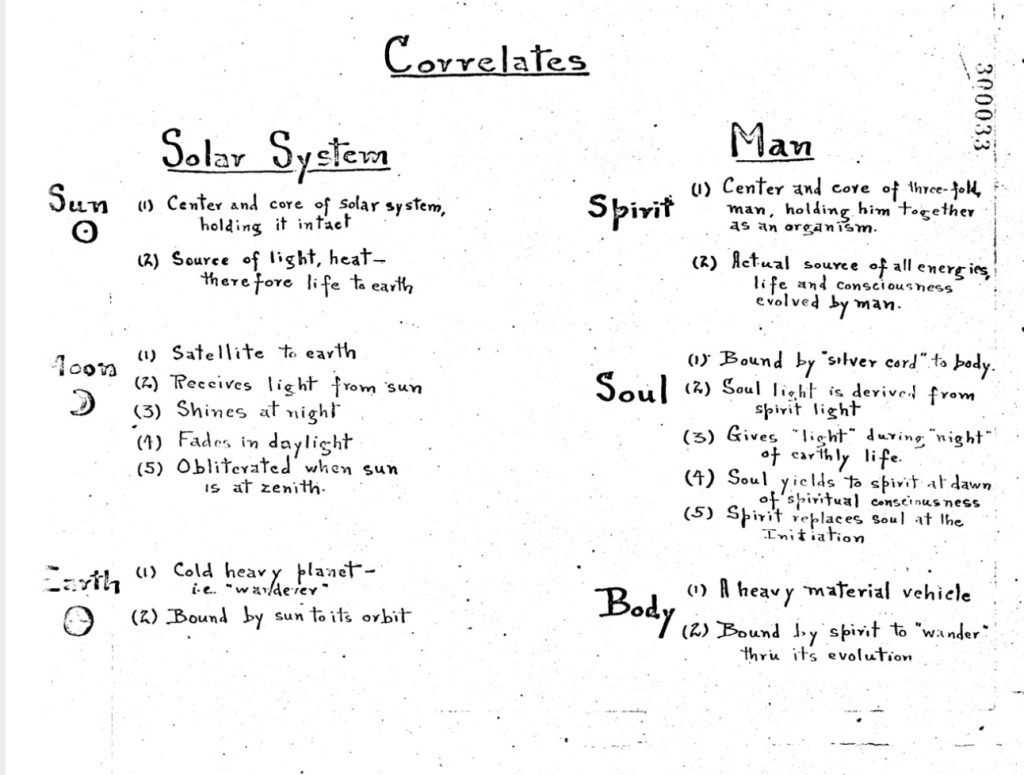
Ishtar and Tammuz are spirit and soul, just as in the Greek Ceres and Persephone symbolize spirit and soul. Soul has the spirit-mother, although it lives with Pluto. Pluto’s realm, in the Babylonian, is the realm of Allatu.
Ishtar regretted having murdered Tammuz; that is, he went to the earth conditions; and she goes through seven stages, at each of which she must disrobe, till she arrives naked in the realm of Allatu.
A nature myth? Yes, but with great truths for correspondences in many octaves. Tammuz is the soul. How is he rescued? Here, he is masculine; in the Greek, feminine; in the Egyptian, masculine; in the Hebraic, feminine. The truth is, the soul is neither one nor the other, but certain types will see the dominant activity as either masculine or feminine.
Isis, or Ishtar, the spiritual self, attempts to find it, and must pay the price for it — tests. But even then, Ishtar is held in the lower world. Who rescues them? Nevo, the Messenger from the Parents — same as in the Hymn of the Robe of Glory. The message is sent from the Father, Ea, down into the lower regions; and there brings the drink which releases Ishtar and Tammuz. That brings the two back to the upper world.
This drama was celebrated every year, as the Christians celebrate Christmas – the keeping of a ceremonial which was worked out by their great hero, Jesus.
Synthesis: The Knowers of the two races knew the same truths. Those who followed the Teachers knew the same; saw it from different sides of the same mountain. Saw life not merely as a little slice but as part of an enormous process, staged eons before the present, and to continue eons after the present.
Work out a cosmogony for yourselves.
Norse Tradition
Nordic Gods, Cosmogony, Macrocosm and Microcosm
Series of three classes
Lecture I April 18, 1940
Our customs are shot through with the threads of the ancient Nordic culture. Names of some of the days of the week: Wednesday (Wotan) Thursday (Thor); names of two Nordic gods.
Topics: What peoples shaped it; How available is the tradition; five ways of considering mythology.
The Nordic tradition is common to the Teutonic peoples. Three groups of them: the North Germans, the Low Germans and the Scandinavians. All shared, in the ancient time, this common tradition. Also High Germany, Germany, Switzerland and Austria. That culture goes back very far; in some ways farther than any culture we have yet studied here at the School.
Sources through which the tradition is available. Through very late material. It was first written, or compiled by one who is called Saemundr, the Wise, who lived in the eleventh century. He wrote the Elder Eddas. In poetic form. Three hundred years later another writer, Snorri, wrote another version of the Eddas, called the Later, or Younger, Eddas. In prose form. The later drew on the first.
Edda comes from Oddi, which was the name of a seat of culture, or learning, at which not only Snorri lived but, before him, Saemundr the Wise; a location where the secret tradition was handed down and where it was finally organized, partially at least, into a written text. Therefore Edda means wise Teaching of Oddi.
The Voluspa, which is part of the Edda, was also written at this place.
Sketch of the Eddas: They are in three parts: Part 1, story of the Creation, etc. Gylfaginning — the things that were taught to Gylfi.
Part 2: which contains the Voluspa, continues the story, but is written with kennings. Snorri and Saemundi the Wise were schooled in these kennings. Part of the learning at Oddi were the kennings. They are some thousand of symbolic clues to Wisdom-teachings; which meant that the writer of Wisdom-lore would use these kennings, things of knowing, to reveal the mysteries of Wisdom-lore — or conceal them to those who did not know — and in the learning of them be cultured in the teachings of Wisdom-lore. Very much as here at the School the teaching of symbology. You must know symbology before you can read the sacred scriptures; and in these old texts the kennings played an important role.
Part 3: An enumeration of meters, rhythms, beats, pulses — literally thousands of them. You wonder what they had to do with important teachings. To those who do not understand these things that does not make an intriguing beginning to the sacred stories. Especially when we hear they were not written till so late. The content shows they go back very far indeed. The tradition from which the Nordic gods derive is one of the oldest. It concerns the Aryan peoples, not only the Teutonic. The Greeks were carrying that on, too.
The world was not always composed as it is now. Many ages further back than the archaeologist goes there were other cultures. It is from one of these which lay in the far north country, when it was not a cold country. It was forested. The distribution of the weight of the earth was different; and a great peoples lived in that northern country. It was mentioned in the Greek as the ideal land in the North. The Nordic tradition is descended from that.
Study of myths
Why should myths be studied at all? What reason or circumstance is there to justify it? I shall not answer that, but I will mark out for you five different ways that myths are considered by the world generally.
The first is one that compels the largest number — the people who have heard that there are such things as myths and legends and say that myths are fairy stories, a meaningless jumble, from ignorant folk. That is not over, and has not the slightest value for moderns in an intelligent world of the twentieth century.
A second interpretation: Which considers myths a result of ages of accumulation of folk superstition, – folkways; and that, as superstition caused their production, so, inevitably, magic wrapped itself around these myths, and a source of supernatural beings (?) accrued. This is a typical way of looking at myths. Andrew Lang is an exponent of this view.
A third way: As a dramatization of the phenomena of-nature. And that, since nature is powerful, often ruthless, often beneficent, the gods were the personification of these forces as they worked over man. That built up a religion. Propitiation. There gradually developed under that impulse semi (?) morals. Little by little that led to a philosophic interpretation of life. Max Muller is an exponent of that view.
4: Euhemerism A Greek philosopher: His theory, and belief — and it has many adherents especially in ancient Greece, is that the gods were, once upon a time, wise beings — men, kings, priests, who, becauuse of their great powers stand far above the multitude. That contrast led, over years of tine, to an ever greater veneration, until they were, as the years went by, conceived of as gods. It adds an important point.
- 5. The fifth includes every one of these others. It agrees that there are any number of those stories that have been assimilated into myths that are idiotic, built up by ignorance, superstition and false understanding, and that they should be discarded. It agrees that the psychology of the crowd, people, the mob, plays a part in the build-up of folklore, and adheres to fundamental teachings as barnacles to a boat. But, because there are barnacles, that does not annihilate the fact of the boat; things that have occurred in every great racial tradition, including Christianity. It is now taking place too.
This approach includes (also) 3, re cosmic forces in the making of worlds, and that those often have been personified. Or rather, later folk have thought that a name meant a person. So the energy became a god. You can’t deal with a force without giving it a name in these states. That name came to be seen as a personification of that force.
It includes also 4: that many of the great beings who are venerated and have been venerated in great racial religions have been in earth — great beings, strong leaders, teachers; and that, as the ages have gone by — decades, centuries, millennia, and people of today think that such a one did not live. Yes, they did. Osiris, Orpheus, Mithra, who have been literal beings in earth who have come to be honored by those who followed them, as Jesus of Nazareth is today. Millennia paused; it is written up; and people of later millennia say that was their god, small g. And throw bricks at it. Paganism has as much truth and vitality as Christianity. It just precedes us, and we have lost rapport with it.
In the old stories of the great myths we will find the dramatization of energies, the appearance of beings who were actually in the flesh, others who were not, and the teachings which you know today either through the great lore of the old Hebrew scriptures or through the teachings of Jesus, or through the Ko’ran, or through the teachings of the Vedanta, the Upanishads, the Gita, or of Persia, etc. We need to liberate ourselves for the world of tomorrow; need to make free our hearts and minds and enter the realization of universality.
The Eddas are a late composing of old stories, much later in time than the Kabbalah. The Kabbalah is, for the Hebrew peoples, the written tradition of what before that was not written, but handed on from one who knew to the next, who was wise and demonstrated that he was capable of appreciating and carrying it on.
There is only one old tradition that gives Creation as grandly as this (the Nordic).
It is said that there was, in the Beginning, a great Emptiness; Unorder — an area in which there was No Thing. What is being talked about is the creation of this world. There was set apart in space an Emptiness where this could be. As with building a house. It does not mean there were not other places. This space was set apart for the production of what became this world.
Into it was drawn the basic substance out of which this world could be shaped. It was highly vaporous, gaseous. Only further back than that. A place between two kinds of forces. As with doing anything — push and pull; putting up and taking down; always these two opposites.
Now, the two opposites in that early stage may be simply called, tonight, heat and cold. Not as we know them, but those conditions which would help that highly volatile gas to gradually take on more solid form. You can find that in any library. Does it seem strange that perhaps 25,000 years ago or more such conceptions were taught by the Teachers who came down, or were in the midst of that people? As today the teacher comes for the humblest things or the great.
That same knowledge has been planted in every race that had a great future before it. Not always as clearly as what comes down to us as the Nordic tradition.
This diluted (?) a force working over thousands of years, millions, gradually congealed the earth, until it became what it is now. It sounds like modern physics. But if there are Teachers, they must know the modern physics before it was discovered by man. Later research and discovery help to make that available.
Into that early stage drained twelve streams, out of the cold, congealing side. That is, out of those chemical forces that helped to make the gaseous force slow down, and, after a while, become solid.
So the story of the evolution of the earth continues.
Finally, in the midst of this congealing mass was projected a mighty plan for evolution. Because the preparation of the ground was only preliminary. And that great Plan was called the giant Ymir. He represents the toe (?) of the force which can presently go into the making of all things. (or is it totality? GB.)
Here we come to the first dramatization of Force (Forces?) out of which will come everything of the future: the things you and I are; the things of the present upset. All of these are there in Ymir.
Nordic Tradition
Class II, MBM April 25, 1940
This tradition a source of myths for the peoples of the Western world. It goes back to an ancient time, long before the recording of history.
Every great teaching comes down out of the same source. But each tradition as it comes is clothed in the garments of a particular race. Otherwise it could not reach people of that race. If that is a teaching which makes appeal to the multitude of that time there will presently be drawn to that teaching from that race an increasing following. And that will continue to reach its apex over a period of time. Cycles. After that apex has been passed there is a return among peoples to that which belongs to the race of the body with which they are, in this present life, identified. That is in the nature of processes.
This is of interest at the present time because of the trend to Nordic symbolism, not only by the present leadership in Germany but in a much wider area, and going back over a considerable period of time. The Christian tradition and the Hebraic are rooted in the tradition of the Semitic races (or race); also carried on by Muhammad. Not in the race body of the Aryan peoples.
In the great Teachings there is always universal truth, which is above and beyond any race. Nevertheless, there is what I might in humblest language call a home feeling, a pull as to a native land, towards that which belongs to the race body in which you are manifesting. It does not come about until after the peak of the dominant race religion of the time. The dominant religion of the Western world has been Christianity, as built up by the Church. Back of that, for the Western races, is something else.
(A quotation from Carlyle’s Heroes and Hero Worship, which I did not get. OB.) also about Longfellow.
Something about building a bridge toward an increasing sensitivity toward the tradition that is the ancient tradition of the Aryan peoples. Greece and Egypt…..The Egyptian has been going into something of a decline. The Greeks contacted it….initiates at the centers in Egypt. The Orphic tradition. Something which is (was) before the peoples of the Western world. There will be more understanding of it.
The Creation, according to the Norse tradition.
Ginnungagap, the space assigned to the Builders of our universe.
Two kinds of forces; restricting, restraining, confining, that are called the Icy World. The other: forces that inflate, expand and cause cultivation and growth, you would say, as of the sun, (with) gradually occurring a kind of vapor, condensed, because, on the one hand, above, in the Fiery Force and below, the white, ice, limits. Muspelheim (the upper) Niflheim (the lower) begins to have magnetic lines of force.
What is shaped up? Primordial substance — the totality of things which begin to fill Ginnungagap. That carries two kinds of force: heavenly and earthly — spiritual forces, which are continually pouring into the Creation, and condensing, materializing forces that are always spoken of as evil, because away from the Light.
Now a division, shaping up the forms: Ymir, the Giant, the totality of all substance, capital S; and, on everything, another force, Audumbla, a cow, symbol of the first food of all life, milk. Hence there are four streams from the four udders of the cow, nourishing Ymir. All this, still etheric .
Those four streams are the pre-Edenic rivers of Genesis in the Hebraic tradition. That is, Ymir is all substance, heaven and earth. But that is too naive. Four streams of spiritual energy pouring down on substance. Audumbla, the cow, is licking a stone covered with salt. Buri arises. Salt, the basic thing of earth substance — really forms of the basic substance; the stone, meaning the enduring substance: the enduring Principles that help to make spiritual form, leading to another state.
From Ymir, in the same way, comes another being called Bestla. These are not beings but further derivatives of this stage of Creation. These two beings unite: the derivatives of spiritual force and of earthly force. Or, heaven and earth mate, is the naive way of putting it.
From that, springs another being, Borr. From Borr, three others: Odin, Vili and Ve. These are the three Outpourings. All secret traditions have those; not the popular religions. They establish the leadership over the vortex. A description of the outpourings and also of the leaders of those outpourings.
The slaying of the giant Ymir, the primordial substance, has gone far enough so that it can be taken into tho differentiated Pattern of Creation. Like the cutting up of the pie — dismemberment. The flesh of Ymir makes the earth, his blood the sea, his skull the sky. His brows, the Midgard, the middle realm in which mankind lives. His brain makes the place where the sparks from Muspelheim can penetrate: higher mind.
The three Outpourings are always the most active, as humans see it. So these three, Odin, Vili and Ve, go about until they discover two trees, out of which they make the first human beings, making a plan for the blueprint. Creative evolution has always been called a tree: the continual unfolding of the plans which were set in the main (or in men?) at that time, and over which the Three watch.
Midgard and Asgard, the humble correspondent of Muspelheim, the vast spiritual forces which helped to enclose the Creation as did Niflheim below.
The tree Yggdrasil. The Plan. An ever shifting, enlarging plan. It has three roots – places which feed into it; which basically control its life – the three major controlling influences on this plane: one that of the gods, another that of the giant forces, Jotunheim.
The result of the slaying of Ymir, the harnessing and limiting of those forces and thickening them, really absorbed a large amount of the raw, primordial energy that was in that substance. But a little of it is still loose, and so this giant’s offspring were all lost except one, Bergelmir. He and his wife are the parents of all the giants, the titanic forces, which man cannot control, like the internal fires of the earth. And all the things that go with it are the offspring of that particular giant. Earthquakes first cousins to that first giant; the winds (?) and those things that come with it — titanic forces which are still loose. Moat of them have been absorbed in the process of the Plan. Those parents are the ancestors of those titanic forces that are sometimes loosed upon the earth — tidal waves…. The Plan is not finished.
Jotunheim, the third root of the Tree in Niflheim, in which is a very famous being and object, known to most of you in part, the Well of Mimir. The serpent Nidhogg, who is continually gnawing at this tree. Always destruction is going on in this world of substance simultaneously with production. That is the serpent gnawing. He maintains a right proportion; balance.
Now follow the processes of light sparks coming down. Have some simple experience. Suffers limitation; yet it comes from godly realms. Therefore it is, as it were, described as Odin, in one stage of the story.
Down at the low root is the Well of Wisdom. Odin travels down from Asgard and begs of Mimir a drink from this well. Mimir asks for one of his eyes. Wotan = Odin, – Breath. Why does he come down to that well? That well represents experience; and it is only through Knowledge — experience — that wisdom is obtainable. Never from books or from lectures. Are you trying to avoid heavy, rich, stimulating experience or are you willing to give up something for it?
The request of Mimir means that you cannot both have your cake and eat it; cannot live in the higher realms and be down here. You sacrificed your higher consciousness to come down. Forfeits. The light, pleasant, dry, clean world has got to come down where it will decay and lose something of what it had. That is losing an eye.
When humanity comes upon the scene the gods have been living with this Pattern, happily, for some time. The readiness for the processes of life in regard to humanity are indicated by the appearance of three beings, familiarly called Norns, – Fates. (Their home) is in Asgard. Cause and effect. Those three are established by the higher laws; have their seat there, but operate everywhere. ……
When the Norns are established, the Golden Age is over, and the travail begins.
Norse Tradition
Class III. Norse Gods
MBM May 2, 1940
Thor, Loki, Baldur
 This the Hammer of Thor. Thor ranks next to Odin in the pantheon of the gods. Odin, in the microcosmic pattern, is the light spark, the great and remote god. Thor is the Shaper god, the Creator god — the symbol of honor, vigor, the Architect, the Creator — all the names we have associated with the God that we know.
They are the attributes of Thor; and the sign of Thor is known not only in Germany and among the Arizona Indians but is known in many countries. The Hammer symbol (represents) the four Elements, with the force of the Creative Will behind it, that has shaped all things. It is a universal symbol. But who really is the leader of the pantheon; for Odin stands behind.
The Hammer is the cross of the four Elements in action. Just as it is good for you if the four Elements are active in your life, not just one. When the flanges are on the left, it is involution; when on the right, evolution.
Loki (is) in contrast to Thor. He is really a giant but he was taken up into the circle of the gods as a foster brother to Odin. He was handsome, strong, stalwart. But he was full of trickery. He got the gods into trouble — but also out of trouble. Always wanting to accomplish something, not necessarily because he was wicked but because it was in him. As with Thor’s wife, Sif. He cut off the beautiful golden hair of Sif.
Loki went down to the agricultural gods in the lower world — dwarfs, who spun a fine golden thread and made a new head of hair for Sif. But now it was real gold.
The counterpart of Thor must be like the counterpart of Thoth in the Egyptian tradition: the truth, great sensitivity, true intuition. And the golden hair is like that. In the beginning she had the golden hair naturally, but mischief — or perhaps it was not mischief — made her lose it; and when she got it as the result of the work done in Niflheim it was true gold. At first it is embryonic; then we lose it. We go down into earth and develop it.
Loki represents the desire world — urges, impulses, desires of all kinds. It knows no bounds. It is full of life without discipline. It is not wicked but it accomplishes wicked appearing things. That is why Loki is the foster brother to Odin. Without Loki Odin could never become the god who descended and re-ascended.
Loki is a titanic force: taken up into the gods and living with the gods. Because the godly sparks need to be lured into action. So as to cause development. Loki is the collective symbol of the titanic force of the psychic, misnamed astral, world. Always producing something that causes trouble. It (he) has suppleness, subtlety, knavery, – always finding the way out (or a way out.)
The three offspring of Loki were terrible; they worried the gods. Because the gods dimly foresaw that they would have trouble, not only with Loki but with his offspring: the psychic world in them; the dangerous dilemmas to which that would lead. Yet they had to go through with it because it is the way of descent and ascent. If humanity had not gone through it humanity would not have been humanity. Would have suffered a fixation. Would have stayed very charming, but blank, angels.
The division of the astral world, as you remember; Ymir had also to be divided. The three offspring of Loki are: Hel, (usually female), a serpent and a wolf. All three offspring grew at a tremendous rate. So much so, that the gods not only foresaw their danger but knew it was imminent upon them.
Odin called a council of the gods, the twelve. “We have to divide it and set (send?) it out. We can’t let it stay up here.”
After the council Odin sent Hel down into the underworld, to govern there. And the serpent was thrown out into the ocean, the great Sea. And it grew so swiftly that it encompassed the whole ocean, inside of which was Midgard. So the serpent was called the Midgard Serpent.
The wolf the gods did not know where to send. So they finally determined to keep it with them and see what they could do.
Hel compares to the realm of Pluto, the realm we are in now, the underworld. The ocean, or the sea into which the serpent was thrown, is the psychic world, so full of dangerous, subtle and often slimy, sinuous and evasive, like the serpent. And you will understand that the world, whose name is Fenrir, represents appetites in their collective form.
Time passed, and the Fenrir wolf grew ravenous. It became again clear to the gods that they could not allow this wolf to be at large. They determined to chain him. So Thor made a mighty chain of iron. He bursts the bonds. They made a second chain, and he bursts that too. It means that it is extremely difficult to harness the desire world, even in the small, individual person. Microcosm as macrocosm.
The dwarfs were told to make a magic chain and send it up to the gods. They listened to the command of Odin and then scattered about in all directions to fabricate something. What they made was delicate, silken smooth. (It was like) the sound of a cat’s footfall, roots of a mountain, the breath of a fish, the beard of a woman, the sinews of a bear, and the spittle of a bird. Nothing droll about it.
The roots of a mountain: those very foundations which make for the security of the mountain. Without a foundation that is secure for the highest things man can conceive in earth there is no making of the chain that will hold the wolf.
Breath of a fish: (similar) to the foam-born goddess; when air is mixed with water. When man does not transcend feeling there is nothing that can chain the wolf in you or in anyone else.
Spittle of birds: Birds are the activity of the mental plane; the higher mind, that is free from earth. The breath of a fish is not free from earth, but birds are free of earth and their spittle, in the language of symbology, represents the life force, in place of semen; impregnating the force of the higher mind.
Dwarfs are humans. You and I are dwarfs. We fabricate in earth the things that will make us free. You cannot do that in heaven. The gods could not do it. Thor could not do it. It took that which is working down below: the chemistry of experience, of learning and achieving and living down in the earth plane, which makes it possible to evolve those powers that will put the chain around Fenrir.
Now the gods carried over Fenrir to a cave, and chained him to a rock, whose roots were deep in the earth. And there Fenrir rests, bound, a sword keeping his jaws apart, and with poison — the poison of the dragon’s jaws, dripping down upon the world. And there he will remain until the twilight of the gods. The story in everyman.
The six things with which you may bind the wolf: Iron went into it. The ancients knew human life rather well — knew not only psychology but the science of the soul. And knew the trials and tribulations through which the soul goes before it has conquered this Fenrir wolf.
Baldur The son of Odin and Frigg – Jupiter and Juno in the Greek pantheon. The gods dimly knew that their rule was not forever. But on the whole they were very happy and Baldur was one of those who kept them very happy. He was the shining sun-god, radiant and youthful and joyous. Like Iduna, the goddess of spring, who had care of the Golden Apples. Which means that power which, while still in the higher planes, is partaking of a state above time, therefore knows no age.
When, later, Loki in another prank contrived to the stealing of the golden apples, the gods grow tired and wan, their faces become wrinkled. Nevertheless Loki was the power, like the serpent force in the Garden of Eden, that drew on the light sparks gradually down into the lower world to evolve — involution for evolution’s sake; the birth of your children that they may grow to manhood and womanhood. Involution has been (?) to evolution, learning, demonstration. It was in the great scheme of things that Loki should do it, should do what he did. As with flowers, so with the souls. Though it takes a little longer. It is everyone’s story.
The gods were sensing the imminent events before them. Even Baldur sensed something which concerned him. His wife had many strange dreams. The mythos says there were intimations that he should die. That sunny nature in him, the sun-spirit, made him shine. The gods were no longer Joyous, because already they had lost some of their treasures through Loki. (think this should read: The gods were joyous altho already they had lost some of their treasures thru Loki. GB.)
But Frigg was troubled. She was determined to prevent the injury that anything could do to Baldur. She went about the world asking everything to promise it would not hurt Baldur. Then she went back to her spinning, working through the ways and means of the creative processes.
An old woman came and asked. Do you know what they are doing over in Asgard? Baldur is a target, but he just smiles: Everything has promised not to hurt Baldur. Everything? Except a little plant, the mistletoe. It really was Loki. Mephisto, drawing life on through experience.
So Hodr, the blind god, pierced Baldur’s heart with the mistletoe, and he died. Odin fears. … Baldur had left the gods, like the shining one of the Golden Apples. It was growing dimmer and more silent in the world of the gods. More and more had been drawn down into Niflheim.
Hermod is sent forth by Odin to see if he could redeem Baldur. Hermod traveled far. Presently reached the underworld. With great difficulty he made his way into that underworld. There he found a fully (?) emasculated Baldur, sitting on the throne beside Hel. The story of Pluto and Persephone, reversed.
Hermod implored Hel to release Baldur. The gods were weeping for Baldur. Ceres weeping for Persephone. One story in terms of the masculine, the other the feminine. You and I are masculine and feminine, regardless of our bodies.
Hel said No. Baldur may return when everything in the world shall weep for Baldur. Until then he remains here. Hel, a place of fixation — held in the realm of Niflheim; under the pull of Hel, until such time as everything weeps for its return. Recapitulation.
When there is full, or complete, repentance, turning back, then, and then only, is the way of ascent accomplished. Everything! not only one part of you. When the whole repents.
Death and the promise of his return.
The story of the light spark gradually attaining the qualities of the higher self. Coming down into earth, until there is little left in the higher places; until the whole of him (?) shall be drawn down and shall have gone through that stage. Darkness to the regions above. He comes into Niflheim.
Eventually he asks for a drink at the well of Mimir. Mimir is the wise, – all wise, to whom even Odin bowed. Because it was Mimir who stated what the rule was by which alone Odin would have been able to drink from that well. .
Odin, by drinking from that well, saw he was to go down. Gave even an eye for that drink — lost something of his rapport with the higher world. At that time came the dimming of the godly world, and a promise to those of the earthly worlds, which again, in due time, would be superseded by the godly world. But only when all things weep for Baldur.
Fenrir is more of the earth dragon; the serpent, of the psychic plane. Fenrir alone has that which points the way back — through earth.
It is the spiritual mountain in you which will tame the wolf, though it is the power of those things made on the earth that binds him.
Let’s again shift our thinking. We are going now into the vastness beyond the little local picture of our earth. We are going back to those remote ages — ten thousand million years ago, perhaps — when our system, our universe, that is, the sun and the planets, was set in its place in the vast spaces that we so glibly call the sky. Much of importance for us today then took place. The placing of our solar system was not a matter of chance. It was placed in its own gravity-picket, as it is esoterically known, with the right stresses and strains. Even as the architects and engineers of today, so the Builders of the past, and since, reckoned and balanced forces and strengths. And because part of this little universe was contrived for the benefit of an evolving humanity, the conditions which would further such a humanity were included in the preparation. Therefore we have, among other things, many movements which give us several kinds of seasons. There is the rotation of the earth upon its axis, giving us day and night. There is the orbital passage of the earth about the sun which, because of the earth’s tilted axis, gives us the seasons of the year. But there is a vaster year which includes a pattern of twelve seasons. It is known as the Great Year. The whole measure, astronomers tell us, is approximately 25,000 years. And just as our year of 365 days is the measure of a complete passage around the sun (with its four resulting seasons) so the Great Year is the measure of a larger cycle within a belt of twelve influences which surrounds, or contains, our universe.
Differences between Cosmogonies, Myths,
Sagas and Folklore
A single lecture by MBM. March 3, 1933
As you know, this is a single lecture, ostensibly to answer questions which have come up to more sharply define the difference between cosmogonies and myths.
Preamble: In the course of human history there are periods of moving, as it were, from an intense materialism, as one opposite, to an identification with emotionalism, and usually with emotionalism, some form of religiousness, this being the other opposite. An oscillation.
We are in a period of transition of that sort: either the identification of the visible, material interests or the flight from reality into the opposite direction. Right now humanity in the Western world is distraught, almost in a panic, and looking hither and thither for solutions; I should like to suggest, though it may sound remote, is a pointing in the direction where solutions will be found.
Cosmogonies and myths may seem as remote to you as the sky. We take little cognizance of the sky; but the sky is there. So the cosmogonies and myths are there. And from time to time, when we look for solutions to things, we are rather compelled to look to larger issues than the lesser ones; to lift up our eyes to big things.
And so it is not inopportune that we look at the question of cosmogonies briefly this evening.
I propose, first, to review with you, rather quickly, what we may call the familiar meanings of these words and then pass to their interpretation, correcting them and setting them in their right place, as in our Pojodag fashion.
Cosmogony means the world and to be born — the theory, therefore, of the birth of worlds; the origin of the universe, or Creation stories. But not, please, the creation of man. Cosmology might be associated with cosmogony, in that it is the science of the progression of things. Therefore all great races are to be expected as having cosmogonies or cosmologies. Researchers have said that to find a well marked cosmogony in a race is to give evidence of the maturity of that race, or the age of its civilization.
Myths are associated with the idea of what is mythical, fabulous. But myth really carries the concept of speech. That speech is the speech of the gods — the gods of the great teachings of the various races. These myths are associated naturally with these peoples. In the world they are seen differently, in broad classifications of myths: culture myths, nature myths, theogonous myths. The first describe the processes of some hero or god who has contributed to man’s culture. Nature myths are associated with the processes of nature; and the theogonic, with the origin of the gods. We have little to do with that.
Saga comes from an Icelandic root, meaning, usually, historical remnant, or important stories of ancient times. Folklore, also from an Icelandic root, or of Icelandic origin, has to do with the crowd — folk tales, fairy tales, etc, behavior patterns which belong to the mass.
So much for the outer interpretation. Now for our real classification.
Cosmogonies have to do with processes of Creation, but they do not concern man at all. Man comes incomparably later, a mere incident in the Pattern. Cosmos means universes, not merely our little universe; therefore the processes of those early ages, or setting the stages for other entities. Man has nothing to do with cosmogonies; they precede him by ages of time.
Every race of any importance has its own cosmogony. And in all cosmogonies of any stature there are certain common denominators. It is not extraordinary. It is inherent. If cosmogonies are stories of Beginnings, and if there is anything in them of fact, then we would expect them to agree.
The facts that are common denominators: All cosmogonies are the descriptions of these Beginnings; namely, that the beginning was from a Nought, or a Chaos. That there was a division into two parts, sometimes called Darkness and Light, or heaven and earth; and that that division again was divided within the Good, as it is sometimes called. And Chaos is not disorder but un-order; so that we have quickly the Four, and sometimes Five, Elements, out of which all things were made.
These cosmogonies again agree about there being a One Creative Agency; whether called Ahura, as in the Iranian, or by some other name, the concept is the same.
These cosmogonies describe many stages, or ages, in which the great entities, banded together in hierarchies, cooperated with the Creative Force, or the One. They describe therefore the preparation and making of worlds, and have to do with hierarchies and some few gods. There is the God and the gods.
Myths have to do with gods, and gods related to the processes; and again, God or gods related to man. Therefore separate in your minds cosmogonies from myths; first, in that you might say myths came later when already there were certain preparatory stages accomplished.
Myths are stories written in one of three ways usually: historical, moral or mystic. Those who know something about these matters agree that cosmogonies and myths are written in a triple cypher. Philo says the same . So does Heraclitus. And all students agree. Another who has looked deeply into the Hebraic cosmogony says it is written in three ways: literal, figurative and Hierarchical.
Let us go back to some cosmogony and see where the myth aspect comes in, – myths of a later stage in the processes that belong to the universes.
Take the Greek, because we are partially familiar with it: In the Greek cosmogony it is said that the Egg out of which all came was Chaos, or Nyx. That there then operated upon it the Creative Forces, which they call Erebus — that is the foment (?) ferment (?) of what is also, in their tradition, emphasizing the love motif — that is, the Cosmic Creative Forces (or Force?). That is long before the beginnings of things, long before Chapter I in Genesis.
Chapter I in Genesis begins, rather, with the next stage in our Greek cosmogony — with Uranus and Gaea; not a man and a woman, or god and goddess, but the division of Light from Darkness — heaven and earth. Or, – those of you who have had geometrical symbolism, you recall that we have had the circle, the germ, or the point being like the Creative ferment, Erebus, and the line across being the division of heaven and earth. Figures in geometrical symbolism will find the first processes descriptive of a cosmogony — in other words, cosmogony written in geometrical symbols.
Out of Uranus and Gaea, or the division of heaven and earth, proceeded those enormous cataclysmic forces known as the Titans, the vast processes of shifting (?) changes before it was possible for entities such as belong to the later stages to exist.
After the Titans in our Greek cosmogony come Chronos and Rhea, or time and space. We are in the abstract — not beings, though they have a name. These names belong to the cypher in which these things were written; and if you literalize them; if you think of them as beings set up in the pantheon, we haven’t any real mythology. They are symbols of forces and stages.
From these two sprang three daughters and three sons: Venus, Ceres and Juno and Zeus, Neptune and Pluto — the lower worlds to Pluto; in between, to Neptune; and Zeus (Jupiter) to the Heights. These three then rule — the three stages getting ready for the mythos. With these three stages the mythos has its beginning, you might say.
When you read the carrying on of Jupiter with the figures on earth, and Juno is jealous, you are reading stories of the mythos that are written in code, which describe the powers of certain high stages working down into the lower regions and annealing them by relationship with them. Don’t be fooled by Juno’s jealousy. It has to do with different processes at work.
Then, as you know, come the various relations of the building up, through the gods, of these next bits before man comes. When does man come? The archetypal man comes with Prometheus. The Golden Age is just about over. The Silver Age is beginning. And Prometheus, in the mythos, is born. Prometheus is the same as the first Adam in the code story in the Bible.
In Genesis, in the code, there are three Adams, not one. Do not take the English translation too literally. Archetypal Adam, or Adam-Kadmon, is Prometheus.
Let us jump right over into the mythos of the Old Testament. The story of Adam and Eve is a mythos; it is not to be taken literally. It is written in triple code and has to do with the processes, on the one hand, of incipient humanity, like Prometheus, who is not a being, but a Pattern being, before the building is set up. So we are in the mythos of the Hebraic stories. The Hebraic stories, unless you get the code, have little to do with Cosmogonies. Genesis Chapter I is very brief, but there are other writings among the Hebraic tradition which contain the cosmogony which is not in the Bible. The Jews therefore have their cosmogony. So, too, have the Babylonians.
The Babylonians say also that there was Chaos before the beginning. They called it Apsu. This is now a cosmogony, which has to do with preliminary stages, you remember. Tiamat is the primordial Water, the mother-side of things, which struggles with the germ which is dropped into it by the Creative Will. We have there the trinity, as we have presently to be discovered in every cosmogony. Mummu, is the third figure.
Every race has its pattern of the archetypal man – Adam-Kadmon in the Hebraic, which the Christian has taken over, is Prometheus in the Greek, Marduk, in the Babylonian. That Marduk is the same ideal ancestor (?), with the same magnificent stories told of his adventures, as in regard to Prometheus. Stories of the doings of Adam-Kadmon are told by the code figures in the first Book of the Law.
After Marduk come those processes which are dramatized by Ishtar and Tammuz. Interesting that in some of the mythos of the various nations the descending soul is dramatized, now with a masculine and now with a feminine figure; for instance, in the Hebraic, as a feminine figure, Eve, accompanied by Adam. Eve becomes the main force descending, which the Adam follows.
In the Greek world (are) a number of figures, not only Prometheus. (Chained to a rock: represents the soul of the ideal man held down in earthly conditions.) There is also Adonis. Ceres and Persephone being aspects of the soul which descends.
Ishtar has much concern about Tammuz, as Ceres in the Greek. Ishtar is called merely a nature myth — the darkness of winter and humanity crying for the fruitfulness of the seed. That is a mere incident. What is actually occurring is that the principle of Correspondence is working; and we find therefore the correspondence to these processes in the processes of nature. But those are the lower illustration of the great step of the descent of the soul into lower matters. That is a mythos.
Most of the stories of mythos relate to the gods in their relationship to man. In this relationship to man they are either beneficent, helpful, or the opposite, blocking the path of man. Those gods are to be seen as forces, either constricting or expanding; either aiding or holding back the soul, just as in the world you know a little better in the Old Testament allegories, figures are held back or helped in their processes of evolution.
The interesting thing that occurs is that cosmogonies have to do with universes; myths begin to localize the picture and sort of draw the attention to our earth; and then, what goes on in our earth and its adjacent condition. We have lost our grasp of immensities and our concern for them. Nevertheless, we should study myths, but should also remember cosmogonies. Re hitching your wagon to the immediate but also keep in mind the star.
So myths begin to tell you of those conditions which the soul experiences. Take, for comparison, a number of cosmogonies and myths. I have given you a little of the Babylonian and Greek. Take the Egyptian. They hardly touch much here. I have done something with Egyptian myths but almost nothing with the cosmogony.
In the Egyptian cosmogony you will find Nu and Tefnut, corresponding to Uranus and Gaea. The next two figures are Nut and Set, which correspond to Chronos and Rhea. Ra, who is the symbol of the solar disk — or better, the solar disk is the symbol of Ra, for Ra is a reality, drawing the influences that have created universes to our own solar system, our own universe; in totality, what we can call the universes, the Cosmos.
When we come to the study of Osiris, Isis, Nephthys, we are dealing with mythos, for we are dealing with allegorical figures that concern stages of evolution after the great processes have been accomplished.
Apsu (?) etc. are some of the names given to the Creator God, like Vulcan in the Greek myth, who achieved (?) a little more definitely, like Jehovah in the Hebraic, the specific conditions with which we are concerned. Jehovah is not the universal God but, as it were, a local god.
In the Druidic tradition, which goes up into the Norse countries, you have again the symbol of the yawning abyss — the Darkness, in which there is cold moisture; then the dawning of water and fire, the two elements which war against each other, causing a ferment. Fire, like love, the great foment, comes next. Then comes the motif of Ymir, who is killed; and from Ymir, just as in the Mithraic tradition, come the parts which make our universe. Ymir is not a god; he is what the astronomer or physicist of today would call nebulae; and out of that nebula are made the segments, or parts, of a universe.
If you will read modern investigations in interstellar space you will read how nebulae are forming themselves into universes — universes being made now; those nebulae gradually attracting and forming various particles, planets revolving around a central point which holds them together. That is, as it were, the destruction of Ymir. The nebula as a whole is killed and made into parts.
There grows out of that the Tree of Life, which, again you remember, has the three roots. The adder is at one of these, gnawing, destroying side, which belongs to the things of Creation that come and go — things of the phenomenal world; but also belong to the Day of Manifestation. They are presently closed when the Day of Manifestation is over. The Hindus saw that literally in great cycles. The Hindus have a well defined cosmogony.
In the Iranian, you have the Day and Night, dual forces working together all the time: Ahurs-Mazda and Ahriman. You find that duality everywhere. In the Chinese, too: light and darkness, expansion and contraction — what the world calls good and evil, which are two manifestations, all of which help the processes of evolution.
The Chinese speaks, in the cosmogony, of everything being perfected by Li, that is, the immanent force which is — immanent in all this process, for it is the Will which is behind it. They recognized the male and female principle, and the vital essence which works with the Li, the Chi. This force, cooperating with the Li in its own way, corresponds to the cosmogonies of the West.
Broadly speaking, that is all before man comes into the picture. If we were to take correspondences in the myths of these various races: in the Greek, Ceres and Persephone was the descent of the soul into the lower regions; Diana, Mercury and the other gods — forces localized, governed by entities; for the One God or the other gods do not work alone, any more than man does.
In the Hebraic, Adam and Eve. And one of the early Fathers (?) speaks of the Four Horsemen — the four Elements, all of which take their place in the scheme of things. Again, the two aspects we have had in the Chinese, Leviathan and Behemoth, must be deciphered in their code.
In the Hindu, we have the figures that move down from, Brahma, Vishnu and Siva; like the three roots of the Tree of Life in the Norse tradition.
In the Egyptian, Isis, Nephthys, Horus and his four sons. Those are myths.
Let us pass over to the sagas. These concern heroes and demi-heroes — have to do with heroes and demi-heroes — partial heroes; and are involved in such stories as, for instance, the quest for the Holy Grail, the King Arthur stories. You know these are allegorical. You don’t take them quite so literally.
The Iliad is a saga. The figures represent heroes and partial heroes, represent stages of man. Achilles represents the personality, broadly speaking, and the struggles for it. Hector is the beauty of Wisdom, or Truth, which all are seeking. On the other side, he represents sensitivity toward spiritual values. It is not, then, so terrible to have stolen Helen. It shows that these figures in the old Greek sagas represent heroes who were not gods, or made gods, but man seen as man, speaking on earth, trying to win the stature of gods — if we might now reverse our picture.
The crowd worships the hero. The stories of the hero stimulate him to admiration and to some degree of activity. They are meant to. The heroes are figures who have lived, or have been set up as magic, ideal figures. These stories, and the heroes, gradually make those of the crowd follow that pattern.
As the hero strives with the tasks (some of which are beautifully told in the Greek world) he is making his way toward what is known as the demigod stage. For instance, Hercules was a candidate for god-stature. He did not quite make the grade; did not do it in the full way. But he is a hero, and a very great hero. Therefore a partial god. He is one who therefore encourages, or incites, the crowd to follow him. So we move from the crowd to the man who worships the hero, becomes the partial hero, becomes complete — the demigod, up to god-stature.
The god-stature is illustrated by the Thirteenth Man. A taboo on the number thirteen. That is folklore, coupled by a philosophical truth. The story is true; the Thirteenth Man is one who has achieved the twelve labors of Hercules, has god-stature, and is therefore through with the human evolution, and dies to it. In superstition is a little sensitivity to philosophical, or allegorical, truths, but no intelligence. Jesus is a Thirteenth Man, and completes the human evolution. He is the Son, fruit, of man, mind.
In the Hindu tradition, for instance, the story in the Gita of Krishna and Arjuna, is really a saga. The story of Arjuna is like that of Hercules striving to make the grade and the superb demands (?). Krishna is like the teachings of Jesus, showing the way it is done. That is the effort of the one who is making the grade, to set a pattern which others may follow.
Gods, as a whole, are too far away and do not really concern man. Their patterns are not man’s pattern. The gods work from above down; but the earth man, who is working from below up, is trying to make that stature, – becoming co-heir with Christ.
The “Tale of Two Brothers” is actually a saga — one of the most glorious stories, I think, ever written in code – as the Iliad also. The Nibelungen saga is illustrative of the titanic type. There are many others.
When we come to folklore we have the garbled versions of philosophical or mystical actualities. You find them primarily in such fairy stories as Snow White, Cinderella, Tom Thumb, the tale of the Three Golden Hairs, Dornroeschen (Sleeping Beauty), which is really the story of the soul as asleep and hidden behind a hedge. That is the soul. Those of you who haven’t won soul consciousness are in the state of the figure in this fairy story who is locked up, as was Brunhilde (in a saga) behind a hedge, or in a castle, or in some place most difficult to win. Who gets her out? The hero.
Now, the hero is the outer man in you. You are two things, and you live in two worlds. It is when your conscious self undertakes the work of releasing the soul in you that you are living the story of Sleeping Beauty. So consciousness is the hero that rescues the soul, of which you are otherwise unconscious, and it is not entering into life.
Naively, and yet philosophically true, the hero marries the heroine. Of course that is true. That means that your conscious being and your soul are mating, and you become a one instead of a divided personality, with each side hidden, one from the other.
Cinderella is how the beautiful soul, like Helen in the sage, is hidden; and only the Prince, who recognizes certain virtues in her, takes her out of the lowly life to which she has been subjected. The life to which we are subjecting the soul is like Cinderella, who does the drudgery, who lives amid the ashes and refuse of things, who by the Prince, the hero, must be rescued. Popular versions do not know the important points. Folklore, the degeneration (often) of philosophical and allegorical truths which have dribbled down into the crowd, handed on by word of mouth, distorted bit by bit by those who did not understand; but certain essentials are there.
Degenerations, therefore, of actual, mystical truths.
Now let us cut a rift across these four columns as another type of thing that we might call the secret tradition, or secret teachings.[1] Secret teachings are open language. They come out somewhat in the cosmogonies as they do, to some extent in the Hebraic, in the Babylonian; but only in bits; and then you have to have the code. Otherwise you take it in its outer shape (first, body; second code, like soul; third, like spirit.). The third is highly occult. The second is mystical and allegorical. To some extent, I am giving you something of the second code tonight.
Secret teachings are in existence. They have therefore the key to all. If you were making a graph you would make a design across all your columns of the implications that the secret teachings have a key to all of them. In a sense, it is from the same teaching that all four are derived.
The cosmogonies and myths are in the language(s) of the Knowers. From time to time bits have come out, so they have been written. As in the Kabbalah, written many years after the tradition early handed down by word of mouth. The whole secret tradition is not there. However, sufficient is there so that, if you have something of the code, you can work it out further, through many of the things that belong to the cosmogonies.
Fabre d’Olivet has made an attempt to give something of the inner significance with which the Kabbalah was written.
All traditions used a variety of codes, or symbols, and you have to know these various symbols, which are like the outer letter, before you can begin to turn the dial to the philosophy of number, for instance; or to astrology, and the others. But it is not enough to know those. You have yourself to be of a stature, a sensitivity, that can use these in turning the dial. If you would like to do it with the Hebraic, try Fabre d’Olivet.
Let us review a little, as I have tried to indicate:
You should know no less than four cosmogonies rather well. You should know eight to ten myths well. You should know five or six sagas. You already know — but get on the inside of them, the content side, say, four or five fairy tales. Because they are the main carriers in folklore.
We have already had, in various work here at Pojodag, a number of cosmogonies — Hebraic, Babylonian, Greek, Mithraic; and something that corresponds to cosmogonies: the philosophy of number and geometrical symbols. In the Philosophy of Number you get the stories of Creation, and processes highly condensed, just as you do in geometrical symbolism.
The last stages of mythos have to do with the Pattern man is to follow. Adam-Kadmon, Arjuna, all have to do with the processes that man follows, but are only a little segment — concern a very small group called humanity; an important incident.
With the end of the myths and the beginning of the sagas, or hero-making, we are dealing with those things that concern the descent and ascent, or involution and evolution, of the soul; and a great many — in fact the major part of the stories, since man has forgotten what happened when he came down, temporarily – are concerned with the process of the ascent. It is the same as in the Christian tradition called at-one-ment, as against dis-memberment, which is the descent.
Most of the stories that count have to do with the at-one-ment. The mural (Egyptian Judgement Scene) shows the weighing of the soul, to see if the soul has reached the stature “beyond the River Acheron.” Is no longer out by the dragons. Thoth, an Egyptian god — a great one — and two other goddesses, watch the soul. Spirit is represented by the hawk. In the vase is represented the heart — the nucleus, gist of that man’s life in earth, measured against the feather — so accurately, by truth, in the symbol of Maat — the exquisite accuracy. One of those many, many periods of testing as to how far your evolution has been accomplished.
The Gilgamesh story, too, is a saga, because it has to do with the effort of the soul to return. Ea and Gilgamesh. (Related to) the Prodigal Son (allegory). The main part of it has to do with the return, when he is tired of the husks. In the Hebraic it (the soul) is masculine, because the soul (on the) return expected activity.
In the Cinderella story, she sits amidst ashes, from which the soul, being sufficiently fed up, wants to get back to the Father.
The outer version of the Hymn of the Robe of Glory, or the descent of the light spark, in the western Asiatic tale; and probably assimilated into the Hebraic tradition.
[1] I do not have this chart. It listed, in four columns, the line from cosmogonies down to folklore, these stories, or representatives of them, from the Hebraic, Babylonian, Egyptian and Greek traditions. GB
Editors Note: The spelling of all the names appearing in this series should be checked against the texts, also the stages of the cosmogony. GB
I did check the names and corrected them.