Consciousness
Series of seven lectures by MBM
October-December, 1942
Lecture I. October 22, 1942
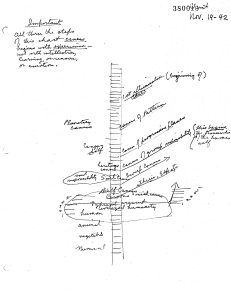
Permanent realities…… Clearer consciousness sometimes makes you suffer; do consciousness seems the road to suffering and pain. But without consciousness you cannot grow and you cannot live. It is necessary to intelligent functioning. To insight. . . future,
and to an understanding grasp of the past. So it is devil and angel; fiend and god.
Out of experience has come consciousness. Consciousness just used naturally will not be very useful to you. It is a power which must be understood and controlled. That is one of the first lessons we are going to learn in this course.
The Eight Seedlets
Wide~perspective of what we are trying to do. Factors which are the primary equipment of man. Consciousness is one of them. Eight primary components, or factors, which are in man embryonically, and which in the course of development unfold. As they unfold he unfolds.
(1) The urge toward growth. Innate. From body up through the entire length of him. It is that which has made you ambitious, restless, until it strikes the awakening mind.
(2) The sensing faculty. Does not belong only to the physical vehicle, but that is where you have the primary lessons. The two systems of nerves. Afferent and efferent. Not only on the physical plane.
(3) Feeling, emotion, desire. The urge which sets the soul in motion, as the urge to grow sets the whole machinery into action. Goes through an enormous development.
(4) Thinking. Equally important with the heart. It has a still greater role, but not at the present stage of our human drama. Leads up the scale until intelligence is developed. A nodule of it. Intelligence in turn leads to mind; mind to nous; eventually to spirit. Each of the factors is unique; peculiar. (Thinking) grows a tree. True also of the other four.
(5) Imagination. Lends itself to anything. For which hands are only an extension. A kind of kit of many tools. Shapes objects, feelings, ideas, concepts, etc. A power, which, like sensing, has come to be used at the lowest levels. At the stage of evolution of the present imagination is still put to very humble purposes. The poet uses it on higher levels. It finally becomes the link between you and larger worlds. As you image truly. Not according to your feelings. As your image making faculty is trained to the technique of meditation. Forging in the direction of reality. No esoteric training possible without careful and intensive use of imagination.
(6) Consciousness. Wholly unlike any of the other factors. Intended to be wholly different, one from another, for they are the primary fields within which differentiation springs. Consciousness is a tool. Make a definition of consciousness for yourselves. There is nothing to take hold of, as with the others. It too begins very humbly. Result of traffic between you and experience. There should be traffic between you and experience, and that often happens. The result of that traffic is a kind of friction. It may be physical, emotional, mental, – on all levels. May be spiritual. Brings in a change. That is the role of consciousness in the pattern of the Builders. Between you and objective experience. It flits about . It is not under control. A main purpose of consciousness is to make you aware of the objective world and give some reaction to it.
If you were not conscious of pain you would not take your hand from a hot place. Consciousness is a means of education, and there is no education without consciousness. Without it, no advancement.
This friction between the outer circumstance and you brings about various reactions. You set up little temporary fields of awareness. If you want that bubble to remain you have to do something about it.
So consciousness has often been compared to a lamp. Friction continued makes heat; that gives way to light. Light seldom is there, with our ordinary run of consciousness. There is only a momentary little bubble of awareness. One reason you don’t get further more rapidly in your education, whatever it is. Because you haven’t learned the way to make that bubble last. You haven’t learned how to control it and drawing on it for the light that is in it.
Consciousness is nothing at all like the other factors. Yet, from the beginning of life, it is there. It accompanies evolution all the way. Evolution should not be described in terms of consciousness. Because a great light is not synonymous with application. Must support, use wisely, apply. Consciousness implies enormous potentialities.
(7) Memory. Capable of enormous growth and unfoldment. Not static. Equips the human with the opportunities for measurement. You draw upon it continually. The more you can have memory adjacent to the field of consciousness that feeds into it, the richer is your experience. They unfold as man unfolds. You are both the faculties and you are served by the faculties. They are an integral part of you. They are you; and yet they are not you: “I food; food eater I.”
Without memory man has no discrimination. Without it he has no foresight. Foresight is based on rear sight. If you want memory to be engraved upon you you have to learn how to use it at the moment when it is red hot, so that the engraving is done. You may distort it with image making. By your feelings. Because, in the beginning, it is feeling that vitalizes imagination. Psychological truths are not real truths.
(8) Again, like none other. And, like reflection, it is closely related to our point. Volition. The ability of choice, of practicing preference, of selecting. “Free will.” The human evolution is partially grounded on this element of choice, of making a decision. We are all conditioned by the past, so our desires are conditioned. Behavior patterns forged by forgotten emotional experience.
Apply these points to the Garden of Eden story. Urge to grow — ties up with choice, 8. Ties up with memory. With memory comes karma. To “become as gods”, choose to go through the human evolution. Apply the eight to the allegory; how in small ways they functioned even then. They remembered the former state and wanted to go back. Our healthy movement forward.
As man moves forward these eight are all developed. You can see the pattern of man in terms of these eight. The nuclei in the seed mixture (Basilides), which are the gifts in every human soul. It is only as the student understands the behavior patterns, mode and mechanism of these eight, and learns to operate them to his purpose, controls and directs them forward in his evolution, that the evolution is really the kind of thing that it should be when man is conscious. Conscious evolution means the understanding and control of the mechanics and modes of the equipment of man.
All are at first embryonic, – small, – functioning under the natural law. What is called in philosophy the procession of fate. Circumstances which he does not understand control him. Momentarily he seems to be free, but then fate and circumstances control him. Little by little his understanding increases, and he begins to control. A new octave. To mind law. It takes ages. He does not know it in the beginning. On the way to shape himself voluntarily….into the pattern of the full measure of his potentials; to shape himself into the Great Face — a potential pattern. That is really your objective. Enables you to function in the Larger Regions. Not the psychic. Through application of the mind law, to the noetic, or spiritual.
A condensed picture of man’s equipment. Place (?) our course held in that setup. From material realities to spiritual realities. From the lowest consciousness to controlling cosmic consciousness. The others (of the eight) must come along. The other seven are all going forward.
Consciousness, a unique ingredient. Essential to higher development. Application, control and development of the power of consciousness are inherent in all higher development.
Lecture II
MBM October 29, 1942
The West is absorbed in the detail. We should not be absorbed in one thing. Life and the understanding of life require whole seeing.
Locke’s definition. Concerning the human understanding. The perception of what is going on in man’s mind is consciousness. Too simple. Three kinds of consciousness described in a book written in l8l8 (by Heinroth). On disturbances of the psyche. A kind of consciousness that is typical of children, recapitulating the primitive, or the savage. That is a kind of consciousness typical of an objective world. Comes in by stimuli. In our modern day called sensual, coming through the senses.
(2) Organization of ideas based on objective facts. It is individual. The third type, that very few come to. Had to do with an awareness of the struggle between the self and the ego in its striving: the struggle between the desires that cause a reaction to the sense world and a certain other thing, which begins to make it go back – an opposition between these two.
Compare with recent psychology: precepts, recepts, concepts. Heinroth’s first classification: (1) that which comes in through the senses; (2) precepts — beginning of the organization of ideas and experience; (3) concepts; the organization of ideas, which are made up of many facts, but now are on an intellectual level. No longer dependent on objective stimuli. These three correspond, in a general sort of way, with those three from Heinroth’s book, published in 1818.
Meaning of the word consciousness and its connection with conscience. The word consciousness, – with and knowing, is exactly the same as conscience. Conscience comes from the French. This conscience is akin to the third step of Heinroth: the observation of the self, with the idea of intellectual connotation true to itself, the idea of conscience. That which did not have to do with behavior your consciousness. But actually they mean the same.
Experiment: prick yourself. You rush the attention to that part of the body and the area around it. The first classification. According to the intensity, everything else is blotted out. The unpleasant is much more effective in commanding attention. Painful memory brings feeling surrounding it. Rush of energy toward that. But the field of consciousness is now associated with feeling.
It is more difficult with thought, to cause this rush. Partly because it is impersonal and partly because it is in the conceptual plane.
You are, in a sense, just beginning mental development, so you are not as familiar with concepts as you are with sensation or with emotions.
Consciousness is the way of knowing; knowing with the self, and without that consciousness there could not be knowing. Consciousness is necessary to knowing.
Consciousness is like a light by which you can see, – but via your mind, or your awareness of what is otherwise dark. Think of yourself as going through life carrying a lamp. The wick has grown a little larger. But put out your consciousness and you know nothing. If you listen vaguely you won’t be able to recover at will what has been said.
Consciousness is usually linear. There are very few who can keep several things in consciousness at one time. The object of consciousness is to enable man, who is essentially a being in continuous life, over ages, to acquire great stature and great knowledge. Not thin, but breadth and depth and height, and other dimensions. In order for that, the habit of linear consciousness will have to be eradicated. Experiences still are, even though they have passed out of your field of consciousness. Fourth dimensional. Recurrent consciousness. Feelings come in easily. So does worry. Experience is limited and brief. And it is under the natural law — the sequence of cause and effect uninterrupted by volition.
Most consciousness is involuntary. From the babe up. We have done extremely little with that tool. Most of the other ingredients have been used more. Consciousness still involuntary. Shocking that it is so little under control. Still elementary with most people.
Myth of the Gorgons, the three gray creatures: a teaching regarding three-fold man. Now one, now the other, has the eye. The eye linear in functioning. This tool, which should take us far, is as yet at only a small portion (?) of our development.
The subconscious: has it no consciousness? If you have been working with that other side of being you know it also has a consciousness. All the eight are to move from the tiny seed to the fullest measure of fulfillment…… When we become conscious that our powers are not to be taken at their present stage, except in a transitional sense. Every one of them is to move on up to enormous development. Opposite to the one eye of the Gray Ones is the “all-seeing eye” of Deity. As the body sees through the eye you see through the consciousness. You don’t need to have a mind to be conscious.
There are many grades of consciousness. But the development of that consciousness is through the gradations of evolution, taking one to the all-seeing eye. Consciousness is capable of becoming a great torch, illuminating not only a little field but a vast field. And the development of the self is dependent upon the functioning of that consciousness.
Cannot come to higher development without it. Not only psychic. The condition of things generally, – the welfare of your neighbor, – all those things right now.
Make this experiment re consciousness: first by pain—physical, psychic, mental.
Lecture III
MBM November 5, 1942
(Two aspects; two sides; transliminal and personality;
individuality; self, ego, “I” and tree; self-consciousness;
between the opposites; Tree Yggdrasil and squirrel, eagle)
Importance of the foundation; our first two classes were for that.
Story of Anselm Byrne, born 1826, New York City. Classic story. Prof. James (Wm.) stated it. Object of the story. Our ordinary concept of consciousness as the exclusive possession of the waking state is not sufficient. Here we part company, for a time, with orthodox psychology.
Man to be known, at different stages of his career, by different names. The same transformation in involution: light spark, nous potential, psychic and man. Motion becomes condition, as condition changes.
One thing remains to be said that is germane to our subject throughout that process, namely, two aspects, two sidedness, two phases. The very motion, or change, means relationship from one to another. Part of the orientation remains in the direction from which that which is changed in condition moved. In the soul there is that which looks downward and (that) which looks upward. This has been known by many names. By religions and by cults. This facing, or orientation, in two directions must in itself change as the intrinsic light spark changes its place of sojourn into that of the lowly sphere of earth, but it keeps that two-sidedness.
That two-sidedness must have, potentially at least, consciousness of its own. The story of A. Byrne illustrates some of those two aspects in the one person. Ambivalent. That is not what we want; but in the early stages it is now to one and now to the other that consciousness belongs. The aspect of Byrne as the carpenter is facing one way, as compared to the A.B. through the brown (?) who was facing another way. (Here MBM referred to a diagram showing a door opening, or facing, in two directions.)
You can’t break (loosen the hold of) the personality without the transliminal.
Our waking consciousness is a very small part of the whole, yet it is still, for the majority of people, the measuring stick. But presently you are able to know intelligently, and make order, out of the region of the transliminal; and presently to the objective beyond it. The size and quality of the lamp will have much to do with what is seen.
What then is the individuality? The word means not divided. Therefore that which has been divided must become integrated. Therefore the first step to building the individuality is one who has brought together that which was divided — objective and subconscious. As these two are interwoven the beginning of the individuality takes place.
Paradoxes begin to expand in ether planes. The “I” is not identified but is loose. The “I” is accompanied by an area of luminosity, which we call consciousness. The means of knowing, a nucleus in this area of luminosity.
Larger areas are not immediately accessible. A grand thing in the scheme. One side looks down to earth; the other, through the subconscious, looks to other areas, up. For the process of growth. The tree motif.
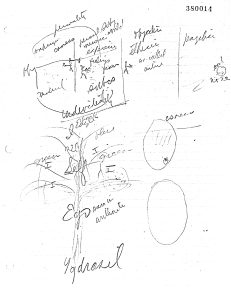
Self, ego, “I”. What is their relationship? Totality of the tree is the self. Egois the evolving essence. The leaves (of tree) come and go; they belong to the self but not to the ego. The little branchlets break off. They belong to the self, but the ego is the essential life, which is evolving through all the experiences, some of which slough off. The “I”, the focal point for functioning. On the sacred (pattern) tree Yggdrasil, the squirrel (which runs up and down the tree) is the “I” principle.
Who are you? We will leave that for next week. The “I” principle is meant, in the pattern of the human evolution, to do that (like the squirrel on the tree) until a certain stage is reached that we call self-consciousness — consciousness of the Self; and the endeavors are to make that squirrel stop jumping. So that, “seated between the pairs of opposites” they are used, but you are not identified with them. The “I” principle is loaned but you are unshaken. Consciousness perceives from the middle point, and does not have to go out on the limb. Consciousness of the self is reached. The work then is to cease the jumping of the “I”, and to stabilize it in the central part, or the trunk.
A final point in the Norse tradition: At the top of the Tree Yggdrasil sits the eagle, with the hawk between its eyes. Nous and light spark. The squirrel may not go up there until certain stages are accomplished. Because it is grabbed, and the illusion of having attained something is possessed by the lower self.
The great Self. Reference to the Great Self: the matrix into which, and toward which, the individual moves: the archetype; the perfect pattern, into which you, by your evolution, pour yourself.
It is customary to think of the Self as something complete and perfect, and all you must do is to attain that. Some have tried (especially in the East) to lay aside the physical, – by many means, – to try to merge into that. That is beside the point. To do it, we must evolve our eight tools. We are stressing consciousness. When the stage of Self-consciousness comes the role of consciousness is more important than it ever was before.
Lecture IV
MBM November 12, 1942
(Five types of consciousness under the natural law;
five in which the “I” begins to serve the ego.)
Everyone wants you to trim the lamp in their favor. Want your attention. I am trying to lure your lamp in terms of mental consciousness. Slides easily. Why? Because the history of the human evolution, put in general words, has been so far primarily under the natural law; and the two main factors that have been developed are sensation and feeling. And it is so much easier to go back to what is habitual than to strain to hold the lamp of consciousness in fields which are not as yet (up) to maintaining that consciousness. The moment you relax it gets away from the mental plane. We are not yet as inured to the demands of the mental plane as with the two other planes.
Major characteristics of that lamp:
Five types of consciousness, all of which five are possibilities within the uses of your consciousness now. The first five do not serve the evolving ego very well. They are the sum total that the monad, or the light spark, has grown in the course of its evolution — the main part of the growth of a tree, the substantial part of that which you have differentiated out of your potentialities: the values which they bring back to the ego and which, of course, the consciousness and the “I” should get from life and bring back to nourish the evolving ego. That, under the first set of five, is done very feebly, and is under the natural law.
The first type is vague. Attention slack (?). Because the “I” is not linked with what the lamp illumines. Seeing without noticing.
dim: faint, weak, small. Condition of the lamp; it is not used very much. Everything that is used grows with use. A process.
dull: apathetic; may be due to condition of the body; or an accumulation of frustrations over a period of time, where the psyche has grown weary of making effort, and so has become dulled.
confused: disturbed, disordered, jumbled, separated. That is the consciousness of the psychopathic conditions.
diffused: scattered, spread, dissipated, strewn about. As soon as need thinking is removed and its exigencies. Relaxation of consciousness spreads it all over the map.
The five do not yield much value to the ego. Because they are not understood by the possessor of the lamp. They are under the natural law. Give low percentage, like a tool not understood. Types 1, 2 and 5 are common; 3 and 4 set a little apart.
Another five (types) that are in partial control. The ten are not the full range of the powers of the lamp, or of that which you, even in the immediate circumstances can do with it. (Here MBM referred to a map on the bulletin board showing higher ranges, supernormal.)
In these five, the “I” begins to serve the ego. The ego and the “I” are the receiving end of the lamp’s food. Many things are not valuable food for the ego. A progress in development. The implication is that the “I” is going to be served by the lamp, and is going to have values as food for the ego. The ego has still to digest it.
The five types, beginning with
clear: transparent, unobstructed; attention good. Personality out of the picture. Report of what the lamp illumines is clear. Absence of conditioned reflex. Strive for it.
concentrated: Converging to a point. Condensing the rays of the lamp on a motif. Provides for perception of detail not possible in any other way. That is part of knowing. The essence of experience is akin to knowing. The contributing of the fruits of all things to mind. Knowing a thing gnostically. The goal of the human evolution, mystical. That is going on through consciousness.
intensified consciousness: Strengthening, increasing; making more vigorous and powerful. Heightening the power of the lamp. It is not just under the natural law. Intensification of the lamp under the mind law, and bringing it under control, like the engineer, from the weak lamp to the fluorescent lamp — now upon the self and its faculty of consciousness.
expanded consciousness: Opening wide; spread; range extended; area expanded. A power of consciousness which gives perspective. Important in the higher evolution of the self, this point. At the disposal of the consciously evolving self. Not diffused. A power able to cover a wide range without loss of strength in illumination. That gives perspective. May vary, from the things of a room to the wide range of philosophical grasp. Widening of horizons. Group consciousness. No such thing as judgment possible without it; – just judgment. Elementary in higher functioning.
penetrative consciousness: Pierces; arrives at inner content. Discernment, understanding, insight are preliminaries. Astonishing depth to which it can go. If you are familiar with it.
These five are possible within the more or less accessible present of your lives. Develop the second five. Come to understand them. Then set about working upon them. They are the object of some of our. exercises (subj. exercise.) …. Spirit of the law vs. the letter. Flash of it sometimes.
The second five are connected with mind.
Compare chart on different ways of knowing. (This is a reference to a leaflet by MBM listing and describing the different ways of knowing.)
Lecture V
MBM November 19, 1942
(Mineral, vegetable, animal kingdoms; vertical study; human consciousness; self-consciousness; soul consciousness; group consciousness; group responsibility; heritage consciousness; consciousness of progressive planes; consciousness of Self.)
The types of last week relate to humanity in its present state of evolution. Concentrated, expanded and penetrative might be seen as something developed a little further than average humanity.
A vertical study of consciousness.
Have the planes below the human – consciousness? Yes. The measurement should not be the familiar one of the human consciousness but rather that which gives sign of response to stimuli.
The mineral kingdom gives response to stimuli. So it has a kind of consciousness. Everything that has consciousness should lend itself to growth, change, evolution. The mineral kingdom does that. Its substances grow from without, by accretion, etc; also from within, by various types of internal changes, – chemical, magnetic, and so on. They bring about effects upon the substance.
That substance, yielding to effect may be said to have a kind of consciousness. But it does not go far. Or the working upon substance by man. Man working upon mineral substance helps to unfold the potentials of the mineral — to break it up and help it to go on its way. Otherwise it is fixed. Our bodies are made up of mineral substance. Many of these characteristics in it.
The vegetable kingdom. A slightly different consciousness. There are no sharp cleavages. An etheric, integrating substance has been built. Above the mineral compounds, into organisms called plants. A gamut, a vast picture. Its establishment has taken hundreds of millions of years. The vegetable has several advantages over the mineral. Etheric elements that make it a living organism. In harmony with that, a certain amount of liberation. The very slow change of the mineral kingdom. But the plant, even in its humblest forms, has a degree of liberty. A wider sphere of experience. Many stimuli which the mineral kingdom, as mineral kingdom alone, cannot experience. Therefore its consciousness is of a much higher type.
Burbank and the cactus. The development of spines; a kind of consciousness. Where did it come from? Largely directed by entities outside of the organism. From one point of view, the human is the first creature that has an indwelling power that has the character mark of the human. That is partly what is meant by the “breath of life.” From within out. In the lower kingdoms it is, proportionately, from without, with the cooperation from the within. The vegetable kingdom has a wide span of consciousness. Various kinds of dispersal of its seeds. But the agencies will use only the laws governing those kingdoms.
(3) Animal consciousness: Again, no sharp division. The animal, as contrasted to the vegetable kingdom, is free at both ends. Hence, an increased range of stimuli, and with that, greater freedom to have the responding consciousness. His nerve cells, or ganglia, are beginning to respond. As small pains. That development continues. Ganglia grouped together capable of acting as small brains. Capable of receiving impressions, and therefore making images. Recepts. The dog re-cognizes that owner. The stimuli have begun to form clusters. Another type of consciousness; more power. Recovering ideas sufficiently that an image outside itself can be cognized. (Took) millions of years to build up.
(4) Human. The vast range of stimuli. Every one that wins his consciousness causes a change within the organism. Continues in a refinement of the nervous system and the organization of the brain. That brain goes further than the animal brain. Not only memories and images, but you are able to gather together many such recepts, and organize them in such a way that they become a new bundle. Octaves. Almost a radical change, and a new octave begins. Can organize his consciousness and be independent of the objective stimuli, in a way that is impossible to the animal. Man adds volition — can reorganize and change things. Extends the freedom of the animal through the use of mind. Has again tremendous extension in the range of consciousness.
Consciousness of the self. Self consciousness, as ordinarily used, is unpleasant, undesirable. Misfit characteristic, conscious of a limitation. From the point of view of the philosophical perspective that is useful; but as it works in society, self-consciousness in that sense is to be gotten away from, because it is uncomfortable.
Come back to the ego. In its young state the ego is very sensitive. State of development indicated by their ego sensitivity. If they begin to welcome it they are beginning to grow. The ego should not be left immediately behind that experience. Remove the ego from the immediate location where that experience impinged. Then your consciousness will come into functioning. It will go up a hill, an octave. If you keep the ego there you are standing within the sphere of feeling consciousness. A practical little trick to know.
(Steps) Present consciousness, with its limitations. Then self-consciousness, with the hyphen. With that is apt to go etheric consciousness, commonly called “psychic consciousness.” ESP. Consciousness begins to be less provincial. Then there may be consciousness of the soul — your soul. When, through contact, a ray begins to impact upon you. And, for a moment, a new type of consciousness is experienced. The first impact is there. The way has been opened. A sign of the larger consciousness, to which, as an evolving being, you are moving.
Work on these types that follow:
Group consciousness: A normal outgrowth of soul consciousness, to other souls. A fixation here is worse than one below (below this type.) Greater stretch of the opposites. Greater depth. Greater height to fall — within the being you are more sick.
Consciousness of Group Responsibility: As the result of soul consciousness there is a further development of consciousness, which is group consciousness, – and a development of consciousness by a group.
Heritage consciousness: Consciousness of your own having gone through other experiences before. Actual, conscious knowing, and is in itself a tree. Every kind of consciousness is a tree.
Consciousness of progressive planes: It must be experiential.
Consciousness of Self: You have heard much of the great Self. Also in the Gita. Can only be experiential. Hundreds of thousands of years. Yet it can be done more quickly. Like man building a tunnel (instead of laborious travel over mountains) because of the mind. When it comes to profundities, there also is the shortening of the way by the wise use of those eight implicit factors. With now the last one, – the strongest, – volition.
And the mind turned toward the Goal. That shortens tremendously the way. In time it would be hundreds of thousands of years. It is not now time, but condition. We are in higher dimensions. And they are approached by different conditions than we have had in the lower planes.
Beginning to shape the self under the mind law. How that proceeds on upward. You must carry with you those other seven.
Lecture VI
MBM December 3, 1942
Consciousness and development; more consciousness, but linear; consciousness and work on the self; overtones of consciousness; expand your consciousness; light of consciousness on troubles; re genuine sympathy; new basis of brotherhood; integration of consciousness.)
Consciousness in itself is of no value unless it brings about some action, or some result. Consciousness alone is like a lamp. It illumines. The work that is done as the result of illumination is not accomplished by consciousness but by other parts of being. The selves must be brought into relation with consciousness. That is why the mystics get results — experiences like those that the mystics have. As results of doing. Always the other seven factors. And the constantly advancing process of development. Without consciousness there could be no human development. And no higher forms of being.
Humble examples: Note how many different types of things you can become conscious of beyond your accustomed procedure. Habit can be our gain, and our sin. Do not get in the habit of going any place, even your home, without week by week finding that your consciousness is able to take in more than it did the previous week. At the same time. Not linearly. Life becomes more interesting. It will give you more to assimilate to your ego. We do so little to aid it that it grows slowly.
Why is it that consciousness is so readily applied to the objective world – the work of man upon nature — and so reluctantly to the subjective, to the self? How seldom are we conscious of the impression we make on others! The real work is that upon the self – the most productive for good.
Note how you are using consciousness all the while on the objective world. Re holiday. Shopping.
Become conscious of your consciousness for a while. Realize what is taking place as you go through the day. What are the overtones expanding your consciousness. What are the overtones, – here, at home, in any situation, – wherever your profession takes you. Expand your consciousness. Move with that consciousness into new areas.
Turn the light of consciousness on your troubles. Examine them with a clear light, and then turn from them. Turn the light off. Learn to use your consciousness as you do a lamp; that is, no longer let your troubles dwell in your consciousness.
In a friend’s home (and elsewhere) become aware of others. The basis of genuine sympathy is a consciousness of the difficulties of others. That is not the same as simulating sympathy. (It belongs) to the one who has penetrated into the subtler circumstances. Cultivate the consciousness of other people.
Becoming aware of remote parts of the globe is an essential build-up to the life of the future. The old angle of brotherhood was Piscean. We are now coming to it on the basis of points the mind can comprehend. The first step is the consciousness that knows remote regions.
To be able to have all things in consciousness at one time is the measure of the completed man. In contrast to the “rosary” kind. It is the consciousness that doubles up on itself. Integrity needed for this. (Not the ordinary meaning of the word, but integer, wholeness.) Re the individual. Natural man and higher man. (The consciousness) may be of the persona, which wants to give a certain impression, and another part of the being is in opposition. Makes the persona attitude a falsehood. A separation which must be overcome. That which we call integrity is based on the integration, or one-ness of the consciousness.
(1) One-ness of the consciousness of the human self; not two-facedness. The conscious, waking self must be integrated, must be at-one. You can’t serve two masters. That is the first step.
(2) Body’s sleep and body waking consciousness. Those two cannot become one, except under extraordinary circumstances. But each of them must have its own integrity. Only at high moments can these two be integrated.
Expanded consciousness beyond the physical plane: telepathy, clairvoyance, clairaudience — consciousness that takes in another plane. Ordinarily we have consciousness in the material world. Now etheric sensitivities.
The sleep state is essentially etheric in nature. You are in the etheric world. In (your own etheric) cocoon. You haven’t broken out of it sufficiently. You live inside of feelings and thoughts, memories, and reactions to them. Even in this state may come an impact from a more remote etheric world, which will puncture your consciousness. May also be while functioning through the physical body.
Also, through the etheric body, you may reach a state where there comes to him (you?) stimuli from the psychic world. From more and from less remote conditions. It must come through the green (psychic) and the lavendar (vital, or binder.) Stimuli to cultivate consciousness in other areas. Just the shore line.
Examples of consciousness in higher states: Conversions, reported in James’ “Varieties of Religious Experience.” The familiar scene of functioning is being challenged. Shift to a new center. Experience of Thoreau in the woods. Whitman. Tolstoy.
Those you know had the five points working in harmony. The mystics, for instance. Ego (feeling) did not resist. The self submitted to the change. You don’t succeed if you don’t remain faithful to it: “Genius is nine-tenths hard work.”
Accomplishment of a higher state is nine-tenths loyalty to what is seen in that impact when the lamp floods the view. The view only attained in proportion to what they bring to bear in harmonious working of these five. It must be applied to the life, and aid the ego in its evolution. Else it is not operative.
Lecture VII
MBM December 10, 1942
(Consciousness subjective and objective; higher types of consciousness; authority of higher consciousness; MBM’s experience of illumination; true consciousness, objective and subjective.)
The eight (seedlets) are first under the natural law. Later they are operated upon by the mind law. To use them consciously, purposively, is to avoid many difficulties.
A vertical study of consciousness. Range over which self-consciousness functions. Objective and subjective consciousness must supplement each other. Thus, service to others is a counterpart to consciousness of higher realities.
Tonight we consider higher types of consciousness. Consciousness an integral part of the training. All things contributive to the human evolution under philosophic mind law. To increase values and accelerate the evolution. True of the subjective as well as of the objective world. It is hard work. Part of all training. The bridge of the mind law is to be made.
Reference to James and to Buck’s book on “cosmic” consciousness. Illustration from Charles Kingsley.
Example from James (Varieties?) of a consciousness far above the mode of operating in this plane. (p. 333), Modern Library edition of James’ “Varieties of Religious Experience.”
The answer of Jesus to Nicodemus that man must be born of water and of the spirit . . . . The water is of the soul; spirit, nous, mind. Mind must grow to adulthood to grow into the kingdom of God.
Paul and higher consciousness. His conversion. Perhaps the most active of the Apostles. Flash of higher consciousness converted him. The effect when these figures are met. They (Paul and those having similar experience) do something as the result of their experiences. The continuity of his high effort.
Plotinus: The dynamics of his philosophy due to three experiences of illumination. His letter to Flaccus. Consciousness developed his sense organs of the mind. And is trusted by the mind as utter authority, as you would to say that I am standing here before you now. It has something of the same vitality as sight in the physical plane.
Until a number have developed their higher consciousness, and attuned it to the same pitch at the same time, we will not have mutual proof of objective, higher dimensional reality. He trusted that higher consciousness (Plotinus). It has more complete authority than the physical senses.
When you will have your consciousness simultaneously on all things you will be infinite. You will be able to include the infinite in your consciousness. Only now and then we can enjoy this condition. MBM has realized it only three times.
Higher consciousness objective and higher consciousness subjective. Of the subjective kind the happiest example a passage in the Hymn of the Robe of Glory. The pearl is intimately associated with consciousness. To be “as a god” is to have the power and wisdom and consciousness. The pearl, which is to be had only through the long, progressive evolution. An example of subjective cosmic consciousness. Because through this experience the traveler who has gone down to Egypt becomes aware that he is a “king’s son.”
Examples of cosmic consciousness objective: Obviously, all the great Teachers must have had it. To close the gap in the channel of communication. Buddha’s (Gautama) illumination.
The “Poimandres.”
The Vision of Ezekial, in parts.
The Cosmic has nothing to do with the self, or even the earth. It has to do with the Cosmos.
The higher ranges of consciousness are beyond the interest of most people. They would not want to know about them. You go to what you want. The drama of the things that ARE — that is Cosmic consciousness. There are many types, vastly stimulating, below that. But do honor to what Cosmic consciousness is. They (experiences of it) are the climax of the human evolution of mind. With its power of Light capable of being turned in the right direction.
(MBM referred to examples of extended consciousness “among my trainees.”)
Intuition[1]
(MBM discussing a student’s dream in which the figure of the soul image was sitting in the School library wearing a hat with three plumes, so tall that they reached to the ceiling.)
The plumes are related to the Three Golden Hairs with which you reach other planes — not really in the material sense but by the faculty of intuition. It is replaced here (in the psychodram) by a shift in polarization.
Through intuition you are able to see into the Larger, looking out of a “window”; like the removal of a wall, or its replacement by something akin to glass. To that extent you participate in what is going on outside. But to literally participate you transcend even the faculty of intuition — that is going out of the window to whatever is beyond. Intuition is a faculty of looking into, and is possessed by highly developed beings — into spiritual planes, not clairvoyance. True intuition has nothing really to do with this world. True intuition is like that reported in the Book of Revelation, a looking into the Cosmic. Both can be used from this plane or the next plane. Do not identify the faculty of intuition with the psychic plane, either (of) looking into it or functioning in it.
(MBM pointed out the great difficulty the writer
of the Book of Revelation must have had in attempting to
describe in words the experience he had had – that no
words could do it adequately.)
Consciousness in sleep state
There is consciousness in the waking state and in the sleep state. They are native to us. We do take over a certain type of consciousness from the third to the fourth dimension, but not a consciousness of the waking state. That sleep state consciousness is the thing to cultivate (it is etheric) but the way to cultivate it is to cultivate the border-line state, between waking and sleep, when you are between two worlds. Also try staying awake going to sleep. Insist to yourself that you are going to remember what you do in the dream state.
MBM, in individual tutoring
[1] Intuition: from Latin intuere,. to see in, or into.