MASS THINKING
In going over material along this line, and thinking about it, I found it to be such a broad subject that I realized that I could only brush the fringe of it, for it includes such broad subjects and concepts as thinking, psychology and philosophy of groups, of crowds as well as education, its aims and functions, and the whole nature of individuals in these patterns. In other words, and in vulgar parlance, “I bit off more than I could chew.” Too, it was rather a disheartening thing, for I found negatives rather than positives. This small study will, therefore, have to become the spring board from which I hope to continue and enlarge my knowledge and understanding.
I started with Sumner’s book “Folkways” and a fascinating treatise I found it. As cultures are brought forth for study and show the growth of customs, mass phenomenas, the thing that is impressing is the way peoples vary, but always function around their culture pattern and the almost “complete” influence it has on them. Sumner calls folkways a tremendous social force and points out that we act in the same way when face to face with the same need, but that the habits in individuals and customs, in groups, are not conscious.
Man acts according to that which was handed down by tradition, “a vast mass of ancient usages on the top surface which, from cradle to the grave, he is slave to”.
“Hunger, love, vanity, fear are the great motives of human action which forces us to think.” He points out throughout how tenacious customs become which originally started for advantage and expediency for life in society.”[1]
“Habit and imitation become irrational forces with no regard for truth; that which is old and tried is held upon and assumes a certain fixity and authority. It is hard to change as the new is viewed with hostile suspicion.”[2]
Bogardus says that “concrete thinking rarely goes deep – a few questions are asked, it raises a few doubts, but perceives few connections”. It constitutes “the major sector of the thought life of every person nearly all the time. The abstract, constructive thinking seeks, causal explanations, classifies concreteness, penetrates relationships and proposes well balanced procedures. This ability to get at deeper meanings of phenomena, to penetrate mysteries of life are rare.”[3]
[1] Sumner, Charles – “Folkways”
[2] Perry, Ralph Barton – “Lectures on Harvard Classics” Kilpatrick Source Book
[3] Bogardus, E.S. – “History of Social Thought”
Experimentalists believe that any beliefs which are insinuated into the child leaves him unable to think critically and is robbing him of his freedom ….. his reactions become like that of the moth to the flame.[1]
Lippman says “that a public opinion is primarily a moralized and codified version of the facts”. “We form patterns of stereotypes and these are at the center of codes. They largely determine what group of facts we shall see and in what light we shall see them.” In other words, we see only what we want to see.[2]
Bernard Shaw is quoted as saying “I think once a week, but moat everybody else thinks once a year!”
Social Psychology of Ross shows how we are slaves to customs, conventions, patriarchal traditions. We have an illusion of free intelligent choices, but we are tied down and react over and over to the power of suggestion. The greater its volume, the more even intelligent people fall; those who are able to criticize and appraise suggestions. The ignorant are at the mercy of the leaders. He feels we hang on to the old because the familiar is pleasant, and that we have still an elemental dread of the unknown. We have security with the known and customs, therefore, release us.
“The fear of the animistic beliefs that dominated early man still sways men’s minds. So long as human beings are so lazy and thinking so difficult, we accept the values that come from the past. Its very survival demonstrates its fitness.”
A study was made by Professor Dresslar of California who found that in a group of 875 student teachers, each had an average of 37 superstitions and he says we “are slaves to the unreason of benighted ancestors.”[3]
Bertrand Russel says, “Men are apathetic because imagination is sluggish and what has always been is regarded as what must always be.”[4]
In a lecture, M. B. Mayer said that few of us go above material and concrete thinkings. Most folk like to evade reason thinking, particularly women. Because we are full of big and little dishonesties due to the life of today, we are incapable of reasoning. There are many steps in the scale of thinking above that even of reasoning, but the world has not yet progressed far enough in its evolution for us to be able to appreciate them or even understand them.[5]
[1] Childs, J. L. – “Education & Philosophy of Experimentalism”
[2] Lippman, Walter – “Public Opinion” Kilpatrick Source Book, Page 272
[3] Ross, E. A. – “Social Psychology”
[4] Russel, Bertrand – “Political Ideas”. Kilpatrick Source Book, p.265
[5] Mayer, M. B. – Lecture Notes from Beatrice Heaton’s unpublished lecture “The Ladders”
Cheney goes even farther: “Events come of themselves so to speak, that is they come so unavoidably and consistently as to rule out causes not only physical phenomena, but voluntary human effort.”[1]
Is it then any wonder that progress is so slow and that propaganda has the power it yields?
“There is only a trifling fraction of 120 million who understand the mental processes and social patterns of the masses. These dominate our daily lives in politics, business, social conduct or ethical linking ……. They pull the wires which control public mind. In practice, if every one had to study obtuse economical, political and ethical data involved in every question, they could not come to conclusions about anything.”[2]
Jung lists four types of thinking: Feeling, Sensation, Intuition and Thinking. About the latter he says, “… … the thinking type orders his life with logical conclusions along facts and objective experience or generally accepted principles. He respects facts and finds a role as a natural scientist, politician, financier or anywhere else where constructive ability of an objective kind is required …. He is apt to be intolerant, fanatical and even tyrannical.[3]
The role of the leader, therefore, becomes very great; and it becomes of paramount importance to know facts, be able to analyze them in order to present it without discoloring or withholding them to the mass. “Conscious and intelligent manipulation of organized habits and opinions is an important element in democratic society. …. Those who do are her true ruling power of the country.”10
These are irrefutable statements and in my every day life they are in evidence constantly. Only today an article on safety came in my hands; its title is They “Didn’t Think”. It is continually necessary to disturb the complacency of staff workers to make them relate cause and effect. The acceptance of things on faith without reason is illustrated by a mother who accepted convalescence for herself and her three babies. When she arrived for the last minute inspection at our office, she didn’t know where she was going or for how long.
It is always a source of amazement to me to see executives, state policies of cooperation, accepting them intellectually and at the next moment deny them in application quite unconsciously. I have no reason to believe that I don’t do the sane thing myself.
A person I know has vision and great idealism. He places people on pedestals and is continually disillusioned when they don’t live up to his expectations.
[1] Cheney, Edward P. – “Law in History” Kilpatrick Source Book, p. 262
[2] Bernays, Edward L. “Propaganda” Kilpatrick Source Book, p. 273
[3] Corrie, Jean – A.B.C. of Jung’s Philosophy”
In education today I see many values for the future which will help to break up this “difficult thinking” process mentioned by Ross: through the new classroom procedures of progressive education which give practice to our children in thinking through problems. I thoroughly agree with Dr. Raup in the need for developing the critical approach in education of children. Too long have we accepted things “on faith” in religion as well as other fields. As I see it, the value of the scientific method is not so much in what it is in itself, for it relates itself to the laws of the physical worlds, and much good it does there, but in the development of a critical attitude of mind which will have values in its application to other realms.
Biddle says the “development of skepticism should be a great educational aim, but only from a negative point of view. If we are to become intelligent in our social thinking, we must engage in positive creative thought as well”.[1] And I believe with Everett D. Martin, that before anything else “the first greatest effort must be to free democracy from crowd-mindedness by liberating our own thinking through self analysis and intellectual courage, accepting the fact of ourselves at our real worth.”
“To see behind the shibboleth and dogmas of crowd thinking and the primitive side of human nature is a great moral gain. Drag it in the light and study it. Stop lying to ourselves and to one another.[2]
The Calf Path – Sam Foss in Ross, E.A. – Social Psychology
One day through a primeval wood
A calf walked home as good calves should
And left a trail all bent askew,
A crooked trail, as all calves do.
“Since then, two hundred years have fled
And I infer the calf is dead,
But still he left behind his trail
And thereby hangs my moral tale.
“The trail was taken up next day
By a lone dog that passed that way,
And then a wise bell-wether sheep
Pursued the trail o’er dale and steep,
And led his flock behind him too,
As good bell-wethers always do.
“And from that day, o’er hill and glade
Through those old woods, a path was made
And many men wound in and out,
And bent and turned and crooked about
And uttered words of righteous wrath
Because ’twas such a crooked path.
“But still they followed – do not laugh –
The first migrations of that calf
And through this winding wood ways stalked
Because he wobbled when he walked.
“And men, in two centuries and a half
Trod in the footsteps of that calf
For men are prone to go it blind
Along the calf-ways of the mind
And work away from sun to sun
To do as other men have done.”
[1] Biddle, William W. – “Propaganda and Education” Kilpatrick Source Book, p.275
[2] Martin, Everett D. – “The Behavior of Crowd” Last Chapter – Education as a Cure
BIBLIOGRAPHY
Sumner, Charles Folkways
Kilpatrick, W. H. Source Book in the Philosophy of Education
Ross, F. A. Social Psychology
Corrie, Jean A.B.C. of Jung’s Philosophy
Dewey, J. Freedom and Culture
Bogardus, E. S. History of Social Thought
Conway Crowd in War and Peace
Dewey, J. Democracy and Education
Childs, J. L. Education and the Philosophy of Experimentalism
Mayer, M. B. A Primary Glossary of Psychological and Philosophical Terms
Mayer, M. B. Lecture Notes “The Ladders”
Martin, E. D. The Behavior of Crowds
Thurs. 1/30/41
Dear Gertrude:
Don’t get a swelled head, but I do think your Mon. Night paper “THE EVOLVING SOUL vs.CROWD PSY.” one of the finest I have ever read! Really good stuff, vigorous and clean cut, and packed with content; breathes a fine insight too – – which has prob. grown enormously thru your tutoring experience.
Enjoying the reading of it. So pressed for reading time, can only do a little each day, standing up in subway. Hope to finish it today or tomorrow.
I myself think, it should be printed, or mimeo’d as is, to give to trainees. Valuable to re-read time to time, too. Glad we have it for future, anyway.
Ema
Editors note: signature above could be “Ena”
SOME CRITERIA
The Evolving Soul vs Crowd Psychology
Values from the Crowd
After all that has been said in this series about the characteristics of crowd behavior and crowd ideology, surely no one interested in the higher development of the soul in earth will wish to remain fixed under the influences of crowd psychology. We have tried in all our papers to look with a just and objective eye on those typical acts and attitudes; have considered many kinds, of crowds, from the least organized and the most violent to the best organized and best led, and we have found in them much that has contributed to growth and education, – in the long range sense of the word. But we have also seen that such contributions have definite limits are, for the individuality and the evolution of the soul, and I will try to indicate where they are most dangerous to the higher evolution and the forward movement of the life force; also some means of transcending these barriers.
But first I want to discuss briefly the benefits to the soul from its participation, through its human vehicle, in crowd activity. And this, not only in an attempt to be fair, but to give something of the larger pattern, the philosophic perspective, in which all life is sacred, or is capable of being made sacred — transformed into eternal values.
Some lowest level values
We might as well begin with some of the crudest crowd behaviors, and see what or if they have anything to contribute. For modern, civilized man, with some degree of culture, the fury of the mob, its cruelty and lawlessness, are of course a regression, as our papers in the psychological part of the series have shown. We who have begun the work of conscious evolution are not so much threatened by the contamination of outburst of this kind, but we must remember that these expressions are a means of release of repressed sensation and feeling, on the lowest levels perhaps, and from the least conscious motivation of the collective unconscious, and that even such release serves a purpose, under the natural law. We have, each one of us, much psychenergy that has not found a channel in useful release, or been transformed and oriented in other directions, and for this life a way out is necessary and desirable, though under the human, or mind, law it will take a higher form. For this consciousness is needed, and of consciousness more later. He who has entered upon the ordering of his household, who has begun to move from the rulership of the unconscious toward conscious control, may at first vent his angers and frustrations in the breaking of crockery in his private room; but a little later he may use the group, to “let off steam”, for by this time his growing mind, and the work upon himself will have “aired out” most of the hurt and poison, and the fellowhship and understanding that should come with it, will help him over the rest. Nowhere throughout the human evolution does man live unto himself alone, and to seek to do so is practically always egoism and foolish presumption, based on lack of understanding of what is to be gained through close and steady contact with others. The higher the level of the contact, philosophically speaking, the better of course, but it is a question whether even the gregarious instinct of the “man on the street”, seeking the physical companionship of his fellows, is not really a worthier behavior, more in accordance with the rules of the Training School of Earth, than the aloofness of the introvert, and fear of the recluse, who imagine, as it were, that they have graduated from the Training School, often before they have learned some of its elementary lessons.
Withdrawals of this kind are made in weakness. Those who make them have not partaken sufficiently to have obtained the enrichment of partaking, and the soul will suffer from these deficiencies until they are made up. There is such a thing as withdrawal in strength, and under law, but we will come to that later. In any case, the strength comes only after participation.
Meanwhile note how, even in it humblest capacity, release of feeling, the sharing with others, help the individual, and points the road toward a great and permanent good – fellowship. We must learn to make our peace with the crowd, – to find a place of our growing individuality in the rough sea of it’s life; for the duality of the crowd, or rather the group, and the individual extend far beyond the Training School into Life itself – the life of higher plane. Only in higher planes the collectivity is not that of the unconsciously motivated crowd, but that of the well organized, purposive group of individuals. In slight measure we see this progression in the labor and professional groups in the world, where the whole group benefits through each, and each benefits through the whole. The aims may still be practical and material, all for the lesser self, but mind has entered, earth-mind at this stage, and a permanent element of association has come into the picture.
Fixations in the Crowd – positive and negative.
To become fixed in either opposite – the self or the group – is to become lost. The way between, which is the way up, requires the exercise of both, the halting by neither. The danger of absorption in the self means loss of touch with reality, – on all planes. Remember the menace of passive introversion, as brought out in your study of the Rosicrucian parable.
The danger of becoming lost in the crowd, or in crowd psychology, is the danger of identification, of becoming the “Massenmench”, who excepts crowd leadership and the dominance of a mass attitudes in the chief concerns of his life. This is the negation of mind, and it’s forerunners – inquiry, understanding, intelligence. Both types of “standpatters” are barred from the higher evolution, until they have dissolved their fixations, cast off the bonds that crush the life of the soul. The one “renders all unto Caesar”, and remains in debt to the other side of life which leads toward God. The other, trying prematurely to reach God, or the higher conditions of life, flies with the wings of Icarus only, and falls into the waters of feeling, – which in fact he has never really left. The one is swallowed up by the crowd, the other by his human, all too human, preferences. Neither has made wise use of human contact, and of the soul contact to which it should lead.
The Two Primal Instincts. Their right use.
Clearly the pattern demands, for the evolving soul, increasingly active exercise of both the basic instincts – the ego, or “getting” instinct, in ever higher types of acquisition; and the “pleasure” instinct, or “spending” side, in ever higher forms of outgiving. Without the training ground of the environment, beginning with the family group into which we are born, we could not wholesomely develop even such relatively early, but very necessary expressions, as play, sympathy and the ability to cooperate. (use chart of the basic instincts.) Note some of the developments on the pleasure side – reproduction, sex, friendship, later altruism, devotion – all things which, quite as much as practical activity in the economic field, make the world go round. Reciprocally, the experience gained in the exercise “outward” brings back resource and power to the self, and, in its essence, to the soul; and if that experience were lacking, or unduly restricted, there could not be the “bread” which must be eaten and assimilated by the ego if it is to reach the higher avenues of functioning on the “getting” side.
Here is where the East often makes a mistake. And its eager pursuit of the treasures it knows are to be gained only through the self, it withdraws too soon from the Training School – the crowd and the struggles and contacts it affords, and so loses some of the very substance that would advance the more ultimate interests of the Self. We must have much experience of the opposites, including those which reach out into humanity and the material environment, before we can be truly “seeded between them” – the ideal, but remote, condition. Much of what we mean by the term “putting into practice”, living, applying, doing, requires accomplishment in the world of people, whether in the circle immediately about us, or, as we grow stronger, the larger circle.
The beginning of the “way between” the opposite is indicated by what we are taught here to the effect that we must not “over-due” – spell, repeat, waste – the tendency of the extrovert, enamored of the world; but neither must we “not do” – the evasion, repression, immature development, of the introvert.
Adaptation.
The key to the “way between” is adaptation, and that implies increasing consciousness of next steps, and the way toward them, gradual detachment from the habit paths of one side or the other. With it comes the ability to participate, without fear and without enslavement, with judgment and without compulsion; with kindliness, discrimination, and with our orientation to the Larger. To fail to carry on with the crowd, and then with the group in which circumstances have placed us, is not really to cease “rendering unto Caesar”, but more likely to come under a negative and therefore more subtle bondage to him.
The danger of “identification”, or being swallowed up by the crowd, is less threatening to those who have awakened to the perspective of the soul’s evolution, in the matter of the grosser and blinder mass behaviors, than in the more sentimental, conventional, and acceptable to the mores of the environment. We are not so likely to fall victim to the race hatreds of the rabble, the childish faith in the high sounding slogans of emotionally charged content.
The subtler holds of sentiment.
The greater barriers to individuation and the soul’s progress are rather to be found in the habits, traditions, good old “nice” ways, so dear to our circle, and that in us which is identified with that circle. All these associations are the arc of environment that surrounds us, moulds our personality, and would imprison the life force if it were permitted to do so.
What the modern, analytic school says of the dangers of hypnotism, through “identification with the love object”, has extensive ramifications. We may be as slavishly “in love” with the ideas and the sentiments of father and mother, the politics of Uncle John, the provincial loyalties to clan, or race, or state, with which a number of our recent papers were concerned.
Or we may be doing yeoman service in a profession, perhaps belong to an active, well-organized group engaged in raising standards, bringing about better conditions in the world. Does that loosen us from the grip of crowd psychology and forward our individuation? Hardly, though it may actually be successful in improving a bit the schoolroom in earth and its physical equipment. No, though it may give us a power in earth, and enhance desirable qualities of mind and heart, and add a plus to the sum total which is the ego, or statue of the self to which we have built it up at any given time.
This, or any other work in the material world – say the mastery of a skill or proficiency in an art, – does accomplish differentiation, to an extent, out of potentials into potencies; out of raw stuff into the structure of an edifice. And to that extent it partakes of individuation. It is true, we have to be both conscious and active while we are doing it. But all this work is still in the service of the personality, and its setting, the crowd; it is still on the horizontal.
The same is true of duty, and indeed of the upper rungs in the lower half of all the ladders of the faculties. What we mean by individuation is in the direction of the soul’s evolution – an opposite direction. Though qualities are developed in the struggle with, and increasing mastery of, the earth experience, eaten in the company of the group and the environment, and though the values of this experience are assimilatedto heritage — their ultimate purpose — yet the less there is of consciousness, of purpose, the less there is of gain.c There is also the danger of being caught in theapplause, the acceptance by earth – perhaps by fame – -and bringing to the soul minimums instead of maximums.
Idealism
Even more alluring and hard to resist than duty is, for many young and ardent types, the call of idealism. That call is understandable, and is one of the finer impulses out of the unconscious motivation of crowd behavior, – one nearer that deep buried source, and beyond the interests of the personality. Idealism may bring into play great personal bravery in a cause, willingness and endurance to suffer great hardship over a long period, even to the sacrifice of the physical vehicle.
For him who accomplishes the “works” of this attitude, there is indeed a gain to the soul, whether the crowd applauds or not; whether it even knows or not. It is the power and quality which comes from subordinating the lesser self to something larger than itself, notwithstanding that that larger is more often than not an illusion. Such experience counts toward the evolution of the higher self. Its weakness is that it rests upon unconscious drives, – personal, racial, karmic, – young and fiery urges, incorrectly called spirit, but perhaps as near to spirit as unconscious impulses may be.
Idealism, so-called, is still unschooled in the knowledge of its own nature, and of human nature in general, its stages of development, its valid next steps, its true aims and goals. The work of the mind has still to be done; the sacrifice of the lesser for the larger still to be made, in knowing, and on behalf of ends above ethics, duty, and the highest of earth.
Of course, much idealism, so-called, is pseudo. It may be protest against ease, inertia, or other crowd ways, but it is likely to be in terms of its own preferences, – that is, of the crowd in the self, – and it is typical of many crowd leaders. It is incapable of the work and sacrifice of the greater crowd leaders, as described in our seminar paper on Leadership.
What is Individuation?
What then is individuation? It is the differentiation out of the mass, and out of the potentials in the self, in the forward direction of evolution.
The more the development takes place under the aegis of the mind, the more conscious the evolution, the greater its economy, its directness, its speed. Evolution proceeds at a snail’s pace under crowd dominance and group psychology. Do not let us be fooled by material progress. It has taken long ages for the race to advance from the dominance of sensation to that of feeling. The steps ahead are toward mind. The individual can hasten his evolution – does not have to wait upon the crowd. But that means the use of the four factors to which MBM referred in her talk to this group two weeks ago. I am very glad to have the opportunity to discuss them a little further. They lie for the most part outside the domain of crowd psychology, and without them true differentiation and evolution cannot be accomplished.
The Four Factors in the higher evolution
These four, let me repeat, are CONSCIOUSNESS, KNOWLEDGE, WILL (or rather, at this stage DETERMINATION), and DISCRIMINATION. Note, that a humbler correspondent to these four is necessary for any real advancement in earth, as, for instance, in the inventor, the leaders of political movements, – even in our own acquisition of a new language. For the soul’s evolution they are still more necessary, and in both profounder and subtler exercise. Please note too that all four are powers and qualities of the mind, which must be the leader under which any genuine upward movement of the soul is achieved. They are therefore in the direction opposed to that of the two great pulls backward, also described by MBM, and so typical of crowd motivation.
Knowledge
Knowledge as we are considering it in this process is the possession of facts — the organized possession of facts, based on long observation, and on its way to understanding, – that is, to standing – under the laws. The laws are behind the facts. Moreover, it must be a knowledge not only of the surface facts concerning the self, but of the profounder – in other words, not only about the earth and water in us, thepersonality and the personal memories or subconscious known to the modern psychology, but also the fire and air, the forecourts and the courts of the soul’s influence. The more it is experience, and not mere theory, the more it is really our own and the more powerful it is in aiding the individuation. Really the first division of knowledge, that relating to the personality and the first areas of the subconscious, pertains to the inheritance; the second to the heritage. The mass experiences the first division in those drives from the unconscious which build up its conservatism, its traditions, its fears of the new except in small matters, and of anything which interferes with its habits and mores. It experiences the second division in the distorted forms that make for blind faith, childish, rosy creeds, or equally stupid superstitions and prejudices. That is to say, the crowd can have no real knowledge in these deeper areas, however great the subconscious pull from them. The crowd has only feeling concerning them, a sort of dim perception, which is sub-knowledge, dull and confusing, though it my be strong in its influence on behavior.
Can we honestly say that either the church, or education, as we ordinarily consider it, penetrates through these areas of feeling, convention, taboo, or the pull of gravity in materialism, inertia, the pseudo-security of the old, the provincial, the partisan; or that they give us more than the smoky fire which reaches, erratically, toward the heavens, and may obscure even the clear view of earth.
Toward higher authorities
The multitude are, and must remain, under these authorities till they, as individuals, seek their freedom through mind; or until enough have done so to provide the leaven that shall raise the loaf. And leaven, you know, is associated with air – with the counter-force to the gravity of earth and water.
Consciousness
So we come to the second factor, consciousness. And I mean, of course, human consciousness, at the mental level (for even a plant has consciousness of a sort.)
This consciousness, you will remember, is a power in the self, which, like a lamp, illuminates for the bearer the field on which its rays fall. It implies the I principle, the field of awareness, and the relationship between them — that peculiarly living thing, which is called consciousness. Like a lamp, too, it can be turned in any directions, is of varying degrees of penetrating power; also varying degrees of the steadiness and the quality of the light which it gives.
Most people are conscious only of their practical daily interests, needs, affections, pride and disappointment, – their likes and dislikes, – all conditioned, for the most part, from sources in the personal unconscious, by the personal memories, by habits, and the “dragons” which rule the lower rungs of the three ladders of the human faculties. That is, crowd influence, crowd ideals, crowd motivation, – or the family group modification of these.
From the binding effects of those attachments we must move consciously. We must differentiate purposefully, if we are to do much for the evolution of the soul, or, the fulfillment of its potentials into potencies. How consciously we shall do it, depends largely on the knowledge we have of other than crowd areas and capacities in the self. It is knowledge which conditions the grade and quality of the consciousness. Of two people looking about in a physical laboratory, for instance, the consciousness of the one who is ignorant of physics will be of a distinctly lower grade, other circumstances being similar, than that of his companion who, let us say, has made a fairly deep study of physics and done considerable work in a laboratory himself. Like is known to like alone, and knowledge is one of the most important elements in helping us to become “like” unto the state or condition to which we aspire.
In the greater laboratory of the self, like is known to like alone both in the world of the self and the objective worlds to be contacted through its higher powers. The crowd man cannot attain these powers, because the fixation in earth-water and the interests of the personality consume the psychenergy, so that none is free for the development of theindividuality. There is no knowledge of other than crowd interests and authorities, or the mere feeling protest against them, which is negative attachment, so the lamp of consciousness is turned in but one direction — out to the world. Consciousevolution must wait — the accelerated, economic way, the way of the mind, while we partake of the minimum, slow movement forward – the wasteful way of trial and error, the tragically needless repetition through fixation.
The Soul Influence points the way forward
Actually the way of evolution is pointed out by the influences from the soul itself, as we come to know them. As we come to know something of the deeper self, the fire and air in us — not merely experience vagux pulls and drives from it – the paths of our true development light up. This is the valid way out of crowd.psychology. Like the lines of force about a magnet, the path of our progress emerges before us, becoming over clearer as we trace it, or as we develop (differentiate) “four square according to the nature of the soul.” Differentiate and develop, this is, each in its own place, all our faculties – the weak and submerged to become strong and active; the strong to become integrated into the service of the whole organism and its good, – not only the personality and the human aspects of our constitution.
Why has the soul this guiding power? Because its nucleus is spirit – the seed of the whole development. As we bring to greater maturity, through exercise, work, discipline, the streams of energy from the soul, we are working on the Twelve Labors, toward that completion whose fruit is mind, the true vehicle of spirit. This is the way forward to our Home, the way toward finding it in fullness, toward functioning in it consciously, the way toward the state of the thirteenth man. That way is barred to the crowd man, in crowd functioning, for he knows, and lives in, only two of the four great streams of life from the “Garden of Eden”. These make for unbalance, not fulfillment. The pull from the two others — fire and air — is subconscious, therefore regressive, remaining undifferentiated — the way backward to source, barred by the Angel with the Flaming Sword.
Higher Authorities
He who detaches himself from crowd fixations moves, and moves validly, toward those higher authorities — God, spirit, whatever they may be called — of which the crowd speaks, all too glibly, and senses, all too dimly, but which only the higher self can contact in any degree of real experience. These authorities are beyond convention and taboo, beyond mores and the man-made laws supporting them; beyond conscience and its requirements. Those authorities are more exigent, for they are in the direction of that maxim for the future expressed by Kant in his doctrine that we should always so act that our maxim might be one that we should be satisfied to see adopted as the way of thefuture. We always come under authority, under law. Which law shall it be?
Help from the Transliminal
Obviously, the work with the transliminal, to those who have done any of it, is the shortest cut to the realization of the higher self, to the wider knowledge of the whole being, so essential to the consciousness we must carry as our lamp in accomplishing the processes of the soul’s evolution. This knowledge and this consciousness aid us powerfully in differentiating the raw, potential stuff of our being, developing the faculties of the “twin” in us, and transforming what would otherwise be subconscious, backward pulls toward the larger into consciously directed, controlled powers of heart and mind — the actual higher rungs of the three ladders instead of their dark, distorted reflections which harry and retard the crowd man. “To the unsubdued self the Self becomes verily hostile as an enemy.”
The admonitions from the soul are wise. They may hint of ultimates, but they press upon us the necessity of doing “next steps”; point out where our “tail” is holding us as well as lure us on in the direction in which we should be making progress. If we have not paid our obligation to Caesar, the requirements of the world, the training school, we are reminded that these will bar us from the higher development and bidden to get to work on the weak spots. But even if this means of further or more intensive outward movement, for a time, it need not be of the crowd, because it then has the sanction of the mind, not merely the drag of gravity. “Man if thou knowest what thou doest…” As we seek and accept the guidance of the once latent, neglected aspects, we not only come to “know what we do” as never before, but know it now in reference to a larger picture and a larger career than we could ever have gleaned from the authorities of the outer world, whether these be academic or religious. Because through the transliminal we come to know through experience, which is always the best teacher, and should be employed for more than the practical concerns of the personality in the material world. Paradoxically, these “higher authorities” become at once more exigent in their demands upon us and give us greater freedom. The demands are those we must meet for the sake of the higher man; the freedom is that of release from crowd and group domination in the world, and from its correspondents in the self.
Next steps.
Among the first of the “next steps” usually illuminated as we break through the shackles of the personality and begin to touch something deeper, are the trends that counterbalance the “loss of the self” in the crowd. That “loss” may be through attachment to any of the lower rungs of the three ladders. And remember, it may be just as bad if it is negative as if it is positive. Neither has done the work, or the lessons, of these particular stages sufficiently to be ready to leave them, which is to be unattached to them.
Which of us who has done work with the transliminal beyond the reflective areas has failed tp meet with such symbols of crowd association and ideology as the hotel, the department store, the tea, with many people coming and going? Which of us has failed to rejoice when, as the process of individuation went on, loosening us from personality fixations, the I principle serving the interest dominant in us at the time, moved away from that which represented its old attachments – even into new adventures and experiences at first strange and cold and uncomfortable.
Such movement is out of the arms of the “other dragon” of inertia, habit that holds, the good old ways. At the same time it is pushing against the “father dragon” of the narrow taboos and conventions of the crowd, the family, the environment. Ease, drift are over, duty (as a barrier) faith unsupported by knowledge; the unchallenged role of tradition, on the one hand, and of personal likes and dislikes, on the other. Rebellion and self-will fade out before the laws, when we come to understand them and see their beneficent working.
Determination
The third factor in the process of conscious evolution is determination. It too, like knowledge, has much to do with the quality of the consciousness – in particular with it steadiness and control. Determination is will in the making, and is based on choice – on many previous choices in the direction in which determination has been built up. Now the making of choices is not a favorite exercise, with the objective crowd. That is one reason why it follows leaders who symbolize its likes and habit trends, or conventional ideas. It avoids the disagreeable necessity of making choices.
But for individuation, choice, painful as it may be, is essential. As we make ever wiser choices, – for the better as against the less good, and as we remain loyal to these choices, we strengthen that which will ultimately become will – that much later developed power of the mind, which maintains the polarization in the larger, and subordinates the lesser, while yet, in wisdom, giving all their place. It has little in common with will-power.
So again, with determination, we are dealing with a mental quality, – a differentiating power, toward that leadership in the self under whose banner it can alone move forward. That this leadership is not undisputed, that it has, indeed, a multitude of rebellions to meet, is the experience of all doing progressive work in the household and laboratory of the self. The rebellions signalize the state of “civil War”. Of course it is the crowd influence – fickle, pleasure-loving, subconsciously motivated, that betrays; that requires constant counteraction and diminution. As we dissolve the bonds of wishes, sentiments, habit paths, old ideologies, to which we must die before the new state can be born, we make these choices which advance us toward free will. Free will is an impossibility to the prisoner of the lower, or the crowd self.
Discrimination
The fourth factor, discrimination, is mind and power too, evolved as we make progressive choices, maintain consciousness and polarization, and act increasingly in accord with what we come to appreciate as the greater good, to which the lesser is to be subordinated. Discrimination, like the others is evolved through the struggles with the crowd influences, subjective and objective, and it marks the advancement from crowd to mind leadership. It requires, as do the others, the supporting power of the heart, theaspirational nature, but in itself it is a peculiarly masculine power, – that of the sword, which cuts its way through resistance, or cuts away that which does not belong to the purpose in view. We develop it by use, and in degree. Discrimination belongs to the fighter in us in the battle for the larger life. We need it also as an operative agent in the lower planes, for it matches the deed of the arm with the understanding of the mind. As consciousness without knowledge is low grade, without determination is fluctuating, so, without discrimination it is shorn of the power to travel intelligently and to transform.
Group life for the individuating soul.
Just as crowd psychology, like a sort of earth mother, nourishes the lower self, so another type of group life can help equally, or more than equally, in advancing the interests of the deeper self, the soul, the higher man, or whatever name we give the higher evolution. Man never lives unto himself alone. To try to do so is wasteful, stultifying to the real growth of heart and mind, though for a while it may feed the ego-feeling.
The Lotus Chart will clarify our understanding of the aid to the soul through its contribution to the life of a group. But here the group is very different from that of the early stages, for it is composed of members becoming increasingly conscious, and more and more integrated in their pursuit of goals in fire and air. In such a group the individuality must no more be submerged as in the crowd groups, if progress is to continue. But one of the very differences in such a group is that individuation is fostered, not frowned upon; accelerated by participation in the group life, not hampered by the taboos and inertia of the environment. The self becomes truly part of a machine, – but an active, glad, interested and living part of an organism which is a forerunner of the type of group life which is characteristic of higher planes, where organization, knowledge, and the other faculties of the mind are far beyond anything we may know in this plane, or in the psychic planes. The heart is still a warming and supporting power, but now used to great ends, instead of to the dismembering and distracting little ones characteristic of groups ordinarily in this dimension.
Through sharing, with and contributing to, a group oriented to fire and air, the qualities of the individual are enabled to become perfected, as they could be in no other way. As MBM has said, the group is our means. There is both a “getting” from the group experience and a “giving”, and an increasing satisfaction in both. Crowd participation can give at best gratification. He who has not experienced the difference can not speak of it.
It is toward this higher type of association that the soul, the monad, moves after it has passed the narrow gate of individuation. This, incidentally, it passes in degree, for it is not a gate of the third dimension. The crowd man neither seeks nor finds this gate. The soul which has begun its conscious evolution benefits as much from this association, based on comunity of interest in larger objectives, as does the crowd man in his earth evolution through the training school. Group and individual grow together, each gaining from the experiences of the other. The valve or the screw, representing the powers and qualities already in the course of development in the individual, have the opportunity they need for expression, for perfection, in the life of the machine, or organism. Without such functioning those qualities would remain largely potential, latent. An important reason for the group life at Whiting Arches is that it affords many opportunities for the contact and sharing in ways that could not so easily be provided in the city.
As MBM said to us two weeks ago, it is the work of years for a trainee to find how far he can safely participate in the interests of the world — crowd psychology – without becoming “wet”. He has still to preserve the place of the self, – to cultivate his individual plot in the greater garden, when he is associated with a more purposefully functioning group. That is why such a group will insure ample time and place for work upon the self. That is part of fellowship and the understanding that goes with the genuine quality. Respect for law – here the law of rhythm, – requires a balance in the direction of the psychenergy. It is again one of the many differences between the.world group and that of a higher type. Basically the world-group is lawless, however slavishly it adheres to mores. Perhaps this is the fundamental reason for the need of ultimately moving from its domination toward the state of lawfulness – the law of the universal pattern of evolution, as Wisdom-lore has always known and taught it.
A CROWD PSYCHOLOGY AND THE EVOLVING SOUL
Some important points to be kept in mind by those
preparing papers for the Monday evening series.
The following paragraphs have been prepared as an aid to all who have papers on Crowd Psychology, to give focus and direction to tho series, and to facilitate the adaptation of each paper to the scheme of the whole.
Motivation The dominant factor in Crowd Psychology is emotion – the expression of submerged feeling. Though the stimulus is from outside, and is often (supplied by the crowd leaders, the motivation is from the subconscious areas. Hence the acts of the crowd have many of the characteristics of this source. The stimulus, or the ideal, is often forgotten, and what comes out is the frenzy, or the hate, or the childish, superficial echoing of catch phrases, which are really the outlets for repressed feeling and sensation. Consciousness there may be, but in the typical crowd it is with the leaders, not with the masses.
Characteristics of crowd behavior. The characteristics of the crowd have been well described, from the psychological point of view, in the eight or nine books on the general reading list, previously posted in connection with this subject. They are summarized on the sheet attached, with a few additions from the philosophical perspective. Whether your paper deals with historical, modern or current crowd movements, it will include some of those marks of crowd behavior. Do not try to include them all. In fact, as the papers are to be rather short, try to single out and emphasize only the outstanding ones which apply to your topic.
The Evolutionary Movement. One of our objectives in the series as a whole is to show that crowd response and behavior patterns are in terms of the personality; that even where the mass influence is constructive and seems to augment and intensify the value and capacity of the individual, it is still a strength not yet the individual’s own, and he must win it consciously if he is on the way to his own higher development – or development according to the philosophic pattern of Wisdom teachings. We must move from the unconscious to the conscious; out of the mass to the individual; from the personality to the individuality. The mass and its action and ideas belong to the Training School in earth, but ultimately we must extract its essential contributions and move on. Even where the crowd touches high points of idealism and courage, these are but potentials and young foreshadowings of what must be accomplished by each, individually, in the long run. Why the crowd cannot really achieve high ideals will come out in one of the later evenings of the series.
Leadership. Direction, will initiative, and such thinking as is done by the crowd is due to its leaders. There is an interesting chapter on head-leaders and sub-leaders in Ely Culbertson’s biography “The Strange Lives of One Man” (appendix) and other references to it in the general reading list on Crowd Psychology. By and large, the consciousfactors in crowd behavior are supplied by the leaders; the subonscious by the mass. Here psychology would leave the matter, with perhaps an appeal for a wider dissemination of leadership qualities. Philosophy says we must move from outside leadership and control to the exercise of those powers in the self: that is, to ever higher leadership within the self – ultimately nous – and at the same time to ever higher authority in Law. We adapt to crowd leadership only to lesser things, – for convenience, devoting the interest and life force mainly to other and greater leadership, both in the self and outside.
Kinds of Crowds. There are many types and grades of crowds, as of most other things. Crowds range all the way from the large, scattered, inchoate mass to the small, well organized group. Leadership is active in all, – in the first type more indirectly and less apparently than in the second; also less purposefully and consistently, but nevertheless operative all the time, and in special ways today, as will be shown in the papers on the press, radio, movies, etc. On the other side of the picture, the highest point is the group consisting of consciously functioning individuals, integrated and coordinated, like the well set-up machine. Such a group (see Lotus Chart) has graduated out of crowd psychology and is preparing for the type of functioning in higher conditions of life. In between are all degrees of group organization and intelligence of leadership.
– – – – – – –
Length of paper. Papers should be about 2,000 words in length, taking about 15 minutes, or a little more to read. This will leave each speaker approximately another 15 minutes for informal additions and enrichments, and for answering questions. There will be two speakers most evenings, and occasionally three. If three, the papers will be shorter, for the whole program should not take more than on hour and a quarter.
References and bibliography. It is most important to record and list the sources of your facts, with dates in the cases of newspapers and magazines. Book sources should be listed with chapter, if not with page. This data is necessary in view of plans for possible publication, and it is really a part of all properly prepared papers.
GB
Crowd Psychology
notes in discussion with MBM, 7/11/40
Permanent crowd influences. for a later evening. Younger souls in flesh will always give that kind of reaction, even when the world is further progressed.
Then there are phases belonging to the desirable type — the joy of participation, first on a lower level, as in a football game. Areas where its excitement and stimulation, and is to be accepted, as long as there are games, among temperamental types, as we have today.
And then where there is a response, collective response, as to the orator, or to some deeply moving opera. Where there are immediate results from crowd psychology and delayed ones. Tearing up of the goal posts of the opposing team; or a lynching. Or the kind of thing in an Indian war dance, where it was purposive, deliberate stimulation of the collective frenzy. Those are more immediate outlets – in war, in the victorious group on the football field, etc., as against the effect that is delayed, and in its delay tends to become individual — like the emotional stirring at an opera, or a great concert, or an orator. Then literally the crowd breaks up and little parts of that stimulus, which they shared with the many, and which augmented what they had, continues over a period of time. Constructive, and more delayed.
The immediate need not be destructive. The thing which is dominant in crowd psychology is emotion. And therefore, when the group is more conscious in its action, it is no longer mass psychology. The conscious group may, however, deliberately use the collective emotion, as for instance the Indian war dance. And, of course, that is done purposefully with propaganda of all kinds. In more organized crowds the consciousness may be in the leaders. The group may know it. People today know a lot about propaganda — no one is unaware of it as a fact, and the. Emotional takes the lead. In collective (crowd) psychology the emotion leads. Consciousness of the ideal becomes submerged to feeling. Example: the lynching mob (typically American). They know all the while that what they want is to hang this person, but what comes out is the frenzy in them. And what should come out in your later papers – and MBM will be glad to help bring it out – is that it is the as yet uncultured, or undeveloped libido (Freud) or the repressed libido, in its hate, vindictiveness, or sadism, that uses this killing, which may not have anything to do with the original cause of the repression or excitation. He now becomes the scapegoat. That motif comes right in here. One of the valuable contributions we can make, but later in the series. In that sense it is always a cleansing. It is analogous for the individual to the cleansing that is now going on for races of their karmic accumulation. What is being attempted now in higher planes is the cleaning up of racial karma. A great deal of the stew and fuss is that, while peoplein earth look for material causes, like the Treaty of Versailles; that is only the outer manifestation.
Karma of the Hebraic race. Every race has (its karma). Collective entity of the race; collective etheric of that race, has gotten into a million and one ruts, fixations down the ages. Vortices in the ethers which have to be ironed out before humanity can go very far forward in the next period. Like the death of the old before the new is born. Breaking down the personality; widening the horizons. Taking your own weight off the shoulders of Atlas. You can’t pull up anyone else till you are up yourself; till you are off the lower.
_____________
Adolescent idealism. Still is ideal, legitimate and great, but it cannot be attained by the crowd because it requires too much of the individual person in the crowd. They haven’t reached that level. If you had a society of individuals, you could get it. Law of averages. The slips of the individual multiplied in the larger group.
Crowd Psychology
in discussion with MBM, June 1940
organized and unorganized crowds. religion, church, as organized crowd
Oxford Movement. Building up its own stimuli.
Organized or unorganized crowd. may therefore be in any field. A.F.L.C.I.O., church, Buchman movement, etc illustrate organization of crowds. Republican Party, K K.K. Chinese terror gangs. Mafia. Loosely organized crowds. Some are unorganized and spring around a leader, as the nucleus; or an idea as the nucleus.
A race difference. The Chinese react differently: have a solidity and stolidity and placidity that makes them capable of receiving all sorts of blows and coming back again; not as individuals but as a people – as a mass.
G.B. act as impresario. Perhaps take opening night. What researchers say. Assign some to make an abstract of some of these books, and see that everyone has access to them.
You might list the main emotions that contribute to crowd psychology both positive and negative.
Child crusades. Witch persecutions.
A few well prepared paragraphs on all sorts of subjects. Witchcraft — say 1,000 words. You might compile them later into a chapter on historical examples. Shakers. Where suggestibility plays a role. You could not have crowd psychology without suggestibility. May be purposive.
Role of propaganda; of advertising; of the press.
The scattered crowd, as in the followers of an art movement. Indirect suggestion as against the actual being together at a place under a definite stimulus at a time.
_ _ _ _ _ _ _ _
Make a list of the special characteristics, like suggestibility.
Re paid guests for the first few evenings, as auditors; not to take part in the discussion. Post two or three people to enter into a discussion intelligently. Crowd psychology is perhaps of all subjects the most important at the present time. Philosophical and occult understanding of crowd psychology at the present time. The psychology of people. Help a dozen get started reading. To get them familiar; not necessarily what they will work on.
The work of the press. What the press does constantly — beat up the people. Hollywood; appeal of the box office and its psychology.
Women’s fashions.
Crowd psychology and the behavior of the personality — when the polarization is completely in the personality, and when there is the fear of breaking away from taboos (Freud).
You will have to compare the ego as used by the psychologist and the philosopher. MBM’s Glossary. The more you use the Glossary as a collective textbook.
Stories that get changed from historicity, as in the Christian story. of Eisler. Or that get debased. Fairy tales relate to the individual soul. Myths to the great processes.
Sub-mental aspects are drawn up to feed, like the wick which fills the lamp. And that is something that mental consciousness can counteract.
Well to bring out what some of the little signs are. Obvious, as when there is a crowd and a brass band. Only there is a direct response to it. Publicity and propaganda.
Difference between consciously integrated individual’s part in a group, consciously functioning, vs the emotional. Pick out the 6 or 8 leading emotions that come out with typical crowd psychology the craving for excitement, sadism, hate, prejudice. Slumbering emotions in the present that are called out; the actual emotions that are repressed, like the sadistic. It will help to clarify the picture.
Show why one must be.on guard against crowd psychology and crowd functioning under the impulse of collective emotion. Will help to clarify why it is important to study, and why it is important, even in following a leader to do it, that your minds as well as your emotions, or that your minds must approve of the emotions with which you are doing it.
SEMINAR IN CROWD PSYCHOLOGY
School of Applied Philosophy – Fall semester
October 1940 – January 1941
Part I – Review of standard literature on the subject, in the fields of psychology and sociology
October 7. Introduction. Psychological and philosophical aspects.
The Crowd: A Study of the Popular Mind. Le Bon.
October 21. The Mass and the Individual, as seen by the modern Psychology of the Unconscious
Some writings of Freud
Some writings of Jung
October 21. Some Aspects of Social Psychology
Book of Edward Ross
Books of William McDougall
Some Aspects of Social Psychology (continued)
Folkways, by William G. Sumner
The Crowd: by Everett Dean Martin
Part II – Some Manifestations of Crowd Psychology
October 4. Historical Examples of Crowd Psychology
In Ancient Times
In mediaeval and later times
October 11. Contemporary and Current Popular Movements
The Church
Some Non-Church Religious Movements
November 18. Current Movement – Continued
Labor Movements
Nationalism and other politics movements
Papers on Crowd Psychology and the Evolution of the Soul.
November 1940 – January 1941
November 25. Current and Contemporary Crowd Influences
Press and Radio
Movies, Theatre, Box office
December 2. Current and Contemporary Crowd Influences, cont.
Some present crowd leaders
Propaganda and the “Massenmensch”
December 9. Some obstructive popular movements in
Sports and Play
The Arts
Social Progress
December 16. Some Racial Differences in Crowd Behaviors
Education and Literature
January 6. Some Philosophic Principles involved in Crowd Psychology.
January 13. Fads and Fashions
Popularizing and Debasing of High Motifs
High Motives in the Guise of Folklore
January 20. Some Criteria for the Individual evolving through Crowd
Psychology.
January 27. Report on Kisler’s Book and General Discussion evening.
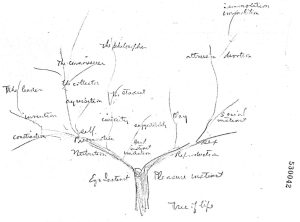
Chart of the Tree of Life
Paper on
“Crowd Psychology in the Church”
- Historical
(A) The Primitive Church
- Evidences of in Book – Acts
- St. Paul’s view of The Church as a living organism.
(B) The Church becomes popular after Constantine.
(C) The Monastic Movements
(D) The Protestant Reformation
- A Picture of Crowd Psychology at work in a typical parish today.
- Analysis of a service of worship
- Analysis of a Church Convention
- Popular rites and customs
III. Conflict between the individual and The Crowd in the Church.