QUESTIONS FOR “THREE REALMS OF LAW”
MBM – November 1942
- What would you say is the general characteristic of Mind Law working on nature?What are its effects when viewed in the large perspective of millenniums?
How much and where is the Realm of Nature objective to man left untouched?
Can you perceive in this same large perspective how it is that the application of the Mind Law to man himself, – the subject, – is the next great step? What illustrations can you give of the beginnings of this application?
What is the role of taboos, – mores, – folk-customs, -..ethics, – in this large picture of social development?
How far would you say that the Mind Law had progressed on the subject in the civilized world, or if you prefer, – how much is still to be accomplished?
- What have you learned about the Spiritual Laws that is new and challenging to your understanding?
Give five characteristics of Spiritual Law that are different from the Laws of the other two Realms.
Put in your own words MBM’s implication that man can perceive only a limited number of the aspects of the Spiritual Realm.
What is the meaning of the name Atropos, and what does Spiritual Law require of you if you would bring yourself under its influence? Explain the paradox of Spiritual Law underlying all other Law, and yet being apprehended last.
Name and describe four or five of the aspects or “facets of the Diamond” as perceptible to man.
Put into words what this course has accomplished for you and send to MBM.
(This series given in four condensed lectures by MBM)
QUESTIONS ON THE NATURAL LAW AND THE MIND LAW
Prepared for Question period, March 2, 1948, preceding MBM’s class on the Spiritual Law. Hence there is no outline in this series for the Spiritual Law.
Give some illustrations of the natural law, subjective
What are some characteristics of the natural law,
Give some similarities of the natural law operative in the objective world and in the self.
What is the purpose of the natural law in the scheme of things,
What is meant by fate,
Give some illustrations of mind law at work upon the self.
Explain the paradox about mind being and not being.
Indicate some differences between mind at work on nature objectively and upon the self.
What can you say about the shift of energy from the work external to that upon the self.
What are some of the functions of the mind; give the main steps in its development.
Why are mores,- legal codes, social conventions not enough for development under the mind law and the evolution of the higher potentials.
MBM in discussion with Training Group
answers to questions
March, 1946
Subjects touched upon: Evolution
Wisdom lore, nature of. Jason story
Heritage Stature
self and Self Soul
Objects of training Archetypal pattern
Aquarian Age Destiny
Karma Beyond the subconscious
Incarnation
Communism vs democracy
Question on the nature of Wisdom-lore.
Answer: It strikes a chord of response. Often you can uncover the deeper areas in yourself. It may get into the waking consciousness, too. And there may have been a contact with that layer in some other life; some memory of it may have been touched in the deeper areas and some reaction of that come through; some interest or rapport; or as something that started a deep reaction in the self. Or it may be that something in the stages of the individual are in analogous condition to that part of the story which has been read. In other words, there are many, many reasons for it, its affect.
Question: To what extent is heritage likely to come through ordinarily; to how much greater extent in training?
Answer: It depends on the degree of training, the intensity in the training, the cooperation in the training. It comes through in a kind of general way in everybody’s life, because the quota of what is actually, or essentially, you is going to be the factor that cooperates or conflicts with inheritance and environment. Some degree of it will be left in everyone’s life. It may be a small proportion but it is likely to be there. It can mean many things. It can mean trends or tendencies which are already being developed, which have received a certain degree of impetus and are on the way of expressing themselves.
It may also be in terms of negativism, – biases, prejudices. It is not all on the good side: evasions, bitterness, willfulness of any marked degree – those are in the heritage, too. Must remain there until they are worked off; the things you have done as well as the things you have not done.
It is, of course, part of the object of training to release the drives that are there, so that the life that is there can come out and fulfill itself as far as it can go in this particular life, or expression.
The further you go in training the more earnest and purposive; according to the amount of cooperation, so is the effectiveness of the release. So that the evolution goes on in terms of the life of the individual being, not in terms of the personality.
Question: How is Wisdom-lore used to aid the evolution?
Answer: Each story represents a different facet. For instance, the story of Jonah and the Whale takes up the challenge of initiation. The story of Adam and Eve, the story of the descent of the soul, that is something else again. The story of Persephone is related to it but it tells it differently than the Hebraic. All touch upon different aspects. The story in reference to the descent may not aid much in the evolution, except widening the understanding. When it comes to the evolution, then stories are of great significance. As for instance, the Hymn of the Robe of Glory. It touches upon four points: descent, forgetting, awakening and return. It is highly condensed.
The Greek story of the winning of the Golden Fleece. Includes some of the complexities.
Jason’s father had, strangely, given up the kingdom to a brother, who was to give it to Jason when Jason came of age. The brother tries to prevent Jason getting the kingdom. Much is compacted in that introduction to the story. The brother, on the throne, is the human self — the false, the lower, self. The true king has had to draw aside because he could not rule. The higher man comes last: “The first shall be last.”
Therefore Jason has to apply for that kingdom. He must first get the Golden Fleece. The story of Jason coming of age as a conscious, evolved, spiritual being — the size of the man who replaces the uncle.
There is encouragement in the way the Pattern is opened up; if he will use it. There are hardships on the way. Jason studied. Little by little, the consciousness of one who studies it is aided. If you take the story only intellectually and no connection is made between the student and the story, it is lost. That is having eyes and ears, and hearing not. The more he applies them the more he gains from the profundities in the story. …..Accomplished by experience and deep pondering.
Heritage comes through into consciousness, but operates automatically in the Pattern. In order to be effective it has to be lifted into consciousness and control; as in anything else; like things used in industrial projects today. They were all here from the beginning. Getting back the memories depends on your development, not where you are, as in the etheric body.
The self has many branches that are stripped off, but the ego is like the trunk of the tree; reduced to their essence, what is left. Not an identity. Lives add a momentum; it may be good or bad. May have to be worked off. You won’t remember, perhaps, until you come to a certain stage. Momentum does not add to the soul’s stature, but plus quality does. You gain through it; the real growth, or development.
Heritage and karma are related. Karma is built on cause and effect; heritage, the quality that is built in.
Use the term monad. It is technically more correct than soul.
Soul is used often in the sense of some deep emotion.
Technically, the individual is is, when an integer, or a one, is made of the two sides of the self. The conscious self is the end of a very long stream of experience, the persona, or conscious self. Most people know nothing else. When you have come to know the other side, and linked it with the conscious, you are making the individual. In consciousness, the two made into one. There is a long trail behind it, the heritage (or behind him) the fruit of experience, all kinds of experience.
All the heritage has to be transformed, if you progress. That can be done consciously. You ascend only by virtue of what you become, or are.
Question: What about the part of the soul that does not manifest?
Answer: In a sense, the soul never comes down. You cannot really compare it to a seed, for that belongs to this dimension. Use your mind to fill in the gap. The soul is an entity, not exactly parallel to the seed but with a life of its own; not, therefore, of this plane. Therefore it never comes down, but it animates this plane.
When you have reached a place; i.e., freed an area in your present being, or self, so you could open it and make it clean, then you can have a rapport with your own soul, or those parts of your being which do not come into flesh but which are of a higher nature and are striving to grow up, and make more bean seeds. (The bean as a symbol of life growing. G.B.)
Question: re the archetypal Pattern.
Answer: The archetypal Pattern refers to the Ideal Pattern, or IDEA Pattern, which was set for evolving life So there is a pattern for man, who is the divine hermaphrodite. That is the archetypal pattern for man, the First Adam. (Not Red Adam.) It is not known until man evolves very far with his mind.
Question: Is heritage also acquired in the etheric and psychic?
Answer: Yes. In the last analysis, the heritage is, in a sense, predestined. Nevertheless, you have your volition about it. In the archetypal is written the ideal design for every one of you. Whether you work that out — your potentiality into potency, is your own determination. It is in the ultimate seed from which you came; not the soul seed, which is a lower stage. It is the potential oak in every acorn. It is your work that does it: the reverent cultivation of the self.
Heritage never has anything to do with what a man or woman does, or becomes, in a material sense. It has nothing to do, specially, with aptitudes. Its primary business is with the evolution of the self toward spiritual stature. The things that belong to what you or I do on the physical plane are very incidental. The big stake is the evolution of the soul to the fullest stature. The aptitudes are not things that really come from the soul or from heritage. They are earthy. They belong to the human being.
Karma has to do with the size and quality of your being. It does not concern you as a human being. It has nothing to do with aptitudes in the human sense. The drive of karma may be away from physical values. Heritage does not work in terms of physical determinants. It works in terms of qualities of the being; is within the volition and height of the evolving monad. The monad shows its stage by the way it uses those qualities.
Question re qualities of evolved beings.
Answer: There are certain standards set by a college to obtain a piece of parchment, but not all graduates are alike. It is potentially in every monad to become as a god. It has a potential power, if it will get the experience, evolving through the ages. All won’t be the same. The greatest freedom is in completest obedience to Cosmic law. It is left to the individual whether or not he does it.
The “Foolish Virgins.” The Bridegroom says: “I know you not.” There are certain powerful laws that govern the higher evolution.
Question about whether the soul is active in the deeper areas beyond the subconscious.
Answer: It is dormant, potential. As with things that the last fifty years have brought into man’s physical life. Research; and now they are made manifest. So it is with the powers beyond the sub-conscious.
Question about incarnation; is it gradual and partial?
Answer: Yes, in a sense as with the redwood tree. Only as far as the form can lend itself can manifestation take place. If the brain, or nervous system, is injured, or does not develop, the life force, or the monad, which wanted to use that body is handicapped. Most do not use their potentials. They go the way of pleasure, the easier way.
Question re Spittler’s “Prometheus and Epimetheus.”
Answer: Spittler’s Prometheus and Epimetheus is a mystical variation of the theme of the Two Brothers, foresight and after sight, worldlings and other-worldlings. Spittler is using the original allegory, with his variations. Some people using old allegories ruin them, as Disney with his “Snow White” picture. Others, like Spittler, make it radiate, so that the potentials in it are made manifest.
Question re communism and democracy, can they be reconciled?
Answer: They cannot be reconciled. Extent is what is in the Pattern. It would stultify growth. But one will influence the other.
MBM with Training Group
Answers to questions
continued
April 4, 1946
Subjects touched upon
aptitudes Teachers and noumenal
qualities worlds
opportunities young souls
need for variety of experience Why God is not known
safety motif, not good Vaughan’s mountain
sketch of cosmogony stages
Question about aptitudes.
Answer: If a soul takes on a vehicle purposively that vehicle may be flexible to the needs of the incoming soul. So the body plays a part. Then, also, there may be opportunities within the life of that human in earth to develop that body.
Qualities are the result of a distillation. There must be also latent aptitudes; there must be something to foster the manifestation of that aptitude. Also a readiness in that soul for an interest in that direction. It is not simple; many factors contribute. An overtone goes with that aptitude; it goes with that monad. There must also be a circumstance to pick it up.
Question: ?
Answer: It is better not to stay in the same situation or attitude too long. The same opportunities in the seedlets……not stimulated. The seedlets are there from the beginning. They have a variety of experience, and that challenges you. To be safe is not good; it is bad for humanity.
Question re Teachers. Do they have places in the noumenal world?
Answer: The Teachers who have reached that stature are free to travel. Unless there is an assignment. But the Homeland is in the noumenal worlds. Those who belong to the higher worlds do not stay in the higher worlds. They can move down on any levels.
Question about young souls.
Answer: Young souls are those who have not yet come to consciousness. They are tossed about by the inheritance of the body, wholly under the influence of fate. They are young even when they begin to come out of it.
Question about God.
Answer: God is not a being in terms of anything man possesses. So he cannot know him.
Question re “the mountain that is near, yet far” (Vaughan).
Answer: Through devotion, it is near (7th rung, ladder of Set); when your polarization changes, it is far away. It is invisible, until you have eyes to see it; not physical eyes. (It is) “hard and soft; enduring, yet yielding” — by applying ourselves in the right direction.
Question re justice.
Answer: It is accurate, strenuous, ruthless – the discipline side of things. What is implicit in justice that man does not know; yields to love and devotion as a tender mother.
Treasures come out as the unfoldment goes on.
Draft of Foreword
by G.B. to
THE THREE REALMS OF LAW
Lecture Series 1934
by MBM
These chapters are based on the lecture-series THE THREE REALMS OF LAW as given by MBM in 1934 at the School of Applied Philosophy in New York City. MBM has given this series at various times, both before and after this date, always with new and more diversified illustrations to enflesh and clarify the principles embodied in the lectures. Each time, too, she has taken her hearers a little more deeply into the profundities, of which the Realms, and the systems of Law under which they function, are an aspect.
This particular series of 1934 was chosen for the present booklet, first, because the notes are extant in fuller verbatim form than in most of the other series on the same general subject; and second, because it represents a sort of balance between the earlier forms of the presentation, with their emphasis on the scientific and psychological derivatives of Spiritual Law, on the one hand, and the more outspoken references in the later series to the Gnostic Source from which MBM draws her knowledge of Cosmic Principles, on the other.
Another factor in the selection is that students attending the later series have come, generally speaking, with greater appreciation, through their own experience, of MBM’s stature as a Teacher than will the average reader of this little book. They have come, too, with considerable background in the modern psychology of the unconscious, and, in many cases, with a direct contact with areas of being beyond the subconscious — areas in which an appreciation of the higher Realms is more likely to be attained than in the life of ordinary waking consciousness and practical affairs of the world.
The later audiences, moreover, have had the advantage of such preliminary courses as The Training School of Earth, the Household of the Self, the Nature of Man and His Psychology, and one or two series, at least, In Metaphysics. References to the forces and substances of Higher Space, which occur rather frequently in the series as given by MBM after 1940, would therefore be more readily understood.by such hearers.
On the other hand, MBM employs the findings of material science so extensively and so cogently to lighten up the operation of Law in the first two Realms that anyone familiar with the developments of modern science will perceive the validity and the accuracy of the correspondences she brings out in the dialectic method she uses. Indeed, even without such formal knowledge the keen observer of everyday life will grasp the essence of the teaching. In respect to that essence all MBM’s audiences have had an approximately equal opportunity, though of course the wider one’s horizons, and the more open one’s mind, the further the penetration.
In similar fashion, the broader one’s acquaintance with the behaviors and laws of the human psyche, in its orientation toward earth, the better will be his equipment in following MBM’s exposition of the unfoldment of the psyche and the mind in their approach to the Third Realm and the larger Laws. But here too observation, sensitivity, and the open mind are more valuable than books.
MBM’s use of the second person in addressing her students, and her phraseology and expression, have been retained in nearly all cases. The idea has been to preserve the flavor of her descriptions, somewhat as, in an earlier school, Plato must have sought to preserve the atmosphere of the discourses of his master, Socrates. Such faithfulness to the spoken word is in the interest of accuracy too, and is likely to be of special value where subtle shades of meaning are involved.
So, if there have been occasional turns of speech strange or awkward to the contemporary ear, they have been permitted to stand, that nothing of content might be sacrificed in a striving for mere suavity of form. MBM herself has never compromised with the dicta of the literal or conventional mind in setting forth the principles governing the life and evolution of the human soul. She is a Wisdom-Teacher of the Order which come to earth only from time to time, to light the Path for those seeking to know the meaning and purpose of life, free of the limitations of creed, cult or an -ism, and eager to begin shaping their own lives toward the lofty Pattern taught by all these Messengers.
No intelligent shaping can be done without some acquaintance with the Three Realms of Law. They constitute, as MBM has pointed out in other presentations of this course, the vast “backdrop curtain”, against which the whole drama of the human evolution is played. They are, as it were, a universal frame of reference, against which the progression of the soul is to be measured. The degree to which the challenge of the higher Realms is accepted, and their commands obeyed in daily living, is a measure of the advancement of conscious evolution. It is the degree to which the individual soul accelerates its Journey.
The Three Realms have been known to all the great racial and religious traditions in which the hearts and minds of men have been nourished through the ages. They have been the subject matter of myth, allegory and parable wherever the Messengers have brought to humanity the long-range perspective and the means of hastening the movement forward toward the ultimate destiny in spiritual goals. Yet these “Realms” are one of MBM’s most fundamental and distinctive contributions. And this for many reasons.
For one thing, she has uncoded the symbolism in which reference to the Realms of Law has everywhere been clothed. At the same time she has demonstrated the universality of the Teaching regarding them, and the complete harmony of the ideas behind the symbolism — in other words, has made clear that in the Three Realms we are concerned with an aspect of eternal Truth, a rock of stability, a permanent guide and standard, safeguarded from the tides of time, opinion, prejudice, attitudes and the mores of earth mind generally. They are thus a staff of support through all the confusions of the world, the chaos and contradictions of the life of men. Could any staff be more needed by the groping, spirit-starved earth of today?
Again, MBM has given us an organized, systematic exposition of what usually appears only in scattered and fragmentary form through the sacred literatures. Even in the loftiest philosophic writings the subject is not treated in an ordered, sequential way. Numerous indeed are the evidences in sacred texts that the way onward is through the application of the Mind Law to the self, and that the goal is cosmic stature, or the Realm of Spirit. But the modern mind, with the best intention and intelligence, is not likely to succeed in tracking out these references, nor to synthesize them into the vision whose realization awaits our becoming. The mind must be aided by the revealing insight of such a Teacher as MBM.
In that revelation is included, without blinking, the struggle and the travail involved in a genuine advancement and unfolding of the potentials of the higher nature. Fearlessly, uncompromisingly, she speaks of the effort, the sacrifice, the learning and the building that are essential, – the need for practicing upon the self those methods of control, construction, refinement that man has practiced with such success upon the world outside himself. His powers must be harnessed now to the development of his own qualities and powers, his own organism, visible and invisible, if his very success objectively is not to become the ruin of his present mode of life and civilization.
Of course, in a lecture series little more can be done than to map out the steps of the Journey, or rather, to sketch in its principal stages. And MBM is tireless in reminding her students that the traveling itself is not done, save as the laws are applied, and the signs of growth become manifest in all areas of being.
Nevertheless, a map has distinct uses and values. It is food for the mind which would stretch to philosophic insight and understanding. In showing forth the sequential nature of the stages, conditions and types of life and behavior through which the true seeker must pass – somewhere, somehow — MBM has made another contribution of inestimable significance. She has conferred a boon upon the thinking mind, which craves Order, and which needs the assurance that Order is at the core of larger processes,.at least as much as it is in the constructive processes of earth.
The heights that dazzle the aspirationist are still there, and they stand out even more clearly, but the way of mind-leadership toward them, which is the Way taught by MBM, is consonant with reason, volition, causation, justice. It never seeks to evade these guardians. So are illusions dissipated and frustration avoided. When the student becomes a tutoree, and begins to take the first steps on the Journey himself, he finds that MBM’s guidance is marked not on|y by reason and justice but also by the stimulating watchfulness and the warmth of heart which the true Teacher draws upon in himself as naturally as he draws upon the Great Source of his knowing.
So MBM’s teaching on the Three Realms of Law, as in other departments of Wisdom-lore, is finely attuned to the best in the outlook and training of modern man, and to the dawning apprehensions of his consciousness. It is in complete harmony with the acquisitions of the age in scientific knowledge. That knowledge is gradually confirming “from below up” what the Teachers have long proclaimed “from above down”. In MBM’s case the Teachings actually utilize the findings of material science to light up, via the principle of Correspondence, the steps in a super-material science, the Science of the Soul. This has never been done before, because the Teachers of previous ages did not have these great stores of earth-mind development, and its achievements in the physical world, to aid them in pointing the Way.
In addition, MBM employs the findings of the modern psychology of the unconscious, of which she is a past-master. Here she wields a new weapon in the penetration of human problems and the release of blockings to the potentials of the higher self. For the higher self can function only feebly until these problems are handled, mindfully toward earth and the practical life, but as incidentals and preliminaries to the Journey, or the Quest.
Thus are the Teachings of the Pattern of Evolution, as brought to men by MBM, organized, supported and illumined in a manner peculiarly adapted to the needs of this new Age. It is to be an age of mind-leadership, but its best work will be buttressed, nevertheless, with faith — a faith based on a knowledge of the cosmic structure — and the sense of the brotherhood of souls. Faith and reverence were the quintessence of the previous Age, not yet wholly past, and their values are not to be lost. But now the faith is to march in the company of understanding and insight, and the brotherhood to be made more conscious, more mature, more steadfast. It will be based on the perceptions of the growing soul rather than on kindly feelings alone; on spiritual realization rather than on aspiration.
One of MBM’s supreme contributions, magnificently exemplified in this course on The Three Realms of Law, is her synthesis of man-knowledge and Wisdom-Teachings, to the end that awakening souls may be led to experience, in and through themselves, the Brotherhood of Man and the Fatherhood of God.
Diagram used by MBM to help illustrate Lecture I of this series on the Three Realms.
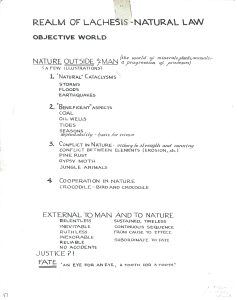
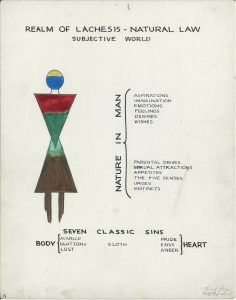
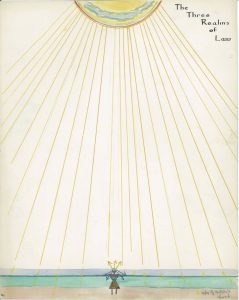
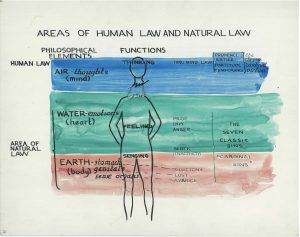
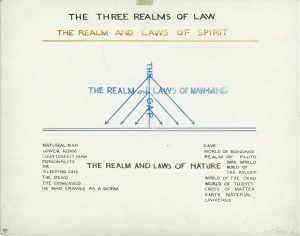
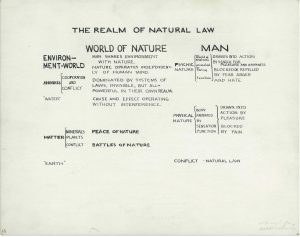
THE THREE REALMS OF LAW
The Natural Law – Objective
What is law: definition
Operations of invisible government
Orderly within itself
Make nature safe and friendly
Three Realms of Law; related to different areas of man’s being
His generic endowment: body, soul, spirit
Misunderstanding of the workings of law in the
different realms a cause of many dilemmas
Greek myth of the Three Fates.
helps to clarify the three realms of Law.
The Realm of Nature in man’s being.
He places too much emphasis on Lachesis, earth, the Fate of the Natural World
Partakes of two other realms
Thread of Atropos works throughout all the planes;
Different behaviors required in the different planes.
But there must be a harmony, a linkage among action in
all three, not a dissonance.
How the Natural Law works: some characteristics of nature objective
to man:
It is independent: examples of drought, floods, pests.
Ruthless; many types of life wiped out.
This on the (to man) tragic side.
But we.can reverse the picture, and we must see both sides: make our stage secure, safe, reliable.
Its procedures orderly within themselves.
Relentless, ruthless, only the way it looks.
We will study something of the Three Realms of Law objective to man and subjective.
Names for the material world: cave, dark world, world of Pluto, etc. but nature is not the end for man;
being three-fold he is only a sojourner here.
Red Adam; Counterfeit Man.
Man in the “cave” in a condition of dis-ease.
World of Thieves
Perspective of the three Realms, and right action in each necessary to living an intelligent life of wise choice.
Man walking with his “feet in earth”.
Soul and spirit in other Realms.
He is spread over all three in varying degrees; which is a reason for many of his blunders
Not enough to know the things that belong to the three Realms, without putting into action
COOPERATE WITH EACH SO THAT THEY ARE LINKED, but not act in one as you should in another
Process of At-one-ment; or harmonizing what has been torn asunder by the descant into earth.
Putting humpty-dumpty together again requires, as part of the equipment, the understanding of the threads of the Three Fates.
Our subject tonight: nature outside of man.
Processes belonging to the mineral world.
May be catastrophic to man, or beneficent.
Seasons; weather;
No accidents in nature — we simply don’t know all the laws.
Disentangle yourself from the idea of “being picked on”, when the operations of nature interfere with your plans or your welfare.
Conflict in Nature.
Pine rust; gypsy moth; animals in jungle; pests.
Not peaceful for Nature.
Nature’s octave is only nature; you have two others.
Bacilli in body. (touching on next week’s subject)
Within each realm there is battle.
“Survival of the fittest” in nature.
Strength developed through competition, adaptation.
A small field of cooperation at the top of nature’s gamut.
Next week the world of nature peculiar to man.
Summary: Value of seeing something of the Natural Law at work in the objective world.
Helps us to understand something of the stage on which the self and other selves act.
Serves as the very useful “animated, picture book.”
Relativity, keynote in scientific research
philosopher
Facts of Lachesis in relation to Clotho, Atropos
obj. world and corresponding world in ourselves
Obj and subj. aspects in three realms
facts assemble in regard to the realm of nature subj. as we did obj
earth, water, two thirds of us in realm of nature
First: birth, fatigue, sickness, recovery, decay, death of body
5 senses; appetites, world of appetite, of sex
Emotions — wishes, desires, our imaginations, aspirations are under
the natural law
man of nature
Have to understand before dealing with the world with
understanding
make for dilemmas, but are also our blessings
Peculiarities of the natural law:
external to man, to nature
work from cause to effect
continuous, tireless, sustained by a momentum from the Source
to remain in that realm is to be subordinated to earth or fate.
appear to be ruthless, relentless bec. meant to be
laws inevitable to the scheme of things
to provide a stable stage on which or within which souls may evolve
?, safety
If these laws did not operate regardless of our wishes, hopes and fears, there would be no opportunity for mind to develop. Ponder on this statement. Mind is dependent upon the security which the stage of the natural law, both obj. and subj. provides.
If the laws did not apply to all…………
Just because of the relentlessness and security of it that you and I can build reasonably safely on the rock which the law of nature makes for us.
Law of nature and the subconscious.
domain of the natural law.
Sex attraction is a natural thing we say. What we mean is that it is
something governed by laws that operate everywhere in healthy
bodies; nothing either right or wrong……it is fatigue….
Here I would remind you that this evolution of souls in earth is
voluntary and that it is to bring potentials into potency. Above all else to develop mind.
From the soul 3-fold man….Man in earth tries to develop the things
of earth with his appetites, then emotions then thoughts. In
this acorn are stored….. heritage….
Man therefore, by virtue…….is more than a natural man.
And therein is conflict…….Not coerced, except by his
discomfort. . . . . .other solutions
body sick….don’t find it pleasant. doctor, has studied how to do something with the natural law
But when trouble is with the emotions which have run amuck
A beautiful series, even though end product is undesirable.
stage setting – well planned scheme
Under the sequence of the natural law — whether of the body in regard to disease, or nervous symptoms, or in regard to wishes, frustrations, emotions which have run amuck, passions lacerating – you get a sense of that sequence which challenges you, which gives you to think, and sets into action the next realm of law.
But before we pass to that realm…….running amuck under the natural law. The seven cardinal sins a running amuck under the natural law. place of fixation, trouble…..erdenergy and movenergy when it has run to the bad.
avarice, gluttony, lust are the running amuck with the body.
inoculated. pride, envy, anger. Sloth
Later the seven classic virtues. Average humanity about in middle of the scale from the dominance…………
want to go to mind law obj to man, as well as finish this summary.
Natural law in man has to do with body and heart, and is subject to all those six regulations
accept that it is natural. first the natural man.
You don’t help matters if you condemn
There is only one solution to any dilemma which a series or a sequence of the natural law can work in you along the lines of when body is ill.
next evening enlarge on natural life in man when we begin to see it in juxtaposition to the realm of mind. . . . not finished with the natural law subj
up to this point emphasis on natural world external to man, the self, and the material law operating in that world. The material law a province….But there is also the subj….
these 2 provinces do commerce with each other
Turn to a consideration of mind…..then again to the objective world and see what the mind has done on the realm of nature objectively. Next evening subj. so we weave in and out 3 times; 6 sets
Strange dilemma….does not exist of and by itself….
bridged by our mind’s development.
evolves as we evolve into it, or become it.
“A natural man receiveth not the things of the spirit” Cro.15,45
Souls are. Minds become. the very thing that souls are on
Early steps in the development of mind……tribe……need thinking.
mfg. a product
observation – – – humble beginnings of the stature of mind.
stature of mind today very humble. ..when man has done on himself what he has done outside.
What has occurred as a result of man’s mind turned on nature.
Not one law of nature changed. But matched, learned how to meet…
pile…dev. of mind on the obj. world.
forestry, insects. care of trees, surgery. shoes….. pearls. ships, radio, fountain pen. Understanding ever more the working of nature, combining and re-combining, amplifying and modifying the laws.
Bk of Genesis. Naming the things Jehovah brought before Adam. The Five Books of Genesis sketch allegorically many of the processes of the dev of man from the natural law, through the mind law, to the spiritual law.
brief refin code…THE NAME MEANS TO KNOW..as chemist working on a lacquer… we are still doing it.
minds develop as we exercise them
curious contradiction, or apparent contradiction: that as we control nature we evolve mind; bridging the gap by work apparent external, actually bridging it in ourselves subj.
kindergarten……….The object of the teacher is to lead you on to other things.
We did not know these things as children. By the same token…
learning to build houses quickly, ships, forestry, we are learning lessons obj. to us — lessons that are meant for something else. We always learn outside first. to have an env.
You can’t think of yourself as living without an environment. That environment is your punching bag, kindergarten, training school, but with an ulterior purpose. And the ulterior purpose is the evolving of mind in yourself, because that is the faculty which alone is competent to take you from the realm of nature to what we call Atropos, or spirit. That is the bridging of the gap.
not by making lacquer, running typewriters, etc . . . .but they are extraordinarily helpful. We could not get to what we want without them.
It is for that reason I have chosen the pattern I outlined before, going from the obj. world . . . .but mind can never control nature except by first understanding it. That is what is meant by the old Book of Genesis
bacteriology. . . .warriors of peace…setting one insect against another. Government spending millions….mosquito control Panama Canal…..
Jason and the Golden Fleece…. warriors that fought each other.
Man has come this far – releases him
Draw a few points together. . . . .As Goethe says: “We have so long thought of authority as truth that we are reluctant to accept truth as authority.” We have to set up truth as our authority and down with authority that is not truth.
Conserve all authority that is based on facts. But wait — what are facts. Facts of three realms. Relativity is the order of the day. Facts of the natural law, of the soul and of spirit, as we see the facts that mind has worked out in dealing with nature.
Six areas of facts, or six areas from which facts may be deduced.
if you take apart
the philosopher is a philosopher only by reason that he recognizes facts, sets of facts that the materialist has not yet come to.
We have to take account of ourselves in a larger perspective. . . .the threads spun by the Three Fates….
threads of six. always environment….
don’t take off a segment…..
Lecture I on the Three Realms of Law
Excerpts
MBM – October 21, 1926
Note: This seems to have been MBM’s general introduction to the three realms, or three laws, as given in an early version. In later courses on the subject terms used sometimes differed from those reported here; e.g. human law to mind law, or sometimes moral law; Cosmic to the Larger, sometimes spiritual Law. (GB)
How the Three Realms relate to man. They are always at work. The human law in a strategic position. A pivot, of mind. Powers (of?) embryo mind do exist, and mind is being made as we exercise our powers. How does it work? As it reasons it discovers causes. Lives not only for the present but also in terms of the future. Has to provide for the limitations of the natural law. Mind, with the aid of heart, which is social as against the individual nature of the mind, finds beauty lovable, is drawn to it, increases it and establishes harmony; finds the place of the pressure, and establishes ethics; is devoted to causes, purpose, and develops obligations. This urge upward must come through the reason, through affection, a faculty of the heart, and through religious aspiration, which is the power of the higher psychic when the soul centers begin to be exposed.
Nature is red and green; man, red and green and blue. Animals also have heart but it is not the rational and has not the higher development on the psychic which the human has.
In the training school of earth is the opportunity to practice linking the kingdom of nature with the kingdom of the Cosmic. As we demonstrate our understanding of these realms and demonstrate our ability to live in terms of that understanding, and synchronize with all these realms, we form a line, between the realm of nature and the realm of the Cosmic, the bridge to be built between the world of nature, which is, in a sense, outlawed from the Cosmic, and the Cosmic.
Regulating of the babe’s activity by the parents is the first application of the human law to the natural law. The learning of mine and thine. Adolescence and the limiting hand put on it. Not always wise. The two laws in conflict; causes frustration, anger, heat. That heat continues struggling until one wins. In the long run the natural kingdom does not win, and never will win. It is the way up, and whether we see it or not does not count. Consciousness, mind and progress are our link, in a peculiarly intimate way. First heat develops, then light. We develop reason and then mind. Must be used to remain with us.
Mind develops only as it is voluntary, just in proportion to the interest. Or else by conflict. Subtle aspects can only be acquired by the adult. Some part of us may be infantile. Physical fatigue; it is of the natural kingdom; another part is ambitious; there is frustration, anger, or you submit to it. Fail to put light on it. Physical limitations on ambition. Emotions are the natural law. When you try to control anger there is a battle between two kingdoms. Fantasy is under the natural law, but over it is the operation of the law of mind, which has a little repulsion against it. The natural kingdom is not wrong, but it is raw. The task of the mind is to organize, rule and finally dominate. Most of us battle a little while each day; for others, 24 hours.
When shall we be submissive ….. when we could use repression? Don’t do it stupidly or ignorantly. Ask, what can I do to prevent it next time. The harnessing of nature within ourselves is as difficult as outside of ourselves. We have the advantage of profiting by all the experience man has had in the struggle with the outside world in the natural sciences. Progress is not even, but progressing through a synchronizing. True occultism is practicing and synchronizing the law of nature.
Two uses of the word natural. To be lazy is to be under a lower law than that of man. A second sense is that of ease, a manifestation of the greater age of that specific soul; has become familiar with the working of a law and does it without friction.
The human law, in a sense, does not exist because man has not yet mind, but he has the strength to the making of mind, namely, reason. Memory, the link to be forged by us. Reason to be exercised on the kingdom of nature will make mind. The thing that compels us to it is the unconscious memory, which is registered, inevitably, by a condition in which it wins us, without mind, to the seeking the way home, into the Cosmic.
The Moral Law
MBM – November 22, 1928
These notes are from one lecture in a series of twelve which MBM gave on the Teachings of Pojodag (later, The School of Applied Philosophy.) The series was given on Thursday evenings beginning at 7:00 and was for students who had already done some class or individual work; beginners classes at that time were held at 8:00.
____________
The question of relating ourselves brings us to the question of ethics. (mores: usage, custom, character.) They change from time to time. They progress, and unless we get this sense of flow we miss the point.
We must fit in and actively take our part in the period in which we live. What Jung calls adaptation. Secondly, we must remember that our laws, manners, ethics, etc. are not ultimate. We must recognize a great process at work, which is progressive, which has its rhythms. It is interfered with by human thickness.
But in spite of these two considerations, this progress of the interpretation of right and wrong is concerned with man’s discipline in earth, and his becoming. Man should play an increasingly conscious and voluntary part in applying this ethics, so that he may administer discipline to himself out of his own desire, on the one hand, and out of his fullness of understanding. Ethics, or the moral law, is essential to man’s evolution. There could not be any human relationships without it.
At the dawn of history the effort of humanity to live for itself was regulated from the outside, but its whole trend is toward insight; and its objective will not be accomplished until each individual human unit functions perfectly. He shall function with the highest ethos (?) in relation to himself and to others; and in relation to others in terms of a group: 1) with himself; 2) in order to relate himself perfectly to individuals; 3) to groups, because humanity is made up of groups.
The birth of morals (was) from two main points of pressure: one from above, one from below: coming from the ancient gods who, through fear and awe, were able to exact a certain kind of behavior from the people. The Old Testament and the behavior Jehovah exacted from his people. Another kind, said to come from the Golden Age, carrying intelligent comments, or instructions, from the gods.
The birth from below is on the basis of what experiences — painful, desperate, sometimes mysterious – does. Man, who is as yet ignorant, had to do things for the maintenance of his race. Sometimes the two are blended: like planting grain as an offering to the gods and to help themselves. You can’t have any kind of a crop without having some regulations for its welfare. Life craves self-preservation — not only wants to continue itself but make itself reasonably comfortable.
Some things necessary are apparent beforehand, but other things cannot be, because the experience of the group changes from time to time, due to the variety of experiences and new factors which are met. These must be adjusted from time to time. No experience can be foreseen. Principles are definite but experiences which illustrate, or animate, principles cannot. That is why morals have changed and must continue to change. New conditions, new factors, arising often out of the situation itself, may be assimilated and become permanent.
Both kinds of administration, from above and below, have at heart the well-being and the development of man.
Oracles made threats if people did not obey. Administration from below made the taboos, prohibitions, obstacles. Worked first through fear – lightning, new creatures in the forest. Worked through pleasure-pain. And from these rose folk customs.
Which implies, in the beginning, ignorance, or the early stages of mental consciousness. Or the first two rungs of the mental ladder. But without these customs they could not survive; had to meddle to protect themselves from the beasts. Later, another kind of Why. No longer survival but convenience.
All the while, as the why’s change man is growing up. Primitive man was much more ruthless than modern man. Had no higher emotions, or reason, or understanding; no affection, fierceness, independent action without any good-will. Man had to be stopped from that ruthless independence. Not because he wanted it; he, was a blind, sub-emotional individualist.
That gives way to a communal spirit; and then comes a new kind of individuality. There are great rhythms and small rhythms. (the earlier stages) were all right for them. They were coarser; it would be worse for us. Man had to be forced into some kind of communal action.
Group functioning is necessary for the future. Everything has its own rhythm, including ethos. Therefore need thinking was essential to man being forced into group action. It was not only inevitable from the development of earth but necessary to the evolution and development of man, determined by the earth forces. You can see the process by philosophical thinking.
If man’s first development was through need, then pleasure-pain, then the establishment of mores of this group against that; note it established regulations which were both good and evil. The Mosaic law, mores, as to which man shall do thus and so: exogamy, endogamy, etc. If you broke them you were unethical. Persons were set to watch that the regulations were obeyed, akin today to the police, the army, the navy. The idea being: It is good for your race, tribe, city, nation, etc; and also good for you.
These are the setting up of discipline from without — force from without; few who (?) operate from within out. They should do what should be done — from within.
Now, what is right? That brings us to the question of conscience, which is the first operation from within out. What is conscience? The “still, small voice.” It comes from the transliminal. The traditions of the previous age sink into your transliminal, and come up again and manifest as conscience. That is why everyone has a different conscience. It will depend on the tradition of your race, legality. But if you understand what conscience is, from the standpoint of modern science, you are out of the dilemma. You are functioning from the sediment dropped down. You should function from the conscious, higher mental understanding. Get rid of your conscience, the accumulation of traditions of the past. Conscience is an uprising from the transliminal as a result of that. No one’s conscience may be good, or right. The past we have had is not worthwhile. So far (it has been) ethically hard, practical.
As man gradually becomes more conscious the voice of his gods becomes gradually weaker. Man gradually undertakes to discipline himself.
Absurd as this conscience is, it is nevertheless the first step of man undertaking his own discipline — or acting from within out. As we are developing toward a higher consciousness the idea of a democracy, or a utopia fades away. What we have left of the voice of the gods is a weak authority. Doing good, kindness, charity is a balance of the voice of the god. With the dawning of consciousness man again is to become an individualist. His religious symbols were but indicative of the trend.
The real why is to make of the human creature a self-conscious, self-managing unit, wherein its behavior reflects the highest wellbeing in itself as well as its effectiveness as a member of the group. This means it will eventually learn to function not only in right for right’s sake (today they are mostly opportunists) (but) the next step is for the sake of the great good — the most effective evolution through earth to the higher states beyond the earth.
Two thousand years ago some thought good lay in the highest happiness to the individual. They were called Epicureans. The Epicureans ate barley bread, water and wine, not delicate foods. They believed that happiness was to be found in the development of the self. Pleasure was the great good, but it was not a physical pleasure. (Thus it was) freedom of the body from pain and the soul from anxiety, egotistic hedonism – not merely physical pleasure.
In contrast to that was another school, in the l8th century, called Universalistic Individualism, which meant the highest happiness for the community. Another name, Utilitarianism. The two extremes!
Plato and Aristotle believed in the perfect individual, and that the only way to happiness cannot go the way of conscious evolution without an idea of why. The Greeks had a conscience which concerned seeking for the good but had no conscience in the sense of our modern conscience — of duty, etc. Ideas of virtues change from age to age.
From the larger point of view, few know the real moral law: living so that the future may live as you live. You must relate yourself to the present, but you must somehow do that with the objective of doing something else that is bigger, and relates to the capital law.
Free will: As long as we are forced to act from the outside we are under fate. The customs are your boss. If you step out of fate so -that you don’t get a boomerang and go to something lower, you must bring to your action something which is a plus. You have no right to break even the simplest convention unless you are adding something. Otherwise it is infantile. Only then are you moving toward the greater Law. If it adds something finer, constructive, a basis for a higher type of life, then you are adapting, instead of adjusting; then you are moving toward the moral Law, instead of through fate or the police officer.
As you move toward the great Pattern, conscious evolution, watch that you are understanding the why and adding that which is in a higher octave than the behavior you have had before. Right ethics is a use of the understanding of conduct of the self in its self-conscious relation to the Cosmic gods, to the great Pattern, to your fellow man, and to the most balanced functioning of the selves in the self.
As you are doing this you find the happiness which the hedonist looks for. It is a test of your wellbeing. If you are happy in the self-conscious self — not just in spurts — that is a token of right relation to the Pattern.
Free will means not only knowledge but being liberated from the compulsions from the transliminal. Or at least we make the second persona, out of which the individual arises.
Fragmented notes on THE THREE REALMS OF LAW
as given by MBM in 1934
(used by GB for series on Natural and Mind Law
for Section ’46, February 1948)
Sets of facts…..almost forget that we know them…enshrined in books and called laws.
Word law means: laid, fixed; to make to stand.
LAWS ARE THOSE OPERATIONS OF INVISIBLE G0VERNMENT — Nature if you like — that sustain in an orderly process those things which belong to our material world.
do not always think it is orderly, but before we are through …. orderly within itself. misunderstood several realms in which laws arbitrate.
misunderstanding of these three realms of law, to be discussed in this series, a primary cause for human dilemmas, and is a deep seated source of disease within the mind of man. perspective later. This evening field of the natural law. other spheres. Forbear to make your mental synthesis…..
s
ubstrata in daily life that we have almost forgotten that we know it. LAWS MAKE NATURE SAFE AND FRIENDLY BECAUSE FAMILIAR. What a topsy-turvy world if. … …water in glass. . .heads on pillow…..
Just in proportion that these things do not occur, and that we do not expect them to occur, do we unconsciously realize that the world is governed by law.
Now there is the law of the Natural World, the world of Nature. In our studies we will see these three realms, beginning with the world about us, objective; and also in the world which we possess, – not inward but of the subject, therefore subjective.
Man in terms of earth and water is related to Nature; the other two elements will come in later.
But it can also be said that man is body, soul and spirit — the original endowment of everyone; that from soul springs the three-fold man in earth, with the object of evolving mind, so that he may come to the fulfillment of the potentials, that is ripen body, soul and spirit to their fullest.
We will begin with the idea of man, composed….body, soul, mind and relate this to a very interesting old Greek myth. Titaness, Themis, meaning law and order…mated with Zeus, who symbolized heaven, and that from this mating sprang three beings called in crowd language the Fates — the Three Fates.
Plutarch..source of esoteric knowledge. .names LACHESIS, CLOTHO, ATROPOS
These three, in the old sacred allegory of the Greeks, have to do with the Fates of body, of soul, and of spirit. Their mother is law, order. So they symbolize the further working out of law on the levels, or planes, of spirit, the plane of soul, the plane of body. Names in the Greek allegory for the three realms of law. (others have them too) So that you and I are governed by three Fates.
Not on one plane, but on three different ones. And it is the misunderstanding of the thread of influence, which simply means the operation in lawful patterns of those laws set in motion, that has entangled the humble and mundane threads of your life and mine, until we have understood them.
Man is not a creature merely of nature. He, as it were, walks with his feet in a physical material world, the world in which your feet walk to bring you to this house, the world of your bodies, of your appetites, occupations, too much of your interests.
We are apt . . .terms of Lachesis — earth — the fate of the natural world. But there are two other Fates, and these three fates are always working together. They come from the one Source, beyond all three of them. And as we walk with our feet in earth we must come to know that there is…..or the threads of soul and spirit.
THE THREAD OF THE INFLUENCE OF ATROPOS WORKS THROUGHOUT ALL PLANES. Clotho from the soul down. Lachesis, which we think is so important. . . .operates only in earth.
the larger includes… …..linked with it.
Difference between linking of influence and identity of influence.
So man walks with his feet, figuratively speaking, in a material world. The ambitions of his heart and soul, take him into another, the realm of Mind. And the as yet, unfortunately, too buried influence of his spirit relates him to Atropos.
Taking our analogy to another figure of speech, to the elements, man must learn to walk, to swim, to fly. Press further . . .If we should act in water . . .Swim in water, or act according to that element . .
Cues to what is implicit in the behavior which is required in the three different realms. You may not act in the realm of water, or Clotho as you act in the realm of Lachesis. Realm of Atropos . . .but there must be a harmony among action in all three, not a dissonance. Otherwise you are attempting to break the linkage
I hope I have conveyed something of the significance of these three realms through the allegory…with the comparison of man’s generic nature of body, soul and spirit, so that you have a kind of perspective of the study which we shall follow.
Now more immediate things. We propose to watch, via specific illustrations, how Nature works ….objective to us . . .so see whether we can gather some little ideas of the typical behavior, lawful within its sphere, that maintains existence there.
What is Nature objective to us? Has been on earth and in the planetary regions and the universes of the heavens, long before we came to earth. THE REALM OF NATURE IS INDEPENDENT OF MAN. Sojourns.
And coming to sojourn there he must have something of a like nature, in order to sojourn there, and that is his body.
But the world of nature is independent of man. Its laws are not the laws of man. Something dramatic to begin with. Peaceful town. .Mountain rips open.
China . . .drought
ship . . . water spout.
Texas….Florida…cyclones…tornadoes….Mediterranean Fly.
Ruthless. And you say, How brutal! Glacial age. many types of life wiped out, animal and vegetable. ..embittered…. embittered atheist.
These are illustrations of the workings of nature in the world about us, objective to us, which were here before we were, and remain here, and follows the course of its own movements to their own logical conclusions.
Tragic side….but we can reverse the picture.. get up from your chairs, walk from the house, and not find it difficult. laws in the same sphere, nature, as those devastating ones…..
when they interfere with our likes, our plans, we call them terrible, and we challenge the orderly scheme of the universe — little stupid pygmies that we are! forget….orderly procedures. everything that is secure and friendly, is based on orderly procedures in nature. Both sides of picture.
relentless..ruthless. ..may be only the ways it seems. Let us be a little honest.
Objective and subjective world. six divisions… Chart if we can have it.
Spirit man Animal man
Rational Soul Irrational soul
Noumenal Phenomenal
The world below known by many names… world of Pluto; world of the dead, of matter, world of sleep, dark world, cave.
Nature not the end for man. Being three-fold he is only a sojourner here.
names of man in lower world: Red Adam, First Adam; Counterfeit man.
Personality is the appearance of the Counterfeit Man in this world.
Disease. what the philosopher says happens to him. Had a much wider application. Said to be dis-eased when he is the Counterfeit Man… without peace of heart and mind.
World of Thieves…Steal his psychenergy, or tends to. energies that should be allocated to several regions….
World of nature is without criticism, but the world of nature as an end for man is with criticism. So man again walks in earth with his feet, but his soul and spirit take him into other realms. And it is because he is in various degrees spread over three spheres that he makes such blunders and is so diseased and unhappy. Once we get a perspective of the things which belong to the realm of nature, or the realms of Lachesis, Clotho and Atropos, we are well on the way to living an intelligent life of wise choice.
Not enough to know the things that belong to the three realms of law do not put them into action.
COOPERATE WITH EACH, SO THAT THEY ARE LINKED, but do not act in one as you should in another…
Picture of At-one-ment. . . . , or harmonizing what has been torn asunder by the descent into earth. .Humpty-Dumpty . . . Requires as part of the equipment the understanding of the threads of the Three Fates . . .
lawful influences in three different realms . . .
different types of behavior.. . . .
Nature outside of man…floods, earthquakes, etc. progressions or processes that belong to the mineral world. . . .shift in strata
Nothing wrong with that…be honest…not because you were there. Disentangle your minds from “you picked on” either positive or negative.
illustration of cinders in MBM’a eye . . .
Another aspect: coal, oil wells, tides and seasons
Seasons . . .weather . . . at the mercy of..
ruthless, inevitable, relentless, inexorable.
Third group: conflict in nature . . . gypsy moth, pine rust
not peaceful for Nature but for you. Nature’s octave is only nature; you have two other octaves. . . . .Therefore within each realm there is battle. bacilli. next week.
Next week we will see how some of these reappear in man
this evening to get a respect for the sequences of laws which are going on inevitably regardless of man, both in the large and the small
A small field of cooperation…..at top of nature’s gamut…..
crocodile bird……taking care of other animals’ young…..
cat and chickens . . .leading tone. . . .
Two movements in nature, downward and upward. earth-water being put through their paces, very much as in business, inventions.
survival of the fittest…that is the realm of nature. there are two other octaves…
Next week the world peculiar to man, the nature world this week the stage….; next stage when we see the effects of Lachesis within us
Class Outline – The Three Realms of Law
MIND LAW – Subjective
Lecture III, G. Borchard
February 24, 1948
This outline is based on MBM’s Lecture series as given in 1934
“We are fearfully and wonderfully made”
as concerns body, psyche, and especially mind.
Relation of mind to man
Review of mind working on nature;
understanding, obeying, before commanding.
Real object of mind: to turn back on tho self.
objective world the animated picture-book.
Resistance experienced in applying mind to the governing of nature in the self.
Transition of mind, external, to nature subj. the greatest transfer of energy to be made in the entire human evolution.
Renewal of the self through the mind.
Characteristics of the mind
Flexible element. Bridge to the larger worlds.
Symbolism of the head.
Work of the mind on the self.
on physical organism: hygiene, eugenics; mind aiding nature.
early methods: taboos; social conventions
The voluntary evolution
Mind at work on the psychic nature
understanding, ordering, directing, controlling, governing. “slippery job” but must bend efforts toward it
the “things that are transitory” and the things that are permanent.
work of the modern psychology in understanding subconscious motives, complexes, disorders.
correspondence in this field to taboos in the physical:
examples: ethical codes, instruction for the direction of emotions.
need for more modern attempts, akin to the scientific work in the external field
application of such methods to man, one of the reasons for the founding of the School
Nature and mind interwoven
emotions affected by body; body affecting mind.
separation of the faculties.
need of perspective of life;
this open to mind alone.
need for self-study, re reactions, points of difficulty;
to remove frictions, as in engine.
dispassionate inquiry.
dangers and treasures through the subconscious.
Purpose of mind
to reach out to the secrets of the Wisdom of the Ages.
requires doing and living;
never attained intellectually.
Mind as pivot
need to turn upward;
to know what we are; then mind begins to pivot
The mind search into the Larger, vs. heart search
mastering of nature in the self building way into the Larger
need of knowledge of spiritual laws for building “bridge”
GB notes for The Three Realms
Mind Law, Subjective
“We are fearfully and wonderfully made — body, psyche, mind”
Mind on nature:
someone’s mind has worked on everything in this room, street.
nature, understood, has been changed in the world objective “first obey”
inquires What are the ways of the microbe, etc. interesting to govern nature external to ourselves,
but the real object of the mind. . . .
“animated picture-book”, classroom, college. . . .
“gain for yourselves, ye sons of Adam. . . .
Resistances
THE TRANSITION OF MIND WORKING ON NATURE EXTERNAL TO WORK ON NATURE SUBJECTIVE IS THE GREATEST TRANSFER OF ENERGY TO BE MADE IN THE ENTIRE HUMAN EVOLUTION.
Rub, – barrier, – but the delights of it, once well started
Mind the gap to be filled between soul and spirit;
it is through the use of mind that we renew ourselves.
Mind the climax. . . . flexible element . . . .
Mind as head; summit; turning outside and to the self; bridge.
pivot, turning in all directions
WHERE MIND SHOULD DO HAS ALREADY BEEN TURNED UPON THE SELF.
health; hygiene, therapy
eugenics
better living conditions
improving nature — NATURE LEFT ALONE . . .
How man has worked on the psyche and body.
taboos — signposts; appetites stronger in early days.
How far has mind gotten? Not 50%
why not in animals
Man has choice
A privilege and a danger; too much, too little.
Having eaten of the tree….in a different category.
Cooking; meets with dangers that the animal does not know.
Nature in man can rise higher and sink lower …
So our bodies and the sense world generally need to be understood and governed
How far governed in you…
Mind working on the second sphere — water, psyche
Mind must conquer that, understand it, order it, direct, control, govern
A still more slippery job
These are the regions to which the mind, trained in the world outside of itself, must bend its efforts.
That is why we have to develop mind.
Transitory things… .and permanent
exercise for qualities
Considerable already done:
Understanding of sub-conscious motives.
Understanding precedes real governing.
You may control by force.
Correspondences to the taboos
Dhamapada
Ptah-Hotep
outer attacks
mores; moral ethics.
do not go far, these attempts at harnessing nature in the human
There should be an attempt in our modern day. inquiring order.
Think how obtained.
no longer possible re atom, bacilli, as 2,000 years ago.
not introspection
In the outer, man comes to understand, to know to dissociate, etc.
Work of the School to give opportunity to experiment in these directions in self-research.
What is hidden comes out
A painter of the commonest order can do a better job on his canvas than most people can do on themselves. It is a pity because the science and the art of all times, known to the wise, has been the science of mind turned back on itself. MBM
Yogi and Gautama
Gautama knew the object of mind
Nature and mind interwoven until nature is mastered.
Separation of the faculties
WHAT SHOULD MIND DO?
Perspective of the human goal
Get perspective of life; know what it is; why it is existing and what it is supposed to accomplish.
Mind alone can determine
Next steps:
investigate ourselves; rub of the engine
As in worthwhile projects in the world.
Difficult transfer, but the most important;
Bring about the combination you desire.
Yogi – western way
When you are struck with the next emotional outburst, inquire dispassionately. . . .
subconscious
Jehovah and the naming of things – secrets
Wisdom never revealed intellectually.
Mind as pivot
neck permits. . . . .correspondences . . . .
turning upward.
most people live. …5 miles in earth’s atmosphere.
Once we come to know what we are, realize the purpose of the human evolution, mind begins to turn toward larger things; it pivots
Mindful inquiry into the Larger
living what he know
mastering nature
that is the very way. It is through understanding, direction
to do this is to bring ourselves
we have finished our glimpse of the second two.
He who does not live what he knows is like one who builds a house without a foundation, He who inquires into larger things and does
not master nature in himself is building a house without a foundation.
The Three Realms of Law
Series of four classes by MBM April-May, 1934
Lecture I – April 12, 1934
There are sets of facts the knowledge of which is of incalculable value. They enter into the very fabric of our daily lives. We become so accustomed to them that we almost forget that we know them. But presently these facts become enshrined in books and are called laws.
“Laws” means to stand. And laws are those operations of invisible government — nature if you like, that sustain in an orderly process those things which belong to our material world. We do not always think that this process is orderly, but before we are through we will find that it is orderly within — in itself, and the thought that it is not so is because we have misunderstood the several realms in which laws arbitrate.
The misunderstanding of these three realms of law which we propose to discuss in this series is a primary cause for human dilemmas, and is a deep-seated source of dis-ease within the mind of man.
We need a perspective on the subject. This evening we are to discuss somewhat of the field of natural law; but I cannot expect to complete that, even in a summary outline. The succeeding evenings we will take up the other regions, or realms and I ask you to forbear to make your mental synthesis until you have gotten that general perspective.
Laws make nature safe and friendly, because they are familiar. Our world would be topsy turvy if any of these laws which we have forgotten that we know ceased to function. Suppose our bodies rose to the ceiling when we put them in bed. Or became tenuous. Just in proportion that these things do not occur, and that we do not expect them to occur, do we unconsciously realize that the world is governed by law.
There is the law of the natural world, of nature. And in our studies we will see these three realms, beginning first with the realm of nature in regard to the world about us, that is objective; and also to the world which we possess— not inward, but of the subject, therefore subjective.
In continuation of our recent course (Subconsious household of the self) I remind you that man is three-fold, and that we find a contradiction, apparently, in saying that he had four elements in his make-up: earth, water, fire, air — those elements, philosophically seen, describing his make-up – earth describing only his make-up of body; water, his make-up of emotion; fire, his make-up of higher leanings; and air, his make-up of mind. Now man, in terms of earth and water, is related to nature. The other two elements will come into the picture later.
But we had one other contradiction: that man is body, soul and spirit. I tried to show you that this is the original endowment, of everyone; that from soul springs the three-fold man of earth; with the object of evolving mind, so that he may come to the fulfillment of his potentials – ripen body, soul and spirit to their fullest. Those preliminary points you should have clearly in mind.
Begin with man in his first endowment of body, soul and mind, and relate to these a very interesting old greek myth. This myth says that a Titaness — therefore a daughter of Ouranus and Gaea, whose name is Themis, and who means Law and Order, – that this goddess, who, incidentally is also the mother of Prometheus — that she mated with Zeus, who symbolizes heaven, and that from this mating sprang three beings who are called, in our vulgar language, the Three Fates. Plutarch, the source of considerable inward knowledge of ancient days, tells you quite a good deal about these three so-called daughters of Zeus and Themis. He says that their names are Lachesis, Clotho and Atropos.
These Three, in the old allegory of the Greeks, have to do with the fates of body, of soul and of spirit. Their mother is Law and Order. So they symbolize the further working out of Law on the levels of the plane of spirit, the plane of the soul and the plane of the body. Those three Fates are the three names, in the Greek allegory – and other races had them likewise – for the Three Realms of Law. So that you and I are governed by three fates.
But these Three Fates operate, not on one plane or world, but on three different ones; and it is the misunderstanding of the thread of influence, which simply means the operation, in lawful pattern, of those laws set in motion, that is entangling the humble and mundane threads of your life and mine, until we have understood them.
Man is not a creature merely of Nature. He, as it were, walks with his feet in a physical, material world, the world in which your feet walk to bring you to this house: your bodies, notebooks, appetites, fatigue, occupation, and perhaps too much of your interests. We are too apt to think of ourselves in terms merely of Lachesis, the Fate of the material world.
But there are two other Fates, and these three Fates are always working together. They come from the One Source, beyond all three of them. And we who walk with our feet and our activities in earth must come to know that there is also a Clotho and an Atropos, or the threads of soul and of spirit.
A significant thing, to which I want presently to refer this evening, is that the fate, or thread, or influence, of Atropos works throughout all planes. The thread and influence of Clotho — not a woman, works through those planes from the soul down. And that of Lachesis, which we think is so important and have so enlarged, operates only in earth. The larger always includes the smaller but the smaller does not include the larger, though it is linked with it. There is a difference between a linking of influence and an identity of influence.
Man’s feet are in the material world. The ambitions of his heart and soul take him into another. And the as yet unfortunately too buried influences of his spirit relate him to Atropos.
We turn our analogy to another figure of speech — to the elements. Man must learn to walk, to swim, to fly. And here we may press our philosophy a little further; for, as the philosophers found, ages ago, it is mightily helpful. If we should go in water as we go on earth we would find it not so good. We swim, or float, in water, or act according to that element. We neither fly nor walk, and if we attempted to swim in the air or walk in the air we should have a rather hazardous experience.
These are analogies which give a clue to what is implicit in the behavior that is required for three different realms. You may not act in the realm of water, or Clotho, as you act in the realm of Lachesis. Nor in that of Atropos as in the realm of either of the other two. But there must be a harmony in the action of all three, not a dissonance. Because, otherwise, in your individual life you are attempting to break the linkage which is to be always sustained.
We propose to watch, via specific illustrations, how Nature works; and we are going to watch Nature objective, and see whether we can gather some little ideas of typical behavior, lawful within its sphere, that maintains existence there.
Nature, objective to us, on earth and in the heavens, has been long before we came to earth. The realm of nature is independent of man. It is simply the sphere in which man comes to sojourn for a time and, coming to sojourn there, he must have something of a like nature in order to sojourn there, and that is the body. But the world of Nature is independent of man. Its laws are not the laws of man.
(re disasters) Down in the sea and on the slope of a volcano. Eruption, and lava pours down the slopes, kills people, destroys homes. What did those people do to merit it? Drought in China and hundreds of thousands starve. Floods. Nature is ruthless, and we say, How brutal! The Glacial Age. Many types of life, animal and vegetable, wiped out.
We may become embittered, and say, “God? Of course not! How could God do such things?” All of these, and many others, are illustrations of the working of nature in the world about us — working objectively — which was here before we were and follows the courses of its own movements to their own logical conclusion. These illustrations show something of the tragic side.
We can reverse the picture. Presently you will want to get up from your chair. You won’t find it difficult. You will go out of this house. That which makes it possible to do even those simple acts are laws of the same sphere of nature as those devastating ones of which I have just spoken. But when they impinge upon us in ways that interfere with our life, plans, set-up, we call them terrible and we challenge the orderly scheme of the universe. We forget that everything we do in this physical world which is secure and friendly is based on orderly procedures in nature. Therefore, in all honesty, we have to learn to see both sides of the picture. Nature works outside of us, is independent of us, is ruthless, relentless, so we say; but those are apparent matters. They may not be true at all. What we say is ruthless may simply be the way it looks to us.
Always the duality: ourselves and outside of ourselves. Even the spiritual world, which is in you and outside of you (see the diagram, the geometrical sign for man) up to the beginning of the realm of spirit. That realm, you recall, is accessible only through mind, not through soul, and is often referred to as the “golden hair on the top of the head.” That is, it is the spirit nature, grown from the seed that evolves out of the stature of mind.
The realm of Nature goes so far (on diagram). Where is the dividing line between that which goes up and that which goes down? Between the lower and upper psychic. The lower psychic goes down and the upper goes up. Earth-water, the animal man, the “irrational” soul — because as soon as it begins to go up it is tinctured with mind, and so begins to become rational.
The world below, in which man functions, is known by such names as “cave”, “world of bondage”, realm of Pluto, dark world, world of sleep, world of the dead, cross of matter. Because Nature is not the end for man, being three-fold; therefore if he gets into this world and stays in it it is as though he were in a cave, or burdened with the cross of matter.
Lower Adam, natural man, counterfeit man. The first Adam, the lower Adam. Red Adam: that which he has become – the light sparks, or souls, just come down into earth. Counterfeit man: because he seems so like a man, but he is not. Man means mind. And most of us look as though we were intelligent; but that is a mistake, the philosopher said. Since all this is temporary, sooner or later we get shaken out of it and made to know that it is so, he has often called him, during that period, counterfeit man. Personality, that is the appearance of the counterfeit man in this world.
Dis-ease – that is, what the philosopher says happens to him – minus ease. It has wider implications than physical or mental disease. Without peace of mind and heart. The “world of thieves.” Why is he in the world of thieves? Because this world saps all his psychenergy, or tends to. He becomes absorbed in the things of this world, and the energies which should have been allocated to several other regions are stolen by the “dark world”, the “cave”, etc.
But now watch well. The world of Nature, for Nature, is without criticism. But the world of Nature as an end for man, is with criticism. Or man, again, walks in earth with his feet, but his soul and spirit take him into other realms. He must tower up into two other spheres. And it is because he is in varying degrees spread over three spheres that we make such blunders and are so dis-eased and unhappy. Once we get an idea of the three, we are on the way of living an intelligent life, if we so choose.
I might remind you, you might know of the things factually that belong to the Three Realms of Law, and many other profundities, and not put them in action; and they would not do you any good. But if you are interested, and put it into application, you are well along. Elect the laws of each, cooperate with each, so that they are linked, but do not act in one as you should act in another. Belong to the
philosophical picture of at-one-ment, or harmonizing what has been torn asunder by the descent into earth. That is the story behind the old riddle of Humpty Dumpty. So that “putting Humpty Dumpty together again” requires, as part of the equipment, the understanding of the threads of these three Fates.
Think of the Fates as lawful influences in three different realms and remind yourselves how differently you yourself act in the different elements of earth and water and air, and help yourself get some comprehension, via that philosophical analogy, of the different types of behavior.
Earthquakes, floods, etc. are processes of the mineral world; shifts in various strata of the earth. Disentangle yourself from the idea of being picked on, from the positive or negative side. (here MBM cited a little recent incident in which a cinder blew into her eye as she was crossing Park Avenue.) The cinder moved under the natural law; I am under another law as well as the natural law. I was on an errand; the human and the natural law came together. Earthquakes and other disasters are the natural procedures, sequential procedures, in the realm of nature itself. Nature would not even call them cataclysms, if nature could speak.
Coal: nature would call it something else. Tides: bring many things up on the shore. Boats can come in with the tide. There are many valuable aspects to tides. Seasons: it will get warm when, under the complicated laws of nature, only a few of which we know, though we are trying to find out others. So we are at the mercy of the seasons. Nature is ruthless, inevitable, relentless, inexorable.
For Nature’s octave is only Nature. You have two other octaves. You can take a vacation, philosophically, from the upper two down to this. We have nothing to do with the conflicts of nature unless they interfere with our plans. There is also a battle between the tree and the pine rust, and between animals in the jungle. Therefore within each realm there is battle .Poisonous bacilli, that destroy the body, which is the realm of nature; the same as the pine rust is destroying trees.
Next week we will begin to see how some of these reappear in man. Today, try to get a respect for the sequence of Law that is going on there — objective, inevitable.
There is a small field at the top of Nature’s gamut, the same as on the top of man’s octave — mind octave — that has to do with the field of cooperation in the world of Nature; as, for instance, the crocodile bird and the crocodile. The former warns the latter of enemies. There is often a glimpse at an amazing cooperation. It is only in bits; still we can see it, among birds, animals in the woods. Different species nursing the young of others. Why? Because at the end of every octave, just as in the musical scale, there is that which leads over into the next, and is even called the leading tone — over into the next. And that field of cooperation in the world of nature outside of man leads over, or up, to the realm of man.
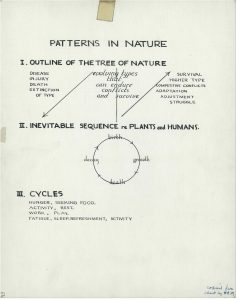
Birth, growth, decay, death: there is the cycle, sometimes called the vicious cycle, which repeats. But there is another pattern — and I am still talking about nature, which we may call the evolving tree. And there are two main movements: downward and upward:
the downward to extinction and the upward, to survival. When therefore you read of the survival of the fit, through whatever it may be, you think of the realm of nature, in which forms, bodies, earth-water, are being put through their paces, very much as in business, manufacturing, invention, now with the governmental attempts at solutions of our great problems; something is tried and is discarded. If it delivers the goods it survives. We know that there are many species belonging to nature now extinct. On the other hand, struggle, adjustment, adaptation, competitive conflicts of higher type, and the ensuring survival.
The Three Realms of Law
Natural law, subjective
MBM Lecture II 4/l9/34
The facts that I rehearsed to you last week were, on the whole, nothing new to you. You had learned these things over a long time, but what I trust was new was the method of assembling these facts; and I did it so as to assist you in measuring them against other facts.
The key word of this age in the realm of scientific research is certainly relativity; and therefore he who knows a set of facts without due regard to other sets of facts does not actually know them. None of the facts that I rehearsed to you last week are facts, though you might think they are, unless they are seen in juxtaposition to other facts. This the philosopher has long known, and it is what we, in our philosophic pursuit of study, propose to share with the philosopher.
We need to see the facts of the realm of Lachesis, of the physical world, of nature, not only in relation to Clotho and Atropos but also in regard to their place in man. For we have always this duality to observe – the objective world and the corresponding world in ourselves. So there is a considerable field of relativity. Broadly speaking, six sets of facts in relativity to each other. We will wend our way back and forth from the objective world of Lachesis to the subjective world of Lachesis: objective and subjective, out and in, three times.
Now we turn to the realm of nature in man, in us. We did assemble facts in regard to the realm of nature outside of you. Now in regard to the realm inside of us. Yet not inside, but a figure of speech that we use as an opposite to the world outside of us, physiologically.
We need to perceive what nature is in us. We have again to return to our elements, earth and water. Earth and water, or the physical and emotional world, are the realm of nature in man; sensation and feeling. Two-thirds of us, as we ordinarily are, is under the laws of nature: as, for instance, birth, fatigue, sickness, recovery, decay, death of the body. Those are all of the natural law. Also the world of the five senses, of the appetites, of sex – these are all within the sphere of the body, under the natural law.
Another area in ourselves is also under the natural law: the emotions, the wishes, the desires, the imagination, the aspirations; they are under the natural law. Two-thirds! We bulk large in this world. That is why we are called, philosophically speaking, the natural man – urges, the five senses, sexual attraction, parental drives. These wishes, desires, emotions, aspiration, belong to the natural law.
We have first to see these things subjectively to frankly deal with the world understandingly. As you know, we are not only that. That is our dilemma — and also our blessing.
Peculiarities of the natural law:
1) First of all, these laws of nature are external to you. You, in a sense are not responsible for them. They are. But these laws permeate and operate your body, the plant, the minerals. They operate.
2) These laws also work from cause to effect; and every effect becomes, in turn, a cause. Makes a long chain. Independent of your presence or my presence. They have been operating in regard to the earth and the planets and all that is on them before the dawn of time. The realm of nature is vast.
3) These laws, continuous and tireless, are maintained by a momentum from the Source; they are sustained, tireless and continuous, at a Source.
4) For a man to remain only within their realm is to be subordinate to earth, or fate. That is what is known as fate, the law of cause and effect within the realm, of Lachesis. Therefore it is your fate, in terms of your body, to grow old and die; to be hungry and thirsty and sleepy. It is your fate to experience the desires of sex, perhaps parental urges. That is fate. That is the natural law.
5) These laws appear to be ruthless and relentless, because they take no account of man’s wishes, hopes or fears. And so we say things about nature out of our wishes, hopes and fears, and project on nature what is not there. This is a ceaseless continuum, and is meant to be.
These laws are inevitably in the scheme of things, because it is their sphere, their task, to provide a stable stage within which souls may evolve. Should their definiteness vary, your security and mine would immediately be lost; not only in regard to the safety of the body but, far more, in regard to the safety in the next realm of law – the safety of the mind. If these laws did not operate regardless of our wishes, hopes, fears, there would be no opportunity for mind to develop.
Mind is dependent upon the security which the stage of the natural law, both objective and subjective, maintains. If your grandfather was not subject to disease and you were; and someone was and some was not, this world would be a chaos. It is just because of the relentlessness and the security of it that you and I can build reasonably safely on the rock which the law of nature makes for us.
The law of nature is not always obvious. There are many, many areas as yet untapped by research. Until recently in our modern age there were areas untapped in the realm of nature subjectively speaking, of man – the subconscious. Two-thirds of it, too, is subject to the realm of the laws of nature, Lachesis; and it is for this reason that we have nervous disorders. And through the discovery of the operation of these laws of cause and effect, willy-nilly, we know that there are causes, and do not just say, Stop being nervous; and modern psychology seeks to investigate those causes.
So I suspect you know there are other areas in you and me that are not yet understood but that are within the domain of the natural law. Sex attraction is a natural thing we say but what we mean is that it is something governed by laws that operate everywhere in earthy bodies. There is nothing either right or wrong about it. It is. Just as there is nothing either right or wrong about thirst, fatigue, sleepiness, play, etc.
Let us go back a bit: That this evolution of souls in earth is voluntary, and it is to bring potentials into potency; that it is above all to develop mind. Now, from the soul as from the acorn, turning again to our chart, springs three-fold man. Get it clear. The soul is not of this dimension, and does not come down; yet from it, paradoxically, springs the tree of three-fold man. How it first develops, a thing of earth, with the appetites, then the emotions, and then the thoughts. That in this acorn are nevertheless stored not only the original potentials, as the oak tree, but also the powers and tendencies acquired previous to this life, which we call heritage.
Man therefore, by virtue of what he has developed, and what he is potentially, is more than a natural man. And therein is his conflict. Being in a type of evolution that we call voluntary he is not coerced, except by his discomfort, pain or unhappiness, to seek for solutions. If the body is sick he calls the doctor. Why? Because that doctor has studied how to do something with the natural law.
You are volunteering, first of all, to be discontent with the natural law, and then seeking competent aid to handle it. That is easy. But when you have problems of the heart, of the emotions that have run amuck – with inferiority or ego-feeling, or depression, you are also discontent with natural law. For remember, these things have come about by the beautiful sequence of cause and effect, and the effect being again a cause, and so on. It is a beautiful series even if its end product is undesirable. We must honor the sequence of cause and effect in its beauty, whether it does us disaster or delight. The same type of law is working.
The more you know of the stage-setting of these things the more you are moved to wonder at the extraordinarily well planned scheme: how, under the sequence of natural laws, whether in regard to the body and disease or nervous symptoms, or in regard to wishes, frustrated emotions running amuck, passions lacerating, you get a sense of that sequence which challenges you, which gives you to think, and sets into action the next realm of law.
But before we look at that realm of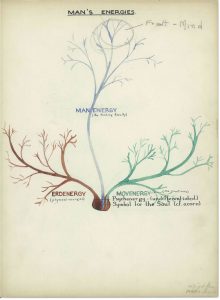 law let us pause to see what has been said in classic philosophy about running amuck under the natural law. You may be surprised that what is called the seven cardinal sins is really a running amuck under the natural law. Seen simply, a place of fixation, trouble. And the seven cardinal sins describe the state of body and heart, or erdenergy and movenergy, when it is running badly.
Avarice, gluttony and lust are the running amuck of the natural law with the body. We are not gluttons but we may suffer from gluttony. We may be average folk, not ridden with lust but inoculated with it. We may not be so avaricious that we may be called a miser, and yet the taint of greed may be affecting us.
Those are all related to the body. The three related to the running amuck of the emotions are pride, envy and anger. To see it, becomes to understand the seven cardinal sins, once we see them in relation to the natural law. The seventh is sloth – simply inactive; that deadness that is worse even than the sins.
But above (on the chart) are the seven classic virtues. We won’t take them up tonight because we are going into the mind law, objective to man, as soon as I have finished the summary of the natural law in man.
The.natural law in man, then, has to do with body and heart, and is subject to all those six regulations that I enumerated to you a little while ago.
First of all, if you are putting your mind on the natural law, accept that it is natural. You don’t help matters at all if you condemn the natural law, working in yourself, husband, wife or child. There is only one solution to any dilemma which a series, or sequence, of the natural law can work on you: that you do something about it according to the next realm, which is mind law. As when your body is ill.
Next week I shall enlarge on this area; that is, the natural life in man when we begin to see it in juxtaposition to the realm of mind. So, we are not finished with the natural law, subjective.
I am now going to turn to a consideration of mind. And after we have considered that we shall again turn to the objective world and see what the blue, or mind, has done on the realm of nature, objective. Next week we turn back to man, mind, the blue, as we have done on the subjective realm of nature.
In dealing with the blue there is another factor, because, unlike the realm of nature, it does not exist of and by itself. It is there in the beginning by virtue of a space. It is the gulf between the natural man and the spiritual man that is to be bridged. It is bridged by our minds developing. Therefore, paradoxically, this realm of law does not exist. The mind does not exist save in the degree that it is developed. It is not there of itself as is the natural law.
It is as though we might conceive on one side the natural law, on the other side the spiritual realm – and in between a great valley, a gulf; and that gulf, vacuum, gap, has to be bridged, or filled up. Therefore that realm evolves as we evolve into it and become it. No one has given souls mind. Souls are; minds become. But souls have nevertheless the potentials for it. Indeed, it is the very thing that souls are on their Journey to evolve. How?
Here we are, natural man. Let us conceive ourselves back in some primitive time, hunting, and our tribe are filled with food. We are comfortable for a time, then comes drought. We do not like it, and begin to think. That is the dawn of mind. We are forced to it by the circumstances in which the natural man is placed.
Herein you have some of the explanations for suffering. If we had not been hungry, or seriously uncomfortable about this or that in some ancient day humanity could not have been or become what it is today. As it is said, everything in number begins with one. Everything amassed in mind begins with the simple thought – by need. It is still going on – a particular machine for a particular product, needs for a particular business.
So perhaps we begin to travel and look for other country, for better water, for other game. Perhaps we went away from floods. Came new experiences; made us think how to meet this or that new situation. And we learned thinking – very early thinking.
Then we began to observe that there was a relation between the things that occurred; that they repeat. Observation developed. It was humble, yet the stature of mind today is very humble before the magnitude of the mind of the future, when man will have done to his mind what he has done outside.
What has occurred as the result of man’s mind turned on the law of nature? He has never changed a single law of nature but he has learned how to meet, match them, turn one against another and one toward another, put one on top of another. That is the development of mind on the objective world—the realm of mind, the law of mind, working on the natural law.
In forestry, – watching the forests, caring for them; watching the insect life which, in the realm of nature, feeds on the tree. Man prefers the tree to the insects. He therefore finds ways, through his observation of natural law, to fight the insect. What types of timber are valuable for various purposes. He plants with an eye to the future, the distant future. He fosters the growth of trees, nurses trees that are ill, uses tree surgery. That is the mind working on trees. Not a single law of nature changed, but intensified, modified. Until man, mind, you and I and the manufacturer get the products we want, – pearls, ships, homes, lights, telephones, clothes, pens – amplifying, modifying the laws.
From the Book of Genesis: Jehovah brings all things to Adam to name. Adam names them, and it is finished. Here is young,,ignorant man; how could he adequately name all these things that Jehovah brought him? Let us think! This is in code, and it is apropos to our subject. The Five Books of Moses sketch allegorically many of the processes of the development of man from the natural law, through the human law, to the spiritual law. The “naming of things” by Adam is a reference, really extensive when the code is expanded, but brief as it appears in Genesis, describing the development of mind. To name means to know. Therefore a condensation of how man in the human evolution must come to know the things of earth about him; and when he knows them he has done what is allegorically called named them. As the chemist did. Working on a lacquer, and wants to make it hard and enduring. We may know it by a trade name, and we do not know it at all. But the chemist who has made the formula knows it. His mind has worked on the realm of nature. That is what is meant by Adam giving names. That chapter is not finished. We are doing it now.
Another point; minds develop as we exercise them. In other words, that chemist working on his formula-to-be is developing his mind. Just as surely is his mind getting muscle as is your arm when you are working on the punching bag. Invisibles are just as real. Hence that curious contradiction that as we control nature we evolve mind. As we are bridging that gap between the natural realm and the spiritual realm by our work, apparently external, we are actually bridging it in ourselves, subjective.
In the kindergarten it is interesting to see the children play with their blocks, their wools. As a child you thought it was great. Yet those things had no permanent value; they were merely steps on the way. And while it may. be legitimate to keep a few souvenirs of that, there is no intrinsic value in it. That was simply your training ground. The object of the teacher was to lead you on to other things. You didn’t know it.
By the same token, we are learning via the lacquer, compelling the oyster to build a pearl quickly; by making ships and learning the art of forestry, – learning lessons objective to us. They are meant for something else.
We always learn outside first. That is the nature of the human. If it were not so we would live without an environment, and that is unthinkable.
Now, that environment is your punching bag, kindergarten, training school, but with an ulterior purpose, and that is the evolving of mind in yourself. Because that is the faculty which alone is competent to take you from the realm of nature to the realm of Atropos, or Spirit. That is the bridging of the gap.
We do not bridge that gap when we make lacquer, build bridges, care for forests, etc. Those are exercises, like those experiences in the kindergarten. But they are extraordinarily helpful. We could not get to what we want without them.
It is for this reason that I have chosen this pattern I have outlined of going from the objective world to the subjective, first of nature, and then to the special world of nature in man. Now to the objective, where mind is beginning to control nature. But mind can never control nature except by first understanding it. That is what is meant by the “naming” in the old Book of Genesis.
What is further helpful in regard to the objective realm of mind? One of the most fruitful, for man’s body, is the work in medicine, bacteriology, control of disease.
Sometimes one sphere of nature is pitted against another: combating the Medfly in Florida, pine rust, Jersey mosquitos. First we must understand the mosquito, – how it grows, what kind of world it thrives in, the habitat in which it multiplies, and then working against it.
The story of the Golden Fleece: When Jason and his companions got to the place where the Golden Fleece was and had to fight the people who fought him, and Medea, who really represents Wisdom, told him to sow the dragons teeth, and armed warriors sprang up, and they fought each other. And Jason was released to get the Golden Fleece.
Man has come so far in his control of nature objective to himself that he is doing that very thing that we are told about, pitting one pest against another, and they do the work, and that releases man to further journey and to getting the Golden Fleece, which, incidentally, is again the realm of Spirit.
Drawing some points together: We set up a new type of authority in our minds. As Goethe said: We have so long thought of authority as truth that we are reluctant to accept truth as authority. Now we have to set up truth as our authority; the hell with authority that is not true. Of course we cannot let it be consumed as quickly as we would like but let us consign all authority that is not based on facts.
And now, wait a minute. What are facts? If there are three realms that we are discussing there are facts of three realms; and if you take the facts of the physical realm without regard to other sets of facts, you don’t know the first set of facts at all. Man’s perspective, by virtue of the leaders, has come so far that he knows that. Relativity! Therefore facts, not only material, but facts of the soul and of the spirit as well. And we see that first via the facts that mind has worked out in dealing with nature. It is by discovering these facts, potential, that man is bridging that gap.
Hence we have what I might broadly call six areas of facts; or six areas from which facts may be deduced, objective and subjective; the same in the realm of mind, the same in the realm of spirit. And if you take apart one set of facts without regard to the other five you are not modern. The philosopher is a philosopher only by virtue that he recognizes facts – sets of facts, that the materialist has not yet come to.
There is relativity in action when you wear lighter clothes in summer. It is that very acceptance of that that makes for the larger perspective. We must take account of ourselves on other levels also. Hence the threads spun by the Three Fates.
It is said that the fate of the second thread, Clotho, is the thread of the soul. But the object of it is spirit, not body or heart. The object of your body and your emotions is to develop mind. Therefore, the thread that Clotho spins is really the thread of mind.
Therefore three threads are interwoven (or rather, interweave.) And again we get six. For none of us are living alone. Hence the threads of Lachesis, Clotho and Atropos wind back and forth, without and within.
Saturate yourselves with that pattern, and realize that if you cut that weaving you have cut into a pattern, which really cannot be good, and taken off a little segment for yourself. But it would never be true. These six are – these six we are living with daily and nightly.
The Three Realms of Law
MBM Class III April 26, 1934
Mind Law
When we pause from the pursuit of our daily tasks to consider what we are we may agree with the old saying that we are fearfully and wonderfully made. How fearful and wonderful it will take us many lifetimes to appreciate.
When we consider how the physical body is made, the intricacy of its parts and their interrelation, and the harmony with which they work, the diseases to which the parts are subject and the endeavor to maintain a balance, the recovery program set up within the body — indeed, the more we know of the body the more fearfully and wonderfully made it appears. If that is true of the body how much more true is it of the psyche!
When we begin to consider the subconscious self, the world of desires and emotions and their potentials, the sphere? of a suggestion and the sub-rosa way it works; when we discover the curious interrelation of so-called nervous symptoms; when we discover the way emotions are powerful to release secretions in the body – manifestations of the subconscious mind into the physical; we see the outpourings of so-called inspiration, – phenomena of all kinds, – we are fearfully and wonderfully made in the psyche as well as in the body.
And when, thirdly, we are turning to the realm of mind I think our awe becomes silence; for the power of mind is so vast that as soon as we begin to uncover even a little of its workings; when we realize the whole regions that are made open to us through the mind alone; when we begin to appreciate what understanding and discrimination and insight are, our awe becomes silence rather than the ecstatic statement: We are fearfully and wonderfully made.
Tonight we will study the relation of mind to man. We glimpsed last week something of what mind did on the realm of nature outside of ourselves. I threw out a few suggestions; but I could sum them all up by reminding you that your mind, or someone else’s mind, has worked on everything that is in this room or on the streets; that nature, understood, has been changed by mind in that world objective to you. As Bacon (Roger Bacon) says: We must understand nature before we can command her. And so the worker on the laws of nature and mind objective to the self first inquires, “What are the ways that the microbe, or the mineral, or the tree, etc., work?”, and then seeks to adjust them to his own determination.
It is rather an interesting, engaging, stimulating pursuit, this governing of nature external to ourselves. But the real object of mind is to turn it back on the self. The objective world in which we learn these things is the animated picture-book, or classroom, or college in which certain lessons are learned. But they are to be applied to life after they are learned on microbes and minerals and plants and animals.
In the previous class we had a saying to the effect that we, the sons of Adam, must seek to make, by virtue of the transitory things — the phenomenal world — those powers which are permanently ours — which are powers registered, eventually, in the soul.
Here we come perhaps to the most difficult mountain, or valley, to cross — the resistance that you and I and the rest of the world experience in applying mind to the governing of nature in ourselves. It is so easy and so interesting and so pleasant and satisfying to govern, in any degree, outside of ourselves. Even pleasant to be a teacher and manage it in other children, or folk, young or old. But when it comes to doing it on our own little private plot, how different is the song we sing!
The transition of mind from nature external to nature subjective is the greatest transfer of energy to be made in the entire human evolution. It is not a rub, it is a barrier. But the delight of it, and the values of it, once well started, are greater than the values of a garden of flowers, or children, industry, or bacilli.
Mind is that curious factor that is in us, first by virtue of the vacuum, the gap between soul and spirit. We recall that it is mind that we are.to develop in the human evolution; that it is through the use of mind that we renew ourselves, as one Teacher put it, constantly conquering, or renewing, ourselves through our minds.
Mind is therefore not merely the climax of the human evolution, it is that curiously flexible element that lends itself to adaptation both outside of ourselves and within ourselves. Yet not within, for that is an error in speech, long in use, but to those aspects of ourselves that are on other planes.
Write these three concepts of mind in your own consciousness: the apex of the human as the head is of the physical structure; the pivot, in that mind more than any other aspect of you can turn to all directions, all subjects; and bridge, in that it connects the earth man with the larger worlds. It is the only bridge that does that.
Now we are going to take a few little steps to show how mind should be turned on the self, and indicate a few regions where it has already been turned on the self.
First, in regard to the body: How has mind been turned on the body? A long ways, – hygiene, therapy. But from the philosophic point of view that is not wholly permissible. We have to be our own doctors. We have to belong to the Therapeuts. The first step in that is the understanding of healthy, or healthful, living.
Another way the mind has worked on bodies is through eugenics, right environment in childhood, schools. These make for an improvement on nature. We know that nature, left alone in the midst of our civilization, will not thrive. It needs mind as its aid. From far, far back there have been little signposts, that the modernist calls taboos — signposts of danger to the body, or to the tribe. We call them taboos but they mean that the appetites, cross-breeding, overindulgence of sex, etc. must not be indulged in; and since, in the early stages of humanity these were strong, even stronger than today, severe penalties had to be set up.
We have death penalties of today but they work: differently. This is all in the service of mind attempting to govern nature in the body.
How far mind has gotten, you will decide for yourselves. You know it is far from even fifty percent. We know from observation that ill effects come from certain things, response to certain appetites. We have learned that those may be held back. Why in man as against animals? The animal kingdom is, but looked at with human eyes, it does not see much. That does not matter. It is not our affair.
The human evolution has the privilege, and danger, of choice. We have eaten of the tree of the knowledge of the difference between good and evil. Therefore man, in his nature kingdom, is in a different category than the animal. For instance, animals cohabit only in heat, humans not. Animals don’t get appetites for liquors or stimulants; they live on an even diet, as far as their environment can provide. They can’t cook and prepare those dishes that amplify the tongue and the nose. They lose much, they are saved much. Think of the vast range of the art of cooking!
So we are in dangers that the animal kingdom does not know. Therefore nature in us can rise higher, and sink lower, than with the animals or the natural kingdom outside of ourselves. So our appetites of tongue and genitals, of the sense world generally, need to be understood and governed. How far they are governed in you — and that alone is your affair, not about somebody else — of that, you be judge.
Now, another aspect of nature: Earth and water belong to nature. The realm of the psyche in us belongs to nature, and mind must conquer that, understand it, order it, direct it, control it, govern it. It is of still more slippery type than the control of the body. These are the regions to which the mind, trained in the world outside of itself, must bend its efforts. That is why you and I have developed mind. The things by which we have developed it are transitory. That to which we are to apply it is of permanent nature — something that endures. But how difficult is the task!
What has mind already done in regard to the psychic. A very considerable. The last (latest) great step has been taken with our modern psychology, in the understanding of subconscious motives, complexes, drives and disorders. And understanding precedes real governing. You may control by force, but to control by force is to invite a revolution; and we, of the Western races, are not as given to revolution as we are to evolution. There are gains in both ways. One is quicker, and more violent. They are fifty-fifty. Except for those who, in the revolution, are squeezed in the winepress where the grapes of God are crushed.
What corresponds, down the ages, to the taboos as the signposts to the control of the body? Two illustrations on the bulletin board. One from Asia, following the teachings of the Buddha — therefore only a few hundred years before our era. Here are instructions for the direction of the emotions, of conduct.
It is surprising how well the old speakers could put these things into words. From the Dhammapada: “Cling to what is right, so will you keep the mind from wrong. Whoso is slack in well-doing comes to rejoice in evil. If one offends, let him not repeat his offense; let him not set his heart upon it. Such is piling up of sin.” (probably separate injunctions. GB) No evil habits, sloth…. Follow after good. The good man lives happy in this world and the next.”
This is a famous set of instructions of a wise man to the governing of the psyche: the emotions, wishes, desires. An outer attack, as it were, whereas our modern psychology is an inner attack. They both have the same objectives.
The other reference is from what is one of the oldest books of the kind on record, the Instructions of Ptahhotep, from the fifth dynasty of Egypt, probably about 3,000 years B.C.: “Oppress no one of him whose heart is already laden. He shall be hostile toward one that telleth him but shall bare his soul unto one that loveth him. Set out, therefore, after a violent quarrel to be at peace with him that is hostile unto thee. Follow thine heart during thine lifetime if thou desire to continue friendship.”
Here we have two illustrations from different races of outward attempts of mind to regulate desire. We call these, first, mores, ethics. If we are superficial we call them social conventions, and we do them in public and refrain from doing them in the family or in private, which is worse. But all of them are attempts to harness nature in ourselves.
You will admit, with me, that this is not going very far and that there should be an attempt in our modern day to do that on the self, which is of the same intelligent, inquiring order as is the inquiry of mind into nature outside of ourselves.
Consider for a moment how deep and sustained and discriminating is the research in modern physics, the structure of the atom, or in biology, chemistry. Consider how seriously it is followed, this pursuit of the mind into an understanding and then of a turning of the rules of behavior of this against this and this against that. With something of the same procedure we should inquire into the nature of nature in ourselves, both earth and water.
It is no longer enough to follow the Dhammapada or Ptahhotep. These (maxims) are from them. It is no longer possible to live in our modern day as folk lived a thousand or two thousand years ago in regard to the atom, or the bacilli, or chemicals, etc. Why should we be content to live less intelligently in regard to ourselves?
Don’t think I am calling you to introspection. It is stupid, venomous, dangerous. But if one follows the method of scientific procedure one does not introspect, but one observes, comes to know, understand, combine, dissociate, and so on, as in the outer procedures.
It is for some such reasons that the work of Pojodag was long ago started. To give opportunity, to begin to experiment in these directions of self research, in such a way that that which is hidden comes out. That which is hidden in the atom, in the bacilli, in the bodies of human or animal must come out — why not in us? And to learn then to govern the factors in ourselves and bring about the combinations we desire.
A painter of the commonest order can do a better job than you can do perhaps on yourselves. It is a pity. Because the science and the art of all times, known to the wise, has been this science of mind turned back on itself.
Mind can do many extraordinary things; and sometimes mind works hard and achieves that which is of little moment. The story about Gautama, who passed a Yogi who had been practicing for many, many years, who was sitting at the edge of a stream. In the East they practice meditation and exercise intensively. Gautama said: “My friend, what have you accomplished?” He answered: “I have worked so many years and can now walk across the stream on the water.” And Gautama said: “How now, my friend, you could have done that in a few moments in a boat, had you paid a few pennies.”
Gautama knew the object of the mind. It was not to do stunts with the body. This Yogi had lost his way. He did something dramatic, but not to the building of the bridge between the human and spirit, and the simple challenge of Guatama revealed it to him.
We all know how the emotions affect the body. If we are cheerful, or insist on having cheer when it is mind in control, the body works more efficiently. The secretions, the internal organs, are more fit to carry on. And, reversing the picture, if the body is what we call sick, it affects the mind. Nature and mind are, in man, intimately interwoven – and they are meant to be — until they are mastered. Hence, one of the steps we take soon after beginning training at Pojodag is separating the functions, the preliminary to that later high step of independent functioning of nature and mind.
What should mind do? First of all, it is mind alone that can see the perspective of the human goal. The heart in you does not know what you are after. The mind can, and is alone able to see that goal. The first object, or at least one of the most useful first steps, is that the mind should get a perspective of life, know what it is, what life is, why it is existing, and what it is supposed to accomplish. Would it not be absurd if a child was accepted in a grade in school, and was expected to accomplish something, but no one told it what to do, nor assigned it tasks? Yet we are all like that until we know what we are in the classroom for — and that, mind alone can do.
The next step is to investigate — observe our reactions; see how far, without difficulty, our appetites and our emotions are restrained. I say, without difficulty, because if you are restraining with difficulty you are only inviting later difficulty. If an engine makes noise, friction, you know it is not going to last long; and if you have any sensitivity or regard for that engine you will have it repaired. So should you with yourself. Therefore if you have to work hard to restrain appetites, to govern your emotions, or, as we saw the other day, the classic sins: avarice, gluttony, lust, pride, anger, envy, sloth — you have degrees of them; if you have difficulty in restraining your tongue, your feelings, in being jealous, or angry, or hurt; in suffering from inferiority or pride, or always want to be on top; look into the why of it. Because, to not look into the why of it is to let your engine rub, and make friction; and sooner or later that difficulty comes out, and the disaster is upon the nature, or the engine of you. Try to learn, bit by bit, the same kind of behavior that you see done in the world in regard to worthwhile projects.
We honor and respect those ways. That same procedure translate over to yourselves. It is the most difficult transfer to make, but the most important. Remember that the world is your animated schoolroom. You won’t carry on in that schoolroom for the sake of that schoolroom forever. You will propose to carry out those things in your life, in living. In the same fashion, translate the methods of some worker in the world, in whatever field, on to yourself.
To understand your body, to know its major appetites and behavior patterns, to know why you do this or that, why you have a propensity to sit down in a certain way, or carry yourself this way or that, – Inquire! Why have you certain resistances, emotional reactions, good or bad, desirable or undesirable? And as you begin to see these things proceed again, as your ideal worker in some field, to bring about the combination you desire.
Now it is true that the Yogis of the East can do many extraordinary things. This is merely an illustration of the power of mind over the functions of the body, when it understands and does, austerely, that which is necessary to bring about results. No knowledge and science has been brought into fruit overnight. If these things can be done in extreme ways, what would it not be possible for you and me to accomplish in sound, balanced ways that belong to our Western type of living?
When you are struck by the next emotional outburst, inquire why?, dispassionately. Above all, come to know your subconscious self. Study what the subconscious self is: the very earth out of which the conscious you arises every morning. You are reborn out of your subconscious. What a pity you don’t know it! The more you know of it the fasteryou find it; and you will say again: nature in man, the psyche, is wonderfully and fearfully made. It strikes us with awe! But that does not intimidate us, in the long run, any more than the cold or loneliness intimidates Byrd at the South Pole; nor other intrepid workers. They are really beckoning fingers.
These so-called dangers have treasures. Do you think that when a man like Commander Byrd, coming out of a period of isolation such as he has undergone, – do you think such a man is of the same stature when he comes out, as when he went in? Do you think there is anything you can do, here in New York City commensurate with what he will have added to the powers of his being? Of course not. We will wait and see how he comes out. But that these things beckon to everyone of heroic stature — and everyone is potentially heroic — is well known. As Emerson said: “Trust thyself; every heart vibrates to that iron string.” And if you do you know that within yourself, through the power of the inquiring and understanding and control of mind, all things of nature can be mastered.
This brings us back again for a moment to that passage I referred to last week: Jehovah brought all things to Adam to be named. Those were all in the objective, animated picture book. Apparently. But in the secret tradition it was not. Why is there a secret tradition? I will tell you one of many reasons, closely allied to our subject. It is secret because you haven’t looked for it. All things that are hidden are to be revealed; and if things are secret, blame yourselves, no one else.
There are secrets in chemistry we do not know. In surgery. In industry. Those secrets may not interest you. They come and go. The secrets that are enduring secrets are the secrets of the Wisdom of the ages. But they are available if your energies move out to them. They do not come to you on a silver platter, all nicely written out.
That is not Wisdom (re chemistry, etc.). Wisdom is something of another category, that requires doing and living simultaneously. Always remember that. Wisdom is never revealed intellectually. It is revealed by mind and act in partnership. But there is not meant to be anything secret, in the permanent sense, but secret because you or I may not have looked, or looked in the right way, or done the things that make it possible. No “Schlaraffenland”, but something that is nevertheless objective, comes.
I would turn to one other aspect of the mind. The mind, I said, was a pivot; just as your neck allows you to move your head in many directions. There is always the correspondence between the things of the body. That is why Jehovah brought the animals to Adam to be named — the correspondence between the outside, visible, objective, and the subjective. As you move your head in all directions, so are your minds to turn. And you can move it upward. But you don’t move it upward very much.
Where are you looking most of the day? Therein you will find an answer to a number of things. Do you think it merely change that the painter, sculptor, poet, actor, dramatizes aspiration with uplifted hands and head; and despondency and depression the other way? This is your animated picture book. As yet, we do not turn very much with our necks to the heavens.
Do not think I am saying that in the future we will all be astronomers. That is not what I mean; but we will consider those things which are outer, or beyond the earth. Now we are so absorbed within the earth’s atmosphere that if somebody had put a veil or a curtain about five miles above the surface of the earth, that would indicate where we live. We know there are planets, but that is all people know. This is an analogy of the little we know of that which is beyond man.
We are living inside of this envelope that we call the earth’s atmosphere, and are content. When our minds turn otherwise, as they have the capacity of doing, even as the neck bends and permits the head to be lifted to the sky, then our head, mind, moves to the consideration of those things that are beyond it. Now it is you, me and the other fellow, and our possessions. Rather routine. We are missing much. Once we come to know what we are, realize the purpose of human evolution, the mind begins to turn toward larger things. Hence the inquiry to things above, of which the physical analogy is the turning of the head to the sky.
Probably you know that in the last ten years there has been an amazing turn to the study of astronomy by the youth throughout the country. Interesting! Just a little sign in our animated picture book – a shadow cast on the wall, by which we know that something is casting it. And what is casting it? A poet has said that events that are coming cast their shadows before. It is true. But it is true now in a sense of great profundities: that there is awakening in this day, more and more in the minds of men, the mindful inquiry into the Larger.
There has been, over the ages, a heartful search into the Larger. Now there is to be, and is beginning, the mind, inquiry into the Larger. But we must be, in this inquiry in the Larger, something as was indicated in one of the quotations in the 6.15 class – the saying that had to do with the importance of action, and that he who did not live what he knew was like one who built a house without a foundation.
Here is the analogue in the 8.30 class: that he who inquires into larger things and does not master nature in himself is building a house without a foundation. That is, the very means by which we build our way into the Larger is through the understanding, direction, control and governing of nature in ourselves. To do this is to bring ourselves into that state where we can actually know of spiritual laws, of the spiritual world.
You and I next week will talk of spiritual laws and the spiritual world. But we cannot know it except we have built the bridge. We can’t be in it unless we have built the bridge. And that was meant by that saying that he who does not act with what he knows is building a house without a foundation. It is transitory.
Hence, in closing what I have to say to you tonight, let me draw on the motif of 2 x 3 that we have had before. We are completing the second two. We have had the out and in on two planes, objective and subjective. We have seen the world of Lachesis; or, at least, we have gotten a little glimpse of it. We have seen that Clotho and the thread she spins is mind; her object, to complete, or make perfect, mind; that mind alone is capable of being spiritualized; which brings us into the realm of Atropos.
Thus we have that curious and somewhat puzzling dis-alignment between the three Fates and the three realms of law. They do not fit, wholly, one with another. Because the second Fate is the seat for the second realm. But otherwise they correspond.
Next week we will have to gather ourselves together in such a way that we can conceive this bridge being built, and with it enter in, via our perception, into the reality of a spiritual realm and spiritual laws. Which means a Cosmic world sustaining a phenomenal world. A Cosmic world awaiting, as it were, the consummation of the human evolution.
The Three Realms of Law
Spiritual Law
MBM Class IV May 3, 1934
Tonight we are to study the thread of the third Fate, Atropos. Her name in Greek means inflexible. It seems strange that powers that are inflexible should still be spinning threads. But the threads are really rays of influence which in themselves are inflexible.
Ironically, the world which concerns us most interests us least. We are humans, earth men. The world of Atropos sustains all the phenomenal worlds — the very backbone of all things. Therefore, rightly, the quality of the name, Atropos, in the sense of inflexibility, conveys the idea, the all-sustaining power that invisibly operates through the other realms.
I suppose we will have to grant that the spiritual world and its laws concern us most as it appears to humans, not as it is in itself. There is very little that I can say about that realm in itself unless we are well grounded in preliminary studies. But there is much that can be said as it concerns humans.
I propose to make the first gesture toward that by referring to two allegories. One is the allegory of the serpent, or about the serpent in its three stages — the three stages of serpent life as they appear in the Hebraic tradition: First, the horizontal serpent, which is the way the spine runs in the animal world; then the erect (or erected) serpent, as Jehovah instructed Moses to show the people, who were becoming more animal again in the Wilderness. He made of them, gradually, men who have upright spines. Therefore the allegory is, first, the change from the horizontal to the upright.
And third, the position of what is known as the Uraeus, a symbol which the ancient Jews had from the ancient Egyptians — the serpent that comes to its culmination on the forehead of man — a symbol which all of you who have observed any of the gods or leading figures of Egyptian pictures will have undoubtedly noticed. That is the third position, evolved, the whole channel from the tail to the head, and now it emerges in power.
Man moves from the realm of nature, the horizontal spine, through the realm of man, the vertical spine, to the realm of Enlightenment, or Spiritual stature, the Uraeus in the forehead, its outer badge. That is the evolving soul through the three realms.
We don’t think much about these things because we are so involved in the glittering phantasmagoria of the outer picture-book. It has entranced us. But now we begin to sense that there is this realm. And the chart we have been studying suggests these progressions, through the very nature of the body. The spirit-mind is the same as the Uraeus on the forehead of the Egyptian symbology. It can be told in many ways.
Another story, from the Greek; the Quest of the Golden Fleece. The yellow above the head (on chart of geom. man.) We have all heard of the Argonauts, of Jason and the trials of that journey. But that is in the Greek tradition the story of every man. It is mystically more correct than the medieval story which is known under the title of Everyman. The truly mystical and occult significances (?) are usually embodied in the story, or drama, put on the stage and called “Everyman.” The story of Jason is the story of everyman progressing through these three Realms.
Jason was a king’s son. His father gave the rulership of the country to his brother, Peleus, to govern until Jason should be of age. Now Jason is the spiritual man, or the man on his way to Spirit — that essence in you which is making that journey. Peleus, the half-brother, is just that — the half-brother, the one-half, the lower man, who is ruling in the world of matter until the higher man, Jason, comes to claim his kingdom.
Jason comes. That is the awakening in you and me — comes, first, minus one sandal. Just as Peleus is the half-brother. So, later, the echo of that comes with Jason half-shod.
The powers are Jason, the spirit man, who is going to be eventually in power. The processes at that stage are only partial; he misses with one shoe. And when he comes to Peleus, the lower man, to claim his kingdom Peleus says: “Very well, I will give it to you if you will bring me the Golden Fleece.” And so the rational mind in you, the earthly self, says, “Oh well, I will surrender to Spirit, but show me!” That is not wholly wrong, provided you learn that things that are Spirit are only to be spiritually perceived.
Jason, the higher man in the Greek story, nothing daunted, accepts the challenge. It is the higher in you, the fire and air in you, which alone can win the Golden Fleece. The earth and water in you never can. It remains with Peleus. Therefore the fire and air in you, the mind that is inquiring, that is first filled with wonder and questing, which is as that the beginning of philosophy — that sets forth on this journey toward the land of the Golden Fleece. And that land of the Golden Fleece is far away to the North.
Jason gathers about him a group of young men, the finest young men, so the story says, in Athens. That is, the finest in you alone is worthy and capable of going on this journey.
There is made for them, by Argus, the boat, made out of the hollowed trunk of a tree. They are trained by Chiron, the horseman, who represents here the wisdom of the lower regions and the higher regions outside of themselves. There must always be the teacher. Chiron has been the teacher of the highest type of youth in Athens.
These gather around Jason, and presently set forth in their boat: the same boat that is known in all traditions, the mystical boat of your will and your determination, of your decision to carry on.
They set forth in this boat toward the land of Colchis. When they come to the land of the Golden Fleece, a distant land, there Jason woos Medea. You have thought of her as a terrible witch. She represents the strange ways of spiritual wisdom, which at no time functions as does worldly wisdom. Never. To worldly wisdom it looks foolish indeed.
Medea has much in common with Isis in the Egyptian tradition, and with Ceres in another phase of the Greek, and the Holy Spirit in the Christian tradition. The Holy Spirit made men do strange things, in the Christian tradition. Medea made Jason do strange things, in the Greek tradition.
Here is our first point of touching the laws and behavior patterns of the spiritual realm. It does not work, and never will work, as do the realms of either nature or man. It blots them out, changes them; uses another method; has a power which the two other realms cannot comprehend.
The faculty, in evolved man, that corresponds to this is intuition, which knows in ways that reason and factual understanding cannot comprehend. Because the whole procedure is different. Bergson, in our modern day, has made some splendid gestures toward describing how it is when you get into the flow of intuition, “in the know”.
But intuition is not in the know of material things, but of spiritual things. Medea in our Greek story symbolizes that. She upsets the whole behavior pattern of these rational youth who have come from Athens.
Jason woos her. Everyone who seeks the Larger woos Medea.
From the Apocrypha, on the quest of Wisdom:
Wisdom is radiant and fadeth not away….
Her true beginning is desire for instruction,
And care for instruction is love of Wisdom.
The love of Wisdom is keeping her laws,
The keeping her laws is immortality.
Immortality bringeth near to God,
So desire for Wisdom promoteth to a kingdom.
The Wisdom of Solomon, Apocrypha of the Old Testament
How one leads to the next. Study them. When you come to the last two (lines) you will see there is no logic in it at all. Then think of Medea.
So Jason is wooing her. Not a young man from Athens. It is the spiritualized and spiritualizing elements in you which seek Wisdom outside of yourself. And Medea, or Wisdom outside of himself, becomes the aid to the Questing, spirit mind in you — Jason, the higher self.
First, Jason must harness the fire-breathing bulls with brazen feet, who are snorting, and are huge, powerful. These represent a balancing up and harnessing of earth and water, and subduing these two powerful elements to the will of Jason, or the higher mind. That must be done.
It is accomplished. The young men rejoice. They are the other selves in the household that await the masterful leadership of that higher self in you which is determined to enter into the world that belongs to Atropos; to win the powers that are called the Golden Fleece.
Then another labor: there are dragon’s teeth to be sown. From them will spring fully armed warriors, who will all turn on the one who sowed the teeth. This is written in very involved code, and refers to a very great and remote secret. I am not uncoding it. But I can suggest something: it belongs to facing all those things, those dragons that you have sowed throughout your lives; and they turn on you and rend you. But Medea, Wisdom, spiritual Wisdom, has shown Jason what to do. And he throws a stone into their midst; whereupon they turn on each other instead of on Jason.
Third, Jason must lull the dragon which guards the Golden Fleece to sleep with drops Medea has given him. The lower nature in you must be put to sleep before you can possess, in consciousness and power, that Golden Fleece. A great work! That which made of Jason and his comrades heroes and demi-gods, as your old mythology puts it. It made them something else as the allegory puts it — it made them of Cosmic stature.
The story goes on with the return of Jason. Jason had touched the world of the Cosmic. So you will some day touch the realm of the Cosmic, and perhaps you may recall then the Golden Fleece. You will recall – for that is involved in the dragons’ teeth — many of your early experiences.
This story of Jason, with the fire and air that accompany the “I” principle that is determined to win for the household of the self the healing touch of the Spiritual World — that story you can see is again briefly outlined by the three positions of the serpent.
It is good to see correspondences in allegories, though the language and symbols in the allegories be far apart, seem to have no relation to each other, use another language. They are doing the same thing.
What of the Spiritual World? It is the Cosmic, or the first rung in the Cosmic. Three-fold man is below the solar disk, with its rays, (chart of human figure, as related to the three realms.) sustaining Creation.
The physicists talk long and hard of the sustaining world, whether cooling or generating, what is actually taking place. They are learning much, and it is good and valuable; but they are not touching the sustaining power that is not contactable by physics. When the physicist comes even near the question the stuff that he would handle fades out into electricity. And then where does it go? The world the physicist touches is down here (brown on chart.) But these are the all-sustaining agencies, powers, influences — those and many other words, that emanate from the Cosmic regions.
You know, or should know, that while we have here earth and water(on chart), the world of substance and emotions — that which makes the animal world, which is not so fully developed as it is in man — and mind, – that these, in this third dimension, have their correspondences also between here and here (lower and higher levels on chart).
Next, the world of connections. (Color lavender on chart, the etheric or “binder” between physical and psychic.) Then the psychic world. A vast region, – infinitely bigger than the world we know. Not of this dimension. Beyond that, the second division, and the merging into the third.
Just therefore as in you, in the little graph we have been studying, there is the material world in which we move about, the emotional world, in which we know we are also active, and which is intangible; and the mental world, which is still more intangible, these have their counterparts also in worlds beyond.
You may be a strong physical being (and) may not know anything about the psychic. You will have many, many stages to go through. Then there are stages beyond that. And only then, when we are through with that, by the great principle of correspondence, correspondents to the mind in you below, do we come to what is known as the Cosmic Plane. And that, broadly speaking, is when Life is said to begin.
Quoting Paul, Cor. I: “Wherefor the psychic man doth not receive the things of the spirit of God, because they are foolishness to him. Oh, there are wonders in the psychic but they are not the Larger. (Of that) we can receive only by becoming spiritual. Wherever you are, whether in the flesh or elsewhere.
These laws that emanate from the Spiritual Plane are the very sustaining power, the domain of the Eternal World. From them are suspended all else; and all of these (sections of chart below the yellow) are the training school for the coming of spiritual man, of which the earth world is only a part.
This Spiritual World sustains all, but it becomes less and less evident. People do not know it; think they are physical laws. Who sustains the physical laws? The very background of all worlds is sustained by the thread of Atropos. Behind the laws of nature are the laws of the Cosmic World, the Sternal Worlds. Behind the psychic world and the great and glorious regions of the mind — not below, but above — those are also sustained by the influences emanating from the Spiritual World.
Those of you in the previous class may make your correspondences via, for instance, the nine hierarchies of entities listed in the Hebraic tradition I referred to.
That goes on, whether you and I know it or not. The laws of fate, – the Three Fates, for there are three Fates. The fate of the laws of cause and effect on the physical plane; and they work in nature and in you until they are modified by the mind law. And again, mind can operate a series of causes and effects that are not natural, are mental, whether it be in chemistry, in the breeding of cattle, the setting up of an industry, the building of ships or airplanes — also cause and effect. And there is cause and effect in the realm of Atropos, no less.
The dice are loaded. What dice? The dice of the influence(s?) working through, and on, you and me from the Spiritual Planes. The influences of soul and spirit. That which is the soul in you works and works, and so does that of spirit. The Jason in you works, and it is aided by what we might call the Hierarchies outside of you. Would it not be silly to think that in earth, on our tiny little planet, was the only place where there was teaching and learning? That is not so. Therefore the dice are loaded.
As the pendulum of a clock moves to the right or to the left over a period of time, until that movement to the right or to the left is completed, and then moves the other way, so moves the Fate involved in the thread of the Three Fates. For instance, if you come, gradually, in the evolution of a human being to a place where the soul in you is ready to break out and claim attention, and you don’t — something is going to occur: a catastrophe! That is positive. The soul in you and me — not because it is so intelligent, but that is the way it is contrived by the ordering of all things from the Spirit — the soul in you and me gives us a certain length of condition – time; and then it brings us up with a short rein. The dice are loaded! The spirit does something analogous.
We go on in our development. Your minds are going about with the construction (?) of things in this world, and you wonder what it is all about, and whether there is actually intelligence outside of the earth, whether there is purpose in the great universe, in the heavens; and whether there is a God. Well, that is Spirit knocking on you, through soul, through mind — spirit embryonic, through soul knocking at your mind. And if you close the doors and refuse to go on, it is not so good.
The pendulum begins to move the other way – cause and effect; this again, as though we had a condition-time in which to work and then things turned the other way and we have to wait until they come back before we can pick them up again. Go to these things while they are in the way.
Men do not understand that there is a rhythm in movements of all kinds. It is these things that we have to know to go with the tide, with the call to these movements in ourselves, while we and they are in the way of them. And then, as with the boat, as with the harvest of wheat or corn, it is well. But if you plant sweet peas in the garden in October, what blossoms do you expect?
These are some of the peculiarities that belong to all three realms of law: cause and effect, a condition-time, in which to work. But the Spiritual Realm, being the powerful one of these three — it is not the last one; there is a realm behind that, and behind that — but the Spiritual Realm is the only one of these higher realms that it is useful to study. The others we cannot know much of until we have gotten a certain familiarity and mastery, in our minds at least, of these.
To recapitulate: Man is born into this world under the realm of nature; has much in common with that by the body and the appetites; is endowed with the potentials for filling the gap between himself and the realms from which he came — through mind. To this, mind with the physical organ of the brain, corresponds. And then he has the capacities in himself which make him capable — not naturally, but capable of rapport with the Spiritual Worlds. “For Gnosis (MBM: which is this blue-yellow, on chart) is not born with men but is acquired; and the acquiring of it demands application and training and progress; and then, from incessant progress it passes into habit; and when perfected in this mystic, it abides, being infallible through love.” (From the writings of Clement of Alexandria.)
Our point of view when we come to relation with the Spiritual World is radically changed. The natural man sees naturally and has natural bodies. The rational man sees orderly and orders this world. When man comes to himself; that is, when mind comes to the awakening and knows itself for what it is, it is as though it said: “I thank you, dear wonderful animated picture-book; you have served me but are not what I want, any more than I want the first grades of school, or kindergarten toys. I am grateful for the stimulus to me. Now I am on my way.”
A great writer of the first centuries has said “The Gnostic will never have his chief end placed in this life. That is a preliminary; but in being happy and blessed, a kingly friend of God. Although beset with ignominy and exile in this world, and confiscation or death, he will never be wrenched from his freedom, because he has become free.” — freed from the attachments to this world. He remains through it all the “kingly friend”, noble, regal, of Deity. He is not turned from his love, and where your love is there is your orientation; all the great things which belong to God.
Now, lest you think the Spiritual World is pallid and undramatic, I would say a word in defense of it. It is more active, more alive, more vivid, more dramatic, in the highest sense of the word, than anything that you know under those terms. And the time comes when, as a Jason on your pilgrimage toward the Golden Fleece, you will wonder at your blindness, at your absurd misunderstanding, to which, alas, false teachings of modern Christianity and Judaism have helped no little bit.
But you will then know that the powers and wonders of these worlds are superlative. Queer, you will say, that my rational mind was so held, or I was intimidated by the laws (or loss?) of material things. May you then be able to say that you have kept the faith of the vision that you have seen, and know that to become a gnostic is the most regal thing that the earth can offer any man.
The faculty of intuition: for this seems so often to be a stumbling block; and naturally, under the law of cause and effect, because it is secret, used in ways so different from what the word itself means or (?) from the way the philosopher uses it. You have all heard of overtones in music, haven’t you? You know that in listening intently to a tone sounded or played you can hear at least another octave, and you do hear overtones. It is significant that three-fold man has the capacity for overtones in his three-fold makeup.
Intuition is the overtone, or super-faculty of the mind. It is not the mind as man knows it. But it is an overtone of the mind. It gives an immediacy of comprehension, whereas the mind, working in time and space, must go laboriously at things. Experiences like Jakob Boehme’s are illustrations of intuition. Intuition, an overtone of the mind, looks into the Cosmic. As we usually use it, intuition refers to knowing something that is going to happen, or concerns somebody.
That is not intuition. It may be sensitivities. Intuition — you can always tell it by this: it does not see anything that concerns man or the human world, in the personal sense. It sees nothing that concerns any event in your life or my life. It sees things, and apprehends processes that belong to the yellow, the realm of Atropos. It looks into the world of Spirit.
But there are two other areas in man which also have their overtones, and they are quite frequent in their manifestation. There are sensitivities, for instance, that belong to the physical man: atmospheric sensitivities, pleasant and unpleasant, a sense of great joy or great tragedy in a place you visit. As the dog senses something we may not see. Also experiences under the name of psychometry. “Porches.”
Then there are overtones of the psychic, of the emotions. Those things really belong to another course but I only want to call attention that the overtones of the natural man, in the sense of the brown and the green (on chart) relate to man — to events, circumstances, past or coming or imminent. They look on a level with him. And such antennae can be developed.
There are also the sensitivities of the mind, which look out beyond the realm of nature; and mind into the Spirit; and they are the very link, the specific link, of man to the spiritual worlds in man: “My mother, the Holy Spirit, lifted me by the three golden hairs of my head and carried me to Mount Tabor” is an illustration, in allegory, of the faculty of intuition.
The Holy Spirit of the Christian tradition is the operation of this yellow – of the faculty of man which is the fruit of mind, intuition. It enables man to become rapport with the Holy Spirit, in the Christian tradition, and to see and know what is closed to man, as man. I remind you it is possible to look into the psychic world. That is not intuition. That is looking into the psychic world, and it is not the Spiritual.
The reason for these classes, condensed: We are all of us in various stages of that journey described by the story of Jason. It is well that we know it. And the emphasis on the Goal of that journey. And you have first to win it (the Golden Fleece); then go about other business robed in it.
The more, therefore, you know, are assured of that as the Goal, the more that becomes part and parcel of your inmost being, the less likely you are, either in this plane or when you are out of the body in the next stages, which need not be advanced — the less likely you are to be beguiled and absorbed in them.
It is as possible to be absorbed in other planes as in this. This journey is full of halting places. Because people, souls, Jasons, have not yet become aware of the Golden Fleece.
You can’t get the Golden Fleece overnight. It is however the great journey, on which we are all bound, because the dice are loaded; and therefore, to know that is to, as it were, become inbred with that realization, which safeguards you against the beguiling influences of many, many experiences along the way.
If then you are beguiled for a while, sooner or later you will know — “I remember something else.” If you don’t know these things, it is not so good. If it is not well to wander aimlessly about the streets of New York can you not see, by virtue of the principle of correspondence, that in a much larger way it is foolish to.wander aimless through the spaces between us and the Cosmic Regions.
Not everyone begins to go one hundred percent after the Golden Fleece, but that you are imbued with that realization, and measure everything else against it.
Another angle regarding the realm of Atropos: that it is our taking-off place. We come down as light sparks, involuntary, potential, a seed. We become involved; Garden of Eden. You get.mixed up with matter. Are asleep. Then slowly, by pain – because the loaded dice of fate in the thread of Atropos are working, and they won’t let us stay put too long; if nothing else will wake us up, pain and suffering and loss will, – and we say, it is not so nice after all. Bit by bit, over ages, perhaps many lives, we begin to come out of it, and we are lost; animal man and the soul consciousness begins to wake, and the mind; and we work our way back — over ages.
Therefore, paradoxically speaking, while this is the getting of the Golden Fleece — the faculty and rapport with Wisdom outside of the self, it is with that that we gradually robe ourselves, bit by bit, until, with the Golden Fleece, we are again back where we were. And if you think we are here as we were there, you have forgotten the analogy of the oak tree and the acorn. With the acorn it is not more than 120 years apart. With this, it is eons, ages. And, as with the oak tree, if it is only 80 or 100 years apart, so here
It is the beneficence of godly love and Will, that comes from Cosmic planes, that is willing to let these little seeds of light sparks have the opportunity to become men, in the sense of Son of Man, Spirit, that this world of Nature was set up. If you, as parents, guardians, teachers are glad to be helpful, see and watch over the development of children; if you thrill with satisfaction when they take on responsibility; if you are moved, but withhold when they are suffering, knowing that it is part of a good thing for them. If you, as little, quite unwise humans as yet, have so intelligent and generous and goodly a concern over those youthful ones in your environment, do you think that the good Hierarchies and Deity cannot have that which you are experiencing, and which so fills your hearts, in an infinitely greater way – as much bigger as our universe is against a grain of sand, so much bigger is the stature you and I attain by this evolution.
This, and the pretty stories of Jason, the serpent, Isis — they are stories of great events that concern processes about you and me, and are in every race, and have been told by the true Teachers, to stimulate the consciousness to knock at the doors of awakening minds that they should know that this was a pilgrimage; that this is the Way; that there is purpose; that this is not the world in which we stay, nor the end. Nor are we to measure the Good by the apparent good of this world.
That is why all great races have these stories, and history has kept them, and we read them as myths. I do not. All knock at your consciousness, to make you realize that these things are so. The content of these stories — some in all places in the world and in all times; the historian, with literal reason, will never find it. Some have already given up. It is bigger than that. It is because those who know have told these things — the stories of everyman through the three realms of law, with the body in the world of Nature, to learn through actual experience, as children in a lesson-book, to come bit by bit to manhood, because of the glory of it, the power of it, the promise of it.
Why not believe that it is good to go when you are in the way of going and the tide is moving. Your reasoning mind provides you with the preliminaries. Now use those preliminaries to greater ends, and you will see that the pilgrimage of Jason and the threads of the Three Fates build a glorious story – a story against which there is no comparison with them in earth.
Take with you some degree of understanding of the Three Realms of Law, the Three Fates, and the Loaded Dice.
The Realm
of
The Spiritual Law
Third of a series of three lectures on The Three Realms of Law
by MBM February 14, 1929
_ _ _ _ _ _ _ _ _ _
When we come to the sphere of the Spiritual Law we are taking into account something of the Immensities. The Immensities go on whether we know it or not, just as our tiny earth is guided and kept in reach by inter-stellar relationships. Other forces sustain our life, regardless of our knowledge of them. By that token, the spiritual sphere is there; and if you do not turn your attention to it any more than you turn it to those vastnesses in the sky, you won’t know about it.
That sphere is lawful — even more orderly than our worlds. Those forces nourish us, guide us, guard us, as do those suns around our own, and impinge on our own.
What is the Spiritual World? The world of Breath. The word has gone way down from its original inception. It was once in highest repute. It is analogous to the Breath and the “blowing” of the Creative Hierarchies; as in the reference in the Book of Genesis. It has its principles, qualities and characteristics. A world which permeates our own, regardless of our knowledge of it. A world from which we came, and to which we will return. It is told of in all the traditions.
To some extent, that world is associated with the Edenic state, in the outer Hebraic tradition. In the descent of the light-spark, which becomes later the soul, it passes through this Spiritual World in a state of unconsciousness — unconscious, in contrast to our state when we are awakened: involuntary; is-ness; unenlightened; undifferentiated. To that state we return, and again are in a world of non-separation, but highly differentiated. This descent is recognized in all traditions.
In the Greek, Ceres, the mother of Persephone, represents the spiritual worlds, and also Eden. When Persephone is with Ceres she is in the spiritual world; when with Pluto, in the world of earth. Persephone, the soul; primordially, the light-spark. Sometimes the contrast is between Demeter and Pluto. Demeter, the personification of the spiritual world, longs for the return of Persephone, the soul.
In the Egyptian tradition, Osiris, is the masculine symbol of the descending light-spark, drawn into the lower world by Set, and lost to Isis, the personification of the spiritual world, from which the light-spark came. Isis weeps, as does Demeter.
In the Babylonian tradition, Ashtaroth, Ishtar, is like Isis and Demeter. There the light-spark is masculine, Tammuz; and Ishtar, again, is weeping for the light-spark — guarding, guiding, sustaining the light-sparks in earth, just as the solar systems to our little earth.
So, on another plane, these figures, the outer forms of great inner teachings, watch over the world of man, nature and mind.
In the secret tradition of the Jews, the Mirkabah is the returning vehicle of the child who has gone down — the light-spark, when it is ready to return to the arms of the Spiritual World. This vehicle is the “fiery body”, spoken of by several writers in the Old Testament and the New Testament.
In the Christian tradition, the Holy Spirit envelops, watches over, and guides humanity as did Ishtar, Isis and the others in the so-called pagan. Isis weeps, until all the parts of the dismembered body of Osiris were found and brought together again. The spiritual world must re-assemble them, as Isis did.
Let us see it as a world which permeates our own. The Logos, it is said, dwelt with man, and man knew it not. “The Word made flesh, and dwelt among us.” Most people think of it only in reference to Jesus. For the time comes when the spiritual conditions, laws and forces and energies become palpable to man. When his condition is ready for it. As with the cosmic rays, so the permeation of this world by the Spiritual will be done when man has done for them as Dr. Milliken did with the cosmic rays.
The Spiritual World is the frontier line of the Cosmic World. As it impinges on man, it is the first meeting with the Cosmic Worlds. They are powerful, vigorous worlds, not to be felt by pygmies. They have nothing to do with psychism. The Spiritual world is beyond the mental, and only those who are mental giants, and whose at hearts are mature, can know the Spiritual World.
You may know it, but your next door neighbor may not. It cannot be proved, or demonstrated, by anything in the physical world; and if you expect it to be, you do not know the first thing about it. You cannot even know the psychic world unless you go to it or materialize it a little. The mental world begins with the philosophical mind, and from there on you get into its actual sphere.
The Spiritual World is here, and envelops you and me; and yet, from another angle, it is beyond, and is not here at all. Perfume and its emanation. As the emanation penetrates the room, so the Spiritual World envelops this. But the Spiritual, like the perfume, remains, as it were, in a container. The Breath goes out, but that from which it came does not go out. The Word goes out, scatters into all areas below it.
What part has the spiritual law in our world? It functions by laws so exact, so fine and economic, that our earthly laws seem crass in comparison. Man’s world is an attempt to approximate, coordinate with, and come to the standpoint of functioning with the higher world.
The law of the Spiritual World is justice. Not man’s justice. First, the law of Moses; and, in that, a suggestion of moral control; yet, a tooth for a tooth. Then we are taught the law of mercy by the law of Jesus: kindness, love to neighbor, forbearance. That is not the end — only a preliminary, the counterbalance which had to come first, and teach a preliminary balance. Man cannot come to justice, in the spiritual sense, until he has gone through the discipline of the “eye for an eye”. But when he has gone through that, and learned the subtleties, and then the warmth and mellowness of mercy, and is tempered by it — not until then has he any grasp of the significance of the justice in the Spiritual Worlds.
That justice cannot operate on man, because he is not ready for it. He is either in the first category or the second. And the Spiritual Worlds do not make any mistake. When the other two have done their work then the impinging, in conscious experience of the law of justice, begins to take place.
Spiritual law, impinging on man, purifies; but not in the sense of the psychic law, which is purification of the heart; which, again, is necessary, and precedes purification by the spirit. That is what is implied in the “water” and “fire” — or the washing of sins away by water and the fire: “Except ye be born by water and by spirit ye cannot enter into the kingdom of heaven”, which is in the Cosmic world. A difference between that and the purification by the heart, which is repentance. Then comes, later, purification by fire, which is of the Spirit.
How does it work? The preliminary pangs of justice (are) through suffering. Mental pain. That is a preliminary to the ultimate work of the Spirit as it impinges on man. The heart would not cause pain. The heart must not cause pain; and he who does it via the heart is a psychic criminal; but the Spirit can, and does, cause pain — that is part of its task. And as it does so, it brings about a gradual separation of the phenomenal from the noumenal — of earth-water from fire-air, which goes up; which man can take on his higher travels, and can finally enter into the Spiritual World.
Pain, suffering, is the impinging on man of the Spiritual World. Man does not like it or understand it. The best thing to do is to learn how it operates. Obey it first; then maybe you can profit by it. It is worked on children to make them aware.
The Spiritual World requires, of all things, self-determination. You can’t know it without being able to function as a self-determining unit. When we come back, after experience of the lower sphere, we are self-determining units, differentiated. And we go back in a consciousness which permits of higher kinds of commingling than the early, non-differentiated type. Not a unity, that is an absorption – any more than a finely finished piece of steel is lost in the machine of which it is a small part. It is useful only because it is differentiated. So in the making of a spiritual organism. You can play no part till you are differentiated.
The Larger World is sustained by the thing that is so inadequately called love in our lower worlds. It is nothing like the love man knows, either in his animal or affectional world. Those are youthful, distant relations of that mighty force, which does sustain, in ways difficult to describe, the whole organism of man’s life. You will become conscious of it only as you develop the sensitive organs that correspond to Dr. Milliken’s apparatus. It is nothing like the psychic or the physical love. Some day you will be ready to understand it.
The law of cause and effect. We know it in earth and science. It operates also in the Spiritual World; but the law as it emanates from that world is of a different calibre from ours. In the Spiritual Sphere, which is in terms of consciousness and condition, cause and effect are known in terms of the condition. From another angle, it is a transparent world, in which content is the obvious thing, the form only for content’s sake. And seen with other eyes than the physical, as we now see form first. The four sides are re-absorbed in the point — a correspondence of the spiritual plane consciousness.*
In this condition, where cause and effect is revealed by apparent condition, man knows in a way he cannot possibly know here. For, having gone through the physical plane; having made the way up the ladder of the mind; having learned, bit by bit, to gather from facts that there is content; he has matured himself so that he can himself be conditioned to be the point, and sum up cause and effect, and enter into the spiritual consciousness.[1]
Emerson’s Law of Growth: Man must grow. If he does not he is indeed stagnant.
The Spiritual Law
(from a Saturday afternoon series by MBM for Jrs. and Teacher Training Group.) December 1, 1942
– – – – – –
Why we know so little of the spiritual law. How often do you look up at the heavens? You judge the world of spirit by the Piscean Age. Through the outer expression as personality of Jesus, or rather the church.
MBM’s contribution, a new presentation of an old subject. The three fates; the series of laws which govern on three planes of unfolding life. Cosmic law as it rays down toward earth. The emanations from that plane. Obviously underlies everything else. These laws (go) all the way through, but the lower planes color and seem the more important.
Some mind interpretation of the spiritual law. It is. What rays from it is only an indication of what that world is in itself.
Spirit law sustains and underlies the world in which we function. We will know it only indirectly. Has its own substances and energies. Man in his highest state can know only some of its characteristics. But there are rays.
The things man does to reach that world. As a preliminary grooming is the applying of mind law. Includes morals, ethics. Until he begins to apply wisdom lore. Wisdom lore helps his mind cover the distance between where he is and nous.
(a) the realm itself; (b) the emanations from it; and (c) man’s efforts to attain it.
Aspects of the spiritual law as seen by illuminated mind: Sustaining, permanent,universal. Based on Cosmic patterns. A manifestation. Teachers too have their grades. Cannot know all. Facets shed rays. Man moves toward the improvement of his sight of that diamond in proportion as he applies wisdom.
The Quest. The search for the Golden Fleece. The cup and spear. The process of at-one-ing. Ways of salvation. Those are ways of moving up closer, through which you come to know spiritual law better. “Like is known to like alone.” In proportion as he understands and practices the demands of wisdom.
Love is one facet. Love on different planes is quite different. (what we think of as love) That is not the thing itself but a derivative as it acts in the lower planes. The effect of love is to work away from the self – correction of ego-centricity. You can’t go far without it. Chemical affinity on the mineral plane. The right hand or the left hand of the man on the cross. A higher law working down in earth. Removes frictions, irritations, hesitations, etc. Produces an alchemical change. Experience magnifies attraction. Pulls the self away from that to which it has been pulled.
The group as the inevitable corrective of the self. Starts on humble planes; works ever more purely on the way up. The self and the not-self. The law operates independently of him but upon him.
No one attains the realm of spirit to whom the love of it is not a supreme love.
Rightness Another facet of the diamond is rightness, which men usually call justice. At first there is meant to be mercy; leeway, until someone learns to do the thing perfectly. In that he comes under the influence of the higher law. It takes no cognizance of weakness. What MBM is doing is under spiritual law, – not psychic, not mental.
Sovereignty Rulership. Power in the ultimate sense. You can take it or leave it, but there it is, implacable. The Christian tradition speaks of mercy and kindness, – of love. That is fine. The humbler grows toward the Larger. But it is not the thing itself. If they (the laws) took cognizance of weakness they would be human. Spiritual laws are for the good alone.
Goodness In the sense of utter quality. The spiritual realm is past all attributes. They appear only for the sake of men. The white light breaking up into the colors of the rainbow. So goodness, another quality of spiritual law.
Truth Another facet is truth. (Reference to) the exchange between Jesus and Pilate. All man can say is silence when it comes to truth. You have to lift yourself up high by the quality of your living, meditation, . . . to journey closer to what that thing is. In his ordinary state man cannot know the spiritual plane, or even rays from it.
Beauty Plotinus on beauty. Paul: spiritual things known to the spiritual only. You come to know as you bring yourself in juxtaposition to it.
Metaphysical aspects On the substance side. The metaphysical principles, the seven principles, represent the mechanics of manifestation. Shot through with some of these aspects I have enumerated.
Wisdom lore The short cut way of reaching spiritual realm. Cf (compare) the quest of the Holy Grail, quest of the Golden Fleece. They do not all indicate the same vision of the Goal. Yoga. What did they vision as the end? Wisdom lore is not spiritual law but describes the way man can hasten his way forward to that realm.
Scripture references to spiritual law. “Thou shalt love the Lord thy God with all thy heart, with all thy mind, with all thy soul, and with all thy strength.” One-pointed. The place of the confluence of the Two Seas, where the Teacher is found (Kor’an), the place of balance. The so-called “ruthless things” that Jesus said. Also many that are patient. All sides. Not to be taken on the same level, as the churches do.
Man moves to the improvement of his sight of that Diamond in proportion as he understands and practices the demands of wisdom. Man cannot take the spiritual law. It is too strenuous for him. He likes to dally. The mystic does it (approach) in his way. Piscean . . . love.
The human evolution is for the development of mind. His assignment is to make the bridge to the spiritual law. Not mind, in the usual sense.
Spiritual Law
(End of a seriea on the Three Realms of Law, given by MBM, spring 1945)
GB not present at earlier lectures of this series. (ABG gave first two lect.)
An object of this School is to give you a perspective of life. A map. Synthesis and analysis. Long range and short range. Neither one alone is satisfactory.
First, the.big perspective. Then I will follow with our special subject.
The Three Realms belong to the Cosmic framework. They are. Myths can now be set up much more clearly….the myths of old, like that of the Three Fates. They represent the three realms; for man, body, soul, mind.
The basic idea of life is growth; and, as a result, changes. Now, vast changes over ages of time. In regard to body, soul, spirit.
Body (has) changed from animal man to earth man. Soul changes, and becomes mind. Spirit changes, and becomes nous. Body, soul, mind. Should become the human, earthly mind, and nous. Shifts.
Heaven and earth. Now as relates to man. Earth and heaven. Man in earth has as his task to build the bridge between these two. That is the mind law. Earth, the place of beginnings for man, where he grows up and finally bridges the gap between earth and heaven. In the old myths, the Tower. The Tower of Babel is a gesture in that direction; distorted.
Earth, kindergarten. The lower mind in service to the physical and emotional, – but growth. His higher education begins with the role of the religious impulse, which starts the movement of man upward. Continues until he has closed the gap. His many names (for that movement): The Quest; the Rough Ashlar (to the polished ashlar); the changing of lead to gold (philosophical alchemy).
The setup is so designed that man has ample room for exercise. If there were no gap there would be no chance to grow. The early stages, our childhood, or the childhood of the race.
The realm of the natural law: cause and effect uninterrupted; except by other cause and effect. So there is conflict among all forms of life. “Survival of the fittest.” Earth is full of the relics of the forms that did not survive. Force without reason. That is, without mind. It takes a long, long time for man to bring himself out of that realm. The many illustrations of force at this time. How terribly difficult for mankind, even leaders, to lift their functioning above the functioning of nature! The conference at San Francisco (at founding of the United Nations). Glimpses of the old forces at work. Power politics. To work together for a race (?) against other peoples. Brute force. The natural law, objective.
Then comes the law of nature, subjective. It is hard to subjugate. Perhaps we are past the old frenzies, lusts, hates; but not the subtler jealousies and competitions. Still the law of nature in you.
Last week we discussed the beginning of the mind law. How much it has been effective in changing the external world. We can’t do it on the weather, but we can make ourselves comfortable in this room. In millions of ways men make new alignments in nature, shaping the world which is our environment.
The struggle to change the nature in man, subjective. Taboos, mores; religious commandments; instructions. They gradually set up barriers against the wild, raw nature in humanity. Later, ethics. But that is just infancy.
From there I will pick up the material. I will now make the connection between the more significant things that mind is doing in engineering and other fields, – what it is doing in these days, and what can be done upon the self. Man received the seed of mind. He has the means of making the bridge between earth and heaven. In his unconsciousness, he first uses it (mind) on the objective world; and thinks that is it. He subdues this world to his purpose.
The search into nature and the new potentials tapped. Which are, in turn, the source of the striking inventions of the last few decades. As man has pressed, with his mind, into these mysteries of objective nature, he needs, in order to build the bridge between earth and heaven, to press into the mysteries of his own nature.
With the soul’s adolescence he begins to inquire. That there must be profound laws that could be invoked to develop his own being. He may not think it through clearly, but that is what it amounts to. When that turn comes and man, mind, begins to be applied to himself, the real bridge building, or tower building, takes place.
(There are) hidden mysteries in the atom. And in man’s own nature. Notification of that is as radical a transformation as any in the objective world, with plastics (and other materials). The objective world is the animated picture book, for training to the real world, the development of the potentials in himself. (As he begins to move) he looks around beyond earth patterns. Perhaps joins a cult. Medical (?) doctrines, – psychic matters, etc. If not too prolonged, these are good preliminaries before he undertakes the major business of his whole career — not merely the human career. That business is to know, and apply, the greater laws upon himself.
These laws are, broadly, called Wisdom. Not man’s wisdom. They are from above down. They belong to the true esoteric Teachings. The kingly science. That science is the use of mind, in its best, upon man himself. “Then I, Wisdom, was with him as a master workman.” (from the Hermetic tradition) As in work in earth, you want the best information. So in the transformation on the way to the third great realm. Nothing lesser will do.
There are laws which govern the human evolution. To tap, and employ, them is to be in the position of making changes under the guidance of the “Master Workman.”
Which brings the motif to our third realm, or the laws that emanate from heaven, as contrasted with the laws of nature, that operate in earth.
Law means to make stand, to fix. Man-made laws do not stand. Like a child with building blocks. He does not know the laws of building. (Goes through) trial and error. Trying to find what will make things secure and fixed. He (man) plays at it. Takes himself too seriously in these efforts. Does not acknowledge that they are makeshifts. The laws we are talking about are not like that. They have been set into operation from the beginning of things. They are part of the Cosmic Framework. Kan’s efforts are exercises.
What is the difference between the laws in the realms of nature and the realm of spirit? I wish I had another word for spirit. The laws of nature are meant to change, to be pitted one against the other, like gigantic experiments. Forms come and go, – governments, – humans. That belongs to the lower world. The world of nature is the world of phenomena. It is temporary; transitory. Within the little local laws they (the laws?) are secure, but pitted one against the other. There is latitude for humans to experiment, produce changes, and to learn.
In the regions of heaven, or spirit, the character of the laws is very different. That is a world that is established. Laws are not pitted one against another. No change. That is a permanent world. The noumenal world. The world of completion. Pleroma. That world should have laws that are stable, because nothing attains that realm which has not attained completion.
Building the bridge from earth to heaven, through mind, man gradually attains the fulfillment. Many names for it. World of permanence. No pitting of one set of laws against another. Therefore these laws have a finality which the laws of nature have not. It is now wet outside, but it is dry in here. We have been able to change things to our purpose; have pitted one set of laws against another. That is not part of the scheme of things in the realm of spirit. Therefore the laws have an austerity.
(Reference to Walter Lippman’s statement about wisdom, but I do not have it. GB.) The laws of the spiritual world work; and, in a sense, are sustaining even the world of nature. They work invisibly, because they work in a different wave frequency. (Reference to a quote from Paul about laws working spiritually and are only to be perceived spiritually.) Natural man has not developed himself far enough to be able to perceive them. Thinks them foolish; as a child cannot appreciate the profound problems and potentials in the San Francisco Conference, (re founding of the United Nations.)
But the interesting thing is that man can, through the use of Wisdom as a master workman, develop the powers in himself which will make it possible for him to apprehend these laws.
An example: the law of rightness. Justice. Men seek Justice. They won’t find it in earth. That is not the place for it. This is a workshop, and (for?) man works where he is. It is (all?) right. Millions of us are going through an education in earth right now. Is it your place, or mine, or everyone’s? Someone knocks over your tower. No rightness. The Supreme Court decrees. It does not yet know what justice is. Opinion – these justices as against those.
So, in the world, there is no justice. (A reference to a statement by the Reverend Coffin on the report of Hitler’s death. Do not have it. GB.) but the statement was along the line that the report “shows God’s justice.”) Even that man had no idea of what justice is, and the spiritual law. Spirit works subtly, not grossly, with health, or sickness, or wealth; or youth or age. No: spiritual things work spiritually.
Justice works wholly by cause and effect. But not on the human being; but on the soul, the evolving monad. The place of “Outward Bound” (a play recently rather popular on Broadway. The characters were people who had left the flesh and were on a voyage on a ship, outward bound.) People met the things they intrinsically were (as dramatized in the play.) That is cause and effect working on the subtler element. Spiritual laws do not work on matter. You would not make that error with radio — expect to reach a certain wave length if not tuned to it.
Spiritual things operate spiritually. They will have an effect on the evolving being. They work subtly, invisibly, but unerringly. There is nothing you can do to change it. As you sow, you will reap. But not physically. There are a thousand other reasons for various physical things.
A second spiritual law is love. Humanity makes many mistakes in regard to love. Sex attraction. Hate? That is infancy. Through ages men learn a little more about love. The object of love is extroversion. All through the building of the bridge between earth and heaven it is inevitable that much attention must be on the self — to evolve. The great corrective to that is the challenge outward, – away from the self. So men begin to know it.
Apply it to those two commandments of Jesus. The people asked him, What are the laws? (So he gave the first commandment: Thou shalt love the Lord thy God, with all they heart, and with all thy mind, add with all thy strength (look up.) A brilliant challenge to the outgoing, toward the peak toward which you are moving. A masterly presentation! Its correspondent on earth: Thou shalt love thy neighbor as thyself. If you love, you go away from the self. In this state of heaven, where perfection, or completion, has been achieved, it is necessary — just is part of it. Every being who has attained that stature functions outward, not inward. Therefore that great law.
All the time, rays of this influence are subtly working on men. There comes up something in their experience, and they know that something that they thought was love, was not. A tremendous transforming power (love.) That is not the love of the realm of spirit, but the evidence of its beginning in you.
In that sense you can conceive of the laws that operate from the realm of spirit; but immutable, austere, finality, making demands upon the evolving self that are ultimates. It is only as those demands are accomplished that your bridge is built. Wisdom as a “master workman” makes the most direct approach. Shifts and transforms the being, with that strange, compelling force, as some biochemistry, where great evils are overcome in a few days. Makes radical changes in the self; as a new octave on the physical. Provides room for the change from the seed to the perfected man. From the first Adam to the Christ. From ignorance to Wisdom.
Spiritual laws take men out of the realm of fate. Fate means the non-operation of mind upon nature — objective, and in yourself. As exercise for the physical; (as) psychoanalysis for the ills of the psyche, the trauma, the reasons for opinions, and the diseases of the psyche, so these can be overcome and the positive side of development set up.
As that is done, the corresponding wave frequencies in the self are coming into functioning. The arc of the radio station is increasing. New receptive faculties are being evolved. You begin to know, experientially, that there are other laws operating. Not because you have faith, but because you have begun to know. We want the experience of the thing. Don’t be content to see that applied only to the objective world — or the etheric, or the psychic. Those are still the realms of nature. But think of it in terms of yourself. Because the potentials in you correspond to those realms.
You are body, soul and spirit. Body corresponds to the physical world and the physical laws. Soul corresponds to the psychic plane. Soul is hard to speak about, but think of it. The third (realm) still more. But do this under the guidance of Wisdom as a master workman. The three worlds have their correspondence in you. But each changes in the course of the evolution.
Nous. Few understand it. Purified mind. They think it is cold, – intellectual deadness. Mind means that everything that has been experienced by the evolving monad is now drawn up and assimilated into nous. But it is made into a distillation of mind. It has no more use for the other areas — “There shall be no more sea!”
The journey from the first Adam to the Christ motif is summed up in that experience. In gold. It has a dynamic, vitality, livingness, that is analogous to the sun.
A NEW ORDER, OF KNOWLEDGE
Facts Existing in Their Own Right
FOREWORD
The theme of the ensuing essay concerns The Three Realms of Life and the Three Distinct Set of Laws in Operation Within and Between Them.
The knowledge covering an expanse of objective reality wider than averagely cognized, derives from the wisdom of a great Teacher, known to her students as MBM. This effort to transmit some of her insights concerning the larger, deeper facts of life is being herewith made by one of those who had the privilege of studying under her for many years.
First a few words about MBM, then an introduction to one of her valuable contributions, one which explains the three realms of life and law, the backdrop curtain, as it were, against which the whole human evolution takes place.
Mrs. M.B. Mayer, a Teacher in the fullest sense of the.word, was known to her students by her initials, MBM, and she will thus be referred to herein. The profundity and, at the same time, the human quality that suffused her work, places her among the sages of the race. She was of the deeply knowing order of philosophers who were at all times and in all important traditions, transmitters of wisdom. They were and are all in fundamental agreement one with the other. Furthermore all of them and their teachings were free of the limitations of any creed, cult or -ism.
The term philosophy and its cognates are used in accordance with their original meaning. They derive from the Greek words, philo and sophia (the love of wisdom). The term philosophy is reserved for that which is essentially and universally true in the scheme of things. Other appropriate names for this order of knowledge are philosophic teachings, Wisdom Lore, Wisdom Teachings. Those highly evolved beings who from time to time have set forth these teachings are Teachers, with a capital T. To name a few – Jesus, Buddha, Moses, Mohammed, Philo, Plotinus, Pythagoras, Socrates, Lao-Tsu. Their penetrating insights extended across the fundamentals of life ranging from the small and close-up of daily living to the large, remote profundities. The latter furnish the frame of reference against which the former could be, had to be aligned, measured and evaluated.
Frames of reference must perforce be large for they need to include both the foreground and background of the field they enclose. They need to unify its overall theme and its detail, the general and the specific, the close-up and the remote aspects. Consider the four main fields of human endeavor – science, psychology, religion and philosophy – and note how large the framework for each has to be. Then, if a framework, unifying all four into one is to be sought, envision how vast that has to be. Philosophy, in its original meaning of Wisdom Teachings, is the one source into which all four great fields fit, in consistent, logical and sequential order. The meaningfulness of each and the relationship of each field to the others are heightened when seen in relation to the immense whole which Wisdom Teachings have set forth from time immemorial to the present. It is this order of knowledge which MBM put forth. Hers is the great contribution of organizing it and of setting it forth in ways, terms and concepts congenial to modern man.
Chapter I
INTRODUCTION
The wingspread of Wisdom Teachings is so extensive that it makes for the widest possible frame of reference as to life and its laws, thereby helping the inquiring individual gain a clarifying perspective on them.
Effort expended to close such gaps as there may be between opinion and knowledge, is always rewarding. In whatever area of human endeavor this effort gets underway, a sound base for constructive attitude and action emerges. Opinion and the ideas it generates will not suffice for they make an unclean condition, the seed-bed for error, dilemma and tragedy. The effort to find out facts leads to knowledge and that acquisition begins to close the gap and displaces the untoward state of the human condition which opinion creates.
The gaining of a perspective – a valid one – of the world we live in and of mankind in relation to that world is not only practical; it is essential for intelligent, well grounded living. The progress and well being of both the individual and of society are dependent upon such a perspective. It provides a balanced point of view, a sense of direction, of proportion, of security. Without a fundamentally sound viewpoint, distortions are bound to enter. In order to gain the kind of perspective that is in keeping with objective reality one must know the facts, the widest range of them.
Casual observation sees only isolated facts. Gradually, inquiry yields facts, then search for relationship between them, for understanding cause and effect may lead to discovery of the laws behind the observed facts. Out of all these stages, knowledge arises – and when that is sorted, arranged in sequence, the good result – organized knowledge – comes into being.
An understanding of the nature of the “player” (mankind) in the drama of life and of the nature of the “stage” on which that drama unfolds, has always been the great desideratum. MBM’s insights have brought about a better understanding of these profundities and of the backdrop curtain behind them. Not that her insights are new. All that is new is her knowledgeable and scientifically oriented presentation of them. In many an old and great tradition we find reference to the concept of the backdrop curtain against which life unfolds, as we shall note specifically later. However, while knowledge of ancient lineage has thus been preserved – in sagas, legends, scripture and allegory – it is often inaccessible because of the symbolic language in which it is clothed.
MBM made a highly significant contribution to modern thinking about basic questions in her decoding of the allegorical forms in which wisdom was preserved, and in thereby lifting out the actual meaning. One of the fields in which she has transformed ancient wisdom into organized, sequential and specific knowledge concerns the three realms of life and the laws applied in each.
At first, a mere naming of the three realms:
The realm of Nature or the natural world
The realm of the mind
The realm of spirit or the Spiritual realm
All the Subsequent chapters have as their purpose the expansion on each realm in turn, describing them first objectively, then subjectively – i.e., how each operates in the subject, man.
While there is nothing new about the threefold nature of the realms of life, each with its own set of laws, what is new is MBM’s presentation of them. By skillfully organizing extensive data, they become accessible to minds of today. This modern method serves well to bring out the cogency of the ancient wisdom and its relevance to today’s world.
Not only is the backdrop setting complex but the nature of man which functions against that setting is also complex. His generic nature has three distinct divisions – body, soul and spirit – the basic triplicity with which all mankind is endowed. The humannature of man is also threefold – physical, emotional and mental. Both triplicities – the generic and the human – are constantly participating in the three realms of life. His rate of growth, or lack of it, is governed by his mode of participation. Unconscious involvement and his progress is both slow and minimal. Conscious functioning and he accelerates his evolution.
The more man knows about the laws of evolving life, the more he can cooperate with them. And the greater the degree of his cooperation, the more speedily he matures and the greater his well-being. On the other hand, ignorance about these larger facts does not obliterate them. It leads to blindness and blindness in turn causes “muddling through” and an excess of trial and error. Indeed it may be said that the misunderstanding regarding the distinctly different areas of life and their respective laws is the leading cause of human dilemmas and a deep-seated source of dis-ease within the mind of man.
Most folk are not yet awake. It is estimated that mankind is conscious to the extent of only five per cent of its capacity. Few know that life has an ultimate purpose and even fewer know something of its larger meaning. In their dormant state most people do not know “what it is all about.” Often this attitude stems from not caring to inquire from sources free of the limitations and distortions created by opinion. Many cloak their apathy in assorted guises. One says, “No one knows the answers”; another, “Why bother? Eat, drink and be merry for tomorrow we die”; or, “I inquired once but received such unsatisfying answers that I stopped asking.” This latter attitude is reflected in Scripture when “bread” is asked for and “stone” is offered.
Life consists of a progression of three vast stages. This progression is, broadly speaking, from the natural realm through that of the mind to, ultimately, the spiritual realm – a process all mankind must accomplish. Another term for this inherent propelling force in life is evolution – a process affecting all levels of human life, which can “be hastened or delayed, acknowledged or denied but cannot be avoided. Growth, another term for this process, moves from early to mature stages, from incipiency to completion, from potentiality to potency in and through three realms.
Before noting the characteristics which set each of the three areas of life apart from the other two, let us glance at a few earlier ways of marking their differences. In the Christian tradition we find, for instance, this reference in Hebrew 4:12, “The word of God is quick and powerful, piercing even to the dividing asunder of soul and spirit.” This passage calls attention to a separation between two of the three.great divisions of life, soul and spirit – a separation few make, fewer understand and still fewer know its application to everyday living. Loss of this gem from timeless Wisdom Teachings has led to much confusion about soul and spirit.
In Thessalonians 1:23 we find, “And the very God sanctify you wholly; and I pray God your whole spirit and soul and body be preserved blameless unto the coming of the Lord.” In the Scofield Ref. edition of the New Testament a biblical scholar (unnamed) has added an enlightening comment to this passage:
“Man is a trinity …. Because man is “spirit” he is capable of God-consciousness and of communication with God; because he is “soul” he has self-consciousness; because he is “body” he has, through his senses, world consciousness.”
To bring the ancient concept of this division of life into language, the soul is to be seen as the nucleus of life and the spirit as the nucleolus of the nucleus. It might help clarify the distinction between these two metaphysical realities to use the analogy of the egg. The soul is comparable to the yolk of the egg, and spirit to the seed on the yolk. This philosophical approach to an understanding of the triplicity of man’s generic nature cuts through the confusions religions may have caused.
As to Illustrations of the concept of differing realms of life in other traditions, an excellent one is to be found in the Greek in Plutarch’s story of The Three Fates. Here the three forces or “fates” governing the three realms in which mankind, as body, soul and spirit, functions, are personified.as the goddesses Lachesis, Clotho and Atropos.
First a word as to the term, fate. Objectively viewed, minus the limitation imposed on it by superstition, it is to be seen as the uninterrupted sequence of the law of cause and effect. Man, however, can interrupt that sequence to whatever extent his knowledge and ability enable him. If, for instance, a fire occurs in his house, the fate of that situation is for the house to burn down.
This would be the uninterrupted sequence of cause and effect. However, in such an obvious case man knows enough to interfere with this sequence and to replace the natural result with a man-made one. He knows the dire results of letting nature take its course so he does not stand by and watch the blind operation of law if he can help doing so. If it lies within his power to interfere he puts conscious choice into operation, replacing fate.
The three “fates”, in the wisdom lore of the Greeks, symbolizes the workings of law on the three planes of life. Other peoples have their names likewise for the different realms in which the drama of man’s evolution unfolds. The Norse gave them the name of Die Drei Nornen.
Using the story out of Greece as our frame of reference, three goddesses spin the web of life. Atropos is represented as spinning the thread of life drawn from the sun, the golden thread, the symbol of spirit. So Atropos stands for the Fate which belongs to the noetic life. Clotho weaves the silver thread, the thread which comes from the moon. That is the Fate of the soul, the moon being the classic symbol of the soul. Lachesis spins the thread that belongs to the earth or body. These threads are being constantly and simultaneously woven – anciently and today. At first (immature stages) they are spun and woven into the fabric of life unconsciously; in later stages, consciously. They represent the three levels of life and their respective laws. Until mankind grows to the stage in which he becomes cognizant of law at work, both in his individual life and in objective world and makes the choice to cooperate with it, he perforce remains blind to and unconscious of its workings.
Everyone is governed by these three Fates, regardless of the names given them. Modern minds do not require “clothing” (another term for personification) to convey ideas. Today the facts in themselves are being sought. However, in previous times ideas and concepts (abstractions) needed the garments of allegory, parable, mythos and saga. Useful as these once were and valuable as conservers of knowledge, they have also been the source of much dispute. Interpretations, ranging from the valid to the nonsensical, made and still make disagreement inevitable.
Law is an abstraction and in this era abstractions can be understood minus coverings. The word itself means to stand. A law is something set, fixed. Natural and spiritual laws are those operations of invisible government that sustain in an orderly process those things which belong to our world.
There are different kinds and types of law – those, for instance, that are legislated, those the courts set up, those the police and others try to enforce. Man-made and flexible though such laws are, they serve to make life a little more ordered and pleasant than it would be without them. Then there are. other kinds of laws – laws that are not man-made, laws which men and women discover but do not create. We benefit from the knowledge of the laws which, for instance, the physicists and chemists open up. They help us control freezings, boilings, contractions and expansion of metal. Other scientists have made known that daylight is due to the revolving of the earth around the sun. We absorb and apply their contributions gladly. This acceptance of law has become such a substratum of our daily life that we have almost forgotten that we know it. Laws make Nature safe and friendly, because familiar. What a topsy-turvy world it would be did any of these laws, which we have forgotten we know, cease to function. Suppose the water which we expect to flow out of the glass into our mouths moved upward today and sideways tomorrow, and disintegrated the day after! Suppose next week it became solid and heavy like a metal! Suppose that when we put our heads on a pillow or bed tonight, instead of being able to put our bodies in that bed they would rise to the ceiling or become tenuous or become very heavy or a part fall off or we would be unable to move!
Just in proportion that these things do not occur and that we do not expect them to occur, do we unconsciously realize that the world is governed by Law. Without it there would be no security. It makes for solid ground under one’s feet. Were it not for law, one could not go to the pharmacist to have a prescription filled. One could not whip cream and refrigerate it if there were not laws behind the smallest operation.
Superficially regarded, we would seem to be in a disorderly world, a view which has given rise to much skepticism and cynicism. Many take the position that if the current scene with its many injustices and chaotic conditions indicates orderly laws at work, they want no part of them – a viewpoint which benefits neither the individual nor society because nothing can be done to get out from under laws. What one can do is accept the inexorability of the operations of laws in all departments of life and gradually learn how to bend some of them to our will and to bend our will to others. Inquiry yields insight into the order behind outer chaos, a discovery which eludes the.casual observer.
To repeat, there are three levels of life, each with its own set of laws – first, the realm of Nature; second, the areas in which mind can govern; and third, the spiritual or noetic realm of life. It is contrary to fact to believe there is only one realm and one set of laws as both the East and the West, each in their respective terms, tend to believe.
The Easterner, generally speaking, believes the spiritual law is the only one, that it governs all orders of life. His yearning and aspiration are devoted to the spiritual. The results in the wake of this trend are often deplorable – starvation, superstition, filth and disease to name a few. The Westerner, with his unfounded beliefs, also in one kind of law, though an entirely other one, comes off differently but fares no better. His one reality is the material world, the world to which are related his five senses, his physical and emotional drives, his keen sense of competition. Here too are unfortunate results. In his absorption in materialism he often suffers the ache of the vacuum and is often poverty-stricken regardless of the size of his bank account.
Both views are distortions of reality. The blinders in each case make for such limitations as to cause much unnecessary hardship. Each of the two cultures is walking, as it were, on one leg. Small wonder the going is difficult and crippled for both. There is bound to be conflict, bafflement, distress and wrong assumptions when we fail to take into account the fact that there are three, not one, vast areas of life; that there are three, not one, dissimilar sets of laws operating in them.
In order to understand the complex scheme of things we will need to consider six sets of facts – facts about the three realms of life and about their three different sets of laws. We shall consider first each realm and its laws viewed objectively, i.e., in the world external to us; and then subjectively, namely in the interior world, that of our individual lives.
The facts of each realm can become meaningful only when seen in juxtaposition to the facts in other areas of life. The first approach, the objective one, will furnish data in the large, clearly marked and impersonal way of all scientific research. The subjective approach will illustrate how these same laws operate in the three subjective realms, in the small, personal world of everyone’s everyday living. And so we shall move from one level to the next – first out, then in with each of the three strands, until a strong fabric is woven.
Chapter II
THE REALM OF NATURE AND ITS LAWS
As They Pertain to the
Objective World
We turn now to a consideration of the specifics which will enflesh the generalities concerning the lawfulness of all things, beginning with the realm of Nature, the objective world around us. It is the world of minerals, plants and animals. Independent of us, it is.a realm that would go on if we were not here. Nature objective to us has been on earth and in the planetary regions long, long before man inhabited the earth. It is the sphere in which man comes to sojourn for a time. For that he must have something of a like nature and that is the body. His physical body is a part of, relates him to and enables him to function in the world of Nature and to the natural laws working therein.
These laws govern the seasons and the tides – laws which we did not make and cannot change. They work inexorably. Nothing can stop them. We cannot stop the eclipses, the aurora borealis; we cannot stop the storms, the floods and tornadoes that tearacross land and sea; we cannot stop the planets in their course nor the movement in interstellar space.
The world of nature is independent of man. Its laws are not the laws of man. For instance, here is a town nestling along the shores of the sea and on the slope of a volcano. The soil is good, the grapes grow there lusciously and the people are living contentedly after the fashion of simple folk. Then one day the mountain rips open and lava pours down the slopes. Vineyards are wiped out. Homes and lives are lost. A happy settlement has become filled with sorrow. And we say perhaps, “How terrible!” “Why did such a thing happen?” “What did those people do to merit it?”
Or, moving to another part of the world, there are floods say in parts of China; or widespread, prolonged drought, followed by famine in which thousands upon thousands starve. What did the people do to deserve it? Tragic!
Here is a ship, sailing at sea, serenely. An iceberg looms, perhaps a tidal wave, perhaps a water spout wrecks the ship. Lives are lost.
A whole stretch of country, as in Texas or Florida, may be destroyed by a cyclone or a tornado. The Mississippi overrunning its banks; the Mediterranean fly ruining much of the fruit crop of Florida. Thousands are made to suffer. Not merely the local suffering but the extended loss of that which had been laboriously set up – orchards, homes, fields, etc.
We say then that Nature is ruthless, brutal. And if we go back further, before our time, we think of the previous periods such as the Glacial Age. During that period many types of life, animal and vegetable, were wiped out. Why? Why? And we cry out in desperation and we may become embittered and blame it on God or say, “How can there be a God who could permit innocent children to suffer?” And so we have the making of an embittered atheist – a fairly common deduction coming in the wake of the mistake of taking the part for the whole.
All these illustrations, easily multiplied by the thousands, indicate the working of the laws of Nature in the world about us, the world objective to us which was here before we were and remains here and follows the course of its movements to their own logical conclusions.
Natural cataclysms belong to the realm of nature. Hard as they are on man, they must be seen.as progressions of processes that belong to the mineral world, regardless of man. They are the sequences of natural laws – Fate. In its uncolored sense, free of cant and superstition, fate is the force that governs those aspects of life – seasons, earthquakes, tidal waves, etc. – occurrences with which man has not the ability to interfere. Fate, we repeat, is the uninterrupted sequence of cause and effect. However, up to a certain point man can often interrupt that sequence – as, for instance, when he extinguishes a forest fire, builds a dam against floods, halts epidemics. Sometimes he is helpless to modify the sequence, as when a volcanic eruption wipes out a town.
Most of these illustrations show the tragic side (tragic to man’s interests) of the operations of the laws of Nature.
But there is of course another side to the coin. The same sun that burns up much of the crop, is also of incalculable value. Rains which on the one hand do endless damage, are also the bountiful source of that which fructifies the land. This by way of illustrating the fact that natural laws are neither good nor bad. They are neutral, oblivious of man’s wishes. We merely see them as favorable or unfavorable according as they affect us. If the sequences of lawful operations interfere with our likes, plans, arrangements we call them terrible. So pygmy-like (with apologies to the pygmy) can be the reactions to the disappointments and frustrations following a sequence from cause to effect that we may question the orderly scheme of the universe.
We tend, especially after ill effects have crossed our path, to forget that everything we find in this physical world which is secure, reliable and friendly is based on the orderly procedures in Nature. If one wants to walk, stand, stretch, rise from a chair, drink a glass of water, one will not, under ordinary circumstances, find it difficult. That which makes all this possible – these and thousands of other simple and more complex acts – are laws of the same sphere, Nature, just as surely as those devastating occurrences we sometimes have to endure.
Nature is neither right nor wrong in its workings, neither constructive nor destructive. It just plain is. There is nothing wrong with shifts in the various strata of the earth or of the ocean bottom. Shifts come about through the internal workings of their own composition and position, and not because we happened to be there or not to be there when large changes occurred. Avalanches and earthquakes that swallow human beings do so indiscriminately, because of their laws, not because the victims merited such ends. It would be human but not valid to entertain the thought that if someone drove on a road two minutes before a landslide crushed the automobile following him, he had been lucky, or he had deserved getting by unscathed. Not so. The workings of law are impersonal; they take no cognizance of the individual. No one is selected for escaping harm or another singled out for injury. What we have to learn is to see both sides of the picture, heartened by the fact that we are in a lawful universe, not mutilating the whole picture when part of it works against our wishes.
Note the collision that takes place in innumerable instances between the individual’s interests and the laws of nature. No person or force is out to harm us if a cinder flies into our eye. The coal, which had been mined, transported, etc., has been stoked into a grate or furnace. That fuel burned but was not completely consumed. A bit of ash goes up the chimney, is caught by the wind and goes in the same direction as that wind. The wind, caused by the currents of its own laws, is going in the opposite direction to that in which I am going. That cinder and my eye collide; there is considerable pain and delay in plans. One could become quite troubled about this, could be angered over the ill effects, could rail against Fate for being responsible, for the inconvenience, if one did not take the laws into account and take in stride the dilemma caused by lawful sequences.
But obviously there are many aspects of Nature we are likely to call beneficent – the resources of the land – coal, oil, minerals and metals – the tides and seasons. We like them because we can use them. Tides bring many things up on the shore. Boats come in when tides are in, something they could not do if the tide is low. There are many values to tides so we are favorably inclined to this element in the natural kingdom.
Such parts of the natural area as seasons have two sides. They are often agreeable to us; they also often cause annoyance and rebellion when our comfort is interfered with, when plans are shattered. But there they are. We cannot do anything about them. The weather will grow warmer or colder when the complex laws of Nature bring us the changes in temperature. Through the labors of such groups of men as go to the Arctic and Antarctic regions to seek out heretofore unknown natural laws causing temperature changes, we come to know a few of the causes. We are at the mercy of the seasons. They take no account of us. In terms of their non-concern for humans, in terms of their not taking into account man’s welfare, wishes, fears and hopes, we call Nature’s laws ruthless, relentless, inevitable.
Another characteristic of Nature’s realm is the element of conflict. Within it, in the domains of minerals, of plants and of animals, conflict is ever present. In metals and minerals we know the phenomenon as corrosion and erosion, caused by conflict with elements external to them. In plant life conflict is present in such conditions as pine rust, the sign of a battle between a destructive agent and the pine tree. In the animal kingdom conflicts rage between the stronger animals and the weaker. The law of the jungle is that victory belongs to the strong and/or the cunning, and does not operate according to the justice of the matter. “An eye for an eye” indicates Nature’s primitive level of justice. Survival of the fittest – fittest in terms of physical power – is primary. Nature has no concern for justice as man sees it.
Battles in Nature are everywhere, even between the elements – between earth, water and air. Besides erosion and corrosion there are avalanches and rockslides caused by rain loosening earth, frost causing expansion of water, which in turn brings on breakage of rock.
Yet we humans say Nature is restful. For man this may be true, not for Nature itself. It is peaceful for man because he is spread over two further octaves of life and thus he finds surcease in the lap of Nature from the problems those further reaches present. As a pause for man, going back to Nature is without criticism. As an escape from the challenges of his next two octaves, it spells regression and abdication and invites criticism as such.
Human evolution depends upon our perceiving differences and making choices based thereon. We grow by differentiation, not by addition. And differentiation could not take place were there not a stable base for investigation, for evaluations, for decisions as to what is constructive and what is destructive. If it were not for the relentless laws of Nature furnishing such a base, nothing would be possible to the scientist. Research would be impossible because if at one time there were one conclusion as to what is taking place and then at another time, under the same controlled conditions, another conclusion presented itself, the opposite of research, namely chaos, would be enthroned. Everything trustworthy is so only because of the laws of cause and effect. There is no safety or security without definite law. Opinion as to the laws at work furnishes a base of shifting sands for conclusions and decisions. Knowledge of the lawful sequences ceaselessly in operation, here in this chapter noted in Nature’s realm, leads to choices based on foundations of rock.
Chapter III
The Realm of Nature and Its Laws Operating Subjectively
The key-word for this age in the field of scientific research is relativity. He who knows only one set of facts without due regard for other sets does not actually know them. We need to see the world of Nature, the realm of Lachesis, not only in relation to the other two areas of life – that of the soul and mind, governed by Clotho, and that of Nous, or Spirit, – under the rule of Atropos – but also its sphere and operation in man. This duality – the world objective to us and the corresponding subjective world within ourselves – has always to be taken into account, and that on three levels. Otherwise there is no possibility of whole-seeing.
Thus we have a considerable field of relativity to bear in mind, operating both objectively and subjectively. Consequently we have six sets of facts which await understanding, each in relation to the other five. And thus we need to consider each realm and its laws, first objectively as we have done regarding Nature, then subjectively as we are now about to do. This is the procedure we shall continue to follow with the two further octaves. Thus we shall have moved out and in reciprocally, three times.
In that sequence we come now to the realm of Nature within man, everyone of.us. As we assembled facts in regard to the realm of Nature external to us, we shall assemble them in regard to the realm of Nature internal to us.
Man is not, as too many suppose, a creature merely of Nature. He walks, as it were, with his feet in a physical, material world – the world of his house, his job, the world of his body, of his appetites, of his fatigue, of his occupation and many other interests. His world of the five senses and the appetites – hunger, thirst and sex – are under the natural law. So, too, are birth and death of the body, sickness and recovery – in short, all that is physical in him.
We have another large area in ourselves which is also under natural law – the world of the emotions. Our likes and dislikes, our wishes, desires, imagination, fears, aspirations, our sense of awe and wonder and our yearnings – all of this vast region in us operates under the natural law.
In the light of man’s three-fold nature of body, heart and mind, two-thirds of him functions according to Nature’s laws – all of physical nature and all of his feelings. We bulk very large in the area of Nature in us. These elements in the self make for both pleasure and dilemmas. As to the latter, we can do more than we usually do to resolve them. We have further equipment with which to extricate ourselves from them as we will see in the next chapters.
What then are the characteristics of the natural law operative in man’s subjective world? They are the same as those noted in the objective world, namely:
First – these laws are external to us, external to Nature. Since they are not of our making, we are not responsible for them but only for what we do about them. We are neither guilty nor guiltless about their operations any more than a plant is guilty when it grows or when it dies. It is under the dominion of law external to itself. These laws permeate and operate in our bodies and emotions no less than they govern the plants and the minerals. Just as corrosion and erosion may alter the the mineral world, just as Dutch elm disease may destroy trees, so too may germs poison human bodies and such negative feelings as envy poison the psyche. Whether the changes be gradual or sudden, kind or brutal toward man’s interests, they are the operations in the natural area of human life and thus subject to Nature’s laws.
Second – These laws work from cause to effect and every effect becomes in turn a cause of further effects. It makes a long chain. These sequences operate and will continue to operate independent of anyone’s presence or absence.
Third – These laws are continuous and tireless, and are sustained by a momentum from a source, whatever that source is. But they are sustained – tirelessly, continuously.
Fourth – For a man to remain only within the natural realm is to permit himself to be subordinated to the blind workings of fate – that is, what is known as fate, namely the law of cause and effect – uninterrupted. Therefore, it is our fate, in terms of our bodies, to presently grow old and sick and die or be injured and die. It is our fate to be hungry, thirsty and sleepy. It is our fate to experience the desires of sex, of perhaps the parental urge. All this is fate operating in Nature’s domain within man.
Fifth – These laws appear to be ruthless and relentless because they take no account of a man’s hopes, wishes or fears. If we naively judge Nature to be either beneficent – in relation to the production of crops – or destructive, in terms of its tidal waves and earthquakes, we are projecting on to Nature what is not there. That area of life is a ceaseless continuum, neutral toward and oblivious of man’s interests.
Sixth – There are no accidents in the urges and drives of mankind any more than there are in the objective world. All things, external and internal, are caused, however little we may know of the causes.
Seventh – This brings us to our final statement about Nature’s laws, namely that they are infallible and inevitable in the scheme of things; and must be so because it is their sphere and task to provide a stable stage on which or within which souls – and their fruit, minds, may evolve. Should that definiteness vary, everyone’s security would immediately be lost, not only in regard to safety of the body but far more in regard to the safety of our next realm, the safety of the mind.
If these laws did not operate regardless of our wishes, hopes and fears, there would be no opportunity for the mind to develop. Growth of mind is dependent upon the security which the natural law, both objective and subjective, maintains.
It is something like this: If one’s great-grandfather had not been subject to fatigue, disease, old age and death and you were, what a chaos this world would be! Or if in the scientist’s laboratory his experiments with the same material and under the same conditions varied from day to day, to what futility would all research be reduced! It is just because of the relentlessness and security which natural laws provide that we can in reasonable safety build on the rock they offer.
The laws of nature are by no means always obvious. Many of them are of course already known but who is to say that the number still to be uncovered does not exceed those come upon thus far? One vast area in man still to a large extent unexplored by researchers is the subconscious. Two-thirds of it is also subject to the laws of Nature and their blind, ruthless workings. It is for this reason that there are such psychological disorders as;”nervousness,” fear of crowds, heights or darkness, compulsions and complexes and psychosomatic ailments. Through the light shed by modern psychology on the laws of cause and effect in the subconscious, we now know there is no use_saying to a person, “Don’t be nervous,” or “Don’t worry,” or “Stop rationalizing.” We now know these malfunctionings are caused and the modern science of the psychology of the subconscious seeks to uncover and deal with their causes. However far back they go, however subtle their workings, not until causes, often buried in the subconscious, are unearthed can undesired effects in behaviors and attitudes be altered.
Let us note some of the workings of natural law in everyone’s subjective life – say, for instance, in the area of the sexual drives. Most people fall into one or the other error regarding this part of natural law. Either they accept it too fully or think they are putting it out of existence by ignoring or denying it. Neither is right. The sex drive may be misread by either over- or underestimation, in which case some will confuse it with love and some will try to dismiss it. Neither misjudgment alters the law. Sex attraction is the urge of Nature for reproduction. When allowed to work her purpose unchecked, Nature makes man her victim. If denied and repressed, this drive is not lost; it is lost only to consciousness and continues to work in the subconscious, the reservoir of all the teeming mass of ignored tendencies, still alive. There is nothing either right or wrong about sex attraction any more than there is about fatigue, hunger, the desire to rest, to play. Sex attraction is a natural thing we say. Well said! It just plain is. It is a part of life governed by laws that operate everywhere in healthy bodies. However, the middle way, neither the overdoing nor the underdoing, must be found if Nature’s drives are to be curbed.
In view of the heedlessness with which Nature rides over man’s interests, is one to conclude that mankind is set adrift without compass to steer a constructive, meaningful course? Is he left without means to harness her power? Is he to fall in supinelywith her allurements and blandishments? This could be were man only a creature of Nature. But though he is that, he is also much else. The considerably more in him both causes his dilemmas and holds the promise of rescue from them. If he tries to crowd his life into only its natural area, he becomes beset by pressures. If he learns to use that moreness which he is and has, he comes into possession of the means for freeing himself from cramped living.
Observing some of the other workings of natural law in his daily life, let us see how the emotions, left to Nature’s ways, can distort reality and cause distress. If a child, for instance, had been reared under the domination of an authoritarian or Puritanical parent against whom he inwardly rebelled, he may later resort to such escape mechanisms as overindulgence in sex or alcohol or drugs, or gambling, in order to run away from the unconscious conflict between his love for and his hatred of that parent. Not until the cause of his conflict is lifted up to consciousness and the reality of the conflict be faced, will the grip of Nature’s ruthless but lawful hold be loosened.
Or when the individual has, let us say, problems in his emotional life, is troubled with feelings that have run amuck or suffers from an inflated ego or from inferiority feelings or from “the blues,” he too is the victim of natural law. These feelings are effects of causes.
The current widespread onslaughts of insecurity and anxiety are likely to increase. As long as modern man likes to believe that the world of Nature embraces totality, his confusions and discontents will mount. His wish to confine reality to the obvious and literal, to the testimony of the five senses, assures the continuation of that situation. Were these notions still the criteria of reality, we would still be the victims of such archaic fictions as the flatness of the earth. The opinion in the today that the realm of Nature is all there is, is akin to that earlier folly. Fortunately opinion.matters little if at all. The facts have a reassuring staying power and never compromise with ignorance. Those who like the firm ground gained by the scientific method of inquiry, keep narrowing the gap between knowledge and opinion. More power to them!
Modern Western man may insist he is a collection of natural drives and forces, no more and no less. But then, in quiet moments he may wonder “What is it all about?”, why he runs so fast and into so many escape devices, what is he running away from, why he resorts to intellectual ivory towers, to too many involvements, why he hides from promptings in other directions. These confusions and tensions show no sign of abatement and probably will not so long as he restricts his search for answers to the outer scene.
It is the inward scene, the interior contradictions that cause the trouble, and no amount of denial of their presence will remove them. The internal, subjective world – man’s physical drives and appetites, his feelings, his thoughts – demands attention and nourishment and ordering. Without these the dynamics of that inner world have odd ways of commanding attention, such as temper outbursts, boredom, restlessness, moodiness, critical attitudes, self-hate, alienation, apathy, violence, neuroses and psychoses. Buried life demands a hearing. Denied that, Nature finds outlets for it – outlets that disregard the individual’s embarrassment, discomfort, well-being.
The many layers of the life behind the mask of personality can endure all kinds of mishandling – defense mechanisms, rationalizations, denial, ridicule, illusion, escapisms, to name a few – but relentlessly and inexorably sooner or later the backlash from neglect of the potentials dormant there strikes at the outer self. No matter how formidable the array of weaponry marshalled by the conscious self to escape reality, that reality has always been and will always continue to be the victor. To restrict one’s living to the natural level and the outer surface is to expend one’s energy on an illusion.
Nothing is gained by condemning Nature’s workings within man. It is, for instance, no use condemning the emotions, however negative they may be, as noted above with regard to worry and “nervousness”. The feelings cannot be stopped. If not outgrown, if not expressed, if left without outlet on some level, they live on in whatever form Nature, not the individual, dictates, becoming thus centers of future disturbances. One cannot throw a piece of oneself away. The undesirable can be outgrown but not erased.
However, to become dissatisfied with Nature’s mindless ways and to seek ways of meeting the challenge inherent in them gives one pause to think. And that is good for it sets the next realm of law, the mind law, into action.
Natural law alone cannot solve problems. There is only one solution to any conflict or dilemma which a sequence within natural law may work in us and that is doing something about it according to the next higher law, the mind law. That is what the bridge builder does when he allows for wind-sway. His intelligence interrupts Nature’s sequences and puts into operation those he deems to be in his interests. So, too, must man learn to do with his subjective life. Instead of unwittingly leaving his feelings for Nature to do with them what she will, his intelligence does well to examine into causes and so begin to control the effects. If for instance inferiority feelings plague him he can develop potentials that will help him outgrow them.
There is nothing new about these facts of life. What is new is a greater accessibility, through depth psychology, to them. Uncovering them is easier these days than of old. However it is evident from their teachings that the wise of antiquity clearly understood the kind of life marked out for those committed to the narrow confines of the domain of Nature and its laws. Here are some of the names classic philosophy gave Nature’s realm relative to mankind: The World of Bondage (because it enslaves so large a part of the individual); the Cave (because of the darkness which ignorance causes); the World of Thieves (because it robs the man in it of much capacity that is meant to be allocated to the other areas of his life); the World of the Dead (because it causes the neglect – the death – of too much else in him when life is crushed back into this one realm).
As to names which classic philosophy gave the man confined to the working of natural law, he was called Lower Man, Red Adam, Dis-eased (minus ease, without peace of mind and heart), Counterfeit Man – one who looks so like a man (mind) but is not, has not, that. The personality (in its original meaning, mask) is seen as the appearance worn by the Counterfeit Man.
Philosophy, as Wisdom Lore, has had much to say about running amuck under the natural law. What are called the seven cardinal sins is just that. Actually a sin is simply a place of fixation and classic philosophy has designated seven notable sticking places – three related to the body, three to the heart and one in between the two groups. The three related to the body are avarice, gluttony and lust – signs of the running amuck of the natural law in terms of the body. We may not be gluttons but we may suffer from gluttony. We may not be beridden with lust but we may be inoculated by it. We may not be so avaricious that we may be called a miser and yet the taint of greed may be affecting us.
The three classic sins related to the heart, the emotions, are pride, envy and anger. Sloth, the seventh frequent sticking place, is simply inactivity, that deadness which is worse than the sins. In the Book of Revelation it is deemed more evil than sin.
It is easier to understand the seven cardinal sins once we see them in relation to the natural law.
Thus from the light shed both by classic philosophy and by modern psychology, it becomes clear that everything dominated by natural laws – in the objective and the subjective worlds – is blind, submental, non-rational. To diminish the human cost exacted by blindness (ignorance), calls for the extension of life into the next octave, its rational element, the mind.
In part man is an element of Nature. That part – his physical organism and his emotions (low and high) – is subject to her laws – laws which he is unable to break. But by virtue of his equipment beyond body and feelings – i.e., by having a mind, the human being is able to learn Nature’s laws and to increase his control of them. The vast realm of the mind – man’s tool for bending, governing, transcending but in no case breaking natural law – will be considered in the next two chapters.
Chapter IV
The Realm of the Mind and Its Laws – Objective to Man
The survey in previous pages of the domain of Nature carried the implication that the minds of men have to be applied to her ways of working if more desirable results are to be achieved. In this chapter the implicit will move on to the more explicit. This brings us to the facts of the second realm of life, that of the mind. We will explore them first as they operate in Nature’s domain and then in relation to the next higher realm, that of the mind. When seen in juxtaposition to both the previous and the subsequent areas of law, each set becomes more meaningful than when isolated one from the other.
The word mental, in popular usage, would seem to cover everything that is not of the physical. However, in regard to the realm of the mind law, it is primarily associated with the thinking faculty. Attributes of that faculty are such cognitive abilities as observation, discernment, discrimination, reason, judgment, the recall and application of knowledge acquired. The more these powers prevail over the motivation of the feelings, the more lastingly desirable is likely to be the quality of the response to outer circumstances and to the condition in the self. This is true even of the finer feelings – warmth, kindness, generosity. If heart and mind can go together, it is well. But they are often in conflict. This is part of the “dismemberment” motif common to humanity and part of the “training school of earth.” There may be little pure thinking because of the coloration of feelings or rationalization. Here we might note that mind and brain are not synonymous.
A word about the relation between the soul and the mind. From the philosophical point or view the evolution of the soul is the purpose of life. The mind is the means for the fulfillment of that purpose. The potentiality for the growth of mind is in everyone’s soul. Until minds are developed, the soul rules. This influence is personified in the Greek allegory as Clotho. Her “fated” operations dominate until the mind understands and takes over the responsibility for its own evolution. It is through this conscious order of evolution that the bridge between the lower and the higher realities – of objective and subjective life – is built.
As the acorn contains the potentials for becoming the oak, so the soul of man carries the potentials for his completion. It is teeming with all the latent powers which eventually lead to spiritual stature. The word eventually means far more than a lifetime. Recognition of the nature of the deeper facts of life and action in accordance with that recognition, release the ability to interrupt Clotho’s blind sequences and to replace them with others better serving man’s well-being. When he elects to follow this course his conscious evolution begins.
Unlike the realm or Nature, that of the mind does not exist of and by itself. It is there from the beginning in pattern and only later becomes a reality in itself. At first it is the gulf between the natural man and the noetic man – a gulf bridged as the mind evolves. That part of us does not exist save in the degree we develop it. Therefore, paradoxically this realm of the mind does not exist and but yet it does. It becomes the actuality foreshadowed by the evolutionary pattern, as the potential for it is drawn out by experience and intelligence.
With a few broad brush strokes let us try to sketch in some of the vast stretches of human life before this era. Let us conceive ourselves back in some primitive time – as the natural man – hunting for food. We eat of it and are comfortable – for a time; then comes drought, food is hard to come by and we are uncomfortable. We do not like the hunger and we begin to think. This is the dawn of mind. We as a species were forced to it by the circumstances in which the natural man is placed. Herein is cause for thought. If we had not been hungry or seriously uncomfortable in some prehistoric day, humanity could not have become what it is today. Everything amassed in mind begins with the simple thought – need. This pressure is, of course, still going on – it is thus that a particular machine for a particular product comes into being. The needs for a particular way of life, for a business enterprise, for solutions of social problems are met by thinking.
Perhaps we began to travel, to look for other country, for more water, for other game. Perhaps we sought escape from floods – needs and desires from which came new experiences which in turn made us think how to meet this or that new situation. And we began to learn to think – very early thinking.
Then we began to observe that there was a relation between the things that occurred, that they repeat. Slowly observation developed. It was humble yet the stature of mind today is very humble before the magnitude of the mind of the future when man will have done to his mental capacity what his thinking has done to the objective world.
By virtue of what he has thus far developed and what he is potentially, man is more than a natural man and a collection of natural forces. And therein lies his conflict. At first that moreness is at odds with the natural man in him – the part of him which can create problems but cannot solve them. Being in a type of evolution that is voluntary, he is not coerced except by his discomfort or unhappiness to become aware of his further needs and to think about how to meet them, how to relate them healthily to the other areas in himself. The mind is being called on increasingly to resolve the conflict his complex equipment gives rise to. Having learned much about the uses to which the mind can be put to solve problems in the objective world, he begins to apply this knowledge of the natural laws to himself.
If the body is sick he calls the doctor. Why? Because the doctor has studied how to do something with the natural law. On the first level of life, the physical, it is easy to be aware of trouble with regard to the body, to become discontent with the workings of natural law and then volunteering to seek competent aid to handle ailments.
The same sequence operates in the area of the emotions, that other segment of us which belongs to Nature’s realm. When a person experiences problems of the heart, of the feelings that have become dis-eased with inferiority or egotism or “the blues,” he needs to first become aware of the sequence of cause and effect working in this natural level of his being. He can then set about doing something to interrupt that sequence. As soon as this awareness dawns, as soon as he volunteers to be discontent with the relentless operations on that level of law and undertakes to do something more akin to his own interests, he sets into action the next realm of law, that of the mind. It does not help matters if one condemns the natural law working in oneself, one’s wife, husband, child or associate. There is only one solution to any dilemma which a sequence of cause and effect in the area of the natural law can produce and that is to work on it according to the laws of the next higher realm.
The very derivation of the word used for our species – human – is significant. It comes from one Latin word, humus (earth), and one Sanskrit word, manas (mind – actually therefore earth-mind). Man is experiencing in earth for the purpose of evolving the mind and gradually turning it to larger worlds; for mind (the fruit of earth experience) is the only bridge between the natural man and the spiritual realm.
We have noted some of the remarkable changes the chemist, the engineer, the physicist, the agronomist have brought about, thereby creating a wholly other environment than Nature provides. Their labors have made it possible to multiply the desirable (the harnessing of power, the making possible of pure breeds, the cultivation of pearls, the tapping of natural resources, flood control, protection from the elements – to name a few of the improvements); and their efforts have made for the diminution of the undesirable (droughts, forest fires, mongrels, pests, weeds). Their contributions create a surround better adaptable to man’s needs and convenience. Thus, through the use of mind observing, experimenting with natural laws, learning obedience to them, mankind has gradually found out how to harness, shape, bend them, extending his control over ever wider areas.
One might sum up what minds have done to the objective world of Nature by reminding ourselves that that which makes up today’s environment – houses, electric light, telephone, radio, TV, automobiles, highways, ships, airplanes, space travel, processing of food, refrigeration, etc., etc. – is the result of what man’s mind has brought about. As man becomes aware of some of the harmful by-products accompanying his technical advances – such as pollution – they will gradually be checked by the same tool that improves the environment – the mind. As man inquires into the ways of the microbe, the mineral, the tree, the animal world, then only can he adjust them, govern them, set them up according to his own determination.
Interesting, engaging and stimulating as is the pursuit of control over the raw material external to ourselves, the real object of the growing mind should be to turn back on to the self what has been learned about the laws operating outside the self. It is to the application to the self of those same laws that we next turn our attention.
Chapter V
The Realm of the Mind and Its Laws –
Operating Subjectively
Upon noting the workings of the natural laws in the objective world and then observing them in operation in everyone’s physical and emotional life, we become aware of the fact that the laws governing both areas – external and internal – are the same. Moving on from the natural realm to the next higher realm of life – that of the mind – we looked at some of the vast changes man has made in the objective world by applying his mind to the untamed situations Nature provides. We now come to exploring the workings of the mind in man’s personal life.
Everywhere man is seeking to improve on Nature and to extend his domination over it – marks of his endeavors to go on from where Nature leaves off. If he is not satisfied with Nature’s limitations outside himself, why should he be content with her limitations within his own being? Much in the material world has been subjected to change but men have not been doing much with the natural world in themselves – the appetites and the feelings – of which they are directly in charge. The transfer of energy from absorption in the objective world to the workings of Nature in the subjective world is the greatest, most needed transfer man can make. Assuredly the majority resist making this shift but perhaps when the importance of the task and the enrichment of life it can bring to the individual and society is recognized, the natural resistance to the effort involved will be overcome.
Not that this need has failed to receive attention already. Much has been accomplished but who is to say how much further room there is for improvement? Man has turned mind to a considerable part of the subjective side of his natural world and has made appreciable advances. There has, for instance, been much research into the laws governing physical health and disease, attested to in the contributions from the fields of medicine, surgery, hygiene, antibiotics, eugenics, diet, vitamins, athletics, etc. The thinking and experimentation in these fields yield information valuable toward both short-range and long-range goals. Researchers observe the ill effects from such habits and behaviors as addictions, excesses and imbalances. Opening up avenues of prevention occupies much of their skill and time. They study certain appetites and cravings, learning which of some of these must be held in check and how. Knowledge of the healing, the control of the physical part of man’s natural world is making headway.
While not quite the same can be said about the extent of understanding and controlling the world of the emotions, mankind’s insights into this aspect of the natural world within are increasing, definitely. Control in this vast area of everyday life is a more slippery job than is the management of the body and its appetites. While in the subjective world of the feelings much has already been done, much more awaits the doing.
The damage caused by immature feelings – a condition found no less among intellectuals than among humbler folk – is being recognized. The good, the constructive in life that comes along with emotional maturity is being increasingly valued. And it is being better understood that the growth of emotional maturity is an individual responsibility. It is being seen as a normal step in the process of consciously evolving the feeling life. Physical maturity comes along naturally, if we manage to breathe long enough. Not so the maturation of the emotions. That has to be worked for. Were this not so, there would not be such an abundance of infantilism in the adult world. Through education, self-discipline and training toward a measure of decent conduct some progress has been made. It is, however, through the advances in the field of the modern psychology of the unconscious that emotional maturity can be accelerated, that the greatest knowledge of and insights into human behaviors in general will continue to be gained. That field holds the greatest promise for the future.
Through discovery of the laws operating in the subconscious has come better understanding of motives, drives, compensatory behaviors, repressions, inhibitions, anxieties, guilt feelings, inferiority and superiority feelings, projection, scape-goat-ism, rationalization, temper outbursts, fears, aspirations, search for identity, etc. Insights are being gained into early conditioning and its effects in later life; into such stumbling blocks and fixations as materialism, psychism and intellectual-ism; into the self-hate which comes to the surface in such forms as prejudice, snobbery, status-seeking, drives for power, for fame; into the thin veneer of the personality and of civilization to date; into the validity, the necessity, for enlightened self-interest and how radically this differs from self-centeredness; into learning to be one’s own keeper before reaching out to be the keeper of others so that the blind will not continue to try to lead the blind.
The many burdens that lighten or even fall away, the neuroses that clear up, the balance and realism that then become accessible, the improvement in human relations, the psychosomatic ailments that are lessened – all these “plus-es” give an indication of the better life attainable through the findings of depth psychology – another way of saying through applying the mind to the human condition.
Though depth psychology is a relatively young science, less than one hundred years old, it is already yielding beneficent results in such directions as discovery of the causes of many misdirected uses of the natural law. In establishing, for instance, that repressed hostility is a root cause of such violences as are plaguing campuses and urban centers, that “acid indignation” precedes acid indigestion which in turn brings on ulcers, that mores can leave much of the.being uncivilized, depth psychology is teaching us how to replace misdirected energies with ways of producing more desirable results. It is releasing new life – life that had always been there but may have been unwittingly blocked or buried
New territory is coming into view and earlier crippling is gradually diminishing. An understanding of the laws at work, of the interrelationships between the conscious and the unconscious life, is the factor that reveals basic causation and precedes rational control. This principle man came upon in his efforts to govern Nature in its objective sense and he is now finding the same principle applicable to Nature in his subjective world.
There have, needless to say, been earnest efforts down the millenia to control the huge, dynamic region of the emotional life. All manner of approaches have been used. Control by force, by tyranny, by exhortation, by manipulation, to name a few attempts, has usually backfired. Control of the feelings has been tried via repression, fear, blind conformity, command – all inviting later revolution. They are sorry substitutes for actual changes in the being.
Again, preachments and indoctrination have been tried. These, too, have on the whole proven themselves ineffectual on deeper than superficial levels. In this age minds are exploring the why of the too frequent failure of such attempts to better human behaviors and attitudes, and are understanding these attempts are usually merely outer attacks on the problem and hence cannot succeed. Genuine government calls for searching out causes, both conscious and unconscious, and for channeling the energies consciously instead of leaving them to work unconsciously and thus free to ride roughshod over the individual.
The modern psychology of the unconscious is a direct approach to the task of removing obstacles to growth and normal functioning. Sufferers from psychological limitations begin to know freedom from their unconsciously acquired bondage by uncovering its buried causes. They come to learn that a handicap recedes when its cause is understood and dealt with.
Thus, when minds take hold of the raw material of the subjective psychic life, its upward transformation, blocked earlier by the ruthless operation of natural laws, has a chance to get underway.
Mind, working on the self, can hasten constructive changes. The same serious thought and research that go into physics should go into human behavior. This is by no means a call to introspection, a behavior that is both pointless and dangerous. This is not to be confused with active introversion, an important factor in growth.
For one, it is necessary for balancing the extraversion dominant in Western culture. Preoccupation with the outer side of things brings with it a restless search in those areas for life’s values. That order of search is self-defeating, hence futile, because the desired values do not derive from possessions. Such seeking leads to an incessant drive for things, activity, involvement and power but leaves the pursuer devoid of a sense of direction. On another score active introversion is constructive in that it helps build inner resources which in turn make it possible, when calling upon oneself, to find somebody home. And thirdly, active introversion is a necessary antecedent toward growth of one’s own being which when turned outward accrues to the benefit of society.
Research into what is hidden in man’s nature is going on vigorously today, boding well for tomorrow. There needs to be more such research. It is needed for extension of control. It complies with the scientific method to look to the causes of friction, individual and social, if we would control the effects. We respect the working of law outside of us; why not in ourselves? This obedience to law constitutes the greatest conquest – that over himself – that man can achieve. It is not easy.
To balance the picture, let us note how much has already been accomplished toward understanding the inner workings. Innumerable subterranean operations – i.e., in the subconscious – that have had an untoward effect in outlook and functioning, have come to light. Wisdom-Teachers from ancient times on, have known these ways of humans but not until relatively recently, when minds have matured somewhat, has there been much receptivity to their counsel. Ignorance of self-management was so prevalent that it contributed much to the general misery. In earlier times the main guide was opinion; a more reliable guide has become available with the advancing knowledge of the nature and management of the self.
We should note, for instance, how much improvement there has been in understanding such behaviors as repression. This way of reacting was held, in earlier times, to be both good and proper. Now we know that if there is too much repression, if one is too prone to conform to environmental demands, if there is too much bending the back to accept blows and burdens, the strain of keeping the repressions from showing, of denial of one’s own needs, can become so great as to cause explosion. The counterforce may be violent, may range from cursing to murder. Eruptions of buried dynamics arise out of pus from festering wounds of dammed-up life. Outwardly the amenities may often still be observed but the guards around rebellious feelings must be maintained, perhaps furtively but nonetheless carefully, if the inner tensions are to remain concealed. Thus there may be the outward appearance of calmness, sweetness, even serenity but it will be merely superficial. In the light of possible later ill-effects, one can hardly believe that in some cultures this sort of control is still practiced, yet it is. It rears its ugly, though seemingly handsome, head in such commands to very young children as: “Don’t miss your parents when we send you to boarding school,” “Stiff upper lip,” “Don’t show your feelings,” “Keep clean,” etc., etc.
Another area in which repressions find fertile soil is that of duty – a pet subject for preachment not too long ago. It was less understood then than now how much of the sense of duty is to the good and how much may be harmful. When the degree of self-denial is not excessive, doing one’s duty is valid and constructive. Indeed, its exercise inmoderation is a necessary forerunner of and basis for a later and perhaps deeper sense of responsibility. But when overdone it is damaging. If the discipline demanded is too tight it means that there will be repression. Cold sweats, hot flashes, rashes are some of the marks of the buried conflicts it causes. The interests of the one upon whom the duty is imposed are often pushed aside. This may give the victim the impression of self-sacrifice but often that is merely the cloak of respectability spread over repression. It used to be considered “noble” to ignore one’s own needs. Fortunately for better handling of human affairs, the awareness is growing that ignoring, sweeping one’s own drives and interests under the rug, will not do away with them. Such practices, if only temporary, can be salutary. But holding the self in abeyance and denying attention to that essential, are worlds apart.
One of the ways buried life often thrusts its power blindly and ruthlessly into both the social scene and into the life of the individual, is the search for a scapegoat – a person, a family, a minority group – on whom to externalize internal unconscious pressures. Instead of seeking the cause, say of guilt feelings, the use of a scapegoat is frequently resorted to as defense against the discomfort of those feelings. To discover someone else on whom to project our conflicts makes for the illusion of victory. History is replete with much cruelty and injustice derived from such distortions. Witchhunts, the Inquisition, the genocides in recent wars have their source largely in such unconscious processes. Temporary relief from conflict may come that way but it solves nothing. The pile-up of misery is likely to increase, with a day of reckoning inevitably ahead. And when it comes, more complexities and complications present themselves than would have with earlier search for causes.
How salutary is the growing urge in the present day to ferret out causes! How essential for solutions of social and individual problems and conflicts is the recognition of the motives, the attitudes, the biases that bring these dilemmas into being! It is both puerile and useless to dismiss the need for probing, by regarding that as making matters unnecessarily complicated. Rather, not to probe, to evade the complexity of things adds to it.
Note the dilemmas that later develop out of childhood psychological injuries such as overindulgence or rejection. They can cause the cauldron that is the subconscious, to.roil and boil. Then come the difficulties of keeping.the lid clamped down so tightly on the life that has been crowded back so that it not spill over into the outer scene – but it still does.
In such devious ways as defense mechanisms, the manufacture of a public.image, the pursuit of social and corporate status, in such untoward expressions as quirks, peculiarities and incongruities, do the submerged conflicts work their way to the surface. If the control-system for excluding this life manages one way or another to keep it from entering the scene of action, this life will find outlets of its own. It will open vents, however tight that system is. Violence, temper outbursts, tics, phobias, neuroses and psychoses are evidence of vents, channels the banished life creates. They are lawful enough but the level of law under which these undesirable and undesired results come into being, is the natural law; and the natural law is blind and has no concern for man’s interests. It is the mind of us that sees, that is the tool for perceiving relationships between causes and effects.
Management of the self under the mind level of law involves the gradual replacement of ignorance by knowledge. In this progression there are, broadly speaking, five stages: Observation and fact gathering; knowledge, the organization of facts inductively as they imply rules; understanding their bearing on conduct and life expression; insight into deeper psychological elements; and, more rarely achieved, wisdom concerning the essential self, the core of being. In the latter stages the more conscious participant in the evolutionary process may well experience the objective reality of the larger worlds.
These five stages comprise the gamut of the possibilities of the mind’s development. What bodes well for the future is the emergence of an awakening of a mindful inquiry into areas of life beyond the physical. There has been over the ages a heartfulsearch into larger worlds, into the spiritual realm but with a lesser guide than spiritualized mind, too much has been trial-and-error.
The will is of course a necessary motive force in effecting the progressions. In its proper sense, will is the combination of judgment and determination. It is a power of the mind and is not to be confused with will-power. This latter drive may be dominated by emotion, may be injudicious and is in all probability the dictatorship of one desire over other desires and needs – hence tyranny in the household of selves. Will, in contrast, is a, clean, economic, uncluttered dynamic, the cultivation of which is a fine achievement.
He who inquires into larger than mundane realities and does not master Nature in himself, is building a house without a foundation. Just as the foundation of the house remains, being an integral part of the whole, so does the natural world in man. The change brought about by growth is that the foundation ceases to occupy center stage. Gradually the mind develops, establishing its own realm – a realm which functions however only so long as man maintains it. If he relinquishes his hold, Nature takes over. For example, as long as the farmer cares enough about the condition of his field to keep it weed-free, his mind devises ways of doing so. Let him for even one season withdraw his control, Nature takes over, filling the field with weeds, no matter how long and well cared for previously. Whenever a higher level of law is deprived of command, the next lower one steps in immediately. In other words, the situation is never left to operate lawlessly. It is the individual’s choice and decision, conscious or otherwise, that determines which level is to operate. Those who care choose the higher, the way of the mind. Others may wonder why their good intentions so often go awry. A gem out of Wisdom Teachings of old compacts that fact of life into the saying, “It remains for the wise to correct the mistakes of the good.”
The more conscious the choice, the likelier it is to have a broader base and be a wiser decision. For a long-range perspective it is well to recognize the lawfulness of the universe. Then we realize that nothing occurs outside of law, that the only question is which octave of law shall govern. Where things are “left alone” the lowest set of laws governs. Where the thinking faculty is exercised the realm of the mind is being built. As that process advances the bridge between the natural and the spiritual realm of life becomes a reality.
Not that the demands of the natural law in man are to be rejected, their rightful place denied or their strength underestimated. Without the fires of passion or the rashness of impulse or the thrust of excess, much that is to the good would not have emerged; much that is evil would not have signaled the need for change. Extremes cry out for moderation, for the finding of “the golden mean” between the opposites. This is the compact, accurate phrase the ancient Greeks used to describe the desired balance between extremes. Wise indeed is the use of the word “gold” to carry the concept of moderation for that metal is the universal symbol of that which is enduring, precious, rare, hard to come by. Just so is the mind’s achievement of balance between opposite behaviors and attitudes.
When functioning under the natural law the individual finds himself swinging from one extreme of behavior to its opposite, from say being rigid to being too soft and indulgent, from too much extraversion to depression and loneliness for the lack of involvement in the outer scene. These extremes arise out of the notion that life is a series of blacks and whites. Not so. The mind, not the emotions, understands that life is made up of all shades of gray, not blacks and whites. It is a mark of maturity to aim toward the middle of the road – middle not out of weakness or fence-sitting but out of the strength garnered from experience with both extremes.
It is the mind which moves to the resolution of problems which excesses usually give rise to. It is the mind which is to become the mediator between the claims of the personality and the imprisoned parts of the self in the unconscious, the engineer who is to channel toward usefulness the energies that have been pushed to extremes by the appetites and feelings, toward a happier use of those energies.
Here are a few examples of the pulls and pushes the natural law imposes and, by way of contrast, the good which growth toward “the golden mean” provides:
GOLDEN MEAN
Talkative Control Silent
Animated Alive Subdued
Turbulent Calm Taciturn
Vehement Participation Shy
Enthusiastic Interested Uncommunicative
Adventuresome Caution Timid
Perfectionist Orderly Careless
BEHAVIORS AND ATTITUDES UNDER NATURAL LAW
A few other telltale signs of the natural law that are inevitable when control by mind is absent – restlessness, boredom, improvidence, fault-finding, irritability, pettiness, lack of consideration, pugnacity, brashness, jealousy, insincerity, greed conflict, indecisiveness, frustration, deviousness, conceit, moodiness, being plunged from heights of enjoyment to depths of despair, and so on ad infinitum.
The mind counters conflict with conciliation; waste with good management; heedlessness with foresight; disorder with order; disintegration with integration; passion with thought; excess with balance; falsehood with fact; unreason with reason; appearance with reality; sloth with discipline; wrath with understanding; disease with healing. Most of that which is regressive or unwise when blindly obedient to the natural law, is reversed in proportion as it comes under the mind law, just as ignorance can give way to knowledge and good judgment. The pull of gravity is modified by the magnet of the updrawing forces.
To summarize:
HOW HUMANITY FUNCTIONS
When Governed By
The Natural Law The Mind Law
“An eye for an eye….” The Golden Rule
FATE FREE-WILL
Victim of circumstances “Captain of my soul”
Driven by wishes, fears, appetites Self-determination
Lines of least resistance Undertaking of up-hill work
Hit-or-miss procedure Planned progression
“Natural” Going on where Nature left off
True to type Transcending type
Exploiting strengths Filling in lacks – evening the bumps and hollows
“Cork on the wave” type of ship Mariner at helm going toward
planned harbors
Smiling when things go right, Serenity in the midst of outer
depressed when things go wrong chaos
Shifting base – foundations in sand Firmly anchored – foundations
of rock
Worm’s eye view of life Bird’s eye view of life
Running around in circles Upward spiral movement
Opportunistic Principled
Purposeless Purposive
False-gold – brass Gold
Lumped together Differentiated
Self-preservation Enlightened self-interest
Dependent Independent
Asleep Awake
Fragmentary view of things Whole-seeing
Etc. Etc.
Here is another way of contrasting the actions and stances of those who unconsciously function under natural law, with those of persons aiming toward increased awareness regarding what they think and do:
UNDER NATURAL LAW UNDER MIND LAW
Scattered Integrated
Temperamental Balanced
At odds with oneself At ease
Ambivalent Sure-footed
Conceit Humility
Unreliable Reliable
Competitive Cooperative
Capricious Principled
Inconsistent Consistent
Superficial Penetrating
Cantankerous Harmonious
Chaotic Disciplined
Gullible Understanding
Spendthrift (or Miser) Provident
Rash Judicious
In the normal course of the evolution of his consciousness the individual’s choice goes increasingly toward the right-hand column. This is inevitable as he grows into the larger area of life – the spiritual – for. the functioning in which he possesses the necessary potentials. The nature of that sphere and of the laws operating therein will be the next and final realm of life to be explored.
Chapter VI
The Spiritual Realm and Its Laws – Objective to Man
The beneficence of the mind level of law as it ascends to leadership in the individual is its moderating, whole-seeing, civilizing influence over the natural law in him. A greater beneficence, though less obvious, is its service as a bridge to the spiritual law. The domain of the mind is a vast octave beyond the scope of the mineral, vegetable and animal kingdoms. There may be little pure functioning of the mind, that is, thinking freed from bondage to appetites and emotions. Nevertheless, the mind is the divinest part of us and, in its loftiest potentials, the means of realizing our essentially spiritual nature.
Of the three realms of law, it is the spiritual law which is the most inclusive. It governs, sustains and permeates the other two. It is the very backbone of all things. Its essence is conveyed in the very name the ancient Greek tradition has given the Fate ruling that realm, Atropos. Her name means inflexibility, a quality whose negative side comes down to the today in the word atrophy. While natural laws, too, are inflexible they originate nothing but, rather, they sustain that which has been set into being and operation by spiritual law. The spiritual law is behind the natural law.
The threads that Atropos is spinning are the rays of influence which shape, mold, compel humanity. Hers is the most deeply hidden yet at the same time the most potent influence. Hers is the realm which concerns us most yet, ironically, at this stage of human development, it interests us least.
All life is dependent on spiritual law, whether we know this or not. The laws emanating from the spiritual realm envelop us yet are infinitely beyond us. They impinge upon man constantly yet man can do nothing to.affect them an iota. They condition our life regardless of our knowledge of them.
Just as the atmosphere in the home is sustained by parents unbeknownst to children, so too are the universes sustained by spiritual laws unbeknownst to humanity until the mind of man probes and explores in that direction.
The child in the home is hardly aware of the sustaining affection and care of its parents. It simply lives in them without consciousness – yet they are there and are the very fabric on which his gentle growth depends. Without them he would remain an uncultivated animal. Without the spiritual laws, man would remain an animal.
Through the workings of these most profound of laws and because of them he is drawn, at first unconsciously, to a larger growth, even as is the child. Further along, as man matures and inquires into the nature of things, he becomes aware that he is on a great Journey.
The laws emanating from the spiritual world are as definitely compelling man to fulfill his destiny – his completion – as are the natural laws compelling the particles of the snow-flake into the pattern of six-ness and the iron filings into following the lines of force toward the magnet.
The analogy between spiritual laws, or spirit, and the sun – an age-old analogy – furnishes the means of beginning to understand profound, remote concepts. Just as the physical life on this planet is dependent on the sun for its existence, so is humanity dependent on spiritual laws for its nourishment and guidance in realms of being other than physical. The sun does not come down to earth – its rays do. So with spirit. It remains in its world, infinitely remote from this life yet the rays of influence emanating from spirit, sustain all life here. The spiritual world, as does the sun, remains intact and does not come down yet its influence does. Without that influence – from spirit and from the sun – life on earth would cease.
Spiritual is the term given all too glibly to vast, unlimited conditions beyond the human. This is like calling all the United States, New York. Most people do not differentiate in realms beyond. The spiritual and the cosmic are not synonymous. The spiritual is the first area of the cosmic. The cosmic begins there but does not end there. The phenomenal worlds begin below the line separating them from the cosmic or noumenal, and from those remote regions forces operate which sustain the phenomenal.
The spiritual world is, and is regardless of the planes below it. That which emanates from that world is only an intimation. Something of that world’s nature is inherent in the word “spirit,” a word which, once in highest repute, has since gone downhill. The word implies the immensity of the concept more in its earlier than in its current usage. It comes from the Latin word, spiritus, the breath. As the breath of the body is all-pervading, all-sustaining, so too is the nature of the world referred to in Scripture as “the breath world.” It is analogous to Genesis, the beginning of Creation. The spiritual world connotes the realm from which we came, unconsciously, involuntarily, undifferentiated, full of potentials and to which we ultimately return, highly differentiated, conscious, potent, voluntarily, by choice. To use a close-up analogy, the difference is comparable to that between the acorn and the oak. As for the humansituation, the two conditions are aeons apart.
Those influences from Source which underlie and overarch all creation have a nature and qualities wholly other than the natural and mind laws. Man cannot conceive the fullness of the spiritual realm nor its laws. Wisdom Teachers down the ages have known much about them and still their insights though deep, can be only partial. What they impart is what they in their highest state perceive and experientially know but they have never claimed totality for their profound wisdom. Single facets of a diamond give a hint of the character of the stone but the stone cannot be judged by a few facets.
Spiritual laws are absolutes; they are inflexible, inexorable, compelling in their operation. They are enduring, immutable, imperative, austere, all-controlling. They operate independently of man but upon him. Transcending time, space and manifestation, they are the most stringent, the most powerful of all laws. They are demanding to the nth degree, requiring complete turning from the ways of humans yet including the finest within human attainment. They take no cognizance of weaknesses. If they did, they would be human. Note, by way of an illustration, how the surgeon operating upon a patient, has to disregard necessary pain.
Turning to some of the ways in which spiritual law permeates the realms below it, we will note first how it works in Nature’s realm, and later in the human realm. The law of cause and effect is one of its manifestations, literal and obvious in Nature. Thus there is never a lawless situation in Nature. Whether the outcome is disastrous to man’s interests as are floods and earthquakes, or beneficent as are minerals and food crops, everything is occurring by lawful steps. Then, too, the presence of balance – rough though it often is – bespeaks a larger control of the immediate picture. There is a rough balance between males and females, between heat and cold, between drought and moisture, the maintaining of some sort of equilibrium – enough to “keep the show on the road.”
A further example of the operations of the spiritual law in Nature’s domain is the presence – adament, permanent – of a process in everything. Whether this be in the transition from the grub to the butterfly, from the seed to the fruit, from ice to steam, from the foetus to adulthood, from forests to coal and oil – in all things a process is at work.
The disorder associated with the chaotic conditions which Nature in its blindness and indifference brings about, stems nonetheless out of a process basically orderly within itself. And order requires intelligence. One does not achieve order without mind at work – whether this be in relation to a desk drawer, a composition, a business or life itself. Another term for the Creative Intelligence behind everything is Spiritual Law. Some personify this force as God. Whatever the nature of ultimates, so infinitely vast and profound are they that even the most highly evolved beings grant they know only the fringes. But even that is far more than is accessible to ordinary thought at its best.
The light of absolutes is refracted as it passes through the distorting medium of human nature. It is contained in spiritual laws which cannot come through to lower areas in their pure state. They are affected by the realm through which they come yet all manifestation is shot through with them. As white light breaks up into the rainbow, so spiritual law breaks up into many facets. Let us consider a few of its facets – love, justice, truth, goodness – all ultimates, and therefore not of this dimension though some of their preliminaries are.
As to love, for instance, it has many grades, starting on the humblest level and capable of progression on up to its power to bring about tremendous transformations. It manifests differently on different levels. In the mineral world one of its marks is chemical affinity. Sex attraction is one of its expressions in the physical world. Another is affection. One cannot make progress without love. It dissolves frictions and doubts. It is an agency which helps one work away from the self, thus a corrective for ego-centricity and leading toward outgoing love. And then there are the higher ranges of love to.which belong these two commandments of Jesus: Thou shalt love the Lord thy God with all thy heart, mind, soul and strength; and Love thy neighbor as thyself. These however are ultimates. And ultimates are not attainable in this dimension. They can be known only in the approach.
Justice is another aspect of spiritual law and similarly is not to be found in this dimension. Some faint approaches to it, yes, but not justice itself, or rightness. Here humanity makes as many mistakes as in regard to love. First gestures are in terms of mercy – a leeway which is necessary until the ultimate, the perfect, way is known; then the law of justice or rightness prevails. Men keep seeking justice but there would be less frustration if it were recognized that they cannot and will not find it in worldly operations. People take their rights as they see them. Even the Supreme Court cannot lay hold of justice. When handing down a five-four decision, they have worked on the basis of opinion, this justice as against that one.
Truth also.is of the nature of spiritual law. How abused is the idea of Truth on this level of life! Yet all progressions toward the “true” have a tincture of that ultimate. Someone learning to be honest, facing himself as he is, has reached a humble degree of truth. He is making headway when he no longer projects nor colors things in his own favor; when loosening the hold of rationalization and other defense mechanisms. Not until he has worked his way on up to integrity can truth be attained. Authoritarianism having done so much to distort truth, the search for it is more difficult than for many another ultimate. As Goethe expressed it, “We have so long thought of authority as truth that we are reluctant to accept truth as authority.”
Considering the relativity ordinarily ascribed to such ultimates as beauty and goodness, it is not surprising that it is difficult to arrive at an understanding of these two facets of spiritual law in.their own right, namely as absolutes. Beauty is not our earthly beauty which is an early attempt to find what beauty really is. So too regarding goodness. In its ultimate sense it does not mean kindness nor even good-will although such attributes are included in the absolute. In its deepest sense goodness is more heroic, demanding more of the being than do the preliminary steps.
The question arises, “Why do we know so little of this realm of absolutes?” Because it is too strong meat. If the law of a lower realm, the Golden Rule, proves itself exceedingly hard to follow, it is clear that obedience to higher law is far more difficult. If the nature in us rebels against the mind level of law regarding human relations, how much more growth is demanded of us before the sterner law of the next octave can be comprehended and followed!
In the next chapter, when we consider spiritual law more subjectively approached, we will be noting especially the qualities and powers to be evolved toward the attainment of spiritual stature.
Chapter VII
Spiritual Laws – Subjectively Considered
Laws – the kind of laws under consideration throughout this discussion – are never new. All that is new about them is man’s discovery of them from time to time. There is nothing new, for instance, in the law of gravity. Nor.is there in the fact that there are three levels of life and a distinctly different set of laws governing each of them. What is new is the assembly of a wealth of supporting evidence and the organization of this order of knowledge, making it accessible and congenial to the analytical minds of the contemporary world.
The sixth and final set of the facts comprising the pattern of the human evolution remaining to be considered, concerns the operations of the spiritual laws in man, i.e., subjectively. Again we will see that group in relation to the other five groups of facts. Again we will cast the eye back to ancient, allegorical ways of offering insights into the different realms, explaining two of them – one out of the Hebraic tradition and the other, the Quest for the Golden Fleece, out of the Greek.
The first of these uses the age-old universal symbol of the serpent, representing the life force in its development from the early, animal stage to the ultimate, Wisdom. The three stages of the serpent life are clearly marked in the Hebraic tradition. First there is the horizontal serpent, analogous to the way of the spine in the animal world; then the erected serpent, the position Jehovah instructed Moses to show the people who were becoming more animal again in the Wilderness. Moses made of them, gradually, men – minds, who are symbolized by the upright spine. The allegory is thus: first the animal life dominates while mankind goes through the wilderness (the maze in another tradition); then the unfoldment of inherent mind-power, told in terms of the change from the horizontal to the upright spine; and then the third stage, signalized by the uraeus, the symbol which the ancient Jews had inherited from the ancient Egyptians – the serpent-pattern that comes to its culmination in the forehead (symbol for the higher ranges of the mind). Thus the serpent-force in life, having run the whole gamut from tail to head, now emerges in power. Man thus moves from the realm of Nature, the horizontal spine, through the realm of the mind, the vertical spine, to the realm of enlightenment or spiritual stature – a long, long story of the evolutionary processes of the soul progressing through the three realms.
The other allegory – this one out of the Greek tradition – also tells, in quite another set of symbols, the story of Everyman and his progressions through the three realms. It is the story about the journey of Jason and the Argonauts in quest of the Golden Fleece (the realm of spirit) and about the trials and tribulations of that journey. Jason was a king’s son. His father, Aeson, gave the rulership of the country to Jason’s half-brother, Peleas, to govern until the former should be of age. This, the allegorical way of saying the personality-half (Peleas) of us dominates until the higher self (Jason, the part that is on its way to spirit) comes to claim its kingdom. Jason comes to his father (that is, the awakening of a higher order of consciousness) minus one sandal. Just as Peleas is the half-brother, so later there is the echo of the unready state with Jason half-shod. The powers which Jason possesses at this stage are partial.
When he comes to claim the kingdom (rulership of his life, his domain) Peleas, the lower, “practical” man, says he will give it to Jason when he brings the Golden Fleece. This symbolizes the lower, rational mind in all of us saying it will surrender to spirit (will accept the fact, the reality of further stages of life) when the things of the spirit are proven. Not wholly wrong this skepticism, provided one learns that things that are spiritual are only to be spiritually perceived.
Jason, the higher mind in the Greek story, nothing daunted, accepts the challenge. It is the higher part of the self, the mind that is inquiring, the mind filled with questing and wonder – the beginning of philosophy – that sets forth on this journey toward the land of the Golden Fleece. He gathers about him a group of young men, the finest, so the story goes, in Athens, to go on this journey with him. So, too, it is only the finest in mankind that is capable of and worthy of such an undertaking. Trained by Chiron, the wisdom of the lower regions (there must always be the teacher), Jason and the highest type of youths in Athens set forth in the boat made for them by Argus – the boat, the vehicle, the conveyor of the will, the determination to carry on.
When they come to the land of the Golden Fleece, a distant land, there Jason woos Medea. She represents not an evil force which popular notion has imagined, but the opposite – spiritual wisdom. Her ways are strange. She at no time functions as does worldly wisdom. Never! To worldly wisdom spiritual wisdom looks foolish indeed.
Medea has much in common with Isis in the Egyptian tradition, with Ceres in another part of the Greek and with the Holy Spirit in the Christian. The Holy Spirit made men do strange things, in the Christian tradition. Medea made Jason do strange things, in the Greek.
Here is our first point of touching the laws and behavior patterns of the spiritual realm. It does not function and never will function as do the realms of either Nature or man. It changes them; it blots them out. It uses a power of a wholly other nature, a power the two other realms cannot comprehend, yet the potential for that power is in everyone.
The faculty, in evolved man, that corresponds to this power is intuition. But that faculty is a far cry from what most think it is. What is usually called intuition is a hunch. The word intuition should be reserved for a larger meaning – a meaning discussed a little later.
Medea symbolizes intuition, this “being in the know” of spiritual things. She upsets the whole behavior pattern of the rational youths who have come from Athens.
Jason’s wooing of her is the symbol for any seeking that which is larger than earlier.comprehension had known about. There is an especially fine assistance toward understanding such matters in the Apocrypha of the Old Testament, on the quest of Wisdom:
Wisdom is radiant and fadeth not away . . .
Her true beginning is desire for instruction
And care for instruction is love of Wisdom.
The love of Wisdom is keeping her laws,
The keeping her laws, is immortality.
Immortality bringeth near to God,
So desire for Wisdom promoteth to a kingdom.
from The Wisdom of Solomon
When one comes to the last two lines there is no logic at all in them. And it is such instruction which gives one to think of Medea.
The allegorized Jason stands for the spiritualized and spiritualizing elements in the self which seek Wisdom outside of oneself. He comes to know there are three things he must accomplish before he can attain his goal, the winning of the Golden Fleece, symbol of the fruits of spiritual growth. Medea, Wisdom objective to and larger than Jason’s at this stage, aids him in these stern tasks. The first: Jason must harness two fire-breathing bulls which are huge, powerful and snorting. These represent the forces which Jason, Everyman, must bring under control before he can reach higher. The large, potentially dangerous animals stand for the earthly level of life (the physical appetites and interests and the emotions) which must be subdued and harnessed. The will of the higher mind (that heroic force in mankind which Jason symbolizes) must control these two powerful elements in life – a difficult task but one which must be accomplished before mankind can grow to larger stature.
This first task is accomplished. The young men rejoice. They are the other selves in the household of the self that await the masterful leadership of the higher self, which is determined the enter into the world that belongs to Atropos, to win the powers that are called the Golden Fleece.
Then another labor: There are dragon’s teeth to be sown. From them will spring armed warriors who will turn on the one who sowed the teeth. This belongs to the facing of all those things, the dragons everyone has sown throughout their lives; and they turn on you and rend you. But Medea, Wisdom, has shown Jason what to do. She instructs him to throw a stone in their midst, whereupon they turn on each other instead of on Jason.
The third labor awaiting Jason, the becoming hero, is to lull to sleep the dragon which guards the Golden Fleece. This he does with drops Medea has given him. The lower nature in mankind must be put to sleep before the Golden Fleece can be possessed in consciousness and power. A great work! One which made of Jason and his comrades heroes and demigods, beings of cosmic stature, as the Greek allegory puts it.
The story goes on with the return of Jason after having touched the cosmic, the outer rim of which is the spiritual realm. When, in the normal course of evolution, there emerges the reaching out to immensities, one may wonder at one’s former blindness to the larger realities, at one’s absurd misunderstanding, toward which such false teachings as have no doubt crept into modern Christianity and Judaism have helped no little.
This story of Jason, determined to win the healing touch of the spiritual world, repeats the stages prefigured by the three positions of the serpent. It is well to note correspondences in allegories. Though the language and symbols in the allegories be far apart and may seem to have no relation to each other, they are marking for mankind down the ages the steps of the way of conscious evolution.
Before taking account of human efforts to attain the spiritual realm, let us note the things man has been trying to do with the natural realm within his own being. How hard he has found it to subjugate that area in himself! Yet there have been some advances over the ages. How much of the old frenzies, lusts and hates are outgrown is hard to say, for much that passes for progress is merely superficial. Perhaps we are past their crudest forms but not yet past the subtler jealousies, greeds and prides.
The struggle to change the nature in man has had a long history. Tribes and clans have set up taboos in the effort to hold in check some of the primitive urges. Societies have established mores and pressures of various sorts for this purpose. Religious commandments, preachments and exhortations have always been aimed toward the control of the appetites, impulses and desires. So, too, humanistic ethics. All these methods have been used to set up barriers against the wild and raw in human nature. All are outer approaches to the problem; their area of effectiveness is limited to preliminary grooming. They have lost their dynamic for this age.
It takes a very long time for mankind, even its leaders, to lift functioning above the level of the natural law. The frequent recourse to wars, power politics, racism, nationalism, sectarianism, serve to remind us that modern man, despite appearances, is not very much in command of the natural world within himself. He tries to reform himself and others and the outer situation but because the efforts do not go deep enough, they must be repeated over and over again.
The modern psychology of the unconscious is opening the door to a more effective way of bringing about changes in human nature. By investigating the so-called unconscious, two important factors come to light. First, one begins to realize how much of life has been “swept under the rug” – conflicts, anxieties, fears, wishes, etc. And secondly, how that repressed, unordered life not only makes unwelcome appearances in the outer behaviors but also blocks vast potentials. When the accumulation of debris is courageously faced and constructive possibilities released, only then will the whole man, not merely his surface nature, grow up. And growing up is always accompanied by the desire and ability to obey larger laws than one did in the immature stages of life.
Gradually the mind develops beyond such earlier ranges as the merely practical, rational levels, though these stages are always carried along. As thinking advances, it sees how much has been done under the mind-law with the raw material provided .by Nature and how much more and better progress it can and must accomplish. The mind thus tinctured is on its way to becoming spiritualized mind.
Such growth of mental stature helps us comprehend the nature and operations of larger, spiritual laws. However, far though this stage in evolution reaches, it still does not qualify for entering the realm of spirit. Obedience to spiritual laws is the only way of entering that realm. That obedience sets such tremendous requirements, means so complete a turning from the ways of humans, that it is impossible except to a Master. For him it is glad obedience. That the appearance on earth of such highly evolved beings is rare, in no way negates its reality.
Inherent in the evolutionary process is the necessity for mankind to work toward the demands of spiritual law. The potential is in the equipment of all souls. The laws of life on that ultimate level require that potentials be evolved to potencies. The question is not whether one is minded to obey them. The point involved is, is oneorienting to them?. Just as the mariner’s concern is not reaching the North star but orienting to it. Just as the plumb line of the building is to guide the structure on its way up, so too regarding mankind and its evolution. The laws and principles which underlie that process are ceaselessly at work, compelling the move toward the goal of completion.
Ultimates can be known only as the individual moves toward them. In his search for the larger realities he is aided, in the course of his.evolution, by plus-powers, extensions accruing to the mind advancing toward spiritual stature.
As mentioned earlier, intuition, the faculty of being in the know, not of material things but of spiritual things, is one of these super-powers of the mind. The word is often a stumbling block. Popularly, we have seen, it is used in ways very different from what it actually means, or the philosopher’s use of it. It connotes an immediacy of comprehension, a direct knowing. The intellect must work laboriously to the same end. The more correct word for the sensing or knowing of something ahead – something trivial or personal – is hunch. Intuition is something wholly other. It is impersonal. It is not concerned with anything personal or material. What.that high level of mental activity sees, knows and apprehends are processes of the realm of spirit.
Intuition knows in ways that reason and factual understanding cannot comprehend. The factual mind resents this. Understandably so because the whole process of higher development is strange to it. To have evolved to the stature possessing intuition is to be capable to looking in upon cosmic processes. In his book, Creative Evolution, Bergson puts it this way, “We recognize the unity of spiritual life only.when we place ourselves in intuition. The process is one that goes from intuition to intellect, for from intellect we shall never pass to intuition.”
Gnosis is another of the additional powers the mind acquires as it evolves. This order of knowledge is experiential. It includes intellectual capacity but goes on from there. Who, for instance, knows a foreign land more deeply – the one who reads a book about it or the one who travels in it? Who knows music better – the one who merely attends the concert or the composer? Or poetry – who knows it better, the reader of a poem or the poet? We embody, incidentally, the significance of the word “gnosis” in such words as prognosis and diagnosis.
Another super-faculty which accompanies great mental stature is Wisdom, that profound, insightful level of intelligence which sweeps its all-seeing eye over the full range of life, from the mundane to the spiritual. When the individual has attained to Wisdom, his being is.both well-rooted and moving toward ultimates. In the ancient Hebraic tradition, in Prov. VIII:30, Old Testament, (derived in turn from a still older tradition) it is expressed thus, “Then I, Wisdom, was with him as a Master Workman.” As with all construction in earth – be it the building of a house or bridge or water-way, one wants to have the best information; so too regarding the transformations of the inner being. For that enormous undertaking, man’s most reliable guide is Wisdom, that faculty for the most part still latent, which can and eventually will direct us in making ever wiser choices.
A scriptual reference, out of the Christian tradition, is contributive in indicating the profundity of the concept that growth of the higher mental power leads to the spiritual realm. In the Apocrypha of the New Testament, is this passage: “My Mother, the Holy Spirit, lifted me by the three golden hairs to the top of Mt. Tabor.” This, of course, makes no sense on the literal level. The Knower who wrote these words was using symbolic language to signify immensities. By way of an entering wedge into this compact symbolism: “the Holy Spirit” is the personification of a spiritual force. It represents man’s first realization of a force radiating from the firmament. This force, as “Mother”, watches over and guides existence in earth – through all the processes of “dismemberment,” torment, conflict, confusion – that training school where man’s lower nature is disciplined. This watchfulness and guardianship is steadfastfully operative, whether man knows it or not. Such is the nature of Law.
“The three golden hairs” stand for such plus-powers as Wisdom, Gnosis and Intuition – capacities which enable man to become rapport with “the Holy Spirit.” That such faculties are of the mind (not of the psychic or aspirational aspects of the being) is clear from the use of the symbol “hair,” that which grows beyond the head (mind) – a figure of speech still used by the teacher of today who, to urge the pupil to think, says, “Use your head.” Golden – related to the sun, the classic symbol for spirit. Mountain-top – higher consciousness. When man’s capacities are keen enough, as these “three golden hairs” are certain to elicit from him, he perceives those influences radiating from larger worlds, and can consciously build relationship to them.
The more man comes to know, the greater his responsibility toward living what he knows. No progressions lesser than those created by the joining of profound knowledge with sound, vital living serves. The attainment of eventual spiritual stature is fool-proof. Neither aspiration, wish nor hope suffices. To matured stature the idea of severity of the law drops away. The law appears austere, even harsh, but it is not so to one earnestly concerned with growing up. True, in order to be moving toward goals demanded by the evolutionary process, one has to be outgrowing the pulls of earth with their lures and fears; and this seems severe. However, the outgrowing of earth-pulls is paired, inevitably, with a diminution of one’s limitations and the augmenting of one’s strengths.
We are all of us somewhere on the journey between material and spiritual realities. Man has the means for bridging the gap between the poles. In the soul are planted all those potentials we need for the completion of the journey.
Broadly speaking, there are three stages of progression toward that end and everyone is at one or another of these stages. The earliest is that in which controls are established by taboos, folkways, mores, conventions. These measures provide a loose harness but leave the essential being, still youngish, covered only by a thin veneer.
The second stage is the one in which society sets up ethical standards and legal systems both to hold primitive urges in check and make outer life more agreeable. Traffic laws, building codes, riot-control ordinances are some of the attempts to regulate the outer scene. Trying to regulate human behaviors from the outside is even less effective. Taboos have been imposed in all societies but when fear of punishment for transgressing them has waned, their effectiveness vanishes. The ethical standards set up to hold mankind’s rampant uncouthnesses within bounds, goes a little deeper than do taboos, still those standards, well-intentioned though they are, also constitute only a veneer. A person may be striving toward ethical conduct but may find himself unable to maintain it in the face of the temptations which assail him through greeds, lusts, pride and other human failings. This second stage, though a long distance beyond the first, is still the ground of only outer and preliminary grooming.
When the maturing process is well under way and a person is growing from the inside out, the third stage looms into sight. Gradually he learns that there are laws at work within and around him that are larger than any he had known earlier and that the body of knowledge conveyed by Wisdom Teachings is the source of light on them. Becoming aware thus that there are laws governing the evolution of mankind and that in the today knowledge regarding these laws is increasingly accessible, he comes to understand how to tap and employ them. Upon reaching this third stage the individual is in a position to make changes in his being far more rapidly and effectively than at earlier stages.
Growth under the guidance of wisdom is the most economic. It is a short-cut to what he will eventually have to do. He can hasten toward the goal of completion or he can drag his feet but he cannot avoid the law which requires this of him.
The destiny of man is to fulfill his potentials. About this he is not offered choice. About much else he does have choice and indeed it is just on the basis of the choices he makes that his growth in stature depends. What he has to exercise choice about are such concerns as whether to move forward or slip backward, whether to choose the more or the less constructive, whether to move quickly or slowly; but as to the final necessity, his completion, about that he has no choice. It is set in pattern from the beginning and remains intact throughout the human evolution. To put it colloquially, the dice are loaded – loaded with purpose, design, pattern – and these have the ultimate authority, no matter what. It is the part of wisdom to move with them and to speed the going. In describing how it is regarding the pace, Seneca put it this way, “Destiny leads the willing and drags the unwilling.”
The urge to grow is implanted for the fulfillment of the evolutionary pattern and that urge never ceases until all the latencies are brought to their full power. The laws, always operating though not obviously, are compelling man onward. There is nothing he can do about them but gradually relate his living to them.
Man aspires to happiness, contentment, ease of heart and mind – all normal human desires. They are obtainable but on the indirect, not the direct. On the direct pursuit these goals elude his grasp. They are realizable only upon growth. There is no going back to ease, to effortless living, any more than the babe can go back to the womb. In that state he had all things without effort and the babe-in-the-adult still wants this. Return to the Edenic state, the symbol for the condition analogous to that of the womb, is impossible. The symbol for the forbiddance, for the unattainability of effortless life by going backward, is set forth in the Old Testament as the Angel with the Flaming Sword. This barring does not spell doom and distress. Indeed, it assures the opposite. All things will again be obtainable but only upon advancing, lawfully, by growing up level by level, by voluntary obedience to the laws of evolving life. Then happiness and well-being ensue as by-products.
Man’s inescapable task then is to build via mind the bridge between the natural and the spiritual realms. At first his mind is in service to the physical appetites and senses and to emotional needs. His growth beyond these begins when either pain or intelligence pushes or leads him forward toward it and it continues until he closes the gap.
The process of closing the gap is taught in all great traditions but is known by different terms in each. To cite a few of these – the Quest for the Holy Grail, the Journey through the Wilderness, the Return of the Prodigal Son, the Noble Eight-fold Path of Buddha, the changing of lead to gold, the making of the philosopher’s stone, the Twelve Labors of Hercules, the Becoming of the Thirteenth Man. A modern description of this process is becoming available to us in the ladders of development of the sensory, emotional and mental faculties.
The goal of the Journey is also basic in all important traditions in such terms as: the Promised Land, Paradise, Salvation, Amenti, the Golden Fleece, Completion, the Life More Abundant, Nirvana – states which bespeak not passivity, not inactivity but highly charged activity. Powerfully active though that stage of evolution is, it is quiet – a quiet popularly mistaken for passivity. Such highly evolved states are comparable in richness, fullness, quiet power, accuracy, dependability of functioning to a Rolls Royce motor; on the other hand earlier stages of life are comparable to the motor of the Model T automobile with its tinniness, low power, frequent malfunctioning and noisiness.
How differently each body of Wisdom Teachings describes the process of the human evolution and its goal! Yet all are saying the same thing about the travel from material to spiritual realities, from ignorance to enlightenment – an undertaking in which we are all engaged in varying degrees according to the level of our consciousness. The more we know about the process and its goal as taught throughout all time by spiritually illumined Teachers and the more it is part of our being, the less likely we are to be sidetracked on the way and the more likely to hasten. Knowledge of the immensities underlying the scheme of things prevents aimless wandering through life – something that is not well for us, for thus nothing basically progressive is accomplished, and life becomes stale. The very being is disappointed. In a much larger sense, it is wasteful to wander directionlessly through the experiences between us and the cosmic regions.
With the dawn of recognition by mankind of the purpose of life, bit by bit, over ages, it begins to come out of sleep. We become less the animal man. Soul consciousness awakens and we begin to work our way back. Via mind we come back to whence we came, but now wholly different – evolved, potent – the oak as against the acorn,with aeons between the two conditions.
L*f
The growing to manhood is moving with the loaded dice. Lower ranges of the mental faculty, the reasoning mind, provide the preliminaries. Sharpened by finding the way through the jungle law, both in the environment and within the being, man gradually learns there are greater ends for which the higher ranges of mind are needed. Insight and understanding capable of penetrating the appearance of things and facts and dogmas and accepted beliefs are the earliest of these ranges. They are the forerunners of wisdom. Efforts under a lesser aegis than wisdom are gamble, projection, wishes and will not complete the undertaking for which thin human species is destined.
Spiritual law, as previously indicated, does not compromise with human ways, to which it is radically contrary. It is, for instance, fitting in earth to take care of one’s family and business. Such standard holds for average folk, not for greater beings. Highly evolved leaders of mankind, such as Jesus and Gautama the Buddha, cut across that relatively small set of demands because they are in service to much larger ones. They act under laws that are more, not less, stringent than human law. Jesus in profoundly poignant utterance, voiced his choice to place his perfected will in service and obedience to an infinitely larger law than his personal wish when he declared, “Thy will be done, not mine.” This ultimate order of choice is faced by only the most highly evolved of beings.
Over the ages then (with time not counting, only condition) man evolves from immature, unconscious, ignorant states of being to maturity, to consciousness, to enlightenment, aware of purpose and progressive law at work in the universe and in himself. Slowly he moves through, and then out of, the domination of Fate, then gradually, over many lives (not all on this tiny planet) he acquires the power of free-will (actually freed will, freed from earlier fixations and bondages); and eventually, ultimately, he undertakes to bring his little human self into alignment with Destiny, obeying gladly Spiritual Law, the sternest but the most beneficent rule governing life.
By way of recapitulation: The universal, evolutionary process in the midst of which all humanity finds itself, unfolds against the backdrop curtain of spiritual law. Concomitant with that law being the background of life it permeates all stages of evolution from the natural on up to ultimates. That which activates human interests, concerns and events originates from a far deeper level than is averagely believed. But then, what has belief to do with what is? The search must be for facts for it is knowledge and only knowledge that can be relied upon to either validate or cancel belief. Not recognizing underlying larger facts of life does not diminish their basic power to shape human events; it only lessens man’s ability to become a conscious participant in that shaping.
Taking a sighting of life from the large perspective of Wisdom Teachings energizes a moving away from the fragmentary and superficial, and toward whole-seeing. To move toward the unification of the large and the small in life is indeed constructive. Some of the gains that movement yields might be outlined thus:
Gains – short-range and long-range
resulting from knowledge of the three realms of life
and their laws
Chief gain – speeds up growth – speeds man on his way
Growth – the purpose of life
Happiness – a by-product of growth
Growth under Wisdom Teachings
Most economic – short-cut
Earlier stages 1) Taboos, folkways, mores
2) Ethics
3) Wisdom-lore
Prevents needless repetition
Prevent going up blind alleys
Prevents being beguiled by illusion – false vs. real gold
Gives perspective
Perspective takes the burden off current problems and
struggles
Strips away the false facade re self-interest
Seen maturely, as not selfish but enlightened
More, not less, careful of the self
A preliminary to better relationship toward self,
toward others
An aid toward breaking of habit paths
Aids growth from the unconscious to the conscious – the
way of all growth.
The unconscious being largely feeling in its
unordered state
Removes expectation that everything can be done in a lifetime; that
the mass can progress quickly; that one can reform others
Recognition that some souls move faster than others
Movement upward of consciousness
Expansion of consciousness
Recognition that we are in a world of degrees, of mind direction
Beginning to know one can come under mind law increasingly
Encouragement that comes with knowing one can become
obedient to larger laws – the goal of life
A knowledge that corrects one’s sights
Increasingly one’s ego is freed from needing massage
Against rigidity, against carelessness
A growing sense of proportion, balance
Heals wounds, self-inflicted or inflicted to and by others
Knowledge of the length of the Journey
All growth brings with it responsibility, recognition
that what one is, is of one’s own making
Reduces frictions
Many arising out of negative emotions
Leads to less judging of others
Makes for wiser choices
Reduces errors
Better management of the self
Prevents misdirected energies
Reallocations, redistribution of energies as mind, not
feelings or appetites dictate
Knowledge of underlying pattern
Gives direction to growth
Vision of the Goal, however remote
Gives purpose to life, preventing aimless wandering
Gives firm foundation for confidence in one’s potentials
Return of the Prodigal Son – the life more abundant
Once we get a perspective of the things which belong to
the realm of Nature and to the realms of Mind and
Spirit, we are well on the road to living an
intelligent life of wise choice.
*A reference to a previous class in geometric symbolism. In the pattern of the cube, the symbol of the ideal, the completion of the twelve, the fulfillment of the four Philosophic Elements, the invisible point in the center within the cube, represents the fifth Element, the higher fire, aether, spirit. GB.