Reconciliation of the Great Four
Lecture I – Science
March 22, 1945
The desire of people for proof is natural and right for something secure. This has a close relation to our subject. Because the step of organization and integration among the people of the earth is analogous to what we need to do in reference to these four fields. The correspondence (among them). A desperate underlying need.
There has been a bitter fight between religion and science. Science draws conclusions re what was seen through the telescope (and other physical means) and that was vital. We owe science a great deal. Science is a respected field. Perhaps we will not wonder why science has a right to a voice with authority to challenge religion. We will not come to any conclusions that are final this evening.
It will not do that we examine a few fields of science only, without a vast perspective. Science has the respected method of observation, experiment, conclusion. It has established for us all the treasury of the world’s knowledge.
Let us rise in a helicopter and see the earth – fields, rivers, emerging in a pattern. Fields being cultivated. Everything that we have seen that is beyond the natural state of the earth is due to research. Science has gradually subdued the natural states to the desires of man. In farms, in villages, in cities. Engineering, agriculture. Forestation and its problems being done. Wherever order appears down below we know it is the work of science being done – organized knowledge, establishing of methods. Learning of definite laws, and putting them together in such a way that man’s convenience and pleasure can be increased. Bringing in of food and removal of waste. Over all this, the network of science – hospitals, clinics, schools, great universities – all these are set up by science. Institutions of culture, concert halls and museums – science has served. How many are the branches of science!
The sciences that belong to the humanities are peering out on the frontier of things. I can’t give you the key to science in an hour but I can help you to see certain basic outlines, axiomatic forms. And that is my objective.
Every one of the branches I have listed, and the hundreds of others, are all dealing with two things. To that we can reduce all these departments. They are dealing with substance; and substance, in turn, as the conveyer of energies: a partnership. A syzygy, into which the modern science is continually pressing, on and on. We have seen the results of the work upon these two. Here are all kinds of substance. Wherever the scientist’s will takes him, that substance begins to reveal the miracles of chemistry, of various kinds of energies that are hidden in it.
Once our outlines, of the different kinds of energy were simple — solar, light, water – the force of water on the wheel of the miller. The simple energies which, not so many decades ago, were the general pattern of acceptance have been splintered into a thousand flaming particles, each one capable again of giving forth its miracle but still dealing always with substance and energies.
You won’t see tonight why I am giving you this simple pattern; but you will, as the evenings succeed.
A few specific frontiers in the field of science. An impetus in physical science that is almost staggering. Result of the war; scientific experiment hastened. Now on a new frontier. With more speed in development. Further miracles. The B-29. ….Now a new cargo plane. (Can carry) a hundred fully equipped infantrymen. 300-plus miles per hour. The study of substances combined to make a machine, a plane, that shall convey materials and men with enormous speed and efficiency. Substance and energy; 600-odd chemicals go into the making of a plane. All have to be known intimately by the chemists and, in turn, by the builders. A battleship requires 1,200 different chemicals. The bow (?) has a new alloy. These things so neatly interwoven that this energy and substance link to form other groups of substances and energy, each in turn part of a larger machine.
John Di …et, experiments in reference to fluorescence. Has found that fluorescence can be stimulated in 6,000 different substances. Means an intimate knowledge, an atomic knowledge, of that with which he is dealing. ….Mechanisms, radiant energy, eyes which can track out ore deposits and identify them. …Yellow stain over freighters (?) lost in the ocean.
Another kind, where again substance and energy are studied; the Seabrooke Farms of New Jersey; 25,000 acres; largest truck farm in the world; all operated thru the knowledge of substance and energy. 90,000 pounds of food per year. Birdseye (frozen foods). Different soils; time. The different kinds of chemistry. Substance and energy, that syzygy, which is converted from one type to another.
Biochemistry, one of the frontiers of the present day. Chlorophyll, as catalyst that enables a plant to change organic into inorganic matter. Chlorophyll halts the growth of bacteria. The sulfa drugs. One kind of energy halting another. Pitting the energy of the chlorophyll and the sulfa drugs against the bacteria. Insecticides.
For several years we rested on vitamins. Now a new field of investigation, new frontier. There is now discovered, and will presently be on the market, another kind of quicker and more effective agent than the vitamins, the amino acids. About ten of them. A chain of atoms. Double head. These amino acids are much closer to the actual mystery of life than vitamins have been, or any other discovery has led. Here we are at the extreme boundary of present microscopic investigation. Vitamins cannot be manufactured by the body; must come in by food. So these acids do certain work in the body which is more intimately connected with the mystery of life; is closer to the secret of what the real transfer of energy is. Secrets of transformation.
Illustrate the different directions in which scientific inquiry may go. Out into the bold (?), as with the super-cargo plane; utilitarian, as the fluorescents; and into the small, micro-atomic life, as with the amino acids. Yet everywhere, in the large or the small, this syzygy is still with us: substance and energy.
Summary of what science has done in these different fields. Posits therefore always the substance and energy; and sometimes these are curiously converted, as with the atom, when the atom, to which substance reduces, becomes force, or energy.
We may wonder whether this atomic world is the place (space?) where substance merges into something else. In any case, the physical scientist is dealing with matter in immeasurably variable form. And as he comes to know that form of substance he taps increasingly latent powers, energies — energies that are capable of doing work for man. He finds that these energies and substances are in many cases latent. They have to be tapped, as described. The energy in the atom. As the energy of the waterfalls. Converted into an energy, – converted into heat, light, running of machinery, and minor applications. This energy is possibly latent, as with coal or solar energy. It is released by burning it (the coal.)
But the scientist has discovered other things. That there is a certain permanent equation: that substance and energy are accountable; can be measured, and are dependably in that measurement. Makes for order and accuracy. The power of determination.
…………lay the ground for the solution.
The world of tomorrow is not something that can be based on ideals or hopes, however good, but must be grounded in knowledge, control and the power of direction. That is what science has been doing in its ways. An interesting moral. It must be grounded on understanding, control. It is idle to think it can be done in any other way. We should give whatever we can of our understanding and grasp toward that reconstruction.
We in this class are going to work out the integration of these four fields, which include everything that man does. Parallels what is being attempted from the time of the Atlantic Charter: what was reaffirmed for the twenty republics here recently in Mexico City. Analogous to a constitution and by-laws; something by which the people of the world will agree to function. Drawn by the desirability.
Energies are constants. That which disappears as smoke or ash from coal is nevertheless an accurate account for that which had not gone into other forms of energy. The basis of stability in the substances. Not only the general substance that we call matter but its innumerable subdivisions. Alloys and compounds.
Energies, as with blight, can run counter to man’s purposes. The world is amoral. It is an advantage for man to organize it and bring it into the pattern he wants. Energy uncontrolled can be disastrous to man’s welfare. Energy and substances, known and understood, controlled and directed, can be to man’s unlimited advantage. And all that we saw from the helicopter, looking down, has already been put through that schooling.
Thus energy and substance can be led up the ladder of development; can be left latent; or can be permitted to run the battle of conflict that is inherent in nature. Form and content. The syzygy, plus the constant equations, plus the convertibility of energy — under the natural law, downward; under man’s will and knowledge, upward.
This is the basis, the little preliminary charter that I offer you tonight.
You will be in sympathy with science; and it has the answer to all things. That the immortality of which religion speaks is the energy-substance. As to the immortality of substance, the scientist can give a million examples. He can taunt the religionist. What can the religionist show?
Thus the world of science has laid the foundation on which we will move forward. We have learned its method, which is one of recording, respect for law, for obedience to law; for every scientist must be obedient to it. As he discovers new laws he moves on to those. Do we wonder then that the scientist has from time to time asserted his supremacy? Has offered conflict to all other departments, which have also claimed a special validity?
Tonight I would like to have your sympathy with science; to think with the scientist; go through the mill with him. The years of investigation. Regard for that which he observes. And see how everything that we have in this world, by which we profit, which is a matter of construction of any kind, is due to the great field of science.
Perhaps the name science is not so good. But we will leave it there tonight. Let us give the scientists our respect, value what they have discovered.
Next week I will ask you to profit by what you learned.
When Dr. Charles Steinmetz, one of the outstanding scientists of America, was asked in what department of science the greatest discoveries would be made, he replied:
“I think the greatest discovery will be made along spiritual lines. Here is a force which history clearly teaches has been the greatest power in the development of man and history. Yet we have been merely playing with it, and have never seriously studied it as we have the physical forces. Some day people will learn that material things do not bring happiness and are of little use in making men and women creative and powerful. The scientists of the world will turn their laboratories over to the student of God, prayer and the spiritual forces which have as yet hardly been scratched. When this day comes the world will see more advancement in one generation than it has in the past four.”
Lecture II – Psychology
March 29, 1945
We come now to a second vast area of the four main fields of man’s interest and activity, psychology; I am in no hurry to put before you the key to the reconciliation of the Four. I will let it grow to your consciousness. However, it will be foreshadowed tonight, even in the brief survey of our second field, which is all I can do with it in an hour.
There are certain ideas which should be with you as a result of last week’s class on science as it serves our physical and material world. There are correspondences in that field with what we are attempting to do in the coordination of the Four–correspondences also in what is now under way in the world of nations (the founding of the United Nations.)
Integration is part of the need of the time. It is as important to eliminate the conflict between science and religion (and psychology and Philosophy) as it is among the countries and nations of the world. That is one of the reasons for this school.
It would take most of our time this evening merely to outline all the activities that belong to science. Think of all the new branches of biochemistry, nuclear physics, oceanography. Innumerable departments but a basically a simple picture. Energy — and multiple types of energy, all of which are living — all of which are blocked, and in blocking become transformed into another kind of energy. Add to that the idea of substance. Energy and substance underlie everything that is done in scientific fields.
Science has found the equation of energy and matter to have a kind of immortality. They are indestructible and transformable. In the case of matter, it is transmutable; in the case of energy, convertible (up or down) but still continuous, conserved (whether active or latent, as heat energy in coal.). The basis of the myriad changes in energy and matter is the ability to transform. So far as man is concerned, all the changes in the outer world which men bring about have been directed by his mind. As man comes to know the laws, and apply them, he begins to control the energies of the world and direct them to his convenience.
Tonight the field of psychology is our subject. What is psychology? The dictionary definition is: “The science of traits of the mind in many of its aspects; the systematic knowledge and investigation of the phenomena of consciousness and behavior traits; the feelings, actions and attributes, collectively, of the mind, as the psychology of criminals.” That is inadequate. The word Psyche comes from the old Greek myth: Psyche gives jealousy, Eros, the behavior patterns of the human being — desire, anger, fears, but also the courage and questing of the hero. Myths lead from the material, physical world to the striding of the one across the stage of all this physical and material stuff, the human — the one for whom the transformation of physical and material is to be accomplished. Which transformation is the more important.
Science has had the upper hand — until recently. There is reason to consider the pilgrim who strides across the stage, the hero who conquers wild beasts and stormy seas; and his motives and actions were considered in old Egypt, India, Persia and elsewhere. There was psychology, the study of the psyche. And that study was thorough among the wise. It is just beginning to be comparable in the present time. The modern psychology is not the beginning of psychology.
Not so long ago, superstitions, ignorance, cruel treatment of the mentally — that is, psychically — ill. Then came the work of Pinel, Escarolle, Charcot. We learn by tragedy. Good comes in that lineage.
There are now many “schools” of psychology. There are those that study the physical body — claim to have the key to human behavior through the behavior of the physical body. Among the many schools are the introspective, glandular, individual, the will to power, the abnormal, the social, the inter-personal. Presently we have the psychology of the subconscious. They are all steps in the foundation of modern psychology; attempts to understand human behavior; akin to the movement in science…from the molecule, to the atom and electron; from behavior and glands down to the detail of the subconscious. The understanding of the subconscious is to psychology as the understanding of the electron is to modern physics, biochemistry and astrophysics. It is the basis on which all other forms are laid. Because in it are the actual secrets of energy and its transformations. Kreplin, Edward von Hartman were early workers in the philosophy of the unconscious. Freud, the basis of all later discoveries of psychoanalysis.
But what has this to do with the solution of the conflict between these four? We are on the way to it. As in the study of the electron and the transformation of matter and elements, so the study of the subconscious revealed a parallel picture to the human being. The secret of the transformation of energy is to be found there.
The most significant thing Dr. Freud and his collaborators did was to demonstrate what becomes of the energy in the human being. Behavior patterns are energies. Transfer what you know of the energies of physical matter to those which ply their way through the human being, – feeling, thinking, hope and despair; jealousy and kindness; anger and good will; faith and doubt. (the list is endless). These are actual energies of the psyche. Expectancy and frustration. Proven by Dr.Freud and later followers to have the same characteristics of persistence as energy which is in the world of physics and chemistry.
No feeling or thought loses its energy. If it is lost to your consciousness it is still working in the subconscious, and from the subconscious produces a change, which constitutes some of the vagaries of human experience. Daily human conduct is shot through with energies going to cross purposes. Things that are forgotten are forgotten because of a displeasure which cuts across the remembering. The book is full of illustrations. Not only the hysteria, forgetting, strange acts, etc. but all sorts of neuroses and psychoses are demonstrations of energy buried long ago, but working its way out. Because energy is a permanent thing. Indestructible. Seeks to ply its way through, whatever the obstacle.
And it brings about an effect. Conversions. Whenever psychic energy affects the physical body it is called a conversion. It is of as much importance as the transformation of coal into electric energy, light, heat, etc. We are just at the beginning of the age that is coming to appreciate the significance of this.
Your personal lives are made up of energies, parts of which are in the subconscious; and only part of which energy, coming up to consciousness, manifests itself in your daily actions. Distortions, prejudices, biases, vagaries, affect life. Change them.
The first work was done on pathological cases. The “talking cure” — energy which, through sympathetic listening is drawn out, as a kind of catharsis. It relieves the pressure on energies in the subconscious. These energies can be as disastrous as energies under pressure in a boiler. A psychosis is the explosion of the boiler when the energies have become too heavy. Then there should be purposive drainage of pressures. The untangling of the multitude of threads which are the psychic life of every one of us.
These threads carry the life of us. But a life that, until recently, we have not considered very scientifically. Because it seems to be unintelligible, and the effects of it something that we can dismiss. If you have had a neurosis you are fortunate, because you get the lesson of physical science in the material world; namely, that here are energies of which account must be taken. This warp and woof of our being merits as much consideration as any of the physical energies of the material world. Which is more important: the stage or the actor? Should one be understood and controlled more than the other?
The psychologist has begun to lay some important groundwork. He is making approximately the same claims that the scientist is. Is science only that which does research with physical matter? Psychology, is the science of the psyche. It is capable of observation, experiment, conclusion, and the building up of evidence that is as secure as any evidence in the physical world. It concerns all the people in the world.
There are a score of leading kinds of psychology: social, abnormal, business, etc But underneath all of these lies the sub-structure of the subconscious — the electronic basis of human life and its intimate energies. These drives have been proven to be indestructible. The memory of an incident at age 2½ can affect the life of the adult, though he does not know the cause. It has an immortality of its own. No wonder psychologists began to be a little full of egotism! Indestructibility, in terms of emotions, thoughts, yearnings. Some hurt, trauma, could affect all later forms of energy.
Healing (psychological). First through the “talking cure”. Later, psychoanalysis; and so up the ladder to the discovery that it was possible to overcome the evil effects, like that of disease, of a psychism. The things which on the physical plane have been conquered, so should that be for the psychic health.
One kind of energy can be pitted against another. That is what is done in the physical world. Certain types can double up and combine, augment each other. Knots can be undone; short-circuits eliminated. And the drive of life, like that of physical energy, sent again on its normal path. Psychology takes its first steps forward through the suffering of people – prisons, asylums, hospitals.
Now psychology is coming to the place where it should enter the life of everyone. Because everyone’s threads of energy are overlapping and knotted. The actuality of energy is that it is split up into many subdivisions. It is indestructible; capable of being organized and re-directed; transformed from one type to another; led upward, and speeding the processes of evolution; and led downward – degeneration. Thus psychology has come to the same general broad conclusions that has physical science.
One important gap in the study of the psyche: substance. The modern psychologist, however far he has gone, is nevertheless schooled in physical science. Is therefore averse, temperamentally, to taking the parallel step with substance. Yet that step is coming presently. The substance that corresponds with the psyche is not a tangible substance. It is another octave up, or away, from the physical world.
So far no one has called the challenge to the psychologist. It is axiomatic that no energy can ply its way except through media of some substance.
The earlier psychologists tried to get out of the dilemma by speaking of the conversion taking place with emotional disturbance in the physical body. It is true that anger, or fear, or excitement affect the glandular system, and the heart and circulation are stepped up, or down, as the case may be. But it is idle at this stage of modern research to conceive that emotions followed the disturbance in the body!
Those things that belong to the psyche are another octave, and the substance side of this is etheric. That is what the psychologist is not yet ready to admit. Because he has been schooled in the physical plane.
That etheric substance, we will come to know, metaphysically, is capable also of subdivision; corresponding somewhat to the subdivisions of matter on the physical plane.
As in the beginning we knew light only through radiation, disease only through its effect on the body; so always, the energy first before we come to know the substance by which, and through which, it manifests (or it is manifest.) In the same way, psychology, which is behind, not ahead of the physical sciences, has not yet made the parallel step with substance. But that parallel step will be filled out when we come to our fourth evening and the picture is really completed. The psychologist covers it up by talking of the subconscious. But the subconscious must have substance to exist. Not the same type of substance or energy as in physics. They are two separate worlds; two distinct compartments. They do not conflict. One relates to matter and energy in the stage of the objective world, the other to the human being.
His physical body belongs to the world of substance. The psyche comes into a field of its own, as it did in various ancient times. Don’t let all fields quarrel. Your own life forces are something distinct from the physical.
The same claims may be made for the skeletonic structure of both of these worlds. The first story over the foundation we began last week. You are not your body. Nevertheless there is something parallel to what is taking place in the physical world. It is a mistake to try to measure everything by accessibility to the five senses.
………
Lecture III – Religion
April 5, 1945
The position of psychology is being continually strengthened and has been verified since the period of the psychology of the subconscious. The psychology of the subconscious revealed accurately too many hidden mysteries and problems to be ignored; showed unmistakably the origins of neuroses in the long buried, and never dead, memories. It shows in the character of human behavior — everyday slips of speech, prejudices and biases of all kinds.
All this seemed to give psychology a power of authority, because here, out of the hidden places, it has been able to build up the source of so many human problems; not only difficulties. In addition, Psychology seems to have peered behind the nature of inspiration, coming to see what are the causes and how it operates, even as to experiences that are mystic. Psychology, like science, under the accumulation of its knowledge, has grown a bit heady.
(I have) no fear of the structure I am building up; so no reluctance to give psychology as big a place as this.
But if I do that, what place can I give religion? The devotion of so many million; scapegoat of so many who deny its realities, its claims.
As we begin a subject we must make ourselves as unprejudiced as possible. Prejudice is never a help. It is a detriment in any study where you really want to know facts. The facts are that there is plenty of evidence in the field of religion as to the actuality of religion — that religion has something.
What is religion? One definition is a feeling of inadequacy or imperfection before the Larger. There are many definitions.
The field of religion must be clarified. Religion claims that it relates itself to Deity. Calls Deity by many names. When prejudice and the ordinary views of life are laid aside, there comes up a realization of people’s inadequacy. But it is not a very coherent or clear idea. If you think of the relationship of man to that which is above him, it may help you.
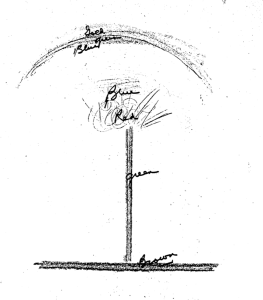
I tried to describe the field of science as the stage, the horizontal line. Man upright (the upright line on the horizontal, on the chart.) Religion as the sun (above the upright line on the chart). You know, even at this stage, that they have their own unique place.
Religion is to man his response to the sun of his higher consciousness, or what his particular religious experience may have aided him to perceive; similarly as, in the spring, all plants in the northern hemisphere begin to respond to the sun — the remote but powerful sun. Deity is remote but powerful. And the influence permeates as the light from the sun permeates the atmosphere and causes the reactions of all life.
How can we find for religion a place of its own where it does not conflict with science or psychology? The first step to that is looking deeper than the ordinary prayer book or dogmatic teaching.
Our search for help in this question takes us unmistakably to one motif —- the motif of the soul. Now all religions admit, claim, the reality of the soul. Some claim the soul as simple, in that it is dual; and that the soul is like Kundry, in Parsifal, turns to earth but also longs for the higher.
The object of the sun is to pull the little seed out of the ground, the bulb to grow, the tree’s branches to reach as far as possible. The motive of the power that is working on the soul, which sphere is the sphere of religion, is something analogous. Its call takes man away from earth. In this thought is the classic idea of so many of the ancient teachings of two phases of the soul, or two phases of man’s life. “I feel two natures struggling within me.” (Paul) The beast, that likes its lusts and pleasures, and that which is struggling to find something else, for it is not satisfied with that. Does not know what it wants.
This dual aspect of the soul is found in all esoteric teachings; and, as you will see presently, is an important stone in our structure with religion.
Religion, the relation between man and that which is beyond him, even as the sun is beyond the earth, has a call to the nature in man to rise above the earth; to be more than a beast. If you have made that equation you will understand the struggle that goes on in man, in yourself, and you will follow through the steps of the evening’s logic for you.
From ancient times soul, called by different names has been recognized. This soul has, presumably, something that corresponds to what, in the physical, was matter; and what, in the psychological plane was the psychic, or etheric. The soul is not the same as the etheric plane. The soul is an entity which, like the seed, has gone down into the earth, only to get up above it again, and be stronger for so doing. That is the basis of all great religious teaching.
How does one make these changes that philosophy speaks about? changing the soul to the divine, nous? “Then Wisdom was with me as a master workman.” guiding everything you do. Then the transformation of the soul to nous is rapid.
Energies of the spiritual plane: goodness, justice, beauty. They are the tools of Wisdom, the master workman.
Obstacles: reason thinking; the lower mind cannot conceive the rationale of these things; blocks to the flow. Does not like to be put aside.
The response in man to those rays from above. Man’s response to them awakens similar potentials in himself. Energizes that life, like the sun with the plant. Work upon the higher planes in you. Beginning of that order in training; when the physical is put in its place — the right thing in the right place and integrated so it can function. To intensify the movement of growth in the higher mind. That is what all these energies do.
Exercise in that region and it unfolds as anything in the physical world. Squaring the circle. Difficult problem, philosophically speaking. Bringing those potentials into expression is squaring the circle; and bringing in the missing link, philosophy.
Dewey: on the deepest problem of modern life: reconciling man’s beliefs and his conduct. Much of the chaos due to the separation.
The problem of restoring integration and cooperation between man’s beliefs about the world in which he lives and his beliefs about the values and purposes that should direct his conduct.
The philosopher calls the blocking death or sleep.
With that comes the question, What about the substance side? Is it energy? Stuff? A second octave away from the physical plane. Science deals with substances and the working of energies, but not in the minutiae, though now we have some interesting photographs of atoms. Even in the world of science the substances and the energies cease being tangible. With psychology they are less tangible, but, on the other hand, personally more convincing. Because you or your friends have had direct experience with the powers of the subconscious through neuroses or psychoses, analysis of behavior patterns, what lay behind their ordinary, everyday peculiarities. These things are convincing.
A rose and its perfume – the reality of the experience, though it can hardly be conveyed to anyone who has not smelled a rose. He who must always use the evidence of his senses is not ready for evolution. The story of Jesus and Thomas. In the fields which concern our life we have no right to be doubting Thomases. In the physical world we profit by the help of the intangibles.
Behind the crystallization that belongs to the form of religion is the recognition that this dynamic force, called the soul, has substance. But that substance is not etheric substance. It is a higher kind of substance. One octave further up, – more etherealistic if you like. In every Teaching it is there — if you have made your way to that Teaching. Every great tradition has its teaching regarding the substance side of the soul.
Substance and energy belong together. A similar partnership in the field of religion. But further, comes another claim of religion, namely, that the soul is indestructible. That is what you learn in physics. Of matter and energy. The three so far are in a unique field; do not overlap; but there begin to be very similar claims for each. What the religionist says, whether Chinese, Egyptian, Persian, or other, is that the soul is eternal; that the soul goes through many changes; and that it is those changes which are the concern of religion.
Suppose this were so. Many have misunderstood its correlate to science. Who would refute the basic claims of science? Religion has not been opened up to the same broad onslaught of experience, – the stage (“?}-, the horizontal line we all share. The things that are uniquely you — your human behavior, what you are, what you have become, your peculiarities, your prejudice, or your freedom from that — your experiences are your own. A friend may sympathize, but the experience is not conveyable.
Those things that belong to your being are not readily imparted. oYou are born alone; you grow up alone; you die alone. You may have friends or family, or you may not. But if you are honest you know you are alone; and that there are many thoughts you have that no one has shared; or is likely to share. That is normal.
Now, when it comes to religious experience, even more than the things that belong to psychology, this apartness is emphasized. Because it is peculiarly related to your relationship to the sun. Your response to the Larger is the measure of your religious nature. At the present time.
According as a tree grows, so is it vigorous, feeble, or dead. By the same token, so as your response, do you give sign of your aliveness in this field.
If you have no consciousness of the soul, does it mean you have no soul? According to all great Teachings, everyone is a soul, a seed; but until you have done certain things, reached certain stages, you are not likely to know it of yourself. That is not odd. Because you have given so little time to it in your life, why should you know it? How much earnest thought have you given? Such is the measure of what you can expect.
Nevertheless, the soul is knowable. My work of research beyond the sub-conscious has actually given location to the soul. That may sound odd; but it is a fact. Everything that is must have substance and place. And the soul is an entity; and it is knowable, but in order to know it certain preliminary steps have to be accomplished: meeting the tests and measures of the subconscious demands. Once the way is set to the Larger it is possible to have direct rapport with your own soul. It is possible to keep it. It is further possible to lose it.
Every great religion has said that the role of the soul is to free man from earth. The soul has certain energies, which go with the substance — not the etheric — and that those energies, and those activities, are as genuine and as certain of bringing about results as anything that may be accomplished in a chemical laboratory.
From far back it has been recognized that man has to be groomed, slowly, from his nature as a pleasure-loving animal. He does not like to go any other way than his own, and follow his own impulses. How hard it is to change that, you have no idea until you begin. But it is the power of the soul, responding to another kind of activity, – not Deity, or God, or heaven, – that brings about a changed being, or a change in the being. Virtues and sins. Evolving soul y& human man. The object of the virtues was to ……….
in reference to religious experience? Interestingly enough, a great many churches and organizations would really be interested to help.
There are ways of getting help. Even here, where the purpose of an esoteric school is to point the way to the healing of the sick soul; because, like the Therapeuts, we conceive that the sick soul is a greater danger than the sick body, but that it is possible to find out the way of healing. Nevertheless, in all the many spontaneous, or so without seeming causes, which William James, and Leuba and Starbuck and others have collected, you will find astonishing experiences. No one who has read, or experienced himself, anything akin to these experiences will question their reality. He may not think through them or be moved by their form.
If you had a sortie (?) would you measure it by your experience, – or be open to it?
The soul is an entity; an organism; it has substance; has energy. Energies of the soul were listed by Philo: goodness, perception, upright thinking, – to reason; to perceive; kindness; tolerance. You think they belong to the human being. They are the early characteristics of the life of the unfolding soul. They are the first leaves that show.
If things go wrong in life there is a blocking. If something goes wrong in you, and you haven’t measured up to the challenge, isn’t there an uncomfortable feeling? Somewheres? It is a forerunner in your experience to some of the sensations of the soul. But, on the other hand, if you have measured up to something in a trying and difficult situation, held up against prejudice, played the game fair and square, even though it went against you, is it not true that something in you is giving you an experience, – you hardly know how to call it, – a sensation, a feeling, – no word quite fits it, – that is one of the treasured experiences of your life? An entirely new kind of an experience. Other energy types are: yearning, aspiration, devotion, earnestness, searching through the heart.
Suppose that the religionist who really knows — I am speaking about esoteric religion — suppose he is correct, and that there are energies of the soul which can be made to function in certain ways that are effective – as effective in another world as the functioning of other activities analogous to those in the field of science. If that were so, would not we be a bit foolish to not investigate? The religionist says this is so; but, like the experiences of psychology, they are unique, alone, not easily conveyed.
In science, the value of resistance is basic. The wire and the light in the bulb. Why not in reference to the soul? Suppose man resisted in the correct way; could he get light as the result? Strange things occur, that lead to further investigation. The scientific method has not gotten very far in religion, but is calling the attention to it. Science would ask why? Not so, in religion. But something occurred. And that is the evidence of energy being transformed.
In science, there are many kinds of substance. Many kinds of energy. It is transformed this way and that way, as man learns and has the skill to transform them. The amount of energy remains permanent, though some of it may escape immediate use. There is transformation that goes down and transformation that goes up. In the field of science man is continually looking to make that transformation go upward. But he is concerned little about himself, and still less about this part of him that is called the soul.
The religionist says the soul has substance and energies. Those energies can be applied to bring about desired results; and that the right application of the transformation of those energies brings man into a wholly new relationship with himself and life. But it is an intimate personal experience. And here is the dilemma: that that which is transformed is himself, – or part of himself.
The human self is the field man gradually leaves behind. He grows away from it as the bulb or seed grows away from the earth. Do not forget it. You are asking a simple seed to do something you refuse to do. Because the lower aspect of the soul likes being in earth. Likes its putter of little things, – talk, gossip, play… Man is as the plant; has the responsibility to move above the earth.
We will see next week what the whole picture is; what is the relation of all the parts we have been discussing. The religionist claims for the field in which he is occupied the same basic characteristics and behaviors that you have learned in science and psychology.
What is sin? The word is misunderstood. You know what a fixation is in psychology: a stage beyond which you don’t help the life in you to grow. You take it for granted that the garden needs help; but the human self, after father and mother and school, can go its own way. That is not enough. Actually, this being in us is to move away from earth, as in the miracle of the plants about us. Its sin is to be held from doing that. The same thing as a fixation in a neurosis; a short circuit in your car. Stagnant water in a pool.
So (are) all things, says the religionist. And he is right. Wherever there is fixation, which is the sin of the religionist, there is the same trouble that has been found in the other planes, science and psychology. These three have an astonishing amount in common.
The Jewish tradition speaks of the two aspects of man as the animal soul, Nefesh — desires, appetites, and the rational soul, Neshamah, the soul that can fight and get itself out of its predicament.
Some traditions speak of “ruffians.” These are the evil ways for the energies to function.
When the people Wm. James speaks of had the experiences he reports the energy served as workmen. Where did that energy come from? How did it accomplish that? Can it be repeated? That is the question you would ask in science. Esoteric science answers yes. If you genuinely seek; know how to serve the desired and to avoid the undesired. You do that every day when you shop. How long before we come to something parallel in reference to the other side of man? How these energies can be tapped and cultivated, put into profit with the same clarity of heart and mind and purpose that we have been schooled to do in the physical world?
So there are diverse substances and energies in all three fields.
The Teachings say this of the soul: that under the natural law it moves downward. That it can be controlled, and turned upward. That there is, therefore, transformation down and transformation up. And that it is in the hands of man — exactly as the world of science speaks.
………
Re mystical states
They break down the authority of the non-mystical or rationalistic consciousness, based upon the understanding and the senses alone. They show it to be only one kind of consciousness. They open out the possibility of other orders of truth. Wm James “Varieties: p.404.
Lecture IV – Philosophy
January 16, 1943
The reconciliation can only be made in terms of philosophy. The larger includes the smaller. Today we are in the field of philosophy itself.
Define philosophy a little more; approach it from the other fields: Science: the knowledge of the physical world — element earth. Psychology: the study and the building up of knowledge in reference to the psyche. Religion: the same in reference to the soul. Philosophy, following the same procedure, is the research, and study and building up of that which belongs to Wisdom.
Philosophy, in the sense that we use it at the School, derives from something very much bigger than itself. That something very much bigger than itself is actually the Gnosis. And no one can speak at first hand of these things except they know the Gnosis. Almost a redundant phrase.
This, in turn, has another premise: the premise that there is profound knowledge available regarding the Immensities. Call it the secret Teachings, esoteric teachings, the work of the Initiates, whatever you will, – that is implicit. That does not mean the work of a group here or there. There are thousands of groups who are teaching, but that which is true esoteric knowledge derives only from one region — that is the Larger. Therefore, it comes down only through the Knowers, or Initiates, or Teachers, – they are the source of Philosophy. Man’s love of that teaching is philo-sophia, sophia being Wisdom. So Philosophy is what appears to men when they begin to love — really quest and search for the esoteric, or secret, teachings.
Only these secret Teachings can reconcile, or put all other activities in their place. The lower worlds can’t do that, because they have neither the perspective nor the leverage — the ability to place. That can only be done by the highest element, Air, which is the garment of everything else, even the sun.
The basic idea in our summary is that there are four fields of inquiry in which men and women active in the world tend to place themselves. The four elements to be expanded and used. Four streams of life shaping all things. Also appear in you — substance and energy. Your light the sun. The great energy, air, behind all manifestation. Philosophy corresponds to that. The same questing, re obstacles, with air.
What is the region in man of philosophy? It is not interested in the physical. Has to do with nous, spirit, pure mind. Capable of being experienced after the opening up of the way to it, and cultivation of the energies in it. Same as in the other fields. Meantime, the others can speak of the way. Opening up to that way is Wisdom Lore, the path up to the higher — that which belongs to the highest in you.
Region, the higher self. What is the substance? (I. Corinthians, Ch. 15) All flesh is not the same flesh. Subtle bodies. Illustration of the cups, one inside the other, vertical. Physicist goes the hard way, in dividing atoms. Verges on the etheric. Mental energy the life side of the psyche. Mind substance over the light spark. Our mind a wee forerunner of what mind really is.
These substances the form side of what philosophy speaks of — the substance more enduring, of which Paul speaks.
The fourth great field the most important, though so little known in the physical world. Its greatest vice is ignorance — ignorance of the reality of larger planes. The psychic plane is two octaves below.
Gnostic science deals with this world, – and in its higher aspects, theurgy, – the work of Deity. The light spark becomes potent only as each below has gone through its experiences, and finally is cast off, and is in the blue. Theurgy functions, to perfect the human soul.
Intuition, – Bergson. Only through intuition, and putting aside intellection that you may know. (Creative Evolution; Bergson) That function of the higher mind which functions directly can know with a swiftness and directness what the sense organs and the lower mind have to work on laboriously. Not to be attained by a mere act of will, but is a flower. Reason merely an exercise which must be wholly abandoned when you are ready to function with the higher mind.
Effective results of making transformations: mind becomes teacher and savior, nurse, and guardian, and leader. Mind the ruler, instead of being ruled by the lower.
The region from which philosophy is derived is the master region. Has the answer to all questions. Because all things have been originally derived from it. Men seek short answers,- about next year. That region is to be put into its place. The regions in you. How the four elements shape up all worlds. How, in you, you have the small correspondent to these four, which must also be shaped up to their fullest.
Most move only within the realm of the physical world; some re psychic; a few re religion, – not just church; very few in the other. Yet you have the seeds, – the way to become the perfect being. To square these four. The twelve labors. Each field speaks of its own field; none contradicts the other. The flowering of the life in each. Philosophy includes the others, but not vice versa.
The hidden side of evolution — that which is derived from the great teachings. Each one of these like a perfect stone, belonging in a perfect structure, which requires the form. No one is the complete picture.
The Four fields as four great stones by which the eternal man is raised from the lower worlds to the higher worlds so life in all four is energic, is continuous, is conserved and capable of transformation; but the methods differ in each.
Intuition never looks on anything human. A faculty of the mind body. By that time not interested in human conditions at all. That from which philosophy is derived has the key to all the fields. Philosophy is the activity of the mind as related to Wisdom lore. Intuition only one way of knowing the Larger.
4th element – air, Philosophy
Philosophy not related to philosophies as taught by earnest seekers in the earth but to Wisdom, coming from above. Philosophy, in the sense we are using it, is the Wisdom Teachings regarding Cosmic processes, brought to men by the great Teachers, Knowers, Initiates. These processes include cosmogonies……..
The Teachers draw on the same reservoir, hence their inherent harmony. That reservoir is actually the Gnosis, the Spiritual Plane, the Larger.
Philosophies are worked out by men in earth, earnest, sincere, trying to find the explanation of things, and building systems of thought. Not in harmony. Mechanistic, vitalistic. So Philosophy draws on something very much bigger than itself. The Source, the One River. Mentioned in Genesis, with the Four. The fourth river is the Pishon, associated with gold.
Philosophy means love of Wisdom.
– – – – –
As a field of study. …….
Only the Wisdom Teachings can reconcile or put in their place all the other activities. The lower worlds can’t do that because they have neither the perspective nor the leverage — the ability to place. That can only be done by the highest element, air, which is the garment of everything else, even the sun.
The fourth great field is the most important, though so little known in the physical world.
Chart of the Four Philosophic Elements in man. (Symbolic colors)
Blue, nearest to the sun.
Spark of gold, at top of blue.
Man is intrinsically like a river, containing a bit of the gold. It comes out successively, not in the beginning. First comes the natural man.
There is energy and substance in all four streams — in man and in the worlds objective to him. In man, all are to be expanded and used. All contribute the essence of experience. The fruit of soul is mind, the prize. The fruit of the tree is something entirely different from that which went before. The quality that belongs to the gold, and the evolving of the gold, is of a different order.
Visualize four cups, one inside the other, in a vertical line.
Body is substance to psyche, linked largely through the nervous system and the glands. Psyche is linked to soul, soul-body to mind. If there were not this inter-linking we could not ascend.
There is interlinking of matter and energy in the atom; that repeats on other planes. The physicist does not get this point in the animated picture-book.
—————
Wisdom is of the Spirit — it is not man-made. It is from Deity, through the Builders.
MBM
—————–
6/60
Re the Four, in boxes, showing area,
energies, obstacles, acceptable results.
Science: barriers a challenge, and an opportunity. Often deliberately placed, like dams on a river.
Psychology Barriers there too may be seen as opportunities — to make use of the dammed up power to bring about a change — to transform to more progressive conditions. Therefore the idea of difficulties in the religious life.
Religion and Philosophy
Soul is the body of the mind, so mind’s body needs healing. Has been made ill by life in the lower worlds — by pleasure, desire, grief, selfishness, folly, injustice, passions and vices. Religion and philosophy overlap. Each of the four links into the others. Religion gives a perspective to the infantile heart and mind of man, but does not do very much. It does not give the over-all perspective. Christianity and Judaism largely concerned with the conduct of men — moral and ethical teachings. But when man awakens, he is already past morals and ethics — takes them as self evident. The philosopher is interested in the long process, not merely the life now related to Deity, as the religionist sees it, but the life going through infinite stages. The object of the fire, as the philosopher sees it, is to ignite the mind, to heat the air, so that our thoughts go up.
Intuition; That faculty of the higher mind which can know with a swiftness and directness what the sense organs and the lower mind have to work on laboriously. Not to be attained by a mere act of will, but is a flower. Reason merely an exercise which must be wholly abandoned when you are ready to function with the higher mind. Intuition never looks on anything human. It is a faculty of the mind body. Philosophy is the activity of the mind as related to Wisdom lore. That from which Philos is derived has the key to all the fields.
GB Outline on Philosophy
Quote R.J. Campbell Gods Life in man
There can be only one reason why eternal spirit should ever consent to become imprisoned in material form – that is, that its latent powers can declare themselves. Undifferentiated unity must become endless variety, the unmanifest must split up to declare itself.
Dewey The problem of restoring integration and cooperation between mans beliefs about the world in which he lives and his beliefs about the values and purposes that should direct his conduct, is the deepest problem of modern life. It is the problem of any philosophy that is not isolated from that life.
Field of Philosophy the grandest of them all
everyone should have a philosophy of life. What do we mean by this. It is that which integrates your beliefs and activities makes of thema synthesis. Few have coordinated them into a picture of life as a whole. Many philosophers picture of life is spun out of theories.
Philosophy means love of Wisdom. Difference between the picture developed by men out of their human mind and that developed by the Initiates down the ages. First, below up – OK 2nd – above down- inclusive. Search for Philosophy by great minds always a major activity.
Philosophy talks of different matters than Religion.
Science – the material world
psychology – man himself and his relation to the environment
Religion – mans relation to Deity-
philosophy- synthetic- takes into view mans relation to the Cosmos
Diagram
Philosophic perspective- includes all these- by what perspective do we find the fundamentals of Philosophy
Porphyry Rational soul is the body of the mind. Here the field of substance soul was life we studied in R. Now soul seen as substance just as matter of this world studied in detail disappears into energy both appear to us as solids because we are adjusted to vibrational rate of them as solids. At another point energy reappears as substance in an ascending scale
soul, for octave above it becomes solid, matter a substance
Boehme All is from God himself and it is his own substance which is himself and he has created all out of himself. Cosmic substance.
Physicist speaks of a cosmos- the physical O that the senses perceive
Philosopher speaks of a cosmos- means the true universe- which the senses do not perceive
this cosmic substance – is the materia of which philosopher speaks – his concern with mind and spirit
Science concerned with matter
Psychology with psyche
Religion with soul
Philosophy mind and spirit
Jesus- In my Fathers house many mansions- different types of substance in which evolved beings live
Paul All types of flesh
Hermetic- substance of E, W, F
Vedantas- five different bodies
Religion interested in bodies of men in E
Philosophy carefree of physical bodies- a mere incident- see this life as incident concerned with eternal body- speak of different types of materia, capable of infinite transformation
these bodies are indestructible
Gift of God is Eternal Life- God, as God, not concerned with man in early stages in this differs from religionist- not contradiction, different octaves
there are gods and God- gods to whom everything belonging to man is registered, but the Great God, to whom the mighty beings, is so great that he does not notes what man is doing.
illus. P. Roosefelt not concerned with indb details –
The Book of Life – verily is – and Recording angels- everything you do is noted
Philosophy loves eternal Qs- wisdom, a different department from the Religion
look into carriers of W tr down the ages- records agree- recorders do not make it- as do philosophies- they record and teach it.
concepts in physical world change- have to be open minded- so in field of Philosophy- its findings upset beliefs and superstitions
Philosophy has found that the great processes belonging to eternal worlds are carefully watched over by God and gods, the lower ones by angels
illus. Gov wathed over by Washington- life of which Philosophy speaks is life of the Eternal Being
Plotinus Wisdom is not from below-up by reason, but always was, and is, perfect. It is not derived from man- this life indestructible and capable of infinite transformations. This is the concern of the philosopher “every soul is divine fragment with a divine history behind it.
Philosophy interested in the long processes – life going through many stages- for this must go to Wisdom lore- must seek the part of life worthy of long duration- MIND not the body or soul but mind the part at which philosophy begins.
Plotinus Mind nourishes the substance of the soul by bringing into recognition the thoughts that are in it.in accordance with the truths of divine law. Thus mind is teacher and savior.
this life evolved till of cosmic stature- worthy of eternal existence until mind undertakes work of saving
mind teaches man in E and the soul- also mind is savior- until then souls held by fate (always so in earth, regardless of sp stature- Jesus, Zoroaster) Saving men from having to go through the same process of birth, death over and over-
Mind is nurse; saves; heals; guides; watches over life in lower planes. Is leader makes for silence of body and psyche- Mind is discipliner, healer, teacher of stages of being moving upward.
How are processes brought about? Aid of mind: Metancia GK~ repentance, nearest to it- Philosophy means repentance,of the mind- not of heart- Metancia, turning back to the true path. Usually seen as a conversion, regret for sin. Phil repentance is economic- minimum of emotion, maximum of mental turning. Not sad- to mind
therapeuts now used for physical healing- group in Egypt- term meant healing of souls, souls made ill by pleasure, grief, selfishness, folly, injustice
passions, vises- these make sickness in the soul body
Paul Inward man renewed day by day- his thoughts, desires
(overlapping between R and P as between S and Psych)
and do no wrong to any man
Great goal of a soul becomes entirely mind
souls continue as souls until this transformation is accomplished
Phil works on soul so it becomes mind- thus becomes tinctured by spirit- spiritualized mind
stages in Phil- akin to fixation- spoken of as sleep- unawakened to higher life-ignorance, frustration-the souls vice is ignorance- having no knowledge of the things that are
Clement Truth is immutable but false opinion dissolved. To know the Truth one must be it.
Here we find facts, not truth- truth only perceived by philosopher following WL
Living in two worlds- a physical life and cosmic life in spiritual worlds
FWH Meyers this life is the goal, aim, work of the philosopher
definition of Religion- WM Kingsland- Religion of the Future
Intuition Bergson
Gnosis (see sheets)
Montague – The Chances of survival- progressions of energy transformations
continuity on basis of energy patterns
fourfold classification- like ours
1- mechanical energy
2- vital, vegetative
3- animal, sensory
4- personal, rational
we set off dif from Montague with perspective of WL
Intuitions: To comprehend with instant effectiveness; to look into those
things belonging to spiritual life
Bergson- We can understand spiritual life only from outlook of intuition- the
pattern of things seen by WLover
genesis 11, lo A river went out of Eden
1st stream- great driving force from beginnings (Will of Deity)
4 symbolize, sp, mental, psychic, material planes- the span of driving
life behind all creation- four entered into everything- down through involution then upward which are the stage of these activities we are watching
look to us Science, Psychology, Religion, Philosophy when they operate in man. They work everywhere. Our interest – how they work in man
Development of four types of energy
mass and energy- first stream- transformation of mass into energy
physicist seeing the transmutation of first stream into another
at border discharge of one into another
eventually four heads will come into one stream
Science coming into phen he can’t explain-only metaphysics will give key
all we have here dependent on solar energy- thousands of years ago, stored in
plant life- buried and becomes coal- latent energy in coal
chemical energy changes it into heat- always loss of energy
but conserved though dissipated
through heat turns fly wheel in dynamo- mechanical energy
dynamo converts into energy- which is conveyed to lamps (electrical energy)
same true in psychic field
for growth- EW have to be refined- highly evolved souls and mind need care
from eW )
Science speaks of 92 types of elements forming stuff of our physical earth
the four philosophical Es are the four great stones which make the eternal man from the lower worlds
nothing of Earth life can continue without the sun. Soul also strives to its sun, spirit- call it Deity…
Science of the soul.tells you how to make this transformation
Air- reaches up beyond where you can go- so great mind reaches where lower
mind can’t go- earth mind can’t reach higher levels naturalist not concerned with it
Science of the cosmos- organization of the understanding of interrelation of the 3 into cosmic perspective
Religion tells of reaching to God- not of relationship of higher man to the cosmos
This is philosophy- soul is substance to energy of higher mind
the rivers are E- the elements
GB 2nd part continued
Four elements -substance and energy side in man- so cosmos sustains individual life. man builds them into the activity of four fields- so utilizes and amplifies them through his will and intelligence- so four fields are expressions of man
purposes- four horses- learning to drive and master them
typical obstacles- short circuit- toxic condition, blocking, knowledge of ourselves
have to learn to know and control
2nd horse- difficult- try to evade- psychic troubles- fixations
to learn management- self respect
3rd horse -more difficult- away from earth- soul intangible- has its powers, behavior patterns, needs, little by little you come to know it- learn behaviors which favor it- Mystics call “Interior life”
4th horse- most difficult- most precious- leads to understanding Mind as an entity with energy and behavior patterns which can be dev, controlled
transformed
house not built with hands-you have to build the other three bodies- the eternal spirit in you, built by gestures, behavior patterns- must evolve the seed which receives the vital germ of the 4 rivers
completed man- mastery of the 4 horse- completed house- process taking time
energy- ultimate man of cosmic stature-
Truth the eternal right, livingness belonging to cosmic areas
Tat when each of 4 are set up in right relationship
below – the symbol of the Lotus – explain
Coordination of the Four
Science, Psychology, Religion, Philosophy
February – March 1941
Necessary, steps to be studied before they can be seen in their inherently supplementary nature, removing the surface conflict among them. Such a procedure necessary to seeing life in a well-balanced way, and the contributions from each of these four fields of human endeavor.
——————–
Imaginary journey to a high pinnacle, from which to survey human life, without time and space complicating us. From this high point we see a great complexity. But little by little upon examination it would grow simpler.
We would see the activities of man as tending to group themselves into four channels, – the departments of science, psychology, religion and philosophy. Possibly art also, but that is not so much a field of mind activity, but the imagination drawing on science and religion.
These four have each swelled from time to time. Sometimes one appeared as the dominant activity, sometimes another. Not so long ago religion dominated, and controlled the laws in its own and civil fields. At that time science was hardly born. Then centuries passed; research grew, inquiry and observation increased, and bit by bit scienceswelled. Now it appears to be dominant and to speak with finality of first and last things. Psychology too has been swelling and speaks with finality.
These four are like a vast toeing with an ego, – all claim to speak with authority. Where is the final voice?. Whose voice speaks truly? A “battle has been going on between science and religion in the last thirty years. Psychology has sprung to the aid of science, and philosophy to the aid of religion in this battle between voices of conflicting authority. To whom is one to turn for the final word?
If the four are here simultaneously, they cannot be contradictory. The trouble is with us, not with the fields. The facts of science are uncovering to man’s mind the ways and means of nature. All the four have always been here. The battle is not in the four fields, but in man’s interpretation of them.
A whole view of life is necessary, an inclusive view, in which none of the four would seem to contradict any of the others. We need a sense of interrelation, so as to see their supplementary character. If we acquire that balanced approach, there is resentment at the thought of the unnecessary conflict among the four. We need to draw on all four.
There are steps by which you can find the way of reconciling the four.
SCIENCE
Note the difference between science and the scientific method, which is the method derived from those used in coming to conclusions in science, and is the method which should be used in investigating any field, not only science.
Science is organized knowledge relating to material things. Hence it is a powerful voice, but not the governing one. It deals with the physical .worlds, with matter, with the tangible; it can be seen; it deals with substance, stuff, body, materia, physic, molecules, atoms, protons, electrons, etc. Then matter fades out. Science also deals with energy, power, life, dynamics, vigor, force, capacity for work, etc. It deals with the form and content; substance and energy, materia and life — opposites. It deals with the stuffs of nature and the energy inherent in it, but in terms of this duality of form and content,-—. the cup and the water in it, the room and the air in it, the clothes and the body in them, the battery and the chemicals in it. There is no place where one without the other is to be found. No substance without energy, nor vice versa. Sometimes the substance is heavy and tangible, sometimes intangible, – like the atmosphere conveying the lightning. The emphasis is sometimes on matter, sometimes on energy.
Science is interested in stuffs because of the energies. In any production of nature or man, there is energy. Looking at the realm of science through the energies in it, we find many types of energy.
Radiant, thermal or heat energy Chemical energy
Mechanical energy Light energy
Electrical energy Gravity, etc.
When the scientist works with energy, it is because in energy there is a potentiality
Energy is the ability to do work.
Work is the transference of energy from one type to another.
Force is the push or pull which produces change or motion.
Gravity is the pull of the earth for bodies on or near it.
Gravitation is the pull of all bodies in the universe on each other. The “pull” depends on the size of masses and the distance between them. It is the source of all motion, because of the interpull of the planets. The source of life is this type of energy.
Radiant energy causes the movement of the winds, the growth of plants, movement of ships, etc.
Chemical energy – the pancreas gland in the body has the power of secreting a certain juice which controls the sugar-consuming power of the body. It burns up the sugar in the tissues. When it doesn’t work properly diabetes sets in. Man, with his mind at work, sets to investigate nature and improve upon it. The mind has found a way of replacing the failing activity of the pancreas by means of insulin. Chemical action is thereby introduced into the blood stream.
Energy can go through any number of changes which can be produced arbitrarily. Behind the end product there has been a long series of transformation of substance and energy. We have the conversion of electrical energy into many uses, light, heat, cooling systems, etc. All changes are without loss of energy or of substance. Science states and restates this:
Conservation of energy and of matter – the first basic law of science.
For example, when the physical body is exhausted, energy appears to have been dissipated, but it has not been dissipated. Through exercise the body develops heat; this is transferred to the thing you do and to the atmosphere. It is no longer at your disposal, but it is not lost.
Tap on a lead pipe (mechanical energy). Put your finger on it after some tapping, and you find it hot. The energy of tapping has been converted into heat energy.
These fundamental laws are the bases of reconciliation.
What is life? The scientist says, cut down a tree and it dies. What he is really saying is that the particular energy, the life of the tree, is apparently gone, but lost only to that tree. The chemist says all the chemical values are still there, but they no longer operate as life. The scientist oversteps his mark when he makes the life of a human, or of a horse, the same as the chemical life in the insulin. The life of the tree, the animal, and the human are not the same. To the scientist it is the same. He thus lords it over another area not in his field.
Mechanical energy. Take a glance into the field of the locomotive. It is in the train yard. There is a fire under the boiler. The engineer watches. The dial rises. A hand on the throttle is needed to move the train, to release the energy created and stored up in the boiler. The coal burns, changing into heat. The heat conveyed to the water in the boiler, creates steam. There is pressure accumulated in the boiler. It is released to work against the piston when the throttle is released. A constant change of energy is at work affecting the different substances. The quantity of energy is the same – merely different forms of it.
Many efforts are made to prevent the escape of energy – prevention of radiation, etc. It depends on circumstances whether it is seen as waste. But it is never lost.
Science watches the upward transformation of energy with the least waste; with the least waste of motion, substance, etc. Always economics is at work.
We eat food and now think of it in terms of calories, units of energy. We regulate this according to the occupation and activity. The process of conversion is at work here – the .conversion of energy in the food we eat into the energy of the body. Because these things are accurate, because dependable laws are at work, the doctor, the nurse, the engineer can govern his procedure. Laws are not hit-or-miss, sometimes working and sometimes not. They are always at work, whether we know it or not.
Inertia – the force which keeps the universe in motion. It means that a body once set in motion, continues in motion unless stopped by an outside force. The table is stable only relatively. Appearances are the intermediate state, which implies latency. Radiant energy (power from the sun) hundreds of thousands of years ago was stored in plant life. It became buried. Now it is coal. The sun power is there, has been there all the time. It is stored now in the form of coal. The radiant power in it is now in a state of potentiality, of latency, and will be released into heat when it burns. So the table also has a potential energy.
There are three stages energy; goes through in cycles — non-activity, potential activity and action. The scientist discovers action is everywhere. Matter molts into action at the point of the atom, a fading out of substance into energy, – transmutation.
Energy is continuous – Second basic law of science.
Energy is transformable – Third basic law of science.
SUMMARY
The field of science studies two great sections of life (form and content) which manifest through energy. Matter cannot be destroyed, but is capable of any number of transformations, and ultimately capable of transmutation into energy. All things we see — paper, clothes, tables, etc are made up of electricity ultimately. There is an intimacy between energy and matter. They are not two disjointed opposites, but joined in their secret depths.
Energy, like matter is indestructible, and is capable of natural or human transformations to an innumerable extent.
Matter is coarser than energy. We can never see energy; we can only see its effects. We cannot see the wind, but only its effect on the water, on the trees, on our bodies, etc.
Matter goes over to energy in the last analysis. What occurs to energy?????
Note the difference between energy, work and force; between gravity and gravitation. The clearer we are, the more we can see likenesses and correspondences in other fields.
The contributions from science are extremely valuable. They are the building stones with which enormous structures are to be erected.
Regarding insulin. There are types of energy which are undesirable, for they work downhill. For example, in diabetes the energy at work is making for a transformation downward. Insulin calls a halt, and makes it possible for the glands once again to transform the energy upward, into a building of tissue as against the former destroying of them. Again, in the growth of a goiter, we see an example of the downward transformation of energy through the lack of iodine. We see thus that there is inherent in energy the capacity to transform upwards or downward.
Science sees to it that the transformation takes place in the direction that man needs and wants. The extension of scientific knowledge increasingly controls the direction of the transformation. If left alone, energies would go down. It takes additional effort for energy to go up.
Topical Outline
KEYS TO.THE RECONCILIATION OF” THE GREAT FOUR
October — November 1939
FIRST EVENING
The four main fields of man’s interest and activity
The value of knowing whether they are in harmony, and if so why.
Correspondence of these fields to the areas in man’s life (the four aspects of human life)
Different fields dominant at.different times.
The dominant field at the present time. Why.
The one which has not sought dominance. Why
What is science?
Matter and energy; the partners
The scientific method.
The many types of energy in the physical world.
Some important lessons taught by science.
concerning matter
concerning energy.
RECONCILIATION OF THE GREAT FOUR
First evening
February 16, 1939
The Four Fields of study comprise man’s chief fields of interest and activity
Importance of knowing whether they are really in harmony.
And if so why. Would clear up many misunderstandings
Those fields correspond roughly to the four areas in man, and in the worlds objective to man.
Man, is three-fold; plus the seed of Nous.
Four fold man, and the correspondence of the Four.
Dominance of different fields in different ages.
Earlier dominance of religion
Present dominance of science.
Psychology too has sought to dominate.
Philosophy alone has not sought it; but gives each field its place in the pattern.
Why science speaks a with such finality.
Science, as ordinarily understood, is the study of substances and forces in the objective world (3rd dimension).
Deals with matter; and with energies.
Various words for matter; for energies.
The duality of form and matter. Syzygy.
From science we have also the scientific method.
Emphasis sometimes on substance. Ex. paper-making, from wood-pulp to newsprint
energy, or power. Ex. power dams.
The many energies of which physics speaks.
Are these all? What about feeling; thought?
Some of the important lessons taught by science:
Matter cannot be destroyed, but is capable of many transmutations
Energy cannot be destroyed; conserved.
Matter in its ultimate divisions becomes energy.
Energy capable of many transformations; some directed by man.
Summary.
Reconciliation of the Four
First evening
February 11, 1937
Introd. Usual views. Philosophy
General anatomy of man – 3 fold plus spirit
Dominance of different fields – historical
What is .science? The scientific method
Why sc. speaks with such finality
Science deals with matter. words for this
And with energies. Words for it
Duality. Syzygy
Illustrations from the press.
wood pulp. power dams
The many energies of which the physicist speaks. Are they all?
Matter cannot be destroyed, but is capable of many transmutations. Finally into energy. Hence the intimacy between the two.
Energy is indestructible. Capable of many transformations. Some directed by man
Energy can be transmuted into matter, but this does not concern us . Energy intangible.
What happens to energy at the other end?
Summary
RECONCILIATION OF THE GREAT FOUR
Second and Third Evening
February 23 – March 2, 1939
Psychology
Second great stream of activity – Psychology.
(Reference to the three great areas in man, plus seed of the fourth if this has not been done in first class.)
Psychology ancient. As old as man. Men observing themselves; getting certain results from themselves and others.
If you read carefully the ancient books, psychology is there in the broader sense in great quantity.
Physical science really the most recent. Physical science the last of the four to develop; the three others much earlier. Exact observation of natural facts came much later. Psychology is the study of human behavior. Many subdivisions.
Psychology known under many names. Even today 30-odd names for psychology; all related in some way to man’s behaviors.
Types of Psychology
Abnormal Psychology
Academic Psychology
Advertising Psychology
Animal Psychology
Applied Psychology
Association Psychology
Behaviorism
Child Psychology
Crowd Psychology
Educational
Experimental Psychology
Folk Psychology
Gestalt Psychology
Glandular Psychology
Hormic Psychology (purposivism)
Individual Psychology
Industrial Psychology
Laboratory Psychology
Pathological Psychology
Personality Psychology
Pragmatic Psychology
Psychology of Advertising
Psychology of Instinct
Psychology of the Unconscious
Social Psychology
Structural Psychology
________
Related studies, involving much of psychology:
Sociology
History
Jurisprudence
Criminology
________
The particular division which we think of as the psychology of our modern day, particularly the psychology of the unconscious is a relatively small subdivision.
But of particular and peculiar importance. The other types relate man to the outside worlds, or to some particular situation or situations. It alone turns pre-eminently to the psyche and observes the behavior of the psyche; the psyche itself, not primarily results of it in behavior patterns. Psyche, the world of feeling and thinking. Not body.
Here we enter upon the world of grades, qualities, values. Not measurable by same standards as physical; highly dynamic.
_________
A glance at the history of psychology in its beginnings with the Greeks. Every Greek philosophy has a part of it a psychology; the part relating to man. Pythagoras, Heraclitus, Plato, Neo-Platonists. That which pertains to man is the psychology. The philosophy relates to greater fields; the psychology to man. You can sift it out. In those days it was distinctly a science of the soul.
So we may make two subdivision of psychology, one related to the practical, everyday world, turned down to the earth and the personality, man and his relation to his material, practical world. The second subdivision is turned to larger events, the psychology of the soul.
Man today too busy with the practical to be concerned with his soul. Is it so practical? Is concerned with material results.
Practical psychology too in the ancient day, deliberately worked for practical results. Crowd psychology exemplified by the speech of Mark Anthony. Even among the primitives was a practical psychology, the medicine man or shaman. Today we might call much of it superstition, but it worked or could not have endured. Shaman worked with the laws of the psyche and got results. Perhaps suggestibility, perhaps hypnotism. The wise men, leaders of the tribe knew practical psychology even to make a person die if desired. Came to be looked on as illegitimate, as witchcraft, etc.
Schools of philosophy developed: Stoics, Epicureans, Essenes, Therapeuts, Yog; often included the great stories of creation, cosmogonies, and cosmologies; and (2) humans and their behaviors. The Mysteries of all traditions full of it. Book of the Dead largely psychology. In the ancient day men were more interested in the eternal man than today.
The schools of psychology arose through observation and recording – the scientific method; so building up a body of knowledge available to others. Great teachers and initiates who taught the people of the larger processes, wisdom-lore. (1) out of this dimension; (2) into this dimension.
All modern psychology schools have much that is valid in them. The valid in one does not invalidate findings in another – all have their place. The stream is divided into many areas, legitimately. Today we are interested in the psychology of the glands. One type does not invalidate the other.
Recapitulation: Psychology ancient. In modern days split up into many departments, like science. Psychology related to the visible and the invisible man.
————–
Science dealt with energy and matter. These two always together. Is there in psychology anything corresponding to the syzygy of energy and matter?
Psychology is concerned with the psyche. What is psyche? It is related to Aisha, Eve, the Mother of all living. Eve is wish, desire, volition, – not a woman; a force activating all living. Desire an energy. As much so as electricity.
Names for this force. Libido; élan vital; psychenergy. A driving force which causes action.
Other energies: instincts (what is an instinct. Can you locate it?) urges, impulses, hopes, fears, likes and dislikes, ego-feeling, ambition, determination, will. Different energies, working in different ways, each peculiar to itself. (See Glossary of Psychological and Philosophical terms by MBM)
This energy too is indestructible. That was discovered by the psychology of the unconscious. By the scientific method.
Life buried but still alive. An anger, a fear, an affection buried long ago is there, as living as it was then. Forgetting, is merely a transfer of an energy to an area where it is not so accessible, but it still is; is living; an energy. Neuroses may be caused by these buried energies. Repression (squeezing) Symptoms. Dislikes. The energy causes changes like compressed steam in a boiler causes changes. Engineer lets the steam out into a vacuum chamber, where it can be constructive. Buried energies not so dealt with may case explosions – nervous symptoms. Tics, etc. the sign of this; paralysis, functional disorders; or general dislikes of situations, as fear of crowds. Our conscious mind does not know why, but the energy is still working in the unconscious. Our likes and dislikes, our peculiarities, are brought about by energies repressed, or compressed, in our boiler room. The psychology of the unconscious shows that energy does not die. The ancient psychologists knew this.
We must find a substitute for term the unconscious. That is merely negative.
Where is the substance side of all these energies?
Glandular psychologists say your behavior patterns are caused by bodily secretions.
Secretions do go on in anger, fear, etc. But which is first, the secretion
or the anger. When you are sad, is the grief through a bodily situation
or through something else.
Others say the gray matter of the brain is the substance side; others the nervous system.
Modern psychology is moving away from these inquiries. (Outline of this trend to be found in the Mueller-Freienfels book)
Emotional system linked into the body, so that it registers impressions on both psyche and body. Body’s complexity linked with an intricate emotional system. Like threevessels on a pipe line would react if something is in the pipe. Three links: physical, psychic, mental; one affects the other. Emotions hooked in. Glands at a sort of strategic place to register. Interaction among the three areas.
– – – – – – –
None of the terms which psychology offers in the present day will fit our need for a substance to parallel these psychic energies.
Until the period of the new psychology of the unconscious humanity too engrossed in the material sciences and physiology.
Even the psychology of the unconscious does not locate the unconscious or give it a substance.
We must have a substance, but it will have to be meta (beyond) physics to parallel the energies beyond the physical.
If we are going to harmonize these four great fields we shall have to find a substance in all four of them. Only one deals with material substance (Science). Glands, nerves, etc. respond quickest when the emotional world vibrates.
The ancients recognized a psychic body; psychic effluva; form for the psychic energies. Means of their expression. Formerly men’s attention was more on the other three (psychology, religion, philosophy) hence he was at ease in metaphysics. We are so engrossed in matter as to be ill at ease with metaphysics. Yet we are native in metaphysics, for we all have psychic energies. Therefore possess a metaphysical body as the form side in which our psychic energy functions.
The physical body has a short range of receptors. In physics rays of all kinds which your body does not recognize. Photo plate made receptive to other rays; extended to receive more through infra-red rays. When you sense an atmosphere it is an impact on your metaphysical body, relayed through your consciousness. It has come in on the substance side of the psychic energies. Receptivity to condition not through the physical senses. Magnetic field of the body – an area with a substance across which energy plies its way. Many types of substance. Do not expect in a new field of study what you have found before. In the metaphysical world things are which are not tangible to our physical senses.
Telepathy and the ethers. In telepathy distance makes no difference. The sent thought is an energy, is broadcast over or through something – an ether. It is picked up by an ether in oneself, because your metaphysical body will be of the same stuff. Transformed into something which your three-dimensional consciousness will get. Translation of the impression to the brain.
We are stepping off into a world not tangible to our physical senses, but may be tangible to our metaphysical senses.
Energies and stuffs of the psychic areas. These energies are indestructible. Examples as to how they can be transformed. The energies are never killed, but transformed up or down. Down, through a shock; or a trauma.
We are tied to our past. Bergson: the past is leaning over our shoulder. Science of the soul seeks to transform them up. The psychologist of the day to correct the downward trend of energies, as in functional disorders. Has discovered buried energies; progressive or regressive transformations.
Physicist and the psychologist saying the same thing re different energies and different areas.
MBM’s coordination of Psychology with Science
The psychologist agrees with the material scientist that there are energies; that they are conserved; that they are blocked, and if too badly, they have malign effects. Those effects can be removed, and we get favorable effects. Also, there is something that works along in the pattern to bring about beneficent effects, like the white corpuscles in the body, for the psyche, like the physical organism, is under the natural law.
That there is another kind of energy, not physical — invisible, but visible in its effects; and it determines your conduct, your physical symptoms.
The two are saying identical things, when reduced to the simplest terms, but one is talking about energies that belong to the physical plane and the other those that belong to the psychic plane. Neither has the key (to the harmonization) that is through philosophy, namely, that this is another type of substance-energy with which we are equipped.
The philosopher sees further: that this energy is an integral part of the larger pattern, because it prepares the ground upon which the higher man is evolved. Different floors of the same house. Different energies and different substances.
Keys to the Reconciliation
SECOND AND THIRD EVENINGS
Psychology an interest of man from ancient days. What is psychology?
Many schools of psychology.
The modern psychology of the unconscious. The special reasons for its importance. Comparison with other types of psychology.
Some differences between psychology and physical science.
Ancient psychology had a philosophy. Today’s directed to more practical ends. Is this so practical?
Psychology in relation to the visible and invisible man. Inclusiveness. Contributions from many schools.
Recapitulation.
– – – – – – – –
THIRD EVENING
Matter and energy in psychology (syzygy.)
What is the psyche?
Wish, desire, volition. Other types of psychic energy. Names given to this force.
This energy indestructible – a discovery of the modern psy.
A glimpse into the subconscious life, or energies.
Where is the substance corresponding to this life?
Interlinking of the feeling world and the physical organism.
Metaphysical substance. Its help in harmonizing.
Recognition by ancients of a form or body for the psychic energies. The short range of our physical receptors.
Transformation of psychic energies.
Psychology
Second great area, seen philos.
Definition: feelings, thoughts, behaviors, related to three dimensional world. Subjective and objective. Individual and collective. World of desire, wish, volition, element water.
History: old as man, observing himself and trying to get results from himself and others. Known factually and described. Ancient writings. In the Greek philosophical systems. Medicine man. Mystery schools of Egypt and Greece, including something of science of the soul too. Science, as the observer of nature younger. Formulations re psychology. of the modern day.
Divisions: today many: Animal, abnormal, crowd, educational, gland, social (folk) modern psychology of the subconscious. One does not invalidate the other.
Related fields, like history, economics, sociology.
Modern psychology of the subconscious: A relatively small division but important for peculiar and particular reasons. The others relate man to the outside world, or to some particular situation or situations. It alone turns pre-eminently to the psyche and observes the behaviors of the psyche — the psyche itself, not primarily results of it in behavior patterns. (2nd story of house)
Dynamic Desire, Aisha. , activating all life – — as much an energy as electricity. Many branches, name some. Different energies, as we saw withscience.
Has a substance side also, to be discussed later.
History of the modern psychology: Challenge of mental illness. Hypnosis. Memories indestructible. Helps us with, the reconciliation.
Talking cure. Functional disorders. Conversions, some everyday ones, some more serious. Transference of energy.
Deductions: reservoir of memories of experience somewhere, and that “somewhere” began to be called the subconscious. other names. A reality, tho not tangible. Brave men. Buried memories could cause trouble.
Freud and followers: Biological drives. Energies repressed or squeezed, voltage in them, stored beyond a point. Sublimination. Transformation upward. Later Adler and the “will to power.”
Value of work with patients in showing how the psyche works normally, and in preventing malign conditions.
Psyche, consciousness and subconsciousness is adjusted to the practical world. Most people shaped by their environment. Energies favored come out, others outlawed. Leads to psychological type. Psychology needs to see that they are really more than that.
Work of Dr. Jung
Psychologists did not work with the substance side. Must look to philosophy for that. Syzygy. Etheric. Why the psychologist and psychiatrist got along without it.
Can begin to see it if you develop clairvoyance. What is really occurring on the substance side. Energies plying through it.
Factor in the higher evolution.
MBM’s comparison with what science says.
Need for obstacles, to strengthen psyche.
What about such manifestations as prejudice, hate, superstition, hostile, critical attitudes? Blocks of mental energy.
Psyche the underpinning of mind.
The Great Four
An Outline for beginning students to aid in the reconciliation of science, psychology, religion and philosophy, the main departments of men’s interest and activity. A single talk by MBM from the series of Thursday 8:30 classes, fall of 1928. Several fuller, presentations of this subject were given in later years.
– – – – – –
Many philosophic systems seek an interpretation of the nature of life, and they don’t agree. There are four important factors in the interpretation of life: religion, philosophy, psychology and science. We can’t dispense with any of them. And there is a solid basis on which we can reconcile them. They correspond metaphorically to the Four Rivers from the Garden of Eden. They must flow back into the Garden if there is, metaphorically, to be a rounded life. We must therefore overcome the conflict between them.
Science. The root of the word is knowing, or means of knowing. Science is the power to know. Conscience is the power to know in the self. Science is the study of cause and effect through material evidences in the physical world round about us. Science talks about life, but also says it does not know what life is. It describes the effects and the appearances of what it calls life, and forbears giving an answer as to what life is.
When science reports a thing as living there is an energy in it; it moves and flows. It may have an organic body, like a plant or animal, human or even an atom. The same thing with the flow of electricity. An energy which moves. Science would always report life as an energy which moves.
Science observes that this energy often meets resistance. Sometimes it seeks a good conductor. When there is an obstacle there seems to be a change in the nature of the life. That is sometimes applied from the outside; sometimes applied from the inside. Then the energy undergoes a change.
There is a constant value in energy. Science has taken many steps to watch it. Therefore energy is conserved. While it is permanent in amount — in that way — it may have gone through many forms. Always a change going on with the conservation; that is transformation. So we note: life is energy; that it flows; that it is conserved; and that it is transformed.
Science looks always to a favorable transformation of energy — that which will offer as little resistance to the flow of energy as possible. Also, certain forms of energy are more desirable than others, as when water power is changed to electricity — cognizes some forms as higher, or more desirable than others.
Until recently science dealt only with what was tangible. N0w it is beginning to deal with ether, psychic research, the manifestation of rods of energy, levitation and other phenomena. Thus science is extending its observation. But wherever it is doing so it still holds i& the fundamental thesis: that life is energy; that it flows; that through meeting resistance its flow is changed and its nature transformed, but that nevertheless its unit value remains permanent . And certain forms of energy are of a higher grade.
Religion Religion is the relating of the self to that which is beyond, or larger, than the self. Microcosm and macrocosm. . . . .We are living a life in two worlds at once (a quote here, I believe, from F W H Myers, author of “Human Personality and its survival of bodily death.” GB)
The life which the religionist discusses is not the life which the scientist discusses. The religionist is concerned with the soul; the soul is the life about which religion speaks. It speaks of it in many categories: soul, breath, karma, spirit, etc. Every one of them has to do with life that is not like the life the scientist discusses.
Religion says this thing has the capacity of choice; moves, as energy. Has the capacity to change; capacity of transformation. This corresponds to what the scientist says, but on an entirely different octave.
Soul, according to religion — the great religions of the world, is said to be eternal; to move from one state to another; to meet difficulties; and this resistance makes for change — either a change down or a change up. This unit of energy, called a soul, is a thing that is enduring; it has conservation, as the scientist would call it.
Psychology We are speaking of the psychology of the present day, with all the values which the present day psychology has contributed to our store of knowledge of the self. One of the missing things which the new psychology has contributed is that thing called experience — those memories concerning anyone’s experience are never lost.
There is always a striving of this energy, at first called libido, to manifest itself in some expression. It may turn down (or be turned down) into the unconscious, but is still living. It never ceases; it is continuous.
This libido, which manifests in you in all sorts of ways, is forever living and striving, but transformed by the resistance the energies meet. When they are transformed down, and the self is not successful in finding solution for the frustrated energy, we get nervous symptoms, neuroses or, later, psychoses. That energy can be recovered. It may be in a latent condition; sometimes powerful, spinning a vicarious existence in the unconscious.
Philosophy Those philosophies which are synthetic hold a complete picture, a pattern. We find them in China, Persia, Old Greece, Egypt. Bits of them are in the Christian Bible.
Philosophy means love of wisdom. Wisdom is above intellect. Philosophy also deals with life. Indeed, Philosophy cares for life itself. It cares less about the form side than any of the other three. It speaks of the essence, content as against container.
It speaks of Great Life, Great Will, First Father; small life, as monads, light sparks, seeds. It recognizes these are the energy, movement; they are all things in esse. Energy, here, is naked – as Will, not desire. Will is a mental product. It is ever active, whether from the Great Will or the seeds, germs. It never ceases; it is eternal.
The particular form of which philosophy speaks goes upward only. It is spiritual in nature. With the idea of continuity goes immortality. This energy which philosophy discusses concerns philosophy for one great reason only: how to transform it from a lower type of energy up to a higher type. Not as religion, but in a particular quality of transformation, namely, a conscious transformation.
Religion is more like an opportunist; it wants to accomplish an end. With philosophy, the very quality of the accompanying factors of transforming life are highly important. Philosophy requires transformation upward, accompanied by a high degree of mental consciousness. It speaks of the way this energy should be transformed, so that its latent, or lower grade energies, may be transmuted to the higher.
Again, this energy has continuity, is conserved and, through an obstacle, is transformed — the task of philosophy being to transform it upward.
Science studies, and advances, life in the physical world. Primarily so. Matter. Psychology studies, and advances, life primarily in the psychic worlds, these being the worlds of desire, the feeling worlds, the emotional worlds. All four advance life as well as study it.
Science has been so effective it has made our world what we know it today. Psychology has done its main work so far in advancing work with cases — neuroses, psychoses. It has already begun to make man understand his psychic mechanisms and transform his energies, bit by bit. Repressed energies are sublimated.
Religion studies, and advances, life in the soul – leading it up in its right desire. The soul is clearly not the libido, not the physical energies. The soul nature belongs to that area which goes up.
Philosophy studies and advances life, transforms it upward, by advancing the mind and spirit through the understanding which the higher mind alone can develop. It is the higher mind only which is able to understand, and to become master, of the household – transforming it into the spiritual plane.
These four: science, psychology, religion and philosophy are each describing life of a different sphere, a different type, or grade, of life. There is really not the slightest conflict among them. The difficulty arises when the scientist tries to speak for the totality of everything. The philosopher does not make that mistake, because he has gone through the discipline of the other areas and his mind is on the job. Each should stay in its own domain. A building of the three first floors need not have the same thing on all floors, but a design combines them.
Science aids tremendously in reference to the first story. Psychology helps us with the second. Religion turns our desires upward; and the mind, through philosophy, gives a scheme, or an attitude, or a pattern, which helps the architect, or the higher self;, to make a coherence, or pattern. Then our Four are not only not enemies but are all essential and become the rivers which become the Garden of Eden. We draw on all Four for assistance, knowledge and strength.
– – – – – – –
FUNDAMENTALS OF WISDOM TEACHINGS
5th Evening — November 7, 1950
Roles of The Great Four
The four great, inclusive fields of man’s interest, activity, inquiry. Another example of “fourness”, with the stability and wholeness it implies.
Science, psychology, religion-art, philosophy.
Let us see if these four are actually all-inclusive.
Test by what was in the newspaper today.
Test by the subject matter of books, plays, radio.
SCIENCE, meaning material science.
Includes: physics, chemistry, biology, physiology, biochemistry, etc.
Organized knowledge in the branches of the field of science.
Deals with the substances and the energies of the physical world
The kingdoms: mineral, vegetable, animal, human
New combinations of substance through knowing laws, as with plastics, new textiles…
Energies:
Such as heat, light, hydraulic, mechanical, radiant, gravity, gravitation.
Substance and energy always go together; (sygyzy)
radiant energy and the plants which grow because of it.
wind and the rustling of the leaves.
We do not see the energic side; life side; intangible.
Correspondent of this field in man: the physical body.
Its substances and some of its energies.
This is the element EARTH
Refer to Chart of the Three-fold man, lowest section; brown.
PSYCHOLOGY—the study of human behavior.
Many subdivisions, incl.
Animal, experimental, industrial, social, educational, glandular, abnormal, psychology of advertising, pragmatic, hormic — some 30 altogether.
Also such studies as history, sociology, etc.
Modern psychology of the subconscious, in which we are especially interested.
Psychology deals with the world of feelings, emotions.
Some of its energies: wish, desire, hope, likes, hates, fears, affection.(see Glossary)
Modern psychology of the subconscious is concerned with the feeling world directly; the others with situations in the outer world;
It alone turns pre-eminently to the psyche and observes the behavior of the psyche — the world of feeling and thinking, not body. It is not interested primarily in the result of the life of the psyche as shown in behavior patterns.
Here we enter a more subtle world — the green belt on Chart.
Beginning of the worlds of grades, qualities, values.
Powerful dynamic of the psyche: Eve (Aisha) the mother of all living; what this means.
Desire an energy as much as electricity.
Earth mind really belongs in this field too, because thinking is ordinarily in leash to feeling. Feeling-thoughts
The Element Water
Why water the inevitable symbol for feelings: unstable, now up, now down; shapes itself to the situation; drawn down to earth.
But green also the color of growth.
Earth and water areas relatively filled out; the range of the multitude;
Cf the lower section of the Four Columns (components)
With the psyche man begins his mastery over the self.
Substance side of the psyche is ether!c. More about this side in later classes.
RELIGION – Art
MBM’s definition of religion (see p. 5)
All grades of this reaching, from primitive, sentimental, up.
Energy types, yearning, aspiration, devotion, earnestness,
reflection, reaching through the heart.
This element, (4th) emerges only as the self begins its growth beyond earth and water. (See middle section of Chart.)
This element FIRE
Philosophical elements not same as physical elements; 96 of these now; four remain in Philosophy.
Characteristics of fire; reaches up; unstable, flickering; active, penetrative, destroys radically.
Art: not separate field; uses imagination on the stuffs of religion and science.
Sees something behind the physical reality, something intangible, but that something is its appeal.
PHILOSOPHY
Derivation of the word — love of Wisdom
Review briefly forms in which Wisdom Teachings are found: scriptures, myths, sagas of all races.
Difference between Philosophy and philosophies.
Latter man – built systems of thought; may reach high, but may, and often do, conflict.
Philosophy teaches of the Things That Are; the Universals; the way to the Cosmic, the worlds of Being.
These Teachings agree.
Represented in man by the higher mind.
Thinking a forerunner. (Note difference in colors of the blue in Chart of 3-fold and of 4-fold man.)
Energies: understanding, insight; in higher stages intuition.
This area still in the main potential in humanity.
Element AIR:
Characteristics of air: is everywhere; universal, transparent (seeing through, understanding, insight); goes where man cannot go; rises higher than fire.
MIND THE BRIDGE TO THE LARGER; none of the lower elements.
Mind purified of all that is below it;
Seed of the higher, noetic mind, or Nous.
First movements toward, when we begin to ask questions as to the meaning of life, etc. and take on responsibility for our growth.
Comparison of Religion and Philosophy.
Religion the immediate reaching by man, as man.
Philosophy takes in the long range view, – the development over ages.
Philosophy includes everything below it; gives all the others their proper place; the worlds of becoming.
Religionist speaks of the soul.
Link between past and present
Stores the values gained.
Men as souls in different states of evolution
Fruit of soul is Mind.
The subtler areas, beginning with the psyche, but of increasing permanence.
We receive our bodies from our parents, but we ourselves are responsible for the development in the other 3 areas.
Two elements which turn to earth, and two which move upward.
Development in all four leads to the completed, or perfected man;
the four natures filled full.
Horus deified through his four sons.
THE FOUR RIVERS OUT OF THE GARDEN OP EDEN
Some laws of energy; work in all four areas or levels.
Is continuous
Is conserved: law of the conservation of energy.
May be released, active; or latent;
Largely latent in the two higher elements.
Energy (and substance) may be transformed and transmuted.
In the process of evolution energies are transformed upward.
Till potentials all develop; cosmic stature.
Summary
We have seen an outline of the Journey upward through the Four Columns, the different levels represented by the four philosophic elements.
Each of the four has its place; no conflict among them; they are supplementary.
Definitions and Quotations
Religion is the response in man to the perception of spiritual realities. Such perception may be feeble and naive; it may be strong and effective; it may be reverent and intelligent; it may be mystical; it may be profound and gnostic, – varying and graded according to the nature and inward age of the man experiencing and responding to it. These are differences of degree and quality wherein the essential nature of the religious sensitivities may clothe themselves in many strange garments; but are always the effort of the soul’s energies striving for expression through the distorting and limiting characteristics of the personality.
M B M
– – – – – – –
I know no better definition of religion than man’s feeling and reaction to the idea of the great all-encompassing, all-embracing whole to which he belongs. But man is intelligence as well as feeling, and this drives him to seek to understand the object of this sense.
Muirhead
– – – – – –
Philosophy means the love of wisdom. Distinction between the synthetic picture developed by men out of their human mind and that developed by the Teachers (initiates) down the ages. The first is from below up, and is valuable; the second is from above down, and is inclusive. The searching for philosophy by the great minds has always been a major activity.
(excerpt from class of MBM)
The life of which the philosopher speaks is the life of the eternal being. His interest is in the long process, not merely the life now related to Deity, as the religionist sees it, but life going through infinite stages. The life worthy of long duration is the Mind, – not body, or soul, but Mind, the part at which philosophy says life begins.
Outline notes on Reconciliation of the Four
as given by GB
April-May, 1960
The Four departments, all inclusive; 4 types of activity among human kind
Science: deals with physical matter – its substance and its energies
Psychology: deals with the psyche, the world of thoughts, feelings, behaviors; problems of adjustment to the body and to the world.
Religion: which looks in another direction; deals with the soul.
Finally Philosophy, which gives the synthetic picture. Not. philosophies
The usual view – conflict. Each looks at the world through the field in which it is active. Especially between religion and science. In this conflict psychology comes to the aid of science; philosophy to the aid of religion. Efforts aiming at “co-existence.”
Historical view: each has sought dominance at one time or another; a kind of ego-feeling.
Religion until the last four centuries; tried to control state; opposed scientific advances.
Now science. Natural that it should.
Psychology too has sought to dominate. Dares speak for the soul.
Philosophy the only one that has not tried to dominate. Hospitable to all that is valid.
Three are from below up; philosophy from above down.
In the midst of humanity the Four have become, as they should, departmentalized. Cure for the conflict is whole seeing.
Wisdom lore regarding the Four: Four Rivers out of Eden, Book of Genesis. The four philosophical elements; the four different substances which inform all things
Everyone in their nature possesses the potentials and partial development of all four: the physical body and its urge — food, sex, pleasure, play, etc. the psyche, which the modern psychology has begun to investigate (water element); those things which reach upward, the fire. Finally nous, spirit — mind purified of everything below it.
The Euphrates we may take as symbolizing the world of science, matter, business, physical body — things tangible to the physical senses. But there are things not tangible to those senses, so they are not the criteria for the measurement of reality. Because of the findings of science we have tended to conclude that science provides us with the criteria of reality. Psychology has already admitted that that is not the measure. Philosophy which begins from above down, says there are four great spheres, areas, regions.
The Four appear in all the great traditions:
The four pillars; four winds; four directions;
Cross of matter. Philosophy never thinks of 3-dimensional matter as the only one.
Cross of matter in activity: It is spinning out the continuous thing that Bergson called Creative Evolution — in the world that is objective and the world subjective.
Seed of each in us, so relationship possible.
Four Sons of Horus, when the elements come to their completion.
Object of this course: to find out how and why there is no conflict. Not enough to say they are all here, so they must co-exist. Certain necessary steps to be studied before our four fields can be seen in their inherently supplementary nature. That will remove any surface antagonism among them.
Value: Necessary to see life in a well balanced, and the contribution from each of these four fields of human endeavor. A whole view
Science: organized knowledge pertaining to material things: atoms to stars, hence its powerful voice. Deals with the physical worlds: matter, substance, molecules, atoms, then matter fades out.
Also deals with energy, power, life, dynamics, vigor, force, capacity for work. Form and content, substance and energy, materia and life — opposites.
Deals with the stuffs of nature and the energy inherent in it — duality: cup and the water in it; battery and the chemicals in it. No place where one is found without the other. No substance without energy, nor visa versa. Sometimes substance is heavy, sometimes light. Emphasis sometimes on substance, sometimes energy.
Looking at world of science through the energies in it, we find many types of energy: solar, heat, electricity, chemical, light energy, gravity, gravitation.
Definitions: energy; work; force. Force: a push or pull which produces change or motion.
Radiant energy: causes winds, growth of plants. Chemical energy: Ex: digestive juices.
Energy can go through any number of changes that can be produced by man or nature. Conversion of electricity into many uses. All changes are without loss of energy or of substance.
I Conservation of energy: the first basic law of science. Ex: when physical body is exhausted: heat.
III Energy can be transformed: ex. coal burning in boiler of locomotive. Man seeks the upward transformation, with the least waste, and minimum of obstacles.
V Energy is continuous.
These three laws are the basis of the reconciliation.
Summary
Matter cannot be destroyed, but is capable of any number of transformations, and ultimately capable of transmutation into energy. All the things we see: paper, tables, clothes, are made up of electricity, ultimately.
Intimacy between energy and matter: not two disjointed opposites but joined in their secret depths.
Energy, like matter, is indestructible but capable of natural or man-made transformations, to an innumerable extent. Matter coarser than energy.
– – – – – –
Contributions of science extremely valuable: building stones with which enormous structures are to be erected. Also gives us the “animated picture book.” Scientific method.
Science sees to it that the transformations take place in the direction man wants and needs. The extension of scientific knowledge increasingly controls the direction of the transformation. If left alone energy would go down. It takes additional effort for energy to go up.
Psychological energy
This energy too is indestructible. Discovered by the modern psychology. By the scientific method.
Linkage:
Emotional system linked into the body, so that it registers impressions on both psyche and body, illustration of 3 vessels with a common outlet.
harmonizing
If we are going to harmonize these four great fields we shall have to find a substance in all four of .them. Only one deals with- material substance.
GUIDING QUESTIONS – Lecture 1
RECONCILIATION OF THE GREAT FOUR
- Why is it of value to be able to harmonize the four fields with which this course is concerned? How has the question of this inter-relation been viewed in the past?
- Why is the voice of science particularly powerful in this age? With what worlds does science deal? Describe these worlds in terms of energy and substance. What is the scientific method?
- Name some of the leading types of energy activating the physical world and the human body.
- Define the terms: energy, work, force, gravity, gravitation.
- State the three basic laws of science in reference to energy Give examples of their functioning.
- What is the general purpose of science in working with the energies of the physical world?
Questions
Reconciliation of the Great Four
- Why is there need of “reconciliation” among those Four Great Fields of human interest and activity? To what do they correspond in the anatomy of man?
- What are some of the principal lessons which physical science teaches in regard to matter and energy, — form and content.
- Trace the behavior of some form of physical energy through both a regressive and a progressive or useful pattern.
- Do the same in the field of the human psyche, naming typical obstructions and aids to its flow.
- Do the same in the field of the higher psyche, which is the field corresponding to religion and art.To what does this lead.
- Do the same in the field of the mind (lower).
- Do you understand the typical behavior patterns in each of the four fields as corresponding with one another, though on different levels; and are you able to eliminate tho conflict in which the world sees these departments of life.
- What are some of the methods of aiding the upward transformations of life as seen by the religionist; by the philosopher.
- Explain the difference between philosophy and philosophies.
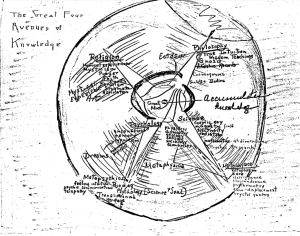
The Two Worlds
|
as seen by
Science visible
|
invisible
Modern Psychology physical world – conscious
|
|
psychical world – subconscious
Religion body earth
|
soul heaven
Philosophy phenomenal
noumenal
Relationship between these two worlds is innate.
At first it is unconscious involuntary, undirected, uncontrolled.
In the process of conscious evolution it becomes a cultivated relationship – a “romance”.