SUGGESTED OPENING FOR “THE NATURE OF MAN”
MBM 1942
The subject for these seven classes is, as you know from the title, a study of the nature of man.
Everyone thinks he knows something of this subject.
Daily experience with one’s self, watching others, – seeing plays and movies, – reading book reviews, – not to speak of the abundance of literature at the present time on the subject of psychology. All of these things do contribute to the general knowledge of human nature.
But the question still remains open on the fundamental veracity (or truthfulness) of that knowledge. For any knowledge, however correct it may appear in itself, – within the sphere of its own field, – may be misleading when seen in the perspective of the many subdivisions which relate to any important subject.
To put this proposition simply, – and to apply it to the subject of our classes, – the fields of anatomy, biology, and biochemistry are important in all the light they throw on the nature of man but seen alone they give no adequate picture of man.
The field of psychology, behaviorism, the enormous role of the subconscious in daily conduct, – these are of tremendous importance in understanding human nature, – but these also, – even in addition to the previously listed fields, are not enough. In fact, they mislead. As the work of the director has demonstrated over years, – there are profounder areas in the subconscious than psychologists have touched. To ignore them is to disregard the deeper or higher values of life, – which even more subtly than the subconscious, gradually shape the development of the individual soul.
But there are still other fields which study the nature of man, – and ignore the perspective of the whole.
Religion, for example, – all over the world, – speaks of man as a soul, – and you know how the preacher until recently completely ignored the psychological factors of man’snature, – and also his biological nature. ….. brought out in that tragic drama of RAIN.. .and ever since then the stage at least, – if not the churches and temples, – have had to reckon with this aspect of the nature of man, – in the theatre and in the unending procession of modern novels.
Then there is the field of spiritualism, – stressing the momentous facts of the continuity of the individual life, – usually all to enamored of the drama of intercommunication, – it, like the other departments tends to stress it own field,- as a guide to the nature of man …..
Now it is noteworthy that only as persons gradually find these various fields to be only partial that they set their feet on the trail for what Mrs. Mayer calls “whole-seeing* – or again the long-range view. It is part of the purpose of this school to supplement these partial studies of the nature of man, – and set the student’s feet on the road to whole seeing and this in turn leads, – as you doubtless know, – to much greater things …..
Let us approach our subject by listing some of the numerous ways in which the nature of man can be approached.
Man is related to the animal kingdom, possesses a physical body, – the highest species of the mamma1 type.
His abilities appear to be limited by the type and quality of his body. His nervous system, particularly his brain, are of enormous importance, etc.
Man is a human being. What is a man? (Manas, Sanskrit for mind and of the earth: humus) He has a lower nature and a higher nature.
Man is a conglomerate of psychological impressions and accumulations, a product of racial conditions, modified by environmental influence and education, etc.
Man is a soul….that is, his higher nature is from above….he is a creature of God, fallen into earth and forced to live under earthly conditions, to expiate his sins. (Parsifal)
Man is a spirit ….. which most persons drop at that point because they do not know what spirit is…and confuse it with soul…
NOW MAN IS NOT ONE OR THE OTHER OF THESE CLAIMS ….. HE IS VIRTUALLY THE SUM OF ALL OF THESE AND A NUMBER OF STILL OTHER FACTORS……
And to REALLY KNOW SOMETHING OF THE NATURE OF MAN, IT IS NECESSARY TO KEEP THE PERSPECTIVE WIDE OPEN ….. lest a local field be seen as the key to man’s nature.
In this first class we are going to try to get a better general understanding of this long range view, so that whatever we later study, the perspective will be in your minds…
For this we find confirmation in the sacred or secret Teachings of all races ….through history. …Some of this I shall now give you in an abbreviated way …..
Very briefly…. the Light Seed, spirit (compare to sun) soul, human ….. (Stressing soul and human, – because they are closer to us and therefore of more practical value.) Invite class members to get the 14 ANALOGIES between moon and soul leaflet (10 cents) …..
THE NATURE OF MAN AND HIS PSYCHOLOGY
Lecture I
Worked out by MBM
Long range and short range views of Man
The plumb line in relation to building stones
The relationship between these two for right functioning.
A vertebra in relation to spinal column
The many approaches there are to an understanding of man
Man’s two basic instincts
Three-fold man: – one view
The three primary faculties
Their relationship to the three energies of man
Relative place of the three, ordinarily, in maturity
Interpenetration – right and wrong kinds
illustrations
Which of the three have been most developed. Why?
Which should lead. Analogy of the automobile.
The uneven growth of the faculties
First work on Types
Feeling and thinking
right and wrong combinations
Ranges among the three
In ordinary use
Metaphysical range
Which type of energy predominates in the following
sympathy aestheticism boastfulness
pride observation duty
ambition fear discrimination
sensuality anger rationalization
reasoning impatience affection
skepticism
Many persons think of mind-training as an intellectual process, consisting chiefly of making the mind acuter, and of strengthening the memory. This is a grave error, for intellectuality and memory are only a small portion of the mental capacities.
Suppose we begin to list some of the sub-faculties of the Mind instead of “lumping them together” as is customary. This will also increase your regard for the versatility of the mind. Here are a few, – accompanied by a phrase to indicate their character. You should be able to double my list quite readily:
observation an attentive power
reason a progressively clarifying power
insight a penetrative power
concentration an intensive focusing power
discrimination power to evaluate differences
analysis a separating dissecting power
judgment power to reach and maintain just conclusions
theorizing power of sound orderly speculation
conception synthetic grasp of ideas
intelligence general illuminating power
intuition direct cognition of noetic realities
These are a few of the sub-faculties of the mind, and in training all of them must be taken into account, each according to its place in the whole.
From article on faculties of the mind
by MBM in LIVING. March, 1938.
For articles on the philosophical elements Water and Air
by MBM, see June and October, 1937, issues of LIVING
Lecture II
The four elements in man – another type of classification
Philosophic elements
The four rivers out of the Garden of Eden
Relation of these four to the four main fields of man’s
activities
Energy – the energic concept of life
the flow of life toward some expression
ideal vs frustrated expression
the struggle of humanity in between these two
Evolution of the soul through vast rhythms
Healthy.flow
Stopping the flow of energy
Energy ever present – in either one of two conditions
the three laws of energy
Types –
The four main elements and their corresponding types
The Tree of Life – its growth – the two basic instincts
The two attitude types – extravert and introvert
Faculty types – sensation, emotional, mental.
Jung’s intuition type added to these three
Why call it perceptive
Conscious and unconscious
The repressed faculties; how caused
First values of work with the so-called unconscious
Strengthening the weaker faculties
Lecture III
Nature of Man
Some further work on type
What is the key to type
Extroversion and introversion
Strengths of each
Weaknesses
The feeling type
the repressed faculties
strengths and weaknesses of the type
the need for rounding out
work with the transliminal
Making the behavior patterns of the self
conscious and available to conscious correction
The mental type, treated similarly
Classification of type according to Jung
Sensation ) Sensation )
Feeling )Extrovert Fueling ) Introvert
Thinking ) Thinking )
Intuition ) Intuition )
How the energy expresses itself in these types
Examples
The need for balance
The values born of the double movement
Intensification of life and dynamic change in rhythm
Among great men of history
Crisis vs Lysis
Examples
THE NATURE OF MAN AND HIS PSYCHOLOGY
Lecture IV MBM outline
General characteristics of the unconscious
Psychological definition of the unconscious
The unconscious – psychologically, philosophically
Dynamic character of memories and experiences
Indestructibility of life
Need for its transformation
Layers in the unconscious
Personal, or first “book of Records”
Collective or racial unconscious
Heritage
The threshold
Some dilemmas in the unconscious
Trauma and its results – danger in the advice, “forget it”.
Frustration and the compensatory movement in the unconscious
under natural law
Fixation
Complex
Neurosis
Phobia
Unconscious behaviors – mechanisms of the unconscious –
distorted expression of energy
Repression – fallacy of “don’t repress” – what to do?
Regression
Conversion
Compensation
Resistance
The “censor”
Inhibition
Will and will-power – vast difference between them
One of them of the mind – the other of the feelings
Conflict between wish and will
Transformation of will-power into will – a long process
Absence of will in the beginning
Control through conscious mind
The “I” principle
What aspect of the self must it increasingly serve?
Transformation of the energies – through what means?
Transforming power of the mind
THE NATURE OF MAN AND HIS PSYCHOLOGY
Lecture V MBM outline
Compensatory types of behavior
Need for finding middle path
Difficulty while attacked by dilemmas from the subconscious
Fears – the need to win release from them
Pleasure – pain vs Reality
The role of pleasure and pain in the beginning; in consciousness.
The acceptance of both
What constitutes reality?
Flights from reality
The crowd and the individual
Slow movement of the crowd – dominated by what?
The process of individuation
Faculty of imagination – the nature of this secondary faculty
Grades, qualities – in the beginning; in later stages
Positive and negative uses
True vs false imagination
The process of “truing” the imagination
The use of trued imagination in aiding the evolution of the self.
The mind
Its relation to brain
Sub-faculties of the mind
Thinking – how much is done ordinarily
Associative thinking
Conditioned thinking
Will – reference back to contrast with will-power.
THE NATURE OF MAN AND HIS PSYCHOLOGY
Lecture VI MBM outline
Review
Man’s two basic instincts
Three-fold man
Four-fold man
Man’s primary faculties
Attitudes – in relation to type
The “I” principle
Man’s genetic equipment
Long-range view of man as body, soul, spirit (nous)
Soul and its relation to spirit; to body
Analogies between spirit and sun
between soul and moon
Soul as
immediate source
linking past and present
storehouse of energy
soul consciousness
Conscious accrual of soul values
Man, know thyself
How to be done in a new way
Progressive changes in orientation
The measure of one’s understanding
The need for larger security
from the material viewpoint
from the philosophical viewpoint
the temporary quality of any lesser security
Implication of the continuity of life
THE NATURE OF MAN AND HIS PSYCHOLOGY
First Evening
Our course views the nature of man, especially the life behind the body as seen in Wisdom teaching.
The three primary faculties
nature of sensation
feeling
thinking
often confused, especially feeling and thinking
which have been most developed; why
which should lead; example of engine
Ranges among the three
in ordinary use
metaphysical ranges – overtones
Interpenetration of the faculties
harmonious
conflicting
Which type of energy predominates in the following
sympathy aestheticism boastfulness
pride observation duty
ambition fear discrimination
sensuality anger affection
desire reasoning rationalization
dislike
THE NATURE OF MAN
and his psychology
Second evening
The uneven growth of the faculties
first work on types
the subordinate faculties
Feeling and thinking
right combinations, as in tact; true kindliness
wrong combinations: prejudice, rationalization
The Four Elements
the four rivers out of the Garden of Eden
further description of each
Presence of all in the subjective as in the objective world
The Soul Node
why we are not ordinarily conscious of it
The Backdrop Curtain
Light spark; spirit; soul.
THE NATURE OF MAN
and his psychology
third evening. April 21, 1938
Man’s genetic equipment: body, soul, spirit
Man’s human equipment
meaning of human
body, heart, mind
Soul as
immediate source
linking past and present
storehouse of memory
higher soul; lower soul
soul consciousness
The four elements and their corresponding faculty types
Jung’s intuition type (add to first three)
why we call it perceptive
The tree of life, growth, and the two basic instincts
The many classifications of instincts; reducible to the two.
The two attitude types: extravert and introvert
Examples
Eight types (on basis of conscious behavior)
Conscious and unconscious
the repressed faculties; how affected
first values of work with unconscious; strengthening the
weaker faculties
Illustrations of types; discuss
politician mother of large family
jazz dancer critic
THE NATURE OF MAN AND HIS PSYCHOLOGY
Fourth Evening April 28, 1938
Extraversion and introversion
strengths of each; weaknesses
The feeling type
the repressed faculties;
strengths and weaknesses of the type;
the need for rounding out;
work with the transliminal – making the behavior patterns of the
self – conscious and available to conscious correction
some practical suggestions for helping the balance from the
conscious
The mental type, treated similarly
General characteristic* of the unconscious
psychological definition of conscious
storehouse of memories
contains the experience of all the faculties
dynamic — but shifting, unstable
the inhibited life and repressed trends
most likely to cause trouble
life cannot be destroyed; should be transformed
Layers in the unconscious
personal, or “first book of records”
collective, or racial
the primitive unconscious
heritage
Why is the “unconscious” not a desirable term?
The threshold: high, low.
illustrated by two types of speaker
THE NATURE OP MAN AND HIS PSYCHOLOGY
Fifth Evening May 5, l938
Some psychological aspects of the subconscious, and some definitions
repression: the exclusion of painful and unpleasant material
from consciousness and from expression.
seen in terms of energy. Illustration: jack-in-the-box.
Discussion of will and will-power
one of the mind; the other of the feelings.
Repression vs. compression.
The question of control, through conscious mind
the “I” principle increasingly in the service of intelligence
Transformation
Some dilemmas in the unconscious
trauma and its results
Danger in the advice to “forget it”.
frustration and the compensatory movement in the
unconscious under the natural law
complexes
fixations
neuroses
Some mechanisms of the unconscious
resistance
the “censor”
True poise, a by-product
how attained
THE NATURE OF MAM AND HIS PSYCHOLOGY
Sixth Evening May 12, 1938
Chart of some “compensatory” types of behavior
over-concern vs. sympathy
self-abasement and aggressiveness
moodiness
inferiority-superiority
Difficulty of finding the middle path while
we are attacked by dilemmas from the subconscious.
Fears
release from: e.g. St. FranciS (drastic way)
more gradual, as in assumption of responsibility
Pleasure-pain: the moulding of the personality
both in the picture
acceptance of both: reality.
The crowd and the individual
slow movement of the crowd
dominated by feeling, not intelligence
the process of individuation.
THE NATURE OP MAN AND HIS PSYCHOLOGY
Seventh Evening May 19, 1938
The Faculty of Imagination
in fantasy; associative thinking;
conditioned thinking; meeting the new with old memories
in the subconscious, perhaps unpleasant.
on the positive side, equipment of knowledge and experience
the process of “truing” the imagination; first on the physical
plane
the value of “truing” in correcting behavior patterns, and in
rounding out the weaker faculties
image making a psychic faculty; aids all the faculties.
its use in aid of the processes of evolution.
“Man, know thyself”
can now do so in a new way
the progressive changes in orientation that should result
as knowledge proceeds
the measure of your understanding is our voluntary following
of what is right and true.
The Question of Security
from the material viewpoint
from the philosophical
implication of the continuity of life.
School is for training to obtain that security
over-concern sympathy coldness
self-abasement self-respect aggressiveness
Rigid control poise disorganization
(repression) (lack of control)
Exhilaration cheerfulness depression
Extraversion flexibility introversion
GUIDING QUESTIONS to THE NATURE OF MAN AND HIS PSYCHOLOGY
What are the three basic faculties? Describe each briefly.
What is the ideal relationship among them?
What is interpenetration? Give examples of right and wrong kinds.
Give examples of human behavior indicating the domination of each of the faculties respectively.
What is type psychologically? To what is it due?
What are the four elements? To what aspects of man’s nature do they correspond?
What is the relationship of soul to spirit; of spirit to Light Spark, or Light Seed? What is the soul, and why is it not ordinarily contacted?
List some of the powers and capacities inherent in the soul.
What are the four faculty types, and how do they correspond with the four elements?
What are the two basic instincts; in what areas of the three-fold man do they operate? Illustrate.
What are the two attitude types? Characterize each. Name some of the outstanding advantages and disadvantages of the thinking and feeling types respectively.
List some of the characteristics of the unconscious.
Indicate something of its geological strata.
What are the repressed faculties? How should they be treated?
Describe in terms of the energy patterns involved, the following subconscious behaviors; repression, fixation, complex.
Name three other well known dilemmas which may occur in the subconscious.
How may this life find constructive outlet?
Compare repression and compression; will and will-power.
Define the terms resistance, censor, transformation.
Name three “compensatory” types of behavior. What is the ideal picture in each case?
Name two general ways of resolving fears.
Describe the influence of pleasure and pain in moulding the personality.
What should be the attitude toward these opposites? What is the reality principle?
What is individuation? Why is it desirable?
What is imagination, and what are its different grades?
What is meant by “truing” the imagination?
How does the work of this course help in meeting the old challenge, “Man, know thyself”?
What are the different types of security? How has this course helped you to glimpse the attainment of a lasting security?
Introductory Perspectives Course
Third Evening November 13, 1957
TOPOGRAPHY OF MAN
Outline of subject as presented by GB
Brief review of 3-fold and 4-fold man, the self. Names of Journey of evolution and goal. Adding as purpose of journey “to become wise as a god”. Allegory of the “eating of the apple.” Progress on the journey to be made, not in terms of material possessions, or position in the world, but in terms of powers and qualities.
Refer again to egg symbol indicating the 4 philosophical elements. Egg symbol old; for potentials. One design of egg symbol does not contradict another, but supplements it.
Divisions into conscious and subconscious, or unconscious, again using egg symbol. Beginning of topographical aspect. Drawing on board showing the three primary faculties in the subconscious, in the three colors, rather mixed up. I used brown, green and darkish blue, so as not to confuse with the red in the upper psychic areas of the four-fold design.
Conscious — The light of awareness that bathes the object, situation, condition of the physical; a small area at any given time. Colored dots in this area, to show awareness, now of a wish, a sensation, etc. Analogy of the iceberg.
Subconscious (or unconscious.) Reservoir of the imprints of all past experience, plus trends which remain potential, or latent. The greater part of our being.
Personality: The combination of behaviors, expressions, attitudes, as they appear on the surface — to others, and sometimes to the self. Most people know that they are more than expresses in the personality. Origin of the word, from the mask worn by the actors in the old Greek dramas. Top layer; facade. Illustration: Mary — gentle, sweet, kindly, but mental side may be less exercised. Trends less developed may be as good or better than those emphasized in the personality.
Contents of the subconscious. Class to contribute suggestions. Memories, skills, images, fantasies, likes and dislikes, our general conditioning as a result of the experiences of this life. We are now dealing with the personal subconscious, or first book of records, or first layer below the threshold of consciousness, in our topographical survey. (I omitted area of the foreconscious, but perhaps it should be mentioned.)
Iceberg analogy too static; these areas not inert, but full of energies. We never see the energy side, even with the energies of physical substance, like wind, heat of water, etc., much less here, where we are dealing with a subtler type of energy, a step away from the material world or plane. By the token that life in the subconscious is energic, dynamic, it can be transformed, to higher states, or grades; as we are doing with mechanical energies, chemical, biochemical, etc.
Collective unconscious. Treated briefly. Trends inherited from the history of the human race: instincts such as self-preservation, pugnacity, “herd” instinct; also biological drives of hunger and sex. These layers, of course, not in neat boxes. Some expressions of life that have been ascribed to the collective unconscious belong to the history of the individual soul, not the race. M.B. Mayer has said that the last word on the collective unconscious has not yet been spoken.
Deeper areas: Come nearer to the life of the soul. Drawing contains symbol of crescent moon, long used to represent soul. Soul is not complete, matured. Is to grow to fullness, to full reflection of sun — a far-off state, but movement toward can be accelerated. Is buried, for the most part, under the weight of the imprints of this life, yet sends up intimations of its own momentum. Class is asked to suggest what these might be. One answer: the religious impulse. Took the opportunity to point out difference between such expression and formal religion. Other indications: emergence of sensitivities, strength and courage, insight, innate knowledge beyond the ordinary. (Innate knowledge needed to learn skills even of earth, native powers; cf. Socrates in Meno Dialogue.)
So, the subconscious as storehouse and seed-bed; cellar with discards and buried treasure. Name subconscious. – inadequate and misleading; so also prefix un, as negative. What is forgotten is forgotten only to the conscious. Better name transliminal, for the whole area, meaning across threshold (of consciousness.)
Ways of tapping the subconscious. Class to mention a few. Hypnosis, psychoanalysis, word association. Dreams. Why dreams are best method. Less colored by the conscious; can be brought back to waking consciousness. Speak in symbolic language, but when interpreted by guide or tutor who knows this language, speak most truly and clearly of the state of the household of the self, its next steps, etc.
Grooming and cultivating the native equipment. Beneficent work of psychology if it makes for the ordering, grooming, drawing out of life in the personal subconscious; brings up the “weaker sisters” in the household, releases life tied up in fears and blockings; may promote physical health; question of interpenetration of the faculties. We want psychological health just as we want physical health, through removal of obstructions, congestions, etc. Psychological improvement is part of improving native equipment in the present life — the horizontal growth also contributes to the upward growth of the tree. (Might mention rings of annual growth in the transverse section of a tree.)
Influences from the deeper self. As the ordering of life in the upper layers proceeds, influences emerge from the deeper self. Often quite early. Draw on board a few lines moving up from moon symbol to upper layers. These are bits of gold. Perhaps some new realizations, sensitivities, perceptions, mystical experience. Not to be confused with “cosmic consciousness”, but valued as extensions from the ordinary ranges of the faculties.
Grooming of the native equipment can also be done to some extent without the aid of the subconscious. That is the aim of our subjective exercise classes. Will make an announcement about the new subjective exercise class later.[1]
Explain why moon symbol appears in upper part of 4-fold design and in lower part of topographical division. Man more than a 2, 3 or even 4-dimensional being; so 2-dimensional directions may be a little puzzling, but not if we understand the limitation.
Question from class: Does inspiration come from these deeper areas? Ans: It may, or it may come from an outside source. There are other planes, conditions, regions of life not of the physical world, but there we touch on the subject of metaphysics, which does not come into this course.
The question of reincarnation comes up when we speak of influences from the soul’s history before the body. Memories of past lives may come up, but usually only in fragmentary form, and mixed up with images of the present life. Dangers here. The movement of life is forward, not back — what counts is what we have gained in power and quality in the previous journeyings of the soul. How do those show up in the present? More about that next week, when the subject will be heritage, inheritance and environment. Probably you have all been on this earth before, or you would not be interested in hidden knowledge. Fragments from past lives useful mainly as providing direct experience of the continuity of individual life.
The past is shut off with the birth of the body, and this is good; or we could not give the needed attention to the work of the present.
What we develop of our potentials we add to our stature — a permanent growth; the good that is not lost; the very trunk of our tree. But man’s cycle is far longer than that of the tree.
[1] Had been asked by the School office to call attention to subjective exercise class.
THE NATURE OF MAN AND HIS PSYCHOLOGY
Three-fold man; the three primary faculties; illustrations of the differences between the physical, psychic and mental energies. Relative places of the three. Mind, or intelligence, at the wheel. Interpenetration; right kind and wrong kind
The backdrop curtain. Light spark, spirit and soul. Dismemberment. Something of types, according to dominant faculty.
Conscious and unconscious; characteristics of the unconscious.
The four elements; differences between the four-fold and the three-fold man.
The persona and its formation. Dissolving its limitations.
Extroversion and introversion.
Balancing the faculties; values of rounding out
Imagination; in service to the primary faculties; the different kinds of imagination. Psychic plane, subjective and objective.
Behaviors due to trends in the unconscious. Repressions; compensatory behaviors; complexes; compulsions; symptoms. Poise, real and spurious. How is real attained. Compression vs. repression.
The two basic instincts. Some of their derivatives
Illustrations of different types, to bring out dominance of extraversion or introversion and of the various faculties.
The question of security. Of orientation.
Pleasure + pain = reality
instability
Racial subconscious conversions
In? crowd psychology
? brain + mind
? inhibitions?
individuation
fantasy
things people do without being marked. Identification. With the idea of bringing it into the normal, average picture. re sympathy (over-concern) if it stays at sympathy it is all right
conversion
A few preliminary words about crowd psychology; or perhaps build up a little.
cut out from extra copy of Living those lists of mental faculties, so as to drive home the realization that the mind has many sub-faculties. Relation of the brain to the mind
Something about consciousness. hold to the psychology definition: “please remember we are taking it now from the psychological. Other aspects in later work.”
Re complexes: condensation, or overdeterminism.
Associative thinking; give them a moment to observe themselves at it. Not really thinking at all; it is like water running over the rocks.
Will and will-power. Familiar example of the Jack-in-the-box. Holding down takes much juice. That energy wants to come out, and it is only the look that holds it back.
Why they don’t know the soul. Illustrate with the different colored bags over the light bulb. Use either with soul or with consciousness and make cross references.
Psychological mechanisms: Inhibitions; instability keeps shifting its base. Nothing there that is solid.
Lists of some of the dilemmas of the self.
charts of behaviors to point the narrow middle path, as with identification difficult to find as long as you are attacked by dilemmas from the sub-conscious.
Making the behavior patterns of the self conscious and available to conscious correction
Idea of self-abasement. a propos of the pairs of opposites conscious and sub-conscious in chart of one side and other. The one who abases himself is sure somewhere to be aggressive or assertive, and it is a problem that concerns a good many.
racial unconscious. Also the primitive unconscious. Why is it that people who seem to be cultured are capable of becoming violently upset and go to war and kill each other.
with phantasy the flight from reality. Pleasure-pain, with the personality. Acceptance of that equals acceptance of reality.
With imagination bring in not only associative thinking, which is water running downhill, but conditioned thinking. When something is called to your mind and you have an unpleasant reaction it is because unpleasant memories of that come from the unconscious. Bring in conditioning of our emotional and mental responses. The good thing is that the more you bring to a work of art, for instance, the more you get from it. If you bring unfavorable, prejudiced reactions, then you are blocking yourself.
Prejudice.
Mannerisms: through them you can have indications of some of the things stored in the sub-conscious. Attack mannerisms as a handicap. Separate them – not all bad, not all good.
trauma — a forgotten injury to the psyche: disappointment or hurt, buried in the sub-conscious
resistances – instinctive opposition displayed toward any attempt to lay bare the unconscious. A manifestation of the repressing forces. It is the opposition that is offered to new ways of doing things. CENSOR belongs with resistances. Resistance sub-conscious mechanisms, and the censor, belong together.
End up with, Man, know thyself. That is the big thing. Now it is possible for man to know himself in an entirely new way. His whole being can now come under the health-making processes, as against man merely knowing himself consciously; and that that thing makes for security. That to really know yourself also makes for orientation. If you get to know that you are literally a soul, that helps your orientation. You are no longer just oriented to this world. If you know yourself physically you will take care of your body. If you know you have a psyche; and if you know you have soul then your orientation certainly will be different. Means continuity of individual life, etc.
If you know the role that the mind plays in the scheme of evolution, if you have any grasp of the great wonders that belong to the mind, you will have still a grander orientation. Point out the fiction of local security – there is no such thing. Idea of Schools in Ouspensky. You go to schools for this and for that. Only schools that make the doors open on these higher questions – where they will be answered. At this school things taught that are not in the ordinary school. Training usually means for things of the body or material world, oriented to time-space. This school serves you in areas where other schools cannot serve you. Where are you going to learn the facts.
re the four elements, articles in Living. have them get copies
Secondary faculties
psychic plane objective and subective. drive home that there must be a region corresponding to every state; challenge their logic on that; just as in the physical world about us.
Signs by which we may know a Shattered Persona
- Elimination of mannerisms
- Impersonal attitude in relationships and reactions
- Subordination of self-feeling
- Overcoming of type—making for true flexibility
- Separation of the functions
- Adaptation
- Sweetness as a result of purgation and understanding
(including such qualities as tolerance, patience, humility,
cheerfulness, etc)
- Orientation to the Larger
9. Demonstration of new powers — the dawn of Individuality
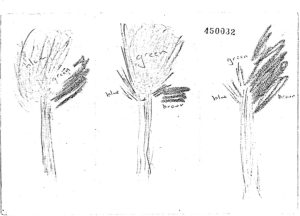
Maybe chart on Modifying effects of Environment
Suggested Reading List
THE NATURE OP MAN AND HIS PSYCHOLOGY
Human Motives. James J. Putnam
Outlines of Psychoanalysis. Van Teslaar
(chapters on Freud and Jung)
Your Hidden Powers. J. Oppenheim
The Beloved Ego. Wm. Stekel
Psychological Types. C.G. Jung (Chap. X)
Mental Hygiene of Childhood. Wm. A. White
A.B.C. of Jung’s Psychology. Corrie
The Crowd: A Study of the Popular Mind. G. LeBon (Part I)
For Reference
The Structure and Meaning of Psychoanalysis – Healy and Bronner
Student’s Dictionary of Psychological Terms — English
Glossary of Psychological and Philosophical Terms – M.B. Mayer
Suggested Questions
NATURE OF MAN AND HIS PSYCHOLOGY
First class
What are the three basic faculties. Describe each briefly.
What is the ideal relationship among them?
What is interpenetration? Give examples.
Give examples of human behavior indicating the domination of each of the faculties, respectively.
Second class
What is type? To what is it due?
What are the four elements? To what aspects of man’s nature do they correspond?
What is the relationship of soul to spirit; of Spirit to Light Spark?
What is the soul, and why is it not ordinarily contacted?
Third class
List some of the powers and capacities inherent in the soul.
What are the four faculty types, and how do they correspond with the four elements.
What are the two basic instincts; in what areas of the three-fold man do they operate? Illustrate.
Class four
What are the two attitude types? Characterize each.
Name some of the outstanding advantages and disadvantages of the thinking and the feeling types respectively.
List some of the characteristics of the unconscious.
Indicate something of its “geological” strata.
What are the repressed faculties? How should they be treated?
Fifth class
Describe, in terms of the energy patterns involved, the following subconscious behaviors: repression, fixation, complex.
Name three other well known dilemmas which may occur in the subconscious.
How may this life find constructive outlet?
Compare repression and compression. Will and will-power.
Define the terms resistance, censor, transformation.
Sixth Class
Name three “compensatory” types of behavior. What is the ideal picture in each case?
Name two general ways of resolving fears.
Describe the influence of pleasure and pain in moulding the personality. What should be the attitude toward these opposites?
What is individuation? Why is it desirable?
Seventh class
What is imagination, and what are its different grades?
What is meant by “truing” the imagination?
How does the work of this course help in meeting the old challenge, “Man, know thyself”?
What are the different types of security? How has this course helped you to glimpse the attainment of a lasting security?
Orientation Course
October 1948
By MBM
MBM’s Orientation Course — “An intensive course, combining instruction, disciplines, and Subjective Exercises for those who are eager to achieve rapid progress. It gives a maximum of opportunity to work under MBM and gain first hand knowledge of Source Teachings and the stimulus of her disciplines.”
– – – – – – –
Oct.14 1948
Preliminary work and engineering of our thoughts – long range view of life and the short range view –
We all agreed that we are more than physical beings.
We have a soul – intangible in evolution
We have a body – our instrument to help our soul grow
We have 8 seedless –
We have a stomach – vitals for reproductions – heart and lungs = emotions; head = mind
Our first aim is to bring our equipment under control.
Starting with entering into silence – make our earthen, human life still. We Western bodies follow through the type of civilization according to Western knowledge
Energizing the Body: Outstretched arms quicken the energies from fingertips to shoulder, include face, neck, down to the toes, then relax. Repeat several times.
Breath control: Posture, stretching the spine, sit erect and swing right and left, back and forth, get up, sit down effortless.
Omit the word EVIL = ignorance
CAIN – tiller of the ground, earthly father of active earthly things
(Occult Allegory)
and
ABEL – keeper of sheep, heavenly father
Cain comes first (lower self) and kills Abel (higher self)
Cain is not acceptable to deity, Abel cannot function before Cain kills matter
Master your physical life before spiritual life can evolve.
Respect for lawfulness. Discipline, harness the body – genuine dilemma.
We have many capacities we don’t know of. Once the mask is taken off, there are unconscious powers behind it.
Imagination – grief – happiness: – all emotions
Smell – see – feel – not material
Dreams, memories – subconscious – Where in us? Functions not physical
Sight – not material
Extended faculties, after training and experiencing … will report to yourself. Remember the 6 blind men – how they saw an elephant; trunk, leg, etc. … if you take hold of one thing only – wrong perspective. We have to have perspective to put things into right relation experientially to see ourselves different