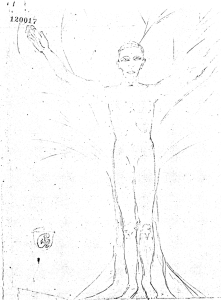
The Process of Involution
The vast processes of evolution are of necessity predicated upon the process of involution. It is unthinkable and scientifically untenable to imagine that something can come out of nothing. The potentials for evolution must be present, else there would be nothing to bring forth, to evolve. As a seed is equipped with the potentials of the fruit, flower or whatever other order of fulfillment lies in its nature to evolve, so mankind has in its own seed-nature the potentials for the evolution of body, soul and spirit.
Whatever is underway in the process of evolution is antecedently present. That from which the present has evolved and the future will evolve is previously existent in involved, enwrapped, compacted states.
It is odd that something on which all else depends has been for the most part ignored in modern times. Not so, anciently. Wisdom Teachings include concepts that explain the process of involution. The great traditions make reference in their cosmogonies to the underlying processes of life. Such reference is in the code language of symbolism. Exoteric religion does not know that here is something of long-range importance to decode. Or it may express its acknowledgement of origins in such tenets as “We are all children of God,” but they are without real appreciation of the long lineage of the soul. Thus much of meaning and import remains hidden. But happily these are not, cannot be, lost. They cannot evaporate into oblivion, except temporarily. The process of involution is inherent in all life. Lack of knowledge does not eliminate the process; it merely deprives mankind of the benefits to be gained from understanding the nature of preceding stages and their relation to the present and the future.
All that the dictionary yields by way of definition is that involution is “something that involves (sic!) or enwraps, an envelope covering. Something complicated, an intricate movement, a tangle.” From this one could never learn that involution is a process, a sequence and is inextricably a part of individual growth.
Strange as it may seem, Hastings in his Encyclopedia of Religion and Ethics does not even mention the word involution nor do any of the other religious dictionaries. Yet the concept of soul is thin without it.
The English poet, Coleridge, in his Satyranes’ Letters says, “Aristotle has required of the poet an involution of the universal in the individual.” Here at least is a little more content.
However, on the whole, the western culture may be said to be pathetically innocent, indeed poverty stricken, when it comes to understanding anything of the process which preceded the present order of human life and is the basis for its evolution. The West eagerly seeks more insight into the nature of the evolutionary processes but how can the thinking individual even begin to understand them without understanding that out of which they stem?
The intellectual has used the term involution, to be sure, but in a limited and reductive sense. It is known chiefly in the fields of mathematics, physics, medicine and psychiatry. In mathematics the “involution” of an arithmetical process is known to precede its evolution but it is neither pertinent nor contributive to go into that usage here. In medicine different organs are said to be concerned with an “involving” process but that also is not our concern at this point. In psychiatry we see a faint stirring of life even though the term “involution” is used negatively, namely, to describe certain psychotic states which are regressive, such as “involutional melancholia.” Here the term is used to designate degeneration, the opposite of development and evolution.
It has remained for MBM’s elucidation of the Wisdom Teachings to rescue the concept from the aridity, confusion, vagueness and inutility caused by ignorance of its basic meaning. By tracing its lineage in ancient traditions in which its philosophic significance is preserved, she has made accessible to modern minds the constructive content of its inherent meaning.
Most of the great traditions embody the story of involution in accounts of their respective cosmogonies and set them forth symbolically, as with all other philosophic, esoteric teachings. To mention a few:
In the Hebraic-Christian tradition – Involution is described in the Garden of Eden allegory, in which Eve (soul) is intrigued by the Serpent (Wisdom) to leave the Garden, a descent culminating in “thick coats of skin” or physical bodies.
In the Greek tradition – It is the story of Persephone (soul symbol) who is drawn down to live in the underworld with Pluto (earth).
In the Norse tradition – The story is symbolized by Brünhilde (soul) who becomes interested in events in lower spheres and descends into the body of flesh.
In the Egyptian tradition – Here the process of involution is symbolically told in terms of Isis (spirit) and Osiris (soul), and their separation. Osiris is lured away from Isis, is clapped into a beautiful casket (physical bodies) and sent down the River Nile, the stream of life by means of which the soul descends to earth conditions.
In the Babylonian tradition – It is Tammuz who is soul, drawn to earth and separated from Ishtar, who is representative of spirit.
A fairly detailed account of the involutionary process is given in the Egyptian “Tale of Two Brothers,” perhaps the oldest story in the world. The brothers are the lower and the higher nature in man, both in their incipient states, and both in the higher, remote regions (the cosmic) – far removed from earth. As the descent proceeds the brothers become separated, quarrel because of the false accusation of the older brother, Bata, that the younger one, Anpu, has seduced his wife. The wife here, as in all the involution stories, is Eve, the prototype of the desire forces in life. It is this element in man which provides the motive power in both the descent (involution) and the ascent (evolution) of the monad. That the story belongs to the corpus of Wisdom lore is patent from its use of symbolic imagery consistent throughout with the universal language in which that lore is expressed.
A briefer reference to the involution of the soul is contained in the beautiful old Syriac Hymn of the Robe of Glory. It is a wise and touching dramatization not only of the descent, and the treasure-potential enwrapped in it, but also of the purpose of the descent as a means of acquiring the powers for the ascent – the return in fullness to the “Royal House.” The same theme is repeated in the biblical story of The Prodigal Son.
Thus down the ages Wisdom Teachings have symbolically described the processes by which souls have been drawn down from original states of being – unconsciously, without conscious intent. In those stages the life of the soul is latent, potential. In its descent, the soul passes through various stages until it is encased in a physical body in earth conditions, here to be “dismembered,” to have the parts of being which had been compacted, involved, separated one from the other the more profitably to go through experience, discipline and learning; to evolve the latent into the potent; to move from unconsciousness to consciousness.
That there are stages of consciousness beyond the physical, emotional and early mental life has been empirically and scientifically established. An underlying theme of the wisdom of the ages is that there are levels of consciousness far beyond those already attained. True, they await verification and substantiation in the lives of most persons. They lie fallow, buried in the involutionary side of life and constitute the seed-bed from which all development and evolution proceeds.
The Evolutionary Pattern, or the Ascent
What has wisdom-lore to say about the evolution of the soul? Far more than about the involutionary side of the picture. Indeed, the greater part of the whole corpus of the wisdom teachings that have come down to us tell us of the way of the Ascent; sometimes certain stages of the whole, majestic, age-long story; sometimes only of its awesome culmination.
As we might expect, the references to the growing of the seed to its destiny in flower and fruit will be more numerous, more detailed, more in line with our own experience in life on earth than those concerned with the planting.
The scriptures, myths, epics, legends of heroes shine with exemplars of advancement, accomplishment and instruction for those who would move forward. They may be coachedin the language of religion but they concern, actually, a more philosophic, more mind-directed, intelligible, though supra-rational, pattern than the religionist ordinarily recognizes. To discern the steps in that pattern, the sequence of the development, he would need to do much uncoding. It was one of MBM’s notable services to help in this uncoding — not only in providing the key to the basic symbols, metaphors and allegories so generally used but in clarifying their meanings, and shades of meanings, on different levels and in different contexts.
Thus, in the Garden of Eden story, which pertains to the soul stage on the descent side, the four rivers are the four main streams of the psychenergy with which incipient humanity is endowed – in their potential — and through the exercise and development of which the soul will, eventually, achieve its completion. The Four are the philosophic elements of Earth, Water, Fire and Air; in their human expression: sensing, feeling and thinking. They are three of the eight “seedlets” of our native equipment — as native as the ability in the newborn babe to draw breath into his body. The other five are: memory, without which we could not learn; volition, imagination, consciousness and urge — in its earlier manifestations, the urge to grow.
The “fourness” is also included in the “twelveness,” or rather, is its very basis; for the twelve is really the original four, in three different positions for each. The “twelve” are associated with the fullness, or attainment of the “soul made perfect.” In the Greek myth they appear as the twelve Labors of Hercules. These he must perform to become the perfect hero. Uncoded, the “tasks” are the manifestation in potency of the progressions in power and quality of the energic potential of body, heart and mind of the soul in the human evolution. Hercules did not accomplish the last of the tasks, which was to bring back the golden apples from the Western Isles. Since these fruits represent the realm of Spirit, and therefore the arrival at spiritual stature, Hercules, though a hero, was not yet the Thirteenth Man; for that means that all the Twelve have been drawn out into living, to their full capacity.
Nor was Theseus the perfect hero. He did release Ariadne, the soul figure, by following the golden thread she gave him to make his way through the labyrinth, but he did not remain loyal to her. Where gold appears in a wisdom context it relates to higher states, beyond the human evolution, the realm of Spirit, or the Goal of the Ascent. In the Garden of Eden allegory, gold is to be found in the first river, the Pishon (?).
The Old Testament account of the trek through the Wilderness concerns the struggles through the lower, or outer, worlds and the approach at last to the Promised Land. That Wilderness is another version of the labyrinth in the Theseus story. The trek took forty years, suggesting something of the four streams. In the Old Testament the twelveness appears also in the twelve tribes of Israel, in the twelve sons of Jacob and in a number of other places, all symbolic in some way of the pattern of wholeness.
In the inner tradition of old Egypt, which is full of wisdom teachings, we find the Tuat, with its twelve divisions. It is shaped like an upended horseshoe, and symbolizes both the descent and the ascent of the soul. At its first end is Amenti, heaven, the start of the Journey, as a seed, monad, from the high places, and at its terminus is also Amenti. But, as the teaching implied, there is a world between. The spaces leading upward require a travel in consciousness – a conscious progression.
We have the twelve also in philosophic astrology and in philosophic alchemy. Neither has much to do with its mundane namesake. Both have to do with processes, from primitive or humble beginnings of qualities and powers, to exalted goals.
The outline of the completed state has trickled down even into some of the long-enduring fairy tales. There, their real meanings have been lost but a vestige of their import remains, like “crumbs from the banquet table.” Examples are Cinderella, Sleeping Beauty, The Twelve Brothers, Bluebeard. Cinderella is a soul figure, and the tale speaks of her rise from the ashes, the bondage to earth, to her marriage with the prince — royalty, the sign of the high state of the soul’s entry into the Larger. The Bluebeard story, with its successive matings, is an allegory of the progressions in the soul’s desires and strivings to its ultimate satisfactions.
Dante’s “Banquet” follows the metamorpheses of his hero’s volition from the material to the spiritual — volition, that most powerful seedlet of motivation which, as it advances beyond earth-water, becomes the fire of the heart, supporting now the will of the higher mind on its way toward its goal.
The morality plays and those in which the protagonist was Everyman run through the culture of the West from early medieval times and are still given from time to time today. Bunyan’s “Pilgrim’s Progress” is an example, in novel form, of a similar theme.
The East, too, has its heroes who battle onward to Nirvana. Some forsake the world, perhaps seek to cut off desire by practicing austerities and withdrawing into the desert for a life of meditation. Gautama Buddha saw in desire the basic cause of the miseries of humanity.
There is no doubt that the Eastern way, i.e., the typical Eastern way, has considerable attraction for many in the West. Partly this is due to the “swing of the opposites1,” the momentum away from the widespread absorption in material values. For young people repelled by this trend and deeply, or even mildly, aware of other, and transcending realities, and with an aspiration toward them, the call to the East is strong.
What many of these young people do not realize, however, is that grappling with the world, and the moral and mental muscle it builds, also have a contribution to make to the growth of power in the soul. A healthy encounter with the realities of the third dimension is likely to bring on more psychological problems, to be sure, than the willingness to forego it, as often in the East. Such problems of the personality as inferiority, frustration, biases and taboos, conflicts and tensions, are commonplace. But, to our credit in the West, we are more apt to face them. The tendency in the East is to bypass them. We of the West face such barriers in our dealing with the psychological areas in the human constitution. The whole field of psychotherapy has burgeoned in the West, with the ideal of helping men and women to a better adjustment to their physical organism and to the world.
In this clearing up in our “wilderness” there may be little or no orientation to a larger goal, but whatever is done to loosen fixations in the personality, including the limitations and egotism of the intellectual mind, aids in opening the way to the emergence and cultivation of the higher, supra-rational faculties. Here the study of the subconscious is of particular assistance. In its deeper areas are latent those abilities of heart and mind through which experiential knowledge of planes beyond earth and water and everyday mind can be contacted.
On the whole, that vast and fascinating field lies fallow for the seers and mystics of the East. Lack of access to its service leads to much false or personal imagination, which a more discerning approach can avoid — and this as regards mystical experience in both its subjective and its objective aspects.
There are many grades of mystical experience, but any that are valid are a stimulus to the soul beginning its ascent to its ultimate fulfillment in spirit. If the aspirant has advanced in the power, strength, skill, quality of his being he may well be touched by a ray from the Larger, from the sun of Spirit. But how does it affect his life in the world — the quality of that life, the power over the self, the augmenting of that stature which he will need at the completion? Here on earth are the tests, and he should be grateful for them.
The teachings of Jesus are devoted to the lighting of the way of the ascent. Paul supplements, or expands them, by clarifying some of the qualities it demands. The parables of Jesus and the Epistles of Paul are wise in their psychology: their sympathy with the problems that beset the humanity of their time as well as ours, the instruction for meeting them, the hailing of even a little improvement, a little moral progress.
The treasures of wisdom lore had to be expressed in the language of allegory and metaphor because their content is supra-mundane and can be handed on only by analogy with the things familiar to men in the flesh. Much of them relate to psychological obstacles to the ascent, as in the struggles of the heroes, demi-gods and even gods with animals and dragons. These MBM explained on the psychological level as well as in reference to the way of ascent. She also gave her students much regarding the ways of higher planes and rejoiced with her students when any of them came under such influences, in the waking or the sleep state. But always she emphasized the importance of “keeping feet on the ground,” eschewing the visionary or false imagination — not hitching their wagon to a star but, rather, taking next steps .while keeping the star in mind. For, as she repeatedly warned, “the Larger includes the lesser, but not the reverse.”
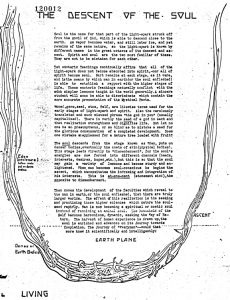
The Descent of the Soul
Soul is the name for that part of the Light-spark struck off from the Anvil of God, which is able to descend close to the earth. As vapor becomes water, and still later ice, and yet remains of the same nature, so the Light-spark is known by different names in the great octaves of its descent and ascent. Spirit and soul are the two most familiar of these. They are not to be mistaken for each other.
Yet esoteric Teachings continually affirm that all of the Light-spark does not become absorbed into spirit,- nor all of spirit become soul. Part remains at each stage, as it were, and is the means by which man in earth (or the soul enfleshed) is able to establish a rapport with the higher stages of life. These esoteric Teachings naturally conflict with the much simpler lessons taught in the world generally. A sincere student will soon be able to discriminate which contain the more accurate presentation of the Mystical Facts.
Monad, germ, seed, atom, Self, are likewise terms used for the early stages of Light-spark and spirit. Also the carelessly translated and much misused phrase “the god in you” (usually capitalized). There is verily the seed of a god in each and that realization strengthens and dignifies life. But let no one be so presumptuous, or so blind as to mistake a seed for the glorious consummation of a completed development. Does one mistake an appleseed for a mature tree loaded with fruit?
The soul descends from the stage known as Eden, puts on denser bodies, eventually the coats of skin (physical bodies). This stage leads directly to “dismemberment”, for the soul’s energies are now forced into different channels (needs, interests, desires, hopes, etc.),but this is so that the soul may gain a variety of lessons and become sturdy and enlightened. When man becomes soul-conscious he begins the ascent, which necessitates the indrawing and integration of his interests. This is at-one-ment (atonement sic!),the opposite to dismemberment.
Then comes the development of the faculties which reveal to the man in earth, or the soul enfleshed, that there are truly larger worlds. The effect of this realization is the seeking and practicing those higher sciences which mature the soul-seed rapidly. Man is now becoming a spiritual or noetic soul instead of remaining an animal soul.
The Household of the Self becomes harmonious, dynamic, seeking the Way of Return. The harvest of human experience is drawn up, the soul is enriched and advances on its Journey towards Completion. The Journey of “Everyman” — would that more knew it scientifically and intelligently!
Chart #3: Desmemberment
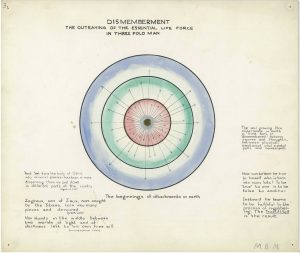
The Outraying of the Essential Life Force in Three Fold Man
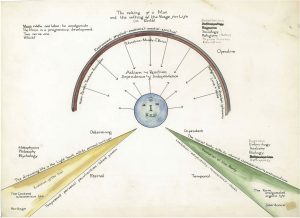
Chart #6: The Blind Dance of the Monad
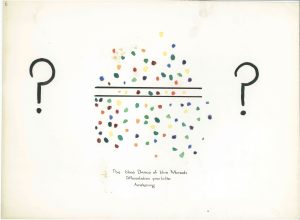
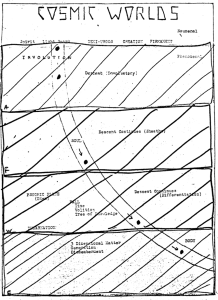
Chart: Cosmic Worlds
Poster: monad and tree