The Training School of Earth
First of a series of seven classes given
by MBM at the 8:30 hour, which was more for
beginning students than the 7:00 hour
January l4, 1932
The point of view of this class is just the opposite of that in the 7 o’clock class (One Rhythm in the Pilgrimage of the Soul, which had to do with progressions through the transliminal). From that point of view our two classes are compensatory. That which belongs to the 8:30 class is the study of man in the outer world, but nevertheless as a metaphysical unit. The outer world seen as an aid to evolution; not an end in itself but rather one that sees in this dimension an episode — stretched in time over years, but still brief. To once get a clear picture, even though compacted, of what the steps are in the outer life, is to have a pattern by which you may guide yourselves to the most useful application of your three-dimensional life.
Very few, unfortunately, pause long enough to get such a picture. Sometimes it seems as though this short period we call the three-score and ten was, for the majority, like a long, comparatively narrow, dark hallway, through which they pass not knowing what was on the other side — not even seeing what was in the hallway. And, pathetically enough, being able to see only according to the quality of light which he himself carries. Some, with tiny wicks; others, with what they think is a big light, the intellectuals. A few, with dignity, and with a good light. But it can’t be seen by others, for each sees only by the light he himself has cultivated.
Where does that corridor end? Should they go through the corridor? Well, we have to cultivate our light in order to know why we go through the corridor. It is just to help a little to cultivate that light that we will discuss the next evenings.
You can’t understand that corridor unless you see a before and an after. And you can’t understand what is to go on in that corridor, namely your life in this dimension, unless you have that before and after. It is not enough to live your life kindly, ethically, or to mean well, for none of those things build the light. Curious ! We use^d to think that good intentions, kindly living, brotherly love and other shibboleths, grew the candle. But they don’t. Knowing alone builds the candle; we stumble until we have that.
Now we must set about making the light that we each carry large enough so that this passage through the corridor is contributive. You can’t stop it. There is nothing you can do to stop your passage through this corridor. It seems like a rotten fate, and some of you wish you could take yourselves out of it. Play the game! And probably, when you have cultivated your light a little you will not only enjoy the game but say it is the grandest game ever. You can’t snuff yourself out. Hence, let us play the game.
How do we start cultivating the light? First, by gaining perspective of the before and the after. And one valuable way to that is to draw on the cosmogonies of the great races and see what those who have studied these things have to say about it.
And as you study many of these cosmogonies with your minds you will perceive certain common denominators in them, and the impact of one after the other will slowly, but firmly, impress you, till you cannot escape their meaning: namely, that all the great cosmogonies contain the history of the evolving life, of which this corridor is one little chapter.
Being What is spirit? We will push behind spirit, in a still greater stretching exercise, and perceive what is called Being. Being is that state of life before differentiation sets in. You, though you have forgotten it, come from an undifferentiated state, and began your differentiation, in the broad, at the stage that is known as spirit; continued it into soul, and brought it to its greatest point in body.
But that is the drama of the individual entity. The individual entity can have no drama unless there is a stage commensurate with the drama. Hence it is not enough to think of life moving from the state of being, to spirit, to soul, to body, but also of a mighty process in which the individual process takes place, and a stage large enough for such processes of environment, not only for you but for me.
Let us turn to the cosmogonies:
Greek: Persephone and Pluto: the individual soul. Prometheus: symbol of the ideal, conquering soul, that has won again the fire from heaven. He is chained to the rock, or the stuff of this dimension, endures it, and wins. Adonis is the light-spark nature within the individual soul. Dionysius, or Bacchus, the spirit evolving as the soul drinks the wine of this life. Zagreus, in the old myth, is the description of the dismembered spirit-soul – as well in your soul and in the collective soul; torn apart by the Titans, who are the conditions of manifestation.
Babylonian: Marduk, like Prometheus. Tammuz, spirit-soul going to the death of its higher nature; Astarte, or Ishtar, is the Spirit, aiding the processes which are going on below.
Ceres, in the Greek, something like Ishtar. The Holy Spirit, in the Christian. Isis, in the Egyptian. Odin and Ymir in the Norse. In this tradition, Baldur is spirit-soul going to the death in earth; Brunhild, the feminine aspect descending to earth.
In the Persian: Ahura Mazda, the savior, very much as Prometheus is in the Greek, and Marduk in the Babylonian. Ahura Mazda, the struggler against Ahriman, the enemy, same as the Titans.
In the Hindu: Krishna is spirit; Arjuna, the soul coming into manifestation. Krishna aids Arjuna, and above them is the pantheon of the Vedic tradition, of the gods who have made the world.
Behind all these figures are what is known as the Creator Gods, who make the stage on which these figures run their drama. The cosmogony covers both: the gods in the various traditions, the gods who made the universe, in which many types of life evolve. These cosmogonies involve the broad types of activity: the activity of those who prepare the stage, and then the activities of those who are performing the drama on the stage. They center, in our human evolution, about the type of life which is called, first, being, then spirit, then soul, and is finally limited by body. In the corridor it is in the physical body, and has no memories of the rest.
By the study of cosmogonies you can convince yourselves, if your minds are open, that there is a process, in which this corridor is a mere segment. And, according to the insight with which you see, the significance of the corridor becomes apparent. I won’t spend time with the cosmogonies, or that which was before, in this series. I will devote myself, rather vigorously, to the processes in this dimension, showing just what they do, and try to communicate to you what they ought to do.
What occurs in birth? We seem to be victims, having no will in what we do. All I will ask you is, How do you know you played no part in your choice of coming down to earth? You cannot answer me, because you have forgotten. You could only answer me when you remembered what went before. For, what swiftly appears from our study of cosmogonies, is that individual life is a continuous thing. You were before, but not by the same name or under the same conditions. Hence, by that same token, it is possible that something of you played a part in deciding to come down in this corridor. Prove it? Until you can prove it keep your minds open. There are more things that are real than present mind grasp can encompass.
What did occur at birth? There our drama begins for this series. Watch it first from the standpoint of bodies. Procreation; ovum and spermatozoa meet. So small you can’t see them. Processes over which you have no control continue the development within the womb of the female. Nine months pass, and in that period of time the embryonic form, constantly changing, condenses swiftly approximately 500,000 years in the development of the form side of things.
We have not much intelligent respect for our bodies. We do not realize that they are the result of a process, selective, which has gone on over a vast period of time; that into the making of them has gone much trial and error, discard, and trial again, and destruction.
The nine months pass. Where is the soul? The soul is a fourth dimensional entity. It is pledged to the body, and the body is pledged to it. But it is at no time the body. Nevertheless, the body influences it very greatly, as we will see.
When the body is born a radical change takes place. Here, in the latter months, has been the young body in the womb, protected by the bag of waters against abrasion and jarring, fed by pre-digested food. It is warm and snug and lives in a kind of Eden. The principle of correspondence.
Now when the nine months are over movements over which neither it nor the mother have control instigate the next chapter. Presently the little body is hurtled out of the mother’s body. It has become a kind of organism, functions now as an organism. That organism is uncomfortable; experiences a kind of dismay. Utters a cry of protest and thus breathing is set up. It is still tied to the mother by the cord. In a few moments that will be knotted and cut, and the chapter is closed forever.
The Angel with the Flaming Sword stands at the gate of Paradise, and the world in which the babe had everything, without volition, is gone, and it must continue in this dimension as our Eden figures, willy-nilly, in the turmoil of this dimension. It gets only a substitute.
So our memory of Eden is overdetermined: the Eden of the state before the soul came into matter and the Eden which the body has experienced in the nine months in the womb.
The little body is born. The soul is never born; it is. For it there is no death or birth. The body is born and the body dies. But when a soul is pledged to a body the consciousness which it had before is lost; for it must now see and function through the eyes provided by the body. And so there is a kind of death to consciousness; that is, there is a loss in consciousness, or a closing up of memory.
Everyone goes through that experience. The memory of what took place before it was in gear with a specific body is wiped out. It is logical that it should be, for the object of coming into this dimension is to play the game of this dimension: first, to build again from below up. The swifter you can recover your memory the better, but it is usually a slow process, if it is done at all. The majority do not even know that there is a memory to awaken. They see only this corridor, and that inadequately.
I said the memory of Eden is overdetermined. That is a thing to bear in mind; for in the Edenic state, and in the womb of the mother, we experienced wellbeing without responsibility or effort, and it is in these two memories that the so-called laziness of humanity has its roots. Even our psychologist of the unconscious refers to the memory of the child in the womb as that to which it is hungry always to return. That is one of the reasons why the child holds to the mother. That is part of the truth but not the whole truth.
It is a fact that this experience is so written in that the evolving child again and again seeks to avoid difficulty, problems; returns literally to the arms of them mother for comfort. On levels of which you are unconscious. You don’t remember the condition in which you were in that so-called state of Eden, before you undertook the human evolution. It is written in you on levels of which you are unconscious.
Now then, what is the unconscious? Don’t you see that the unconscious is, first, the memories of that which is before the time that this corridor begins. You become unconscious of it. It is still there but your power of recollecting it is nil. And so we say: I am unconscious of it. But to be unconscious of anything does not prove it is non-existent. Too many have been able to get back their memories of many things closed to the average to permit the acceptance that what we are unconscious of does not exist.
There are certain common denominators in human experience among those records which have been recovered to not enable us to project them on the whole pattern of evolving humanity. I mean something like this: that each of you have had your experiences both in the Garden of Eden state and in, through your body, the womb of your physical mother. That is experience you have forgotten but they are registered in you and come into indirect expression whenever you avoid difficulty. It is more than laziness; the tendency to avoid difficulty is the harking back to these two Edenic states.
So the thing that we call struggle, and of which we usually make so heavy a thing, is really not as we make it but is loaded with the rebellion of body and soul, because of its memories. The more you understand these things the more you can unload that weight, and say to yourself: I am on to you.
Recognize that we are dismembered. Practice interior conversation. For most, it is a mess; and there is no pattern to it. Wherever there is construction there is pattern necessary. If you want to get out of your corridor, and you want the key to things, you will have to put construction into your lives. And that means that you practice constructive interior conversation; that you have to realize that a part of you is more intelligent than another part of you and that the deciding vote is always cast with the intelligent side — that is, your will, the fruit of your mind, is thrown, as the deciding ballot, with intelligence. That is what it is for.
Only then will you have, gradually appear in your life, constructive living. And you will see how the pattern evolves. Interior speech is one of the most fruitful of practices. It is not introspection. It heals from introspection because it finds a way out. Introspection is being lost in different aspects of the self, and having no way out.
Let us follow a little further the child. The soul is now geared in with the body. But only partially, and experiences are slowly being piled up in terms of this dimension. What comes first? Pain, or discomfort; hunger, which, before, was taken care of automatically. Then gratification; the attention of the nurse and mother to both warmth and hunger. So the first lesson that belongs to this dimension is recorded, not in the conscious mind but on levels from which, at a later date, conscious mind can recall it.
Now the child, the babe’s body, not the soul, experiences other stimuli: noise and quiet; begins to note light and dark; the pairs of opposites, and through the pairs of opposites the stuffs of this third dimension, which slowly unroll to the experience of the incoming soul, first through its body and later through other factors.
It has been said that with Creation the pairs of opposites came into being. Again the Principle of Correspondence with the emerging of the little body in this dimension and the soul gradually coming through. And as it comes, the pairs of opposites spring into being for it and stretch themselves, until presently the boy and girl, the adolescent and the adult are surrounded by pairs of opposites. You remember the tree of which we spoke, the tree of the pairs of opposites. And our whole human evolution unfolds in terms of the nature of that tree; and we don’t get back except in proportion as we have mastered that lesson.
Hence, when you have conquered all desire, or are seated between the opposites; when you have come to a place between them and have no more desire, yet can use them all — and that is the only time you can — you have attained, in consciousness, in fullness of power, what you lost at the time of your descent; and your pilgrimage, the Training School in earth, is through.
And in the midst of these pairs of opposites, until we have learned that lesson, one of the primal objects of it is to teach us that lesson. Through it we attain stature and power we could obtain in no other way. Hence it is important for an esoteric concept of exoteric life that we observe that, from the dawn of life in this dimension, the pairs of opposites have sprung into being and continue to spring up all over the place. They are still springing for many of you.
So through these the child’s body learns of the objective world: hard and soft; near and far, – these are all things it has to learn. They are all things it has to learn; belong only to this dimension. Get their philosophic importance if you want to walk through your corridor, in consciousness; if you want to increase your life.
It learns, this soul, through the body. For the soul, being of larger stature and power than the body, cannot come through the body. In a sense, at no time does it. It uses the body. But it starts from below up with the body, and all else that has preceded, relatively speaking, is forgotten; that is, sinks into a state of consciousness which we call subconscious. It is still a state of consciousness; it still has life.
So, through the development of the physical body, unfolding in this life, therefore through the sensation function, the first lessons of the pairs of opposites are learned. The sensation function includes the five senses. That is not the whole range of it. It is the range of the body of it. Those senses are the avenues through which the body receives the impact of the pairs of opposites, and provide the first area within which the soul gets its lessons.
As the body grows older, more mature, capable of taking its place in this life, more and more of the powers of the soul can get in and under, and express themselves through; so that soul which, as I said, never comes into this dimension; yet now I say that soul becomes loaded with three-dimensional stuff. Becomes the animal soul. The higher aspects of the soul, the fire-air of it, are out of the picture, as with Abel and Seth in Genesis; and the Cain side works.
The Cain side is this time related to our individual boy or girl. Little by little the perspective of the growing body is enlarged. Can now take into account more than nurse or mother. Friends. Begins to note objects. Its orientation is becoming increasingly three-dimensional, until the third dimension absorbs it, and the other is completely out of the picture.
Our task in watching the processes of evolving life is to see now how the struggles of the soul through the body move on, via the child, the adolescent, the adult, until the experiences are returned to the soul.
Spirit, soul and body. Spirit feeds soul as soul feeds body. Hence we might say that the nucleus within the soul is the spirit. As the spirit feeds soul and the soul feeds the body, so, in the return picture, the experiences of the body, or man in this dimension, are returned to the soul; and soul returns them to spirit — reversing the process.
We journey through this corridor, presumably, not just one time. Presumably you have journeyed somewheres before. None of you are immature in your consciousness. None of you are just beginning this process. All of you have a past. Now your past, or the fruitage of your past is hidden, though it comes through vaguely through the quality of you when the body of you is mature. It is only when the body is mature that the powers that have accrued can begin to function adequately. Before that you may see signs, but it takes a mature organism to function. I am speaking now of the self-conscious man. But there are, presumably, layer upon layer of consciousness in your unconscious.
We are forced to conclude, by findings, that the unconscious has its own kind of consciousness, for it carries on processes, as we have seen with the study of dreams, intelligently. Hence it has a consciousness. And my closing word to you this evening is that, as we deal with the consciousness that belongs to this dimension, and the evolving of man in his training school of earth, do not fall into the error of saying that this is the only consciousness which you possess. For each of you has another consciousness, which has power that has accrued, and which is recoverable. The more you pass through this corridor, carrying the light which includes the content of cosmogonies — not intellectually but with a sense of having entered into the quality of them, percipiently — the more you realize that there is a great stage, or drama, beyond this, in which many play a part.
The more you try to apply these things to your daily life the more you enlarge the light you are carrying, and the closer you are, via that light, to the recovery of that memory; for memory is only a recalling of what, in other states is there. And your memory is therefore really, in this dimension, your power of recollecting the records already made.
MBM Class II
January 21, 1932
We are watching the pattern for the evolving of the light spark in earth. See earth as a training ground; that is the way the conscious one sees it. And we are trying to bring our pattern into that realization.
Recapitulating: Via some of the cosmogonies we conceived of the descent of the light spark, becoming spirit, soul and entering into a body, with the birth of a body. But only partially. Of becoming limited when it enters this dimension, first, because it is in this dimension and must necessarily therefore forget what has preceded. If we did not forget we would not begin to work energetically in this plane. It is not safe for us to have our memories until we have reached sufficient stature to hold up against them.
Our second dilemma in this dimension is that, with the babe’s body, there is handicap for the soul to function, because the body is immature. The soul is now limited to this dimension and awaits the development of the body. The object of all this is the evolving of a state within man, each one of us, that brings to a high state what is only latent, or potential, in the preliminary condition. The energy is inherent in the soul but works through body. What we knew before has become unconscious, or is now in that state of our being of which we are unconscious when we are oriented to this dimension.
The soul which does not have a perfect body in which to function, or a body which dies early, continues its training either in another dimension or waits opportunity for another body that will endure. There is no cessation of development in the long run; only for a period. We are driven by that urge, inherent in life itself — the quality of energy set in motion, namely, the urge to grow. And that urge to grow manifests itself in many ways in the course of our human evolution.
We noted also last week how the body responds to stimuli within a world that is stretched for it individually, as in the great Pattern, into the pairs of opposites, and how that body responds to the stimuli of these pairs of opposites via that which is pleasant or that which is painful. These two constantly operate upon the body, as we will see tonight. Opposites the philosopher sees; but also the psychologist.
One further point we should recall: the memory of the Edenic state, twice determined, once by the Edenic state itself, when the light spark lived in a condition of possessing much — that is, all things necessary to it in that condition, without effort; and the second determining memory is the Edenic state for the body while the body was in the womb of the mother. Harking back to that state. In psychology that is known as the “terrible mother, whose soft arms draw back to death”. The beneficent mother, who is stern, calls out into action, is the one, in contrary fashion to the Edenic state, undesirable. Yet it is the beneficent mother, appearing terrible, who is in truth the beneficent mother. The terrible mother is the one who brings back the memories, either literally or in fancy, of Eden. Sometimes part of the life is lived with her for years and years. Sometimes she is repelled; sometimes not.
The evolving body. Our soul is hampered with the babe’s body. We won’t get the pattern of its evolving life in earth.
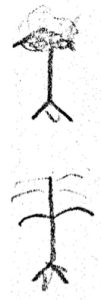 The tree of growth: The tree with its roots in earth. Driven first by urge: the part of the tree that is red. Breaks into a dual movement. Anything that is frustrated breaks into a dual movement. The breath. Food: intake, excretion. So the little organism, like the objective world outside, responds. What is driving it on? Urge; the urge of the organism to live. It is affected by pleasure and pain. With the breathing there is a relative limit set by the organism itself as to capacity. The movement stopped by pain — pain, the curber of the outgoing movement, and pleasure, the inciter to the outgoing movement.
The tree becomes quite complex. It has its roots in earth, via the body; and the soul, which is not yet functioning, except vicariously through its coat of skin, or vehicle, has a pattern etched for it in the organism. But usually, the mind that comes through, or the soul that comes through as mind, is not very alert, and does not understand the patterns. Our minds have reached the stature where we can read, philosophically, the signs we have known biologically or psychologically, through the effects on the body.
Presently a new area of functioning enters, the feeling world, the green part of the tree. Wishes go out and are blocked — the dual movement. The feeling function, as before we had the sensation function. The feelings may go out via attraction. A frustration, which sends it back. All these are the “out” and the “in” that belong to a breathing organism. And as the body breathes physically to maintain itself, so the psyche breathes, or the psychic area in you — always out and in.
You move in many directions, out and in simultaneously. You move out and in wherever you have activity. That is one of the characteristics of the energy functioning in man. Nature sets the key; let man read the signs.
Slowly the pressure of the life force, derived from the soul, which first vigorously sets the body in motion, then comes into functioning itself via its own stuff, feelings, now pushes a little further into the world of thought, or the thinking function. And again, the dual movement takes place, out and in: the acquisitive and the expanding, the getting and spending.
So think of the child with the body, slowly expanding into a three-branched tree, or three-tiered tree, the three functions, but that movement forever going on; stimulated into action by pleasure, held back by pain. That is the pattern of man working from earth up.
But there is also the tree reversed, since we are studying the philosophic pattern: the tree with the roots in heaven. Man grows from the roots of the earth tree, till he becomes wide, then gathers slowly the powers he has won together, till, philosophically, he moves up into the roots of higher tree. The upper tree is a pattern tree, not literal, but awaiting the making. It is there, like the magnetic field which obeys the crystals of mineral matter. The lines of force of this pattern are there. Hence we call it the archetypal pattern. Man’s return, or at-one-ment, is the reverse of this tree (tree with its roots in earth.)
Let us go back to the soul, bearing in mind these symbols. The soul is not something which springs into being with the birth of the body. It has its own past. It has a long range, of which you become unconscious at birth. That becomes covered over, forgotten; but is a potent factor. It is what we call heritage. It is strong in determining quality. But since all souls are different in the evolution of the soul itself, so they express differently through bodies. Therein you have the philosophical explanation in the difference between twins; or among children born close together, under similar conditions in one family. Due to the nature of the soul, or that which is behind the body.
Another stream, also pointing to the now (see chart of the three factors) is inheritance. This has to do with the long stream of characteristics in a body – a racial body, on the one hand, and a family body. Predispositions in that racial body. There are conditions in that body. There are also conditions in a family which are, as it were, added to the racial conditions. Darwin and Wallace and other researchers have spoken of the evolution of bodies.
The evolution of bodies goes through curious recapitulations. Development up to the human form within the nine months that the body of the child is in the womb of the mother, condensing a very long period into nine months.
So also there is a recapitulation of racial characteristics and of family characteristics. They are, for those of you interested metaphysically or occultly, written in the ethers that accompany the body, and cause often great disturbances if the soul is not rapport with them. But they still belong to the physical side.
Now note where that brings us: to the recognition that there are two factors behind the present: 1) your soul heritage, clothed now with a body that also has a long line behind it, which we call inheritance. Where the soul is stronger the body becomes subservient to the soul. The soul should be the determining factor, but it is rarely so. The determining factor is usually the race and the family. Look about you. People are still going in crowds, still clannish. They still go forward looking backward, – wrapped about with the mores, convictions, fears, duties, of their kind. They are not going as independent souls using bodies but bodies, and the inheritance that comes with it (them), is dominating soul. Too bad! That, sometime, will be changed. For souls accumulate experience and, being wounded or frustrated by pain, will presently learn their lesson, and grow stronger because of the accumulated impacts in the soul’s experience. That means that a life in this dimension records its experience in the soul. Body renders a certain power to the soul, as the earth does to the moon.
Environment The child is growing up, and hence the momentums in both soul side and the body side begin to impact themselves on the Now: that which learns to say I. That environment is like an arc, over it. It is not only that you have the limitations of the past, and your race and family; you have also the limitations of environment. And here is where we should be careful. If we do not understand this pattern, and use it, we are getting only a minimum out of this life and are really accumulating momentum for the inheritance instead of the heritage, and somewhere that stacking up is going to cause a burden. Even on someone else.
What is our environment? First, physical: family, family circumstances, the type of parents we have , position of father and mother in the world about us. The life in us would like to go out. If it is normal it wants to stop at nothing. There is the blocking of the family; small sum of money; modest position in the world; pressure pushing down. Reciprocal movement.
The dilemmas are only beginning. The feeling world — that, too, would go out. It too meets the arc of environment. Frustration. Can get only a little of what it desires. Our affections, wishes, fantasies, blocked. Also, our environment superimposes upon us its ideas, prejudices of your kind – their limited views, types of ambitions, hates and loves. And so you are shaped.
Now the mental part of our environment: the thoughts of your family; of the school to which you go; of the church which you attend, or.the synagogue, or the Sunday school; or the books you read; the lectures; all of which, by absence or by presence, are impacting upon you — the arc of environment. A sweet (?) dilemma for the soul entering the body. And how intelligently have we handled it in the past? Hit or miss. Trial and error, through the pages we call days and weeks and months – points of existence, in the midst of which we search for the true patterns. For they are hidden all over the world, physically, psychically and mentally. You have usually taken any pattern handed to you.
Behind you is the determining force of the soul, which, from one point of view is unlimited in power. Why? Because, in the last analysis, it is derived from the light spark, and the light spark is most extraordinarily dynamic — so dynamic that it can’t be in this earth in full, because it would tear it asunder.
So our soul is not willing to be held at these things. The stronger the soul the more resistant it is to environment; the weaker, the more it succumbs and makes a pseudo-peace with environment. The strong soul never makes peace with environment. It is always pressing on through it and blazing a trail that others shall see.
The result of these blows that we receive by the frustration of environment etch in certain characteristics. They are character marks, the way you have responded over the last 30-50 years. Those are your character marks, or your characteristics. They arise as the result of the battle of heritage and inheritance with environment. If the soul is not strong it presently succumbs to the frustration, and the battle scars show it bound, warped, and shaping itself according to environment. The strong soul never shapes according to environment. It goes through environment, penetrates it, and begins to set a pattern for something else.
How much have you adjusted yourself to environment? What characteristics have you allowed to be etched in on you? The soul has many potentialities that have never come into expression. Where are they? Buried. You identify yourself with the little end product. The tragic thing is that you always identify yourself, until you know the philosophic pattern, with the end that you have become – your characteristics, your character marks. They even etch themselves on to your body. You put marks on it by your behavior during these thirty years.
They are rarely pretty marks. Sometimes they sound nice and tinkling. But it has no resonance. What has occurred? This process of reciprocal onslaught and repulsion has been selective, and only a proportion of the capacities of the soul in any given life have been accepted. Those characteristics which your environment, family, social world, business, have been willing to tolerate in you, those you have accepted; the rest??? The making of the persona, the mark, over the residue which you scrapped, because you were too weak to do battle and penetrate through the arc of environment.
You can’t penetrate carelessly, for then it boomerangs, but only loyally to the drive in the heritage. Just as a plant must be loyal in its pressing through, to its particular kind: a violet, a cabbage – though an ever better kind of cabbage. The quality improves, the kind remains. So you can’t press through the constraining arc of environment carelessly. You can’t ignore one set of laws unless you replace them with higher laws.
Personality, then, has the character marks which have been etched upon it beginning with childhood, with the birth of the body into this dimension, determining, bit by bit, the way the adolescent and the adult will behave under varying conditions. We call that the mask. The familiar illustration of the iceberg, with its one-eighth above the water and seven-eighths below — the heritage: that which has been outlawed because you either didn’t have strength or intelligence enough to bring it into functioning. You adjusted it. Instead of penetrating environment.
Stay sufficiently in touch with environment to be geared in, but are in the vanguard; that is, adapt. Your engine will not run unless it is in gear. You can’t be too far from environment; you still stay in gear with it, but you are on the other side of it.
Memory One more element enters into our talk this evening: memory which is lost to consciousness but is preserved as conscious memory in the other areas of you. You have been living in this dimension many years, and having many experiences; have gone out further one way than another.
You have gained much. But still the memories have accumulated and in turn been forgotten. Then there have been droppings over the memories of the soul, the discarded memories of this life. And so memories of the past are doubly obliterated. The debris of this life, layer by layer, accumulate; heritage is buried.
So we have, broadly speaking, two types of records, or memory, in the transliminal: the areas of yourself of which you have become unconscious — the memories of your past of the soul and the memories of this life, the things you have forgotten – the painful experiences, sometimes the pleasant ones. Both belong to you individually.
There is another type of memory, toward which Jung was driving with the collective unconscious: the memory of that, akin to what clusters around the race body, the delicate stuff that surrounds the race. That, too, has a memory. It is one of the things that, while it has its advantages, against which one has to guard. Jung finds in this “collective unconscious” all sorts of engrams — collective images. I suspect he is referring to this race memory. For the individual memory of the soul is something quite different, and belongs to each uniquely.
We are apt to think that memory is a dead thing, like the pages of a book that is closed. That it therefore cannot do much damage. Or be valuable. Well, you know even a book has dynamics. But the book of life – your life and mine, or anyone’s, is still more energic; for these memories are not dead things, but are vibrant with life. They are actually stuff of another dimension that is teeming with activity.
That activity is constrained, because it is as though it were surrounded by an envelope; but presses out now and again. Release it, and it is like the beginning of the chick; a new generation begins as the life within the envelope is released.
Therefore never think again, or believe for a moment, that memories are dead issues. They are vibrant. As matters now are, they are loose, uncoordinated, forgotten and neglected. They await, these memories, your recovery of them. And your gathering the power, the energy, which is now loosely scattered through them.
These energies are necessary to the return, the philosophical ascent, or the “tree with the roots in heaven” — the indrawing of the energies in the tree below. In the tree below, the energies are widely scattered — necessarily, to get experience. That is dis-memberment. The energies are in-gathered on the return. That is at-one-ment. They then become the potent, from the potential.
Class III
MBM January 28, 1932
In this class we are watching the outer entity develop, the journey made in the third dimension, and the aid which the third dimension gives to the fourth. Also, how we should behave in the third dimension. But first, what the third dimension does to us. Hence, this evening we are still watching life below its adult stage.
Last week we studied the limitations of birth into a body on the soul, and attachment to the body. This week, the development from the child and the adolescent, and then making a correspondence between the adolescence of the body and the adolescence of the soul.
The babe, now the child, and it is nearing the adolescent stage. What is really occurring is that the body has gone through an orientation in this dimension and an unfolding of physical powers that will enable the soul to use it as a vehicle in this dimension. The babe and the child are not as they are idealized by sentimentalists, – so sweet, clean, beautiful; they are preliminary stages. Interest me in only a minor degree (much more) in the soul when it has a mature body and is really ready to grapple with this dimension. The body that is young has not the capacity for expressing what is behind it. Occasionally something comes through. Maybe due to emptiness in the soul. But that is not the soul.
Do try to separate them — and your friends — from their bodies. Take care of the body as you would a garment; but the body is not the soul. Sense the vitality of the soul life which is behind it. That is the only thing worth loving (in friends). The other comes and goes, and is merely an instrument, garment, bridge. It should be, and is indeed, affected by the soul, but at no time is it to be associated in your mind with the soul. Practice looking at people through their bodies.
We are still watching the behavior of bodies. Those of a child have not come to the stature to enable the soul to function through them. Moreover, there are laws peculiar to bodies and their repetition in earth — meaning they’re being produced again, that also affect the soul. And so we come to the chapter of adolescence.
Adolescence is, first, a new birth, a new octave, puberty, hairing. Hair means power. Merely the physical sign of new powers, powers of reproducing bodies. That is necessary; belongs to the physical side of things, and is in the hands of nature – Lachesis. Atropos sits in the sun. Has to do with regions, Spirit; never comes down. Clotho sits in the moon; the soul has to do with the awakening of desire, wishes, hopes. And how Lachesis sits in earth and begins the threads which bind the body! But if you think you are of the body you are bound with the thread of Lachesis.
At adolescence the threads of Lachesis are spun a little more in dimension. They have a greater thickness, power of binding, that they do not in the earlier stages. If you believe it you go through the antics of this transitional experience. A strange state. Neither a child nor an adult. The body shooting up with a new vigor is ungainly, joints not rightly set, lack of coordination. Really the soul does not possess the body at this time. As though it got out of hand. Because there is a new rising of sap.
From the standpoint of the soul it is a thrilling and dangerous period. For the movement of the sap in the physical body brings about, more or less inevitably, a closer identification with the third dimension. The interests of the body take a new stature. Sex comes into the picture with a compelling force; that is, wherever there is normal development. There is some consciousness of sex in the body before this, in the sense of autoeroticism and narcissism; but homosexuality and heterosexuality are the two new phases put into the drama at the stage of adolescence.
And so the person, or body, is going through its periods. Strange desires, on the one hand toward crude sexual experience and on the other hand a leaping forth toward idealism. At no time, until the soul is mature, is there such a leaping upward with idealism as at adolescence. Why? Because, in this life the soul, which is sending forth its sap together with the body, has not yet had experience which has embittered or discouraged it; hence knows no obstacle. Believes he will be the one to set right the world.
At this time the adolescent is generous; but it is a generosity in ignorance. The same with courage. So it is neither; but a swift, glorious pushing up of the sap. Courage is a thing which comes only in conflict with fear. Generosity is a thing that is only born out of self-deprivation; and neither of these are within the experience of the adolescent. Therefore let us thrill with him at the rising of the sap; but don’t let us mistake the idealism or courage with that mature, disciplined quality that comes well along in life; that sees issues, and pays the price.
So our adolescence is really a reviving of the physical vehicle, after which we have the adult body, so that the soul may have an adequate vehicle. Before that it can only express partially. Perhaps later too, but then the partial expression is due to a different type of condition than the condition of the immaturity of the vehicle itself. The soul tries to get in through its idealism when the body is getting in through its gestures, sometimes acts, in sexual life.
The child had no consciousness. The consciousness which the soul had before birth has become unconscious. Hence the young child has no consciousness. Now comes the slow accumulation of an unconscious in this dimension; and that unconscious in this dimension widens the gap, or, more correctly, fills in the space between the conscious and the heritage. Makes a division, pushing its nose and depositing debris between the areas of which the child was unconscious and the waking state.
So we have the unconscious, the growing consciousness of the child in this dimension, and a space, being increased, in between, in which the personal unconscious, or memories of this dimension, are being deposited. So you have two types of unconscious.
What makes up the painful side of the unconscious? The.boy repressed at home may become the ringleader in classes. The teacher makes him a scapegoat. May be expelled. Restless. Cannot find the right place. What has occurred? The accumulation of painful memories, which never came to a successful issue are eating into him and, in the fashion of the operational unconscious, his hatred for the grandmother grew. One day he received word that his grandmother had died. Now at last he was free to dream. The divided face. The painful memories that had accumulated warped his life. But this was the sort of thing that caused the neurosis.
The case of Sally, who got no affection. She became a little thief. With what she stole she could buy candy for her playmates and they would show her signs of affection which she did not get at home. So the feeling type needs its response. In the unconscious of this child there remained for years the memories of unanswered affection, agonizing to a child.
In these two cases pathological lines are etched by the environment. With adolescence the character marks are etched in deeper. Adolescence, with the new birth, is a possible turning. With the new rise it is possible to have the strength to break away. And many of them do break away from an unfavorable environment. If they don’t break away at this time it is bad. They will grow up into sour, bitter, frustrated, neurotic adults. Their development is uneven.
The soul is attached to a body. The life begins to pour through as the body is born, but is first physical; though that energy is derived from the soul it is physical. Then, slowly, the emotions unfold, and still later the mind. The child has no thoughts, only preliminary gestures. With few exceptions, they are not capacities within the self but are stimulated from the outside; and either unconscious reverberations of what has been taken in, or due to suggestion. Very few children think, but they do feel and sense. Energy rising, to become dual, because of frustration.
Behind all this growth there is an archetypal pattern; and it is that archetypal pattern we should, ever and again, look at, to measure the pattern which we are studying – presumably ourselves or some case. If we have no norm, or pattern, we do not know in what health rests.
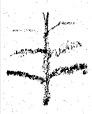 In what does physical health rest? When you have discovered that, make the correspondence on the mental and psychic planes. That health will lead you toward that archetypal pattern. Here we are drawing at least enough from the archetypal pattern to enable us to lay it in juxtaposition, as in our little chart. The archetypal pattern is one that means fulfillment of the three areas, having to do with the three streams of life ordinarily called sensation, feeling and thinking, – and these in their dual movement.
Fundamental energy in man (has been) described by many words: libido: too much identified with sensation and affection, – if that be love. Élan vital. Hence we use the simple expression, psychenergy. Because all these energies are derived from the soul. So the undifferentiated energy is called psychenergy. That which belongs at to the red is erdenergy; psychic, built on the word describing emotion, movenergy — that which moves, or causes action, desire, feeling; manenergy, as a result of the collaboration between heritage, inheritance and environment. These three are not even. They are in many variations; mind usually small, the two other functions being incomparably larger in their development.
In the behavior of people in response to feeling, whether expressed or not, the feelings are dominant. They misuse the word love but show how much their feelings are involved. Also use the word hate. Someone has gone berserk. Their correspondence in patterns of the myths when they are true-d The berserks, according to the Eddas, were great, powerful figures that Odin called upon to hold the steed, or horse, that a great giantess drove. This great giantess was Hyrrokkin. She represents the primordial monster of feeling, on its fearful side — the terrific forces of feeling, or movenergy, on the askew, – the early stages of human evolution, when titanic fears, terror strode across the stage of man’s life. Oden, who represents the god above, the higher intelligence, like Zeus, orders four of the Berserks to hold this steed. The force with which the giantess comes along is terror, and the Berserks are the corrective of that.
And there are four of the Berserks. They are: courage, which counterbalances terror; cunning, greed, avarice, which is the getting, while terror disintegrates. And the early forces with which man counterbalances this giantess mean that he must get for himself the egocentric forces. They are not pretty, but we have them all over the place still. The gradual setting up of the ego. Man growing up from the babe, goes through them — recapitulates, as the body does in the womb of the mother. So the child has its terrors.
And how the berserks must be set up — not high and ultimate but early stages of the protective, corrective influence in man: courage, self-interest — all the things that strengthen him as an individual against the outer forces. So cunning plays a part. He who has not cunning at early stages does not survive. At later stages cunning is out of the picture, is illegitimate. But if you have the same demands at all stages you have no idea of a process. The Berserks are therefore a corrective for the early stage of man, or the child. Through the Berserks he sets up a solidity in himself.
The child’s attitude toward his environment: aggressive, regressive, progressive. The first two are of the opposites. The progressive attitude is used in spots but not consistently. By a word here and a phrase there steer the child toward the middle course. If feeble, the soul does not gain much from the environment. If progressive, it is willing to learn and use, and penetrates environment when environment is a handicap to its own vital evolution.
Imagination, development of: It is the extensor faculty. It goes beyond. Whether it is with an invention, business achievement, industry, an art – in all cases it has that advantage. And, through the use of imagination to these things, it finally comes into its true inning, which is not in regard to an engineering project, or business adventure, but something else: a fourth dimensional development.
We must watch how the soul is developing imagination. The soul needs it terribly. Three types: 1) fantasy and wish fulfillment, when imagination is not outgoing, is really repressed. 2) when it is undeveloped because it is absorbed in facts. That is one of the great tragedies: where there is power to deal with facts, and no imagination; 3) and then the development in re-formation of actualities toward abstractions. You remember, there is no creation, only a re-formation of things. It is therefore disciplined, and imagination that is not disciplined belongs to fantasy. From that, it moves toward abstractions — toward the things abstracted from this world. When you can deal with things apart from similarity to this world you can deal with abstractions.
Fear Caused by two types: either subjective or objective. It is due to the impact of forces stronger than one’s own – father, teacher, the universe, the dark, preparation for an examination. It is a realization that there is something bigger than one is oneself.
We are always going to meet something that is bigger than ourselves, always. So we might as well learn what is the archetypal way of meeting these objective and subjective realizations of forces stronger than one’s own. When the fear is lodged in the feeling area it numbs the mental faculties, makes for a psychic disease.
If the fear is led by a quick snap of the mind; if it is led to the mental area, it becomes corrective, becomes instructive, leads to perspective and power; also preparedness. Fear, taken to mind, makes mind examine it, critically, no feeling; something is a challenge; the mind is cool. And so, that which seemed to imply danger now sets up a higher consciousness in the mind: heat leading to light. So becomes a means to progress. Eventually it leads to perspective and power, and at that stage connects up again with the feeling world. And the thing we left behind is there, in advance, to meet us. And the richness of feeling, now on its positive side, in terms of courage, because it has met fear, and conquered it through mind, leads to power.
Power in the self is necessary to sustain one as one goes on. For the soul, in its pilgrimage through various stages, must grow stronger, to meet stronger conditions. The further you go the more dynamic, the more extraordinary, the more charged is the condition; and you must become calm to that charged condition, until it is norm to you. As long as a thing is abnormal to you, or beyond you, you are below it. When you are even with it you are parallel. When you have learned to hold it you begin to go in advance of it; and the picture of relativity goes on accompanying us in our journey in the Training School of Earth.
Excerpts from chart of behavior patterns in child and adolescent
Childs attitude toward environment
aggressive: he is too strong
regressive: he evades
progressive: a middle attitude
Development of imagination
The exterior faculty
1. in fantasy and wish fulfillment
(not in gear with life; repressed
because should be going out in objective grappling.
2. undeveloped because absorbed in facts.
3. in re-formation of actualities and towards abstractions (developing)
Fear
Power
Due to the impact of objective or subjective realizations of forces stronger than one’s own
lodges in feeling area, benumbs mental faculties; unnerves; makes for psychic diseases. led to mental area, is corrective, instructive; leads to perspective and power.
This is the pattern. Usually the green is much enlarged and the blue small.
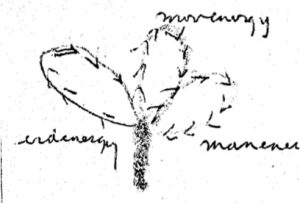
movenergy
Erdenergy manenergy
Psychenergy in a balanced flow
Lecture IV
February 4, 1932
Three types of adolescence which we are going to try to coordinate this evening: the adolescence of the soul; of the body; and the adolescence of humanity in the mass. Stages which characterize themselves by the same common denominator.
Inherent in adolescence. We experience all three. Overlap. Interweave. What is the adolescent? That type of life which is at the completion of one octave and at the point of breaking forth into another, and is on the fence. Seeking its liberation from the old. The upward surge of the new energy, even in the body, is to provide the body with an independence and a capacity for functioning independently of that which has enveloped it previously.
The adolescent strives to become free from parental environment and from the identity with the individual present. The soul, when it is adolescent, is striving to find that which will give it the capacity to stand on its own. No longer content to be cradled in the beliefs, customs or conditions of the many. Seeks individuation.
And so, humanity in the large, though it does not hold for all humanity — still humanity in masses — is coming increasingly to the adolescent stage, where it seeks autonomy for race, or group; and it is one of the characteristics of the world today — economic, political and international, that races are coming to their adolescence which before had been content to be cradled in the environmental conditions and feeding on the things which nourished them in earlier stages. Characteristic of adolescence is its inherent drive towards standing independent of the past. That is its purpose.
It is not done evenly. The endeavor of the individual soul to find that to which it belongs, and orient itself accordingly. Perhaps the most useful way to begin our study is to watch the chart on the board:
mass
horde
tribe, patriarch
clan
family
The movement of the mass is always toward differentiation, breaking up. Correct. That is its movement toward the adolescent stage.
Horde, another type of consciousness, where groups horde together: hunt, live, die together, in hordes.
Still smaller, tribe. Now the first signs of real leadership. The horde has only temporary leaders.
clan: the leadership passes on to the descendants of the patriarch.
family: further subdivision of the clan father.
In the family and clan, the beginning of discipline by man. At the tribe, begins a making for order. This continues over ages. Moving bit by bit, as does the individual child, whom we later call the person, via his body, until we come to the family.
For the majority, the family and hangovers from the clan, hold sway. A narrow gate, which only the individual can pass through. It can’t be done by the family. You become an individual as you achieve the power of adolescence, and come into your own.
Past that point comes the gathering in new groups, based not on family or blood ties, but on ties of another type: in terms of feelings and thoughts. Before that, the physical relationship. Later, the breaking off into relationship in terms of volition — likeness of feelings and thoughts.
These things really interweave. The object is, however, that each individual unit should stand on the strength that is his or hers. The body does the same.
The mass we have seen. The soul, in the same fashion, throws off, but more potently, the ties. Makes a cleaner job of it. After that comes the capacity of the new organism, and one who is a citizen of the Cosmos. You can’t be a Cosmopolitan until you have passed through the gate of the attachments to the older states.
It is sometimes reassuring, and sometimes bewildering, that one should find in the ancient myths stories of human evolution that we are only undergoing now: the myth that describes the breakup of the individual as he becomes dis-membered in the different pulls of this dimension, through his adolescence into adulthood; and how he also builds up the unconscious areas in which are stored the things that are at once dangerous and beneficent.
The story of the hero who believed he could get what he wanted by prayer. He was the son of a god. He prayed for a bull. His wife fell in love with the bull. The god had vowed vengeance. The law of cause and effect.
Hercules journeyed there and sought to capture the bull. The place was Crete. The one who prayed for the bull was a descendant of Minos, the great lawgiver of ancient times.
Hercules captured the bull and led him across the waters, over to Athens. But the bull left behind him some offspring, a strange creature, the Minotaur (Taur (bull) and Mino, after the one who prayed for the bull.) The creature had a man’s body and a bull’s head. He, also, ran wild over the island. Again, justice. And every year, from Athens, seven youths and seven maidens had to be sent to Crete to satisfy the appetites of this creature.
Now comes Daedalus: “I will build something in which the Minotaur will get lost, the labyrinth.” He was complimented. But the creature still demanded his tribute.
The story describes, in this ancient day, some of the processes that belong to our pattern that we have been describing. In the early stages the child is young, the soul is adolescent. It uses prayer, prays unwisely, proudly, with ego in it; and then has not the sturdiness to keep its side of the bargain. Asks for the bull and becomes enamored of the earth plane, which it symbolizes.
And the wife is like Aisha in the Genesis story. Like Persephone. In love with the things of this plane; and the nature which just preceded, the state in which the soul is, was losing its voltage, gone down lower.
Then comes the hero – those efforts to repress, when a leadership tried to control the wild forces that remained in humanity, when being (?) sprang up from earth — here, aspects of Hercules. They disciplined, set up taboos, and held back the bull. By and by, the powers that are symbolized by the bull in its early aspect — the courageous, physical living in the early days – is taken away by Hercules, by all the regulations that confine it; and it disappears.
But the next generation of the bull remains behind. There are always derivatives. And so with the bull. He, too, makes damage. Then Daedalus, the clever one, who teaches repression. They restrained the Minotaur; hid him; put him in places where it is difficult to get him out. All the passions and the early stages, which were beginning to be disciplined by the early stages, were crushed into the oblivion of the unconscious. The labyrinth is the underworld of the unconscious self, where, hidden in dark passages are the primordial forces that still demand tribute from Athens, the beautiful.
The adolescent who comes to the place of breaking with the old is like the hero who begins the struggle with the Minotaur, and finally slays it. The Minotaur, the compacted symbol of the dragons in the unconscious self – all those powerful urges, descendants of the beautiful bull, who had his place in the early days, but must go through many transformations.
Thus we are now in sympathy with the adolescent, slowly pulling out. All the while the Daedalus, the clever artificer, who have restrained humanity in terms of the arc of environment, have shaped the young soul, the boy and girl, the coming master. Then comes the insurgency, the breaking away.
Daedalus comes to a bad end. He, too, has ego. He would climb high; become good; fly high. Has identified himself with the personality. Would fly to the sun. There was one who did not think so highly of Daedalus, and he was cast into prison.
Daedalus tried to get away by making wings for himself. Icarus was his son. Daedalus made wings for both of them. Someone warned them: don’t fly too high. Icarusforgot. The wings melted. He dropped into the sea. So he who identifies himself with the personality – his goodness, or his pseudo-goodness, is flying to spiritual things, but presently, as the wings melted, he falls into the sea and, temporarily at least, drowns.
Watch how the beast develops. Theseus is something like Osiris. The ideal hero liberates the soul. Theseus gets the thread through Ariadne, and that leads him out again. The “thread” represents laws, ways, order. Economy, the way of the Knower.
Some types arising from unbalanced expression of energy.
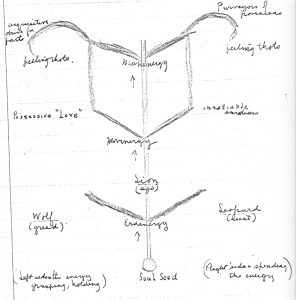
Wolf, lion, leopard: unbalanced expression. If there is too much energy going on on the physical side for getting, it develops physical greed, known as the wolf. That wolf is really the beast for the whole left side of the picture, not merely physical. When the energy on the psychic plane is moving with too much momentum with regard to the rest of the movement, it is known as possessive love: too much flow of the energy on that side of the tree. It is greed on the psychic.
On the mental, it has characteristics that are akin to the intellectual type. Few individuals represent pure thinking. And the drive for facts, that is so tremendous in some people, is greed on the mental level. Therefore the world becomes a symbol of that side of the tree — the centripetal movement, towards the center, that is overdeveloped, – and of course at the expense of something else.
Leopard too much energy toward sense pleasure. It is spending of energy. It is not acquisitive, it is dispursive. On the psychic plane: the spending of emotions; people who are prodigal in their emotional expression, can’t spend themselves enough; illustrate the leopard on the psychic plane. On the mental plane, usually feeling-thoughts — thoughts going out in unbalanced fashion; best illustrated in that type of person who are fanatic in setting up panaceas of all sorts. They are those who have spent too much.
The reality motif. What draws them out is, first, pleasure-pain. (seeking pleasure, avoiding pain.) But then the thing that the adult meets increasingly, and is one of the dominant factors in changing the growing person from an adolescent to an adult, namely, the reality motif — so-called in psychology and philosophy. The adolescent, in the home and the school, has had to face only a small proportion of reality. It does not impinge on him. The adolescent has done it only in spots, if at all. The adult must do this increasingly. And the one who becomes the adult is the one who does it successfully.
Lion How does the lion develop? As we move from the mass, becoming more differentiated, until we set up our own individual nature – something that stands apart from the rest in a little, or greater, degree, there has taken place what we may call differentiation from the mass. The differentiation you make out of the raw stuff of your life, that becomes your gift to the soul. This differentiated thing is capable of being colored with self-feeling, – water stuff — one of the sheaths — because of its special nature. Just because it is different from the mass it tends to draw the I principle to it. Wherever there is a stimulus the I principle leaps to obey the call of that stimulus — until you have brought it under control.
Now this mass which you are differentiating out of the horde of yourself is different (?), wraps itself about with this psychic cover and, by that very nature, attracts the I principle, a subtle development. Watch it, so you can counteract Daedalus. It works by the natural law. The “I” identifies itself with this differentiated mass, becomes proud of the work it has done, or what it is, whether it be body, wealth, or family position – however it differentiates itself from the environment. Of that it becomes proud; and so the lion is born, and our third animal appears on the screen.
And we grapple with him for a long, long time. Until we have, through the mind law taken the I principle away, once and for all, from the mass which is being differentiated. And differentiation should continue throughout the human evolution. This differentiation goes on, without attachment or identification of the “I” — one of the philosophical tasks which the adult has to learn.
Labyrinth Even in the early chambers of the Labyrinth we find something rather startling. It is not like the outer world. And the very nature of what we have found in the conscious and the personality is reversed in the unconscious.
There are those who err by underdevelopment as well as by overdevelopment. And from the point of view of the growth of the tree of each individual human life, underdevelopment is as bad and, via the analogy of the tree, worse than the overdevelopment. There are people marked by their absence of greed and of lust; rarely, but still often, by absence of ego. They suffer by what the psychologist would call inferiority. These people, in the labyrinth, are just the reverse. If you have too mild, evasive, an exterior in any one of these, be sure that the opposite is in the labyrinth.
Development of personality, in the arc of environment, plus the drive from the heritage and inheritance. The conscious is only a part of the totality. The so-called unconscious, which is the labyrinth, in which the Minotaur garners tribute — the energies that should go to the response to the great Seven of yourself — those seven you, instead, give to the collective dragon in yourselves.
Meeting obstacles: How does one move along freely and progressively? We meet obstacles of course as we go along. No metal without them. But when we come to an obstacle we should seek two things: to know its nature — to walk around it, as it were; and then pass. Otherwise we build up a fixation. A complex is a mass of associated feelings and thoughts,.forgotten, therefore in the unconscious. Down in the labyrinth energy grows; more discomfort, but also the more challenging, because it may grow so much that it will challenge the conscious by developing a neurosis, or some nervous symptom, so that a Theseus must be sent down to undo the network.
More energies cluster around the original tender point, until presently the policecome and you have to use restraint over yourself. Otherwise something of the disorder that comes from the complex will break through into consciousness. The answer is: learn how to meet each obstacle day by day, that it sets up no disturbance; does not get into your labyrinth; so that next time it comes you will handle it easily. Material things won’t change you. You are three-, four-, and five-dimensional, and you will change. You won’t hang so much on the third dimensional solution. The true adult can do that; can shift his polarization according to his needs.
The adult of soul begins to function as the body becomes mature, and heritage should begin to express itself as the body reaches the adolescent crisis. That is one of the significances in certain acts of Jesus in the allegorical story at the age of twelve, puberty. He made the first assertion of independence. Everyone should, at the psychological, philosophical age of twelve. Now I am talking about soul age. At that philosophical age of twelve you break through with your heritage; and you continue it until you have reached the age of thirty.
Uneven development makes for type.
Lecture V
MBM February 11, 1932
Theseus The story of Theseus. He was born the son of the king of Athens. A hero of Greek mythology. When his father, Aegeus, left the mother he placed under a great rock a pair of shoes and his sword, and said: When the child is grown, and can remove the shoes and the sword from under the rock, send him to Athens.
An allegory. When the child shall have grown to be an adult; when he can remove obstacles and take the shoes that were his father’s. In other words, when you have become an adult you will know how to remove obstacles. You will know how to put on the shoes which, before, your father had worn. You will, in turn, become the father. And by that same token you will possess his sword. By that will you know the adult: ready to go forth to Athens to become king. So will you know when you are, yourselves, at the stage of the true adult.
Types of adulthood
We have been watching the child and the adolescent, up to the stage of maturity. What are the signs of maturity — not only the signs of the physical body?
There are many types of adulthood. That of the mind and heart are described by the story of Theseus. When you have the heart and the mind capable to meet the obstacles which the world presents to you, and put on the shoes by means of which you go forward, carrying the positive, masculine principle — the sword of active discrimination, separation, forward going, of war and peace, according as it is necessary — then you are the true adult.
When the body is mature the soul has, for the first time, an adequate vehicle, one that is capable of carrying such momentum as the soul may be able to project through into this dimension. All the force of the soul cannot be projected through into this dimension. But the quality of the soul and the nature of it can come through with the adult body. Just as the quality of water may come through from a reservoir though the pipe be small.
Men and women are what the world calls adult. What do they do? They have come down into earth; associate with the physical body. How do they act? What does the Training School do to them? And what, in turn, should they get out of the Training School?
The mature body should be nothing more than a vehicle – a means to relationship in a three-dimensional world. But when the soul is not experienced, is not adult; when therefore it does not understand, it loses itself in this dimension; and identifies itself with the labors of this dimension, which, to the adult soul, are only incidental.
Nevertheless, there are four points which every adult of body must face and give answer to. Not in weakness, but in the strength of the shoes and sword of the father. That man or woman has to find the way to:
Right relationship to the family in which he was born. Not an easy task. It should have a valid answer, both in quality and degree; but the true adult will first sever relations. All relations, to be free from the hold of the old, must first be severed. If there is a tie, in terms of family, or in terms of other figures which replace family, so that it is one type or another of fixation, it is as though there were threads which prevent free movement. You cannot make a complete movement. Whereas, when all threads are cut you may turn completely, without strain; and your relationship to the old becomes, in that freedom, released to a higher mode of expression.
Thus the adult man or woman must, to be an adult in soul, free himself from the family. He may return in friendliness, sojourn, or in staying with the family; but it is not in freedom until, first, the threads have been cut. Those who are healthy in living, quite regardless of soul consciousness, move toward that sort of behavior. They break the threads more or less simply, and go forward.
Place in life activity: He has to find his place in life. No adult can be happy — and happiness is based on health, physical and psychical, though later it becomes independent of physical health — unless he has found the activity which gives him or her a place in the world. Not an easy task.
It is often complicated. Yet he who does not find it is distressed. It is better to do any work than no work. Better to have any activity than no activity. Better to be the humble worker than no worker. The time is already coming when interpretation of work, as the world sees it, will have gone through a radical transformation; and when any work that is done has its standard, its place, and is honored in that place. A new pride in activity is evolving. And it is as it should be.
So the adult must find activity. And it is better to have any activity than no activity.
Standing, social standing. Not in the social world, necessarily. That is becoming increasingly incidental – but standing in the community. It is sometimes derived from work. It should be so; that is the best. Thus the old concept of social standing, via family, falls away.
The work of this age is terrific. It is disrupting but in the last analysis it will be beneficent. Don’t ally yourselves with the old order. See what the signs are, in their reconstructive effect, and become of them.
Thus, one of the things you do is to find your own standing, on your own feet, in your own shoes, which you have removed from under the rock, because you have overcome obstacles and the standing is your own – not family, tradition, wealth, but is squarely your own. That is one of the challenges which the adult faces and to which he should, to stand on and in his adult nature, must give an affirmative answer.
New family From the standpoint of bodies the urge to family building is strong, and is one of the drives that every healthy adult senses. Every healthy adult does not, and should not, marry or reproduce. That is not essential to the picture of the adult. But what is essential is that the adult shall face those drives clearly and give a coherent answer to the challenge. Not to do it is to cause a mutilation and a blurring in the forces of life that belong to the body.
If the adult marries, and sets up a home, there grow out of that further tasks and responsibilities, which strain the very fiber of the conscious man or woman, and which no adult who is awake can put aside. Nor should. Those questions are intricate, complicated, many. Our course is not to discuss them, nor the building of the family.
The answer is given according to how the personality has developed. We might say that there are six leading types of personality: the looking out extravertedly, through sensation, feeling, thinking; the looking at life introvertedly, through one of the three. And with the setting up of a type, more or less intensely defined, have accrued those problems of fixation in the unconscious, or transliminal.
(Fifth problem) Now let us lift our eyes an octave to another type of adulthood. In the large, the adult becomes absorbed in one or two of these challenges and is lost to anything beyond them. They absorb energies, attention, conflicts – therefore causing battles, within and without. And so, very little is accomplished beyond the orientation to a three-dimensional world. Rarely do we find an adult who gives clear, coherent answers to all four of these challenges. Still more rarely one who gives, out of an overflow or a conscious realization, minimum (or minimizes) to the third dimension and strives to become an adult in regard to other matters.
There is the adult of soul, as well as of physical body. And the purpose, from the standpoint of the soul is to acquire an adult physical body, answer these four questions in a normal way, make them subservient, and then get about the business of the soul. For these four are not the business of the soul but are the business of the body.
The physical body is a means to functioning in this dimension. It is never meant to be the complete story in this dimension. Thus, make these four points secondary.
You will say: They absorb all my time! The mind is like the organizer, engineer, builder. It must become resourceful, intelligent, so that it can win for the soul the things that are necessary. By the same token that it is not easy to win your bread and butter, by the same token it is not easy to win things for the soul. And if you set about winning your place in the world, finding your activity, building up, year by year, your standing – and it takes years to do it — by the same token you must go about winning, building, setting up those things that are the soul’s business.
Don’t mistake the things of this dimension for the business of the soul. If you have been able to set up anything in this world you will be able to set up more. For the powers of the mind are enormous, once they are applied.
Attitude Most comforting of all concepts in regard to the business of the soul: not being of this dimension, it does not require primarily time and space to feed it; but requires, rather, the subtler things that correspond to its own nature, attitude.
There is such a thing as doing a piece of work in a way that feeds your bank account, and a way of doing the same piece in a way that feeds the soul. The same with standing in the community — gratifying your ego and making your relationship secure, and a way of doing that very thing so that it contributes stature to the soul.
The thing that really feeds the soul is not primarily time but primarily attitude. And attitude you can carry with you, when you have learned it, 24 hours a day. Thus you will find comfort in that when you have really come to the adult stage in your soul, when you desire to feed it. Realize that time is not necessary, but attitude.
It has been said: Tell me what a man does in his leisure and I will give you the measure of that man. A true saying! In time and space, we are, and should be, held, to a considerable extent by the needs of the orientation to things. But every one of us has leisure; and it is what you do in the leisure that reveals the age of your soul – reveals the age of your soul in manifestation. For the soul is like a light that is covered over with a hundred veils, and thus affords us no light, no consciousness of it. The more the veils are removed from that light the more light is shed from the lamp. Gradually the quality and strength of that lamp are apparent. Thus, the quality, strength, nature, age of the soul are not always apparent, because it has gotten covered over with so many veils.
That is why, in the work of Pojodag, the first purpose in the training is to remove the subsoil, or the veils from the light, to release the nature of the soul. When that nature is released, then what you do in your leisure reveals, unmistakably, the age and quality of the soul. Because, being released from the drive and exigencies of three-dimensional things, the leisure bounces us back into a condition of rapport with the soul nature.
And when the soul nature is of a certain stature it is compelling. It requires certain types of activity as naturally as that the plant responds to the light of the ,sun, and reveals its nature.
So, ask yourselves what you do with your leisure. Do you use it to feed the growth of your soul? For your soul must become an adult as well as the body. And the adult nature of the body is only as a good instrument to serve the increasing age of the soul.
Thus, when you don’t serve the soul you are not doing the thing which it is contrived that you should do. When you are not conscious of the soul nature, and are not serving it consciously, the return to the soul nature is small and incidental, casual. When you are conscious and purposive the return, or rapid development of the soul, is proportionate.
The three functions We move now to a study of the functions. These three functions in man interpenetrate. One affects the other, and in our careless, or unknowing way of living, we have made what was inherent in the beginning, increasingly worse, until the functions are in a chaotic condition.
Our object now is to sketch the nature of these functions, to imply that what is desirable is to separate them, so that one function is independent of another. They can’t function freely till you have separated them, and can put them together at will. And 3), some scheme by which we can follow the evolution of a function. A function is not like a current of electricity that remains the same, but changes, rather, as it grows – not only quantitatively but qualitatively; and in other overtones, which we shall see presently.
Sensation function, the. The sensation function is that stream of energy, derived from the central source, which we call psychenergy, that flows through the body, and is known primarily through the five senses. The five senses are the means of the relationship of the physical vehicle to the third dimension. You will get the import of this if you conceive of a body without this one, then that.
These senses begin in a very humble, crude fashion. The psychologist lumps them, and calls them the sensation function. Let us note how they unfold. Which are the earliest senses in their effectiveness in the organism? Touch and taste. Then, slowly, the other three.
These are the gates through which impressions move in to register within the organism, and by which the organism, in turn, relates itself to environment. But these five should evolve; should not remain in a simple state but should grow. The capacity for taste, touch, and differentiating through both, increases with use. That also they can become benumbed through misuse; and they can remain undeveloped through non-use. Three types of movement.
Urge In the body they begin, since the body belongs to nature, as an urge. The drive is in the body itself. Man does not begin it. The body begins it, or, if you like, the great forces which operate through the body begin it.
(MBM then went on to describe the ten rungs of the Ladder of Sensation. These notes will not be transcribed there, as other descriptions of the Ladders, both of the primary faculties and the other 5 “seedlets” were given later, in several separate courses, and have been placed among the typed notes of these courses. They have also been included in a manuscript on the Ladders drafted by GB, based on the various courses. Only MBM’s description of the first 3 rungs on the sensation ladder will be given here.)
1). Bodily urge. Inherent in the organism. We should watch it unfold. Anything, to bear fruit, must evolve. And so it must be induced to experience. It is induced to experience via an increase in sensation; and that, in turn, is accomplished through pleasure. It is modified through pain. As the body, or the sense organs, find pleasure they are drawn into increasing their area of functioning. They are drawn out by pleasure. Therefore the second rung is
2) Sensation-pleasure `A growth. Outward movement.
3) Carnality We leave the animal kingdom at carnality. Man, who has eaten of the Tree of Choice can go lower than the animals as well as higher than the animals in the development of his sensation function, which he has in common with the animals; but carries it further. He must expand it, and he expands it, as the primitive does, through lust, urges, through an immersion in sensation pleasure that reaches out for ever more experience. It is still drawn by pleasure; it is corrected, or modified, by pain; for too great an urge brings a dilemma, exhaustion, surfeit, etc. And so the sensation function is slowly drawn on, pushed on to the next stage, which is sensuality.
Chart of “Social Form” Progressions
(The mass movement towards individuation).
Beginning of race as- – – – – – – -Hordes – –
Beginning of discipline by man- – -Tribe – -leadership – Patriarch
Clan – – (power) subdivided by position
family – -genealogy – father
Unit. The Gate
the individual – – – -by election
sympathetic group affiliates by selection
The New Organism
The Cosmopolitan
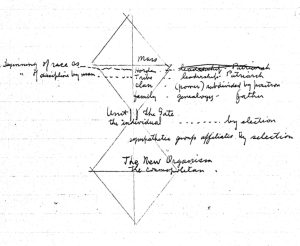
Some Types arising from unbalanced expression of energies